Reviewed by the PeptideMind Team · Updated August 28th, 2026
Free Peptide Blend Calculator
Calculate exact draw volumes for peptide blends, stacks, and custom multi-peptide preparations. Enter your blend ratios, reconstitution volume, and anchor compound — instantly see every peptide's individual quantity and the total syringe volume. Works with pre-loaded blends like BPC-157 / TB-500 and fully custom mixes. For research purposes only — no signup required.
peptidemind.com
As seen on






Search Peptide Blend Dosage Guides
Your peptide dosage cheat sheet: search our library of peptide blends and stacks for vial size, BAC water, dosing, frequency, and cycle length. Tap any guide to load it straight into the calculator.
tes
Tesamorelin/Ipamorelin Blend
400 mcg
Reconstitution
3.33 mg/mL
Frequency
Mon–Fri
Cycle
10 weeks
cjci
CJC-1295/Ipamorelin Blend
200 mcg
Reconstitution
5 mg/mL
Frequency
Daily
Cycle
10 weeks
What is a peptide blend?
One vial, two or more peptides
A peptide blend is a single vial containing two or more peptides in a fixed ratio, reconstituted together in bacteriostatic water.
Every draw delivers all compounds
Because the compounds share the same solution, every draw delivers a precise quantity of each one simultaneously — no need to draw from multiple vials.
Complementary combinations
Common research blends and stacks pair peptides with complementary mechanisms to simplify a protocol into a single daily draw. Popular examples include BPC-157 / TB-500 and growth hormone secretagogue combinations.

Popular named peptide blends
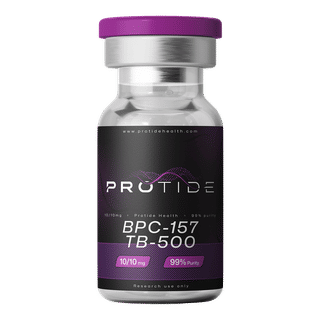
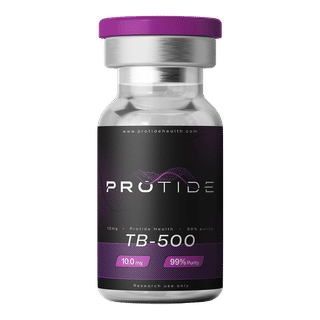
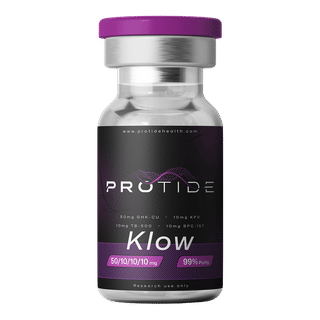
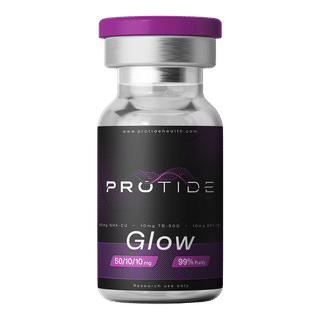
GLOW, KLOW, and the Wolverine stack are common multi-peptide vials sold as fixed-ratio preparations. Typical research dosage guides for each can be found further down this page.
GLOW
BPC-157, TB-500, and GHK-Cu, typically totaling around 70 mg per vial. Ratios vary by supplier.
KLOW
BPC-157, TB-500, KPV, and GHK-Cu, typically totaling around 80 mg per vial. Ratios vary by supplier.
Wolverine stack
A recovery-focused pairing built around BPC-157 and TB-500, popular as a growth-hormone secretagogue combination.

Shop research peptides
Live pricing from our top-rated vendor. Prices update as vendor listings change.
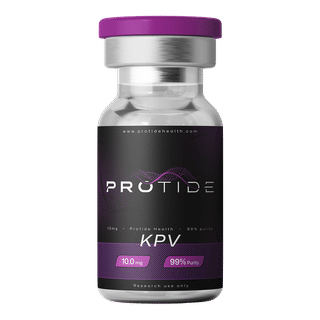
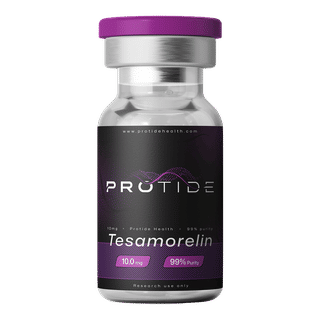
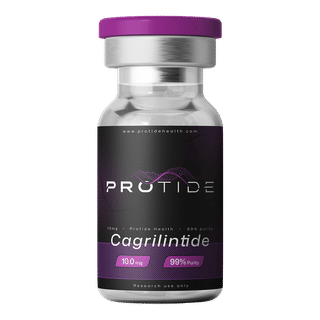
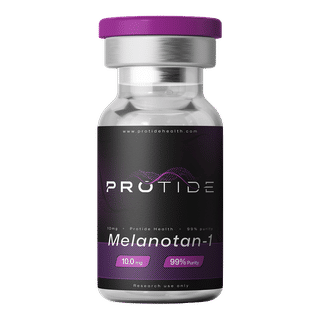
How the peptide blend & mixing calculator works
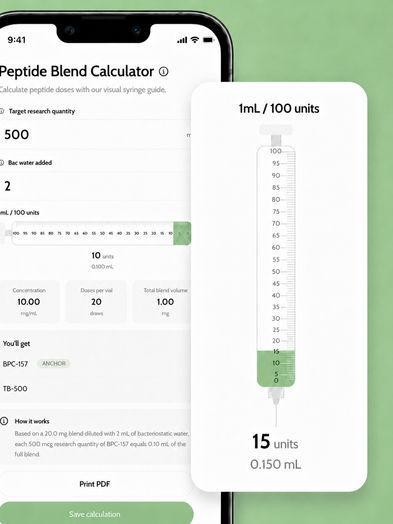
Blended peptide vials contain two or more compounds in fixed ratios. Calculating a research quantity means working from one compound's target amount outward — determining the draw volume that delivers the correct quantity of every other compound in the same preparation.
Select a blend or build a custom mix
Choose from pre-loaded peptide blends with known compound ratios, or enter a custom combination. Each compound is listed with its proportion of the total vial content so you know exactly what you're working with before the calculation runs.
Set your reconstitution volume
Enter how much bacteriostatic water you added in milliliters. This sets the concentration of the entire blend — the same volume applies to all compounds proportionally, so their ratios stay constant regardless of how much water you use.
Choose an anchor compound and read your results
Select the anchor compound for your research calculation. The calculator works backward from that target research quantity to determine the draw volume, then shows the resulting quantity of every other compound delivered in the same preparation.
Understanding blend ratios and multi-peptide dosing
Unlike single-peptide vials, a blend delivers multiple compounds in every preparation. The calculator accounts for the fixed ratio between compounds so each draw reflects the correct research quantity for all of them.
Fixed ratios
A blend's compound ratio is set at manufacture — every draw delivers each peptide in that same fixed proportion.
The anchor compound
Dose the blend by targeting one compound, the anchor, and accept what that volume delivers of the rest.
Reconstitution volume and concentration
More water lowers concentration and raises draw volume; less does the opposite. The ratio itself never changes.

Storing and tracking a reconstituted blend
Once a blend is reconstituted, how you store it and track what's left matters as much as the initial ratio math. These are the practical details most calculators skip.
Storage and stability
Keep reconstituted blends refrigerated and shielded from light. Avoid repeated freeze-thaw cycles, which can degrade the peptides.
Doses per vial
Doses per vial depend on your reconstitution volume and per-draw target. Track remaining volume so late draws stay accurate.
Unit conversion reference
1 mg = 1,000 mcg, and a U-100 syringe reads 1 mL as 100 units — how the calculator maps your dose to syringe markings.
Frequently asked questions
Straight answers on blend ratios, anchor compounds, and reconstitution volumes for multi-peptide research protocols.
Peptide Blend Dosage Calculators & Guides
Get exact reconstitution and draw volume instructions for the most-searched peptide blends, including the Wolverine Stack (BPC-157 + TB-500), Klow, and Glow. Each guide has its own pre-loaded blend calculator with reference ratios, dose ranges, and reconstitution steps for that specific stack. For research purposes only.
Healing
wol
Longevity
Healing
klw
Skin
Skin
glw
Skin
METABOLIC
Mtp
Longevity
Calculate peptide dosages
Reference our peptide quantity, blend, and accumulation calculators for laboratory purposes. Enter vial size, reconstitution volume, and target research quantity to calculate exact draw volumes instantly. All calculators are for research use only and do not constitute dosing or administration guidance.
