BPC-157, KPV, TB-500 (Coremend)
FDA APPROVAL PENDING
Limited Research
Healing
BPC-157, KPV, TB-500 (Coremend)
13
Amino acids
Molecular weight
Blend
Type
Coremend is an enhanced healing peptide blend featuring a higher dose of TB-500 (25mg) combined with BPC-157 (10mg) and KPV (10mg) for a total of 45mg per vial. This formulation emphasizes TB-500's tissue repair and cellular migration properties, complemented by BPC-157's growth factor upregulation and KPV's anti-inflammatory effects. The higher TB-500 ratio (2.5:1:1) compared to standard healing stacks targets more significant tissue damage or accelerated recovery needs.
Top researched benefits
Overview of BPC-157, KPV, TB-500 (Coremend)
Each peptide contributes distinct healing pathways: TB-500 (Thymosin Beta-4) enhances cellular migration, promotes actin polymerization, and supports blood vessel formation for tissue repair; BPC-157 upregulates growth factors (VEGF, EGF), accelerates wound healing, and provides gastrointestinal protection; KPV (alpha-MSH fragment) inhibits the NF-κB inflammatory pathway, reduces pro-inflammatory cytokines, and may improve injection site tolerability. Together, they address inflammation, tissue regeneration, and cellular repair.
tissue healing
- Higher TB-500 dose targets more severe tissue damage requiring enhanced repair.
- TB-500 promotes muscle fiber repair and cellular migration.
- Combined collagen support and growth factor upregulation.
postsurgical recovery
- Multi-modal support for surgical wound recovery.
- KPV component reduces post-surgical inflammatory response.
- Enhanced tissue remodeling may reduce scar formation.
sports medicine
- Accelerated return to activity after sports injuries.
- Address accumulated tissue damage from repetitive stress.
Typical Dose
200-500mcg total blend (higher end for acute injuries)
Frequency
Once daily
Cycle Duration
4-6 weeks for active healing
Storage
Reconstituted: 2-8°C, use within 4-6 weeks
Chemical Makeup
Key benefits
Enhanced TB-500 dosing for significant injuries
Multi-pathway tissue regeneration
Anti-inflammatory effects from KPV
Complementary healing mechanisms
Community interest
This peptide is still gaining traction in the community.
High-Dose Three-Peptide Healing Blend
This overview is informational and based on aggregated descriptions from studies and user reports.
Was it helpful?YesNoBPC-157, KPV, TB-500 (Coremend) Molecular Information
View the scientifc details of BPC-157, KPV, TB-500 (Coremend).
13
Amino Acids
BPC-157, KPV, TB-500 (Coremend)
Thr
Thr
Position 1
Asx
Asx
Position 2
Asx
Asx
Position 3
Pro
Pro
Position 4
Cys
Cys
Position 5
Lys
Lys
Position 6
Pro
Pro
Position 7
Val
Val
Position 8
Arg
Arg
Position 9
Ala
Ala
Position 10
Thr
Thr
Position 11
Ile
Ile
Position 12
Pyl
Pyl
Position 13
Molecular Weight
0DaChain Length
13Amino AcidsType
BlendBPC-157, KPV, TB-500 (Coremend) Protocols
Subcutaneous injection is the primary delivery method. Can inject near injury site or systemically. The higher TB-500 content makes this suitable for more significant healing needs.
| Goal | Dosage | Frequency | Route |
|---|---|---|---|
| Conservative healing | 200 | 1 week range | SubQ |
| Standard healing protocol | 300 | 1 week range | SubQ |
| Intensive healing (acute injury) | 500 | 2 week range | SubQ near injury site |
| Cycling protocol | — | 4 week range | SubQ |
Reconstitution Instructions
Materials needed:
Steps to reconstitute
- Clean vial top with alcohol pad
- Add 2mL bacteriostatic water (creates 22.5mg/mL)
- Gently swirl - do not shake
- Solution should appear clear
- Label with date and concentration
- Store refrigerated immediately
- Use within 4-6 weeks
BPC-157, KPV, TB-500 (Coremend) Cycle
The BPC-157, KPV, TB-500 (Coremend) Cycle section explains how long a typical cycle lasts and what to expect during each phase. Over time, your body can become less responsive with continuous use.
Taking breaks between cycles may help maintain effectiveness and support better overall results.
- Day 1-5
- Anti-inflammatory effects from KPV; initial healing cascade activation
- Week 1-2
- Tissue repair processes accelerating; reduced inflammation
- Week 2-4
- Significant healing progress; collagen remodeling
- Week 4-8
- Advanced tissue regeneration; assess for cycling off
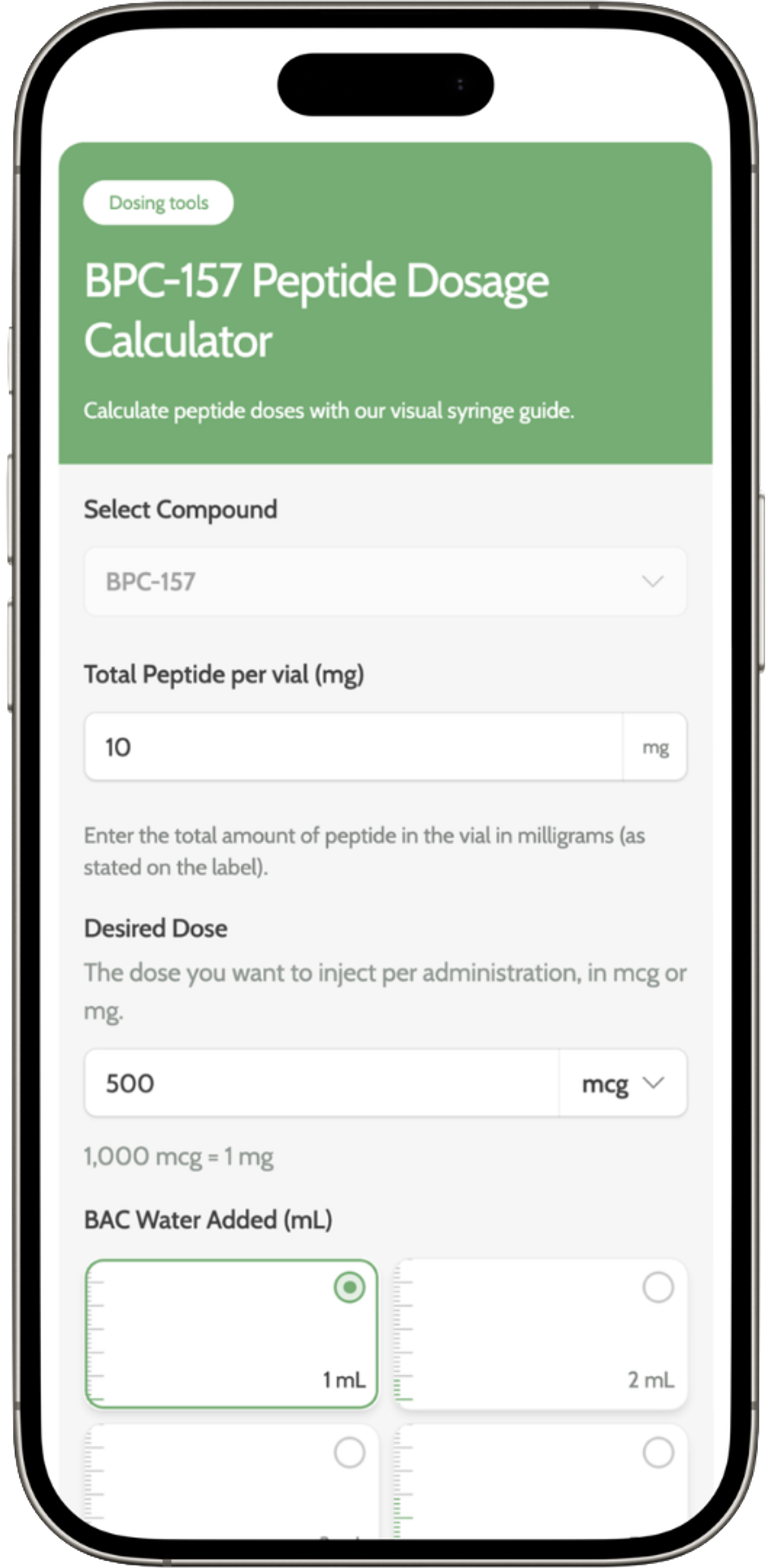
Dosing tools
BPC-157, KPV, TB-500 (Coremend)Blend Dosage Calculator
Calculate blended peptide doses with our visual syringe guide.
Volume of bacteriostatic water you add to reconstitute the powder. Use BAC water for preservation.
1 mL
2 mL
3 mL
5 mL
Custom
Blend Composition
Total: 45.0 mg
mg
mg
mg
The compound you want to dose by. Results will be calculated based on this compound.
The dose of the anchor compound you want per administration, in mcg or mg.
Conversion: 1,000 mcg = 1 mg
Results
Concentration
45.00
mg/mL
Doses per vial
40
Total blend to inject
1.13
mg
You'll get:
- BPC-157
- 250 mcgANCHOR
- KPV
- 250 mcg
- TB-500
- 625 mcg
1mL / 100 units
2 units
0.025 mL
Dosing Guidance
Recommended Schedule
Once daily
Supply Duration
This vial provides 40 doses (40-day supply at 250 mcg daily)
Peptide Interactions
Research suggestions of BPC-157, KPV, TB-500 (Coremend) interactions with other common peptides and substances.
Healing
ghk
Longevity
GHK-Cu
COMPATIBLE
Complementary healing mechanisms; GHK-Cu adds copper-peptide benefits.
Side effects
Contraindications
No clinical trials on this three-peptide combination
Active cancer (theoretical concern with growth-promoting peptides)
Pregnancy or breastfeeding
Active infection at injection site
Stop signs
Severe injection site reactions or signs of infection
Allergic reactions (rash, swelling, difficulty breathing)
Unusual bleeding or bruising
Worsening of underlying conditions
Bad signs
Comments
0.0
0 reviews
5
4
3
2
1
No comments yet
Be the first to share your experience. Your review helps others make more informed decisions.
Frequently asked questions
What is a peptide dosage calculator?
A peptide dosage calculator is a free tool that converts your vial size, bacteriostatic water volume, and target dose into an exact syringe draw volume. Instead of doing the reconstitution math by hand, you enter three inputs and instantly get the concentration of your solution and how many milliliters or syringeunits to draw. This calculator works for single peptide compounds and multi-peptide blends.
How do I calculate peptide dosage from a vial?
To calculate your peptide dose, divide the total peptide content of your vial in micrograms by the volume of bacteriostatic water you added in milliliters. This gives you your solution concentration in mcg/mL. Then divide your target dose by that concentration to get your draw volume. For example, a 5mg (5,000 mcg) vial reconstituted with 2mL of BAC water gives a concentration of 2,500 mcg/mL. A 250 mcg dose would require drawing 0.1mL. This calculator automates all of those steps instantly.
How much Bacteriostatic water should I add to a peptide vial?
Most people add 2mL to 3mL of bacteriostatic water per vial, but the right amount depends on the dose you want to draw and the syringe size you are using. Adding 1mL to a 5mg vial gives you a concentration of 5,000 mcg/mL, making each dose very small in volume. Adding 2mL gives you 2,500 mcg/mL, which is easier to measure on a standard insulin syringe. A general guideline is to choose a volume that puts your typical dose somewhere between 10 and 30 units on a U-100 syringe. Use the calculator above to test different water volumes and find what works for your dose.
How are peptides different from proteins?
Both are made of amino acids, but peptides are much smaller than proteins. Because of their tiny size, peptides can act like tiny messengers in the body, sending specific signals to your cells to tell them exactly what to do.
BPC-157, KPV, TB-500 (Coremend)Research References
BPC-157, KPV, TB-500 (Coremend) is a limited research compound
BPC-157, KPV, TB-500 (Coremend)
BPC-157, KPV, TB-500 (Coremend) is a limited research compound
Thymosin Beta-4 (TB-500) Tissue Repair
TB-500 promotes cell migration, blood vessel formation, and wound healing through actin modulation.
n.d.
BPC-157 Healing Properties
BPC-157 upregulates growth factors and accelerates healing of various tissue types.
n.d.
KPV Anti-Inflammatory Effects
KPV (alpha-MSH 11-13) inhibits NF-κB pathway and reduces pro-inflammatory cytokines.
n.d.
No Published Studies on Tri-Heal Max Combination
Specific three-peptide combination has not been studied in clinical trials.
2024
Calculate peptide dosages
Learning how to calculate a peptide dose? Use our beginner-friendly peptide dosage, blend, and accumulation calculators. Enter vial size, reconstitution volume, and target dose to get exact draw volumes instantly. No guesswork, just clear guidance that helps prevent common mistakes.