How to Use Peptides for the First Time: A Complete Beginner's Guide
Just received your first research peptides? This step-by-step beginner's guide covers reconstitution, BAC water volume, storage, and dosage calculation.

How to Reconstitute, Store, and Dose Peptides: A Beginner's Guide
Receiving research peptides for the first time can feel intimidating. The vials arrive sealed, the bacteriostatic water sits in a separate bottle, and the instructions are usually scattered across forums and product pages. This guide walks through everything a first-time researcher needs to do, from opening the box to drawing an accurate volume into a syringe.
Every step below follows standard research protocols. By the end, you will know how to reconstitute a lyophilized peptide vial, how much bacteriostatic water to add, how to store the reconstituted solution, and how to calculate the correct volume for any research dose using Peptide Mind's peptide dosage calculator. For exact ratios across specific compounds like BPC-157, semaglutide, and CJC-1295/Ipamorelin, see the complete reconstitution guide.
Disclaimer: This guide is for educational and research purposes only. Peptides referenced are research chemicals, not for human consumption. By accessing this site, you agree to our Terms of Service and the full disclaimer at the bottom of this page.
Quick Start: How to Use Your Peptides
Your peptides arrive as a dry, freeze-dried powder sealed in a small glass vial. They cannot be used in that form. The work flow is: mix the powder with Bacteriostatic water to create a liquid solution (reconstitution), store that liquid in the fridge, then draw measured amounts from it over the next four weeks until the vial is used up. Everything below explains how to do that correctly the first time.

What You'll Need
Peptide vial (lyophilized powder). The dry peptide. You will add Bacteriostatic water to this vial.
Bacteriostatic water (BAC water). Sterile water containing 0.9% benzyl alcohol, a preservative that keeps the solution bacteria-free for 28 days after you puncture the vial. Plain water, saline, or distilled water are not substitutes. Without the preservative, the solution is no longer sterile after the first puncture.
3mL syringe with 21 to 25 gauge needle. Used one time to transfer bacteriostatic water from the BAC water vial into the peptide vial. The 3mL barrel size matches the typical 2 to 3mL transfer volume. The 21 to 25 gauge needle is thicker than an insulin needle, which pulls water faster and resists bending against the rubber stopper. After the transfer, place this syringe in a sharps container. Never reuse syringes.
1mL insulin syringe (U-100). Used every single time you draw a research dose. The 1mL barrel has 100 unit markings printed along the side, which lets you measure small volumes precisely (typical draws are 0.05 to 0.25mL). The needle is much thinner than the transfer needle, around 29 to 31 gauge, which is correct for small volumes and creates a smaller hole in the rubber stopper each time you draw. Use a fresh 1mL syringe for every draw. Never reuse syringes.
Alcohol wipes. For sanitizing the rubber stopper on each vial before every puncture, and wipe your skin where you are injecting, including draws that happen weeks after reconstitution.
Sharps container. Used needles do not go in regular household trash. Buy a sharps container online or at a pharmacy. Many pharmacies will accept a full container for safe disposal. A thick-walled plastic bottle with a screw lid works as a temporary container until you can purchase a proper one.
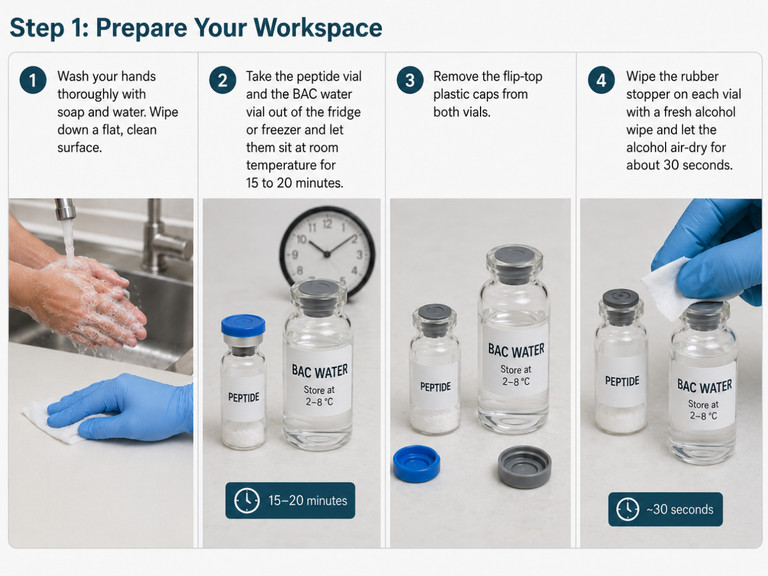
Step 1: Prepare Your Workspace
Wash your hands thoroughly with soap and water. Wipe down a flat, clean surface.
Take the peptide vial and the BAC water vial out of the fridge or freezer and let them sit at room temperature for 15 to 20 minutes.
Remove the flip-top plastic caps from both vials.
Wipe the rubber stopper on each vial with a fresh alcohol wipe and let the alcohol air-dry for about 30 seconds.
Why this matters: anything that enters the vial through the rubber stopper, including bacteria from your fingers or dust from the counter, will stay in the solution for the full 28-day usage window. Cold vials cause condensation inside the glass, which adds unwanted moisture.
Step 2: Add the Bacteriostatic Water
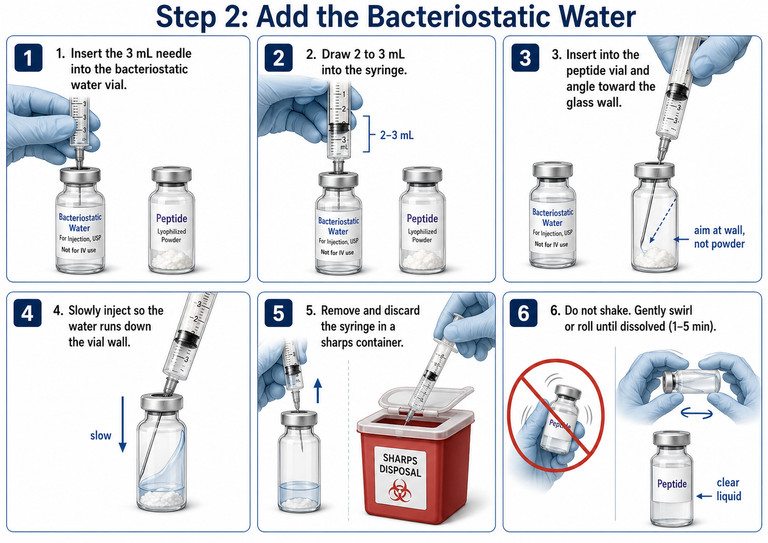
Insert the 3mL needle into the bacteriostatic water vial through the rubber stopper.
Draw 2 to 3mL of bacteriostatic water into the 3mL syringe.
Then, insert the needle into the peptide vial through the rubber stopper. Angle the needle so the tip points at the glass wall, not down at the powder.
Slowly press the plunger so the water runs down the inside of the glass and pools at the bottom around the powder.
Remove the syringe and place it in your sharps container (discard the syringe).
Do not shake the vial. Gently swirl or roll the vial between your palms until the powder fully dissolves into a clear liquid. This usually takes 1 to 5 minutes.
Shop research peptides
Live pricing from our top-rated vendor. Prices update as vendor listings change.
Why this matters: hitting the powder directly with a stream of water causes foaming, and foaming damages the peptide molecules. Shaking creates the same problem through shear stress and aggregation. The gentle swirl approach preserves the peptide's structure.
DO NOT RE-USE - only use 1 syringe per each vial. Then discard and use a fresh one if reconstituting more than 1 vial.
Step 3: Storage After Reconstitution
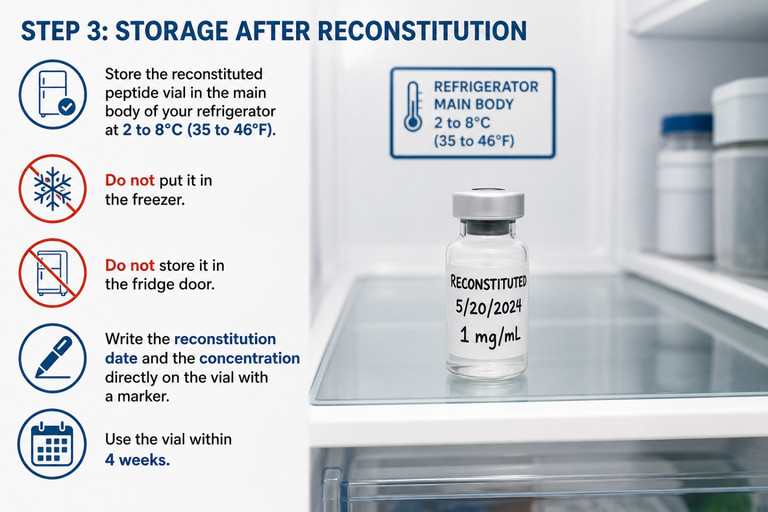
Store the reconstituted peptide vial in the main body of your refrigerator at 2 to 8°C (35 to 46°F). Do not put it in the freezer. Do not store it in the fridge door. Write the reconstitution date and the concentration directly on the vial with a marker. Use the vial within 4 weeks.
Why this matters: the preservative in bacteriostatic water inhibits microbial growth for up to 28 days under proper refrigeration. After that, the solution can no longer be considered sterile even if it still looks clear. Freezing causes ice crystals to form, which physically damage the peptide. The fridge door swings through warmer temperatures every time it is opened, so the main body is the more stable location.
Step 4: Calculate Your Dose and Draw
Decide on the research dose your protocol calls for, usually in micrograms. Open the Peptide Mind dosage calculator. Enter three values: the total mg of peptide in your vial (printed on the label), the mL of bacteriostatic water you added during reconstitution, and the dose you want to draw. The calculator returns the exact unit mark on a 1mL U-100 insulin syringe.

To draw the dose:
Wipe the rubber stopper with a fresh alcohol wipe
Insert a new 1mL insulin syringe through the stopper, invert the vial, and pull the plunger back to the unit mark the calculator gave you.
Withdraw the 1mL insulin syringe from the vial and inject the concentration slowly in your lower abdomen or thigh.
Place the used syringe in the sharps container immediately after the draw (never re-use).

Why this matters: research peptides are listed in micrograms, concentrations in mg/mL, and insulin syringes in units. The calculator handles all three conversions in one step so you are not doing mental math while holding a needle. Reusing a syringe contaminates the vial and dulls the needle, both of which compromise the research material.
Full Peptide Dosing, Reconstitution, and Storage Guide
What You Need Before You Start
Gather everything before opening a single vial.
You will need:
The lyophilized peptide vial (the freeze-dried powder, usually sealed with a flip-top cap)
A vial of USP-grade bacteriostatic water (BAC water)
One 3mL syringe with a 21 to 25 gauge needle, used for transferring BAC water
One 1mL insulin syringe (U-100), used for measuring and drawing the reconstituted peptide solution from the vial
Alcohol prep pads
A clean paper towel or flat workspace
Syringes and alcohol pads are available through Amazon or any pharmacy. For background on why bacteriostatic water is used specifically, see the bacteriostatic water guide.
Shop research peptides
Live pricing from our top-rated vendor. Prices update as vendor listings change.
How Much Bacteriostatic Water Should You Add?
Most beginners add 2mL to 3mL of bacteriostatic water per vial. Here is the reasoning.
The amount of BAC water you add determines the final concentration of your solution. Concentration matters because it controls how much liquid you draw for each research dose. Add too little water and tiny doses become impossible to measure accurately. Add too much and you may run out of vial space for routine work.
For a typical 5mg peptide vial:
1mL of BAC water produces a 5mg/mL solution (very concentrated, tiny draws on the syringe)
2mL of BAC water produces a 2.5mg/mL solution (the standard starting point for most beginners)
3mL of BAC water produces a 1.67mg/mL solution (more dilute, easier to measure smaller volumes)
For most research peptides, 2mL-3mL is the practical sweet spot. It gives you enough volume to read accurately on an insulin syringe without making the solution so dilute that you run out of room.
If you are working with a larger vial (10mg or 15mg), scale up to 3mL of BAC water to keep the concentration in a workable range. A 10mg vial reconstituted with 3mL gives roughly 3.33mg/mL, which still draws cleanly on a U-100 syringe.
Step 1: Prepare Your Workspace
Clean hands, clean surface, room-temperature vials.
Wash your hands thoroughly with soap and water. Wipe down the work surface so dust and pet hair stay out of the area. Take the peptide vial and the BAC water vial out of cold storage and let them sit at room temperature for 15 to 20 minutes. Cold vials introduce condensation inside the glass, which adds unwanted moisture to the lyophilized powder.
Once both vials are close to room temperature, flip off the plastic top caps. Wipe each rubber stopper with a fresh alcohol prep pad and let the alcohol air-dry for about 30 seconds before puncturing anything.
Step 2: Add Bacteriostatic Water to the Peptide Vial
Draw your chosen volume of BAC water into the 3mL syringe, then inject it slowly down the inside wall of the peptide vial.
Insert the 3mL syringe needle through the rubber stopper of the BAC water vial. Invert the vial and pull back the plunger until you have drawn your target volume, usually 2mL to 3mL. Pull the syringe out carefully.
Now insert the needle through the rubber stopper of the peptide vial. Angle the needle so the tip points at the glass wall, not directly at the powder cake at the bottom. Slowly depress the plunger so the water runs down the inside of the glass.
This angle matters more than it sounds. Research on protein lyophilizate reconstitution shows that injecting water directly onto the powder can cause foaming and localized concentration spikes, both of which promote aggregation. Aggregation means the peptide molecules clump together and lose their intended structural conformation, compromising the research material. These findings come from controlled pharmaceutical studies, so technique consistency matters even at the home research scale.
Once all the water is added, remove the syringe. Do not shake the vial. Roll it gently between your palms, or tilt it slowly at a 45 degree angle, until the powder fully dissolves. Most peptides dissolve within 1 to 5 minutes. Slower-dissolving sequences can take 15 to 30 minutes. The final solution should be completely clear with no cloudiness, particles, or persistent foam.
If the solution stays cloudy after gentle swirling, the peptide may need a different diluent such as acetic acid.
Shop research peptides
Live pricing from our top-rated vendor. Prices update as vendor listings change.
Step 3: Storage After Reconstitution
Refrigerate at 2 to 8 degrees Celsius, never freeze, and use within 28 days.
Once the peptide is reconstituted, the clock starts. Bacteriostatic water contains 0.9 percent benzyl alcohol, a preservative that inhibits microbial growth for up to 28 days under proper storage. After that window, the preservative system can no longer be relied on, even if the solution still looks clear.
Store the reconstituted vial in the main body of your refrigerator at 2 to 8 degrees Celsius (35 to 46 degrees Fahrenheit). Avoid the freezer compartment, and avoid the door, where temperature fluctuates every time the fridge opens.
Do not freeze the reconstituted solution. Freezing causes ice crystal formation, which can damage the peptide structure through mechanical shear. A 2023 analytical study on benzyl alcohol stability also showed that even small shifts in pH outside the 4.5 to 7.0 range can reduce its antimicrobial performance, so consistent refrigeration matters. These measurements were performed under controlled laboratory conditions.
Label the vial with the reconstitution date and the concentration. A working label might read: "BPC-157, 5mg / 2mL = 2.5mg/mL, reconstituted 2026-05-23." Writing the concentration directly on the label makes every future dosage calculation faster.
Unreconstituted lyophilized vials should stay frozen at -20 degrees Celsius until you are ready to use them. The frozen shelf life is far longer than the 28-day window for reconstituted solutions. For the full storage breakdown including unopened vials and travel considerations, see the peptide reconstitution guide.
Step 4: Calculate Your Research Dosage & Draw
Dosage volume depends on the concentration of your solution and the markings on your insulin syringe.
This is where most beginners get stuck. The math is simple once you see it, but the units throw people off the first time around. Here is the formula:
Volume to draw (in mL) = Desired dose (in mg) / Concentration (in mg per mL)
Worked example: you reconstituted a 5mg peptide vial with 2mL of BAC water. Your concentration is 2.5mg/mL. The research protocol calls for a 250 microgram (0.25mg) dose.
0.25mg / 2.5mg per mL = 0.1mL
On a standard U-100 insulin syringe, 1mL is divided into 100 units. So 0.1mL is 10 units on the syringe.
Most research peptide doses are listed in micrograms (mcg), most concentrations are listed in milligrams per milliliter (mg/mL), and most insulin syringes are measured in units. That means three different units in your head at the same time. You can use the dosage calculator to find the concentration and measurement you're aiming for.
How to Use the Peptide Mind Dosage Calculator
Enter the peptide amount, the BAC water volume, and your desired dose. The calculator returns the exact number of insulin syringe units to draw.
Shop research peptides
Live pricing from our top-rated vendor. Prices update as vendor listings change.
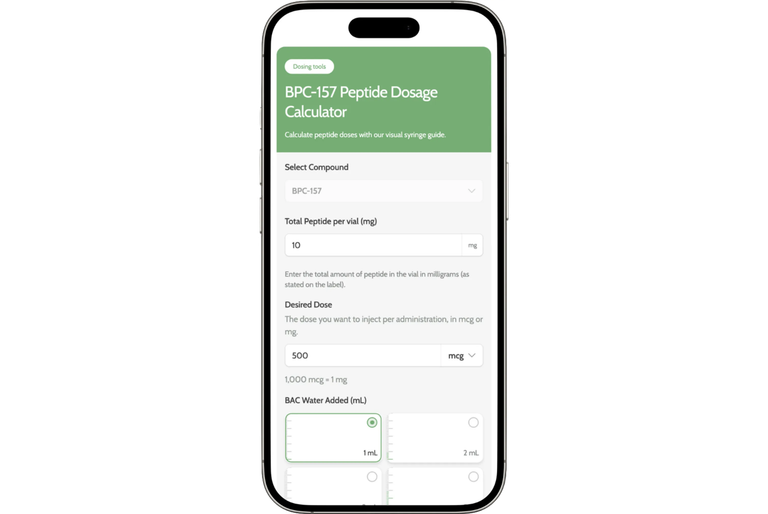
The Peptide Mind dosage calculator handles unit conversion automatically so you do not have to redo arithmetic every time you pull a dose. Here is how each field works.
Field 1: Peptide vial amount (in mg). Enter the total amount of peptide in your vial. If the label says "5mg," enter 5. If it says "10mg," enter 10. This number comes directly from the vial.
Field 2: Bacteriostatic water added (in mL). Enter the exact volume of BAC water you used during reconstitution. If you added 2mL, enter 2. If you added 3mL, enter 3. Together with Field 1, this determines your concentration.
Field 3: Desired dose. Enter the research dose you want to draw, usually in micrograms (mcg). The calculator should default to mcg, but check the unit selector if available. Common research doses range from 100mcg to 500mcg depending on the peptide.
Field 4: Syringe type. Most research work uses U-100 insulin syringes. This is the default used on the calculator.
The output displays two numbers. The first is the volume in milliliters (the actual liquid drawn). The second is the unit reading on a U-100 insulin syringe, which is the marking you look at on the barrel when drawing. Pull the plunger back to that unit mark, and you have your dose.
Save the calculator as a bookmark on your phone. Every time you draw from a vial, open the calculator, enter your three numbers, and read the unit value. After a few weeks the math becomes second nature, but the calculator stays faster and removes the risk of errors.
How to Draw Your Dose
To draw the dose:
Wipe the rubber stopper with a fresh alcohol wipe
Insert a new 1mL insulin syringe through the stopper, invert the vial, and pull the plunger back to the unit mark the calculator gave you.
Withdraw the 1mL insulin syringe from the vial and inject the concentration slowly in your lower abdomen or thigh.
Place the used syringe in the sharps container immediately after the draw (never re-use).
Why this matters: research peptides are listed in micrograms, concentrations in mg/mL, and insulin syringes in units. The calculator handles all three conversions in one step so you are not doing mental math while holding a needle. Reusing a syringe contaminates the vial and dulls the needle, both of which compromise the research material.
Still have questions? Ask an AI chatbot like ChatGPT, Grok, or Claude. Modern AI models are surprisingly accurate when it comes to research peptides, especially around reconstitution, dosing math, and storage. The trick is asking it to cite sources. Add "and send me references" or "link to the studies" to your question, and the AI will usually return PubMed or PMC citations you can verify yourself. Treat AI answers the same way you would treat a forum post: a useful starting point, not a final source. Cross-check anything important against the linked research before acting on it.
Common Mistakes to Avoid
Most first-time errors come from rushing, shaking, or guessing at units.
Shaking the vial. Vigorous shaking introduces air bubbles and creates shear forces that can damage the peptide chain. Research published in Interface Focus confirms that agitation-induced aggregation is a documented degradation pathway for peptides in solution. These aggregation findings were observed under specific experimental conditions and may vary by peptide type. Always swirl gently or roll the vial between your palms.
Injecting water straight onto the powder. As covered above, the water stream should hit the glass wall, not the powder cake. Direct impact promotes foaming and localized aggregation.
Guessing at concentration after the fact. Once you write the concentration on the vial label, every future calculation is straightforward. Skip the label step and you will be redoing math from scratch every time you draw.
Shop research peptides
Live pricing from our top-rated vendor. Prices update as vendor listings change.
Using a reconstituted vial past the 28-day window. Microbial contamination at low levels is not visible to the naked eye. After 28 days, the preservative system can no longer be trusted. Discard the vial and start fresh.
Storing in the freezer after reconstitution. Freezing damages the peptide structure once it is in solution. Refrigeration is correct for reconstituted vials. Freezing is only appropriate for unreconstituted lyophilized powder.
Forgetting to equilibrate to room temperature. Working with a cold vial straight out of the fridge causes condensation inside the glass. According to research recommendations, equilibrating in a desiccator prevents water absorption during this step. For most research, simply leaving the vials on the counter for 15 to 20 minutes is enough.
Frequently Asked Questions
Should I remove the rubber stopper?
No. The rubber stopper is designed to be punctured by a needle, not removed. Pulling it off exposes the contents to airborne contaminants and there is no way to reseal it. The stopper is self-sealing for needle punctures, which is the whole reason vials are built this way.
Do I insert the syringe through the rubber stopper?
Yes. Push the needle straight down through the center of the stopper. The rubber closes around the needle while it is in place and seals back up when you pull it out. Wipe the stopper with a fresh alcohol wipe before every puncture, including the first one and every draw after.
Can I touch the rubber stopper with my fingers?
No. Skin oils and bacteria transfer to the rubber and get pushed into the solution on the next puncture. If you touch it by accident, wipe it again with a fresh alcohol pad and let it air-dry before using.
How long does a reconstituted peptide vial last?
Up to 28 days when stored properly in the refrigerator at 2 to 8 degrees Celsius. The 28-day window is set by the preservative efficacy of benzyl alcohol in bacteriostatic water, not by the peptide itself. Discard any solution that has been reconstituted longer than 28 days.
Can I reuse the same syringe for multiple draws?
No. A used needle is no longer sterile, the tip becomes dulled which damages the rubber stopper, and you risk contaminating the entire vial. Use a fresh 1mL insulin syringe for every single draw and place the used one in your sharps container immediately.
Do I invert the vial when drawing a dose?
Yes. Turn the vial upside down so the rubber stopper points at the floor and the liquid pools against the stopper. This lets the needle sit in the liquid rather than in the air pocket at the top of the vial.
Should I tap the syringe to clear air bubbles before drawing my dose?
Yes. After drawing, hold the syringe with the needle pointing up, tap the barrel gently to send any bubbles to the top, then push the plunger slightly to expel the air. Air in the syringe means less solution, which means an inaccurate dose.
Can I use tap water or saline instead of bacteriostatic water?
No. Tap water is not sterile and contains minerals that can interact with the peptide. Standard saline does not contain a preservative, so it cannot maintain a sterile solution for repeated draws over multiple weeks. Bacteriostatic water is specifically formulated for multi-puncture vials and is the standard diluent for research peptide reconstitution.
Shop research peptides
Live pricing from our top-rated vendor. Prices update as vendor listings change.
How do I know if my peptide was reconstituted correctly?
The solution should be completely clear, with no cloudiness, visible particles, or persistent foam. If the powder fully dissolves within 5 to 30 minutes of gentle swirling and the resulting liquid is transparent, the reconstitution was successful. If your peptide contains GHK-Cu (copper peptide), the solution will be a clear blue color rather than colorless. This is normal and expected for copper peptides.
What if I added the wrong amount of bacteriostatic water?
The peptide is still usable. Just update your concentration calculation. If you intended to add 2mL but actually added 2.5mL, a 5mg vial now sits at 2mg/mL instead of 2.5mg/mL. Enter the actual water volume in the dosage calculator and the unit reading will adjust automatically.
Why do insulin syringes show units instead of mL?
Insulin syringes were designed for insulin dosing, which is measured in international units. On a U-100 syringe, 100 units equal 1mL. For research peptide work, you can convert by moving the decimal two places (50 units = 0.50mL, 10 units = 0.10mL), or use the calculator and read the units directly off the output.
Do I need to filter the reconstituted solution?
For research use with bacteriostatic water from a sealed USP-grade source, no additional filtration is needed. The benzyl alcohol preservative maintains sterility within the 28-day window. Filtration is only relevant for non-bacteriostatic diluents or for storage attempts beyond the standard window.
Can I reconstitute two peptides in the same vial?
No. Mixing peptides in a single vial creates unpredictable interactions and makes accurate dosage calculation impossible. Always reconstitute each peptide in its own vial, label clearly, and draw separately if a protocol involves more than one compound.
Can I use the same bacteriostatic water vial for multiple peptides?
Yes, with two rules. Wipe the rubber stopper on the BAC water vial with a fresh alcohol wipe every single time you draw from it, including the very first draw and every draw after. Use a new 3mL syringe for each peptide vial you reconstitute. Never reuse a syringe on the same BAC water vial or move it between peptides. A standard 10mL BAC water vial is enough to reconstitute roughly 3 to 5 peptide vials, but only if the stopper stays clean and every transfer uses a fresh, sterile syringe.
How do I open the plastic cap on a vial?
Place your thumbnail under the edge of the small plastic disc on top of the vial and flip it upward. The disc pops off cleanly, usually with a soft click. Some vials have a small pull-tab on the side of the cap that you can lift first, which makes the flip even easier. Once the plastic disc is off, you will see a metal ring crimped around the rubber stopper underneath. Do not remove the metal ring. It is there to hold the rubber stopper in place permanently. The rubber stopper itself stays where it is for the entire life of the vial, and every syringe goes through that stopper, not around it. If the plastic cap will not come off with your thumbnail, the edge of a butter knife or a coin under the lip will lift it without damaging the stopper underneath.
Disclaimer
The information provided on Peptide Mind is for educational purposes only and is not a substitute for professional medical advice. Many peptides discussed on this site are unapproved research chemicals intended strictly for laboratory and preclinical use. Furthermore, any dosage calculator provided is a theoretical tool for math visualization and does not represent medical dosing instructions. The FDA has not evaluated these statements, and nothing on this site is intended to diagnose, treat, cure, or prevent any disease. By accessing this site, you confirm you are over the age of 21, waive any claims or liability arising from the use of the content portrayed, and fully indemnify Peptide Mind against any unauthorized usage, claims, or liability in accordance with our Terms of Service.
References
Reconstitution protocols and protein lyophilizate stability, PubMed, 2019
Benzyl alcohol antimicrobial performance under pH variation, PubMed, 2023
Agitation-induced aggregation in peptide solutions, Interface Focus, PMC
Add a comment
This will be publicly visible.
Your email address will not be published.
Your comment will be reviewed by an admin before it is published.