Reviewed by the PeptideMind Team · Updated August 22, 2026
How to Store Peptides: Complete Guide (Fridge, Freezer & Shelf Life)
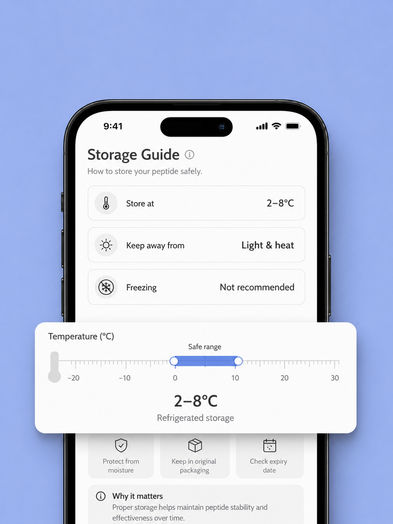
Peptides should be refrigerated at 36–46°F (2–8°C) as soon as possible. Unopened lyophilized powder is more forgiving and can tolerate brief room-temperature periods, but a reconstituted vial needs consistent refrigeration and should be used within 28 days, the window supported by bacteriostatic water's antimicrobial preservative.
As seen on






Do Peptides Need to Be Refrigerated?
Yes, lyophilized (freeze-dried) vials do best refrigerated at 36–46°F (2–8°C), tolerate cool room temperature for short periods, and last longest frozen at -20°C (-4°F) or colder.
Unopened powder: refrigerate, or freeze for the long haul
Lyophilized peptides are far more stable than liquid solutions. They handle short room-temperature periods during shipping, keep well in the fridge, and stay stable longest frozen at -20°C or colder.
Reconstituted vials: refrigerate and use within 28 days
Once mixed with bacteriostatic water, keep the vial refrigerated and away from direct light. Use it within 28 days, the window supported by the antimicrobial preservative in bacteriostatic water.
Heat and light are the real enemies
Temperature swings and UV light speed up peptide breakdown. Keeping vials cool, dark, and in their original packaging matters more than hitting an exact temperature.
Storing Lyophilized (Powdered) Peptides
Before reconstitution, peptides are in their most stable form: freeze-dried into a powder with no liquid to accelerate degradation. Correct storage here can preserve potency for months to years.
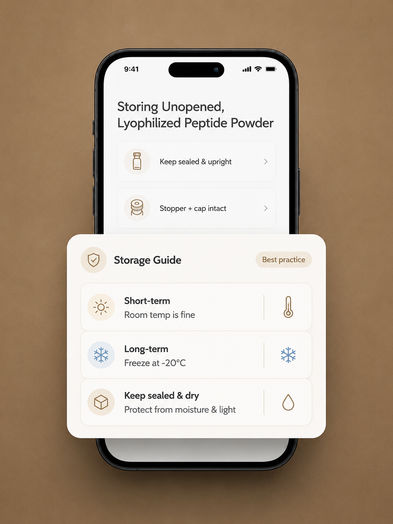
Short-term: room temperature is fine, briefly
Dry powder tolerates room temperature for days to weeks, such as during shipping. Keep it in a cool, dark place, and move it to the fridge once it arrives.
Long-term: freeze it
For the longest shelf life, freeze unopened powder at -20°C (-4°F) or colder, where many peptides stay stable for months to years, well past their reconstituted shelf life.
Keep it sealed and dry
Powder pulls moisture from the air, which speeds degradation. Store vials sealed in an airtight container, ideally with a desiccant pack, and let a cold vial warm to room temperature before opening so condensation doesn't form inside.
Storing Reconstituted (Mixed) Peptides
Once a vial is mixed with bacteriostatic water, the storage rules tighten: refrigeration becomes mandatory, and the usable window shortens to weeks rather than months.
Refrigerate immediately after mixing
Once mixed with bacteriostatic water, store the vial at 36–46°F (2–8°C) right away, and use it within 28 days, the window its preservative supports. Don't leave it out while you finish other steps.
Never freeze it
Freeze-thaw cycles form ice crystals that degrade the peptide, and a single cycle can cut potency by 20 to 50%. Keep reconstituted vials in the fridge, not the freezer.
Handle it gently
Keep the vial out of direct sunlight and UV, store it upright, and avoid hard shaking. Peptides are fragile, and agitation can break them down. Label the vial with the mix date so you don't lose track.

Peptide Storage at a Glance
The full storage picture in one place: what each temperature means for powder versus a reconstituted vial, so you're not guessing.
Room temp (68–77°F / 20–25°C): powder briefly, never reconstituted
Unopened powder holds up for days to weeks if kept cool and dark. A reconstituted vial should not sit out for more than a few hours, and sustained heat above 77°F (25°C) degrades either form.
Refrigerated (36–46°F / 2–8°C): the everyday default
Powder keeps for weeks to months; a reconstituted vial lasts up to 28 days. Use an interior shelf, not the door, which swings in temperature every time it opens.
Frozen (-20°C / -4°F or below): unopened powder only
Frozen, unopened powder stays stable for months to years. Never freeze a reconstituted vial.

How to Tell If a Peptide Has Gone Bad
A healthy peptide gives few surprises, and a degraded one usually gives itself away. Here's what to check before you use a vial.
Cloudy, discolored, or full of particles
A good solution is clear and colorless (or blue if it contains GHK-Cu, orange if it contains 5-Amino-1MQ). Cloudiness, a yellow or brown tint, or floating particles usually means it has degraded or been contaminated.
A broken seal or signs of leakage
Check that the cap and stopper are intact, with no cracks, leaks, or liquid pooled around the top, since a broken seal can mean contamination.
Powder that's clumped, sticky, or collapsed
A good lyophilized cake is dry, fluffy, and loose. If the powder looks clumped, sticky, discolored, or has collapsed into a solid mass, moisture may have gotten in and stability is compromised.
Remember: damage can be invisible
Potency can drop well before anything looks wrong. A clear solution is not a guarantee, so respect the storage window and discard a vial once it's past it.

Traveling with Peptides
Peptides travel fine with a little planning. Keep them cold, keep them with you, and know the rules before you fly.
Pack them in your carry-on
Checked luggage can swing to temperature extremes in the cargo hold. Keep peptides in your carry-on, where the cabin stays climate-controlled.
Use a cold pack, not direct ice
If your peptides need to stay cold, use an insulated bag with a cold pack rated for 2–8°C, and avoid direct ice contact, which can freeze and damage them. Unmixed lyophilized powder travels much better than a reconstituted vial.
Know the TSA rule
TSA allows injectable medication, syringes, and needles in carry-on bags for medical use. Tell the agent you have injectable medication before your bag is screened.
Refrigerate as soon as you land
At your destination, move peptides into a refrigerator as soon as you can. A hotel mini-fridge, or the front-desk fridge for short stays, does the job.

Storage by Peptide: Quick Reference
General storage guidance for the peptides people ask about most. Always confirm against the manufacturer's specific instructions for your vial.
GLP-1s and BPC-157: tirzepatide, semaglutide, retatrutide, BPC-157
Follow the standard rules. Refrigerate unopened powder at 36–46°F (2–8°C), freeze it for long-term storage, and use a reconstituted vial within 28 days.
Standard fridge-first peptides: Sermorelin, CJC-1295, Ipamorelin, TB-500, PT-141, GHRP-2, Gonadorelin
Refrigerate unopened, freeze for long-term storage, and protect from light. Refrigerate immediately once reconstituted, and use within 28 days.
More sensitive peptides: IGF-1 LR3, Cerebrolysin, Melanotan II
More storage-sensitive than most. Refrigerate promptly, keep them out of light, and minimize freeze-thaw cycles once reconstituted.

Common Peptide Storage Mistakes to Avoid
Most potency problems trace back to one of these storage errors, not the reconstitution process itself.
Leaving vials in direct light or heat
A sunny counter or a car interior can push a vial well past safe storage temperatures within hours.
Refreezing after thawing
Repeated freeze-thaw cycles damage peptide structure. Freeze unopened powder once, and never freeze a reconstituted vial at all.
Losing track of the reconstitution date
Without a label, it's easy to keep using a vial well past its stable window. Always mark the date you mixed it.
Storing near the fridge's coldest spot
The back wall is the coldest spot and can push a vial close to freezing, which is especially risky for reconstituted solutions. Keep vials on a middle shelf, away from both the back wall and the door.

Peptide Storage Questions, Answered
The most common questions people have about keeping peptides stable before and after mixing.