Why Is My Peptide Cloudy or Gelled? How to Fix It
A beginner's guide to fixing a cloudy peptide solution and peptide gelling. Learn why hydrophobic peptides like AOD-9604 turn cloudy or gel in water, and how 0.6% acetic acid restores clarity.


The most common reason a peptide turns cloudy or gels is that it was reconstituted with bacteriostatic water when it needed acid first. Water-repelling peptides such as AOD-9604 and hGH Fragment 176-191 will not dissolve in plain bacteriostatic water, so instead of going into solution they clump together into a cloud, white flakes, or a gel at the bottom of the vial. Nothing is wrong with the powder. It is in the wrong liquid.
The fix is to add the acid before the water. Put in a small volume of 0.6% acetic acid first, roughly 10 to 20% of your target volume, swirl gently until the solution turns clear, then dilute to your final concentration with bacteriostatic water. A vial that has already gelled in BAC water will usually still clear if you add acetic acid a few drops at a time. Adding the acid first, rather than trying to rescue a cloud afterward, is the part that matters.
That covers cloudiness that appears the instant liquid touches the powder, which is where most cloudy vials come from. Cloudiness that shows up days after a clear reconstitution is a different problem entirely. That is aggregation or contamination, it does not reverse, and the sample should be discarded rather than used. When the cloud appeared is the fastest way to tell the two apart.

This guide walks through the acid-first reconstitution method step by step, ranks all seven causes of a cloudy or gelled vial, shows what each state looks like so you can identify yours, lists which research peptides are expected to cloud and which are not, and gives a checklist for deciding whether a vial is recoverable or should be thrown out.
Cloudy Peptide: Four Quick Checks
Work through these four checks in order before deciding whether a vial is recoverable.
Check the timing. Cloudy immediately on reconstitution points to solubility. Cloudy days later points to degradation or contamination.
Check the peptide first. AOD-9604 and hGH Fragment 176-191 repel water and are expected to cloud or gel in plain bacteriostatic water. They need 0.6% acetic acid first.
Check the volume, then the water. Too little diluent leaves undissolved powder sitting as a haze. After that, bad or mislabeled bacteriostatic water is the next thing to rule out.
Check reversibility. If 0.6% acetic acid or added diluent clears the solution, it was a solvent problem. If it stays cloudy, the peptide has aggregated and the sample should be discarded.
When Did It Turn Cloudy?
The moment the cloudiness appeared tells you more than the appearance itself. Solubility failures are immediate and reversible. Degradation failures are delayed and irreversible. Almost every cloudy vial falls into one of the three timing windows below.
When the cloud appeared | Most likely cause | Reversible? | What to do |
|---|---|---|---|
Instantly, as water hit the powder | Hydrophobic peptide in the wrong solvent, or concentration above the solubility limit | Usually yes | Add 0.6% acetic acid in small increments, or add more diluent, then swirl gently |
Within minutes to a few hours | Wrong water chemistry (bad pH, sub-spec or expired bacteriostatic water), or water that was too warm | Sometimes | Re-prepare from a fresh vial using verified bacteriostatic water |
Days after a clear reconstitution | Aggregation from temperature cycling, agitation, or microbial contamination from sterile water or a re-entered vial | No | Discard the solution and prepare fresh |
The single most useful test is reversibility. A peptide that was simply in the wrong solvent will clear when the solvent is corrected (for example adding 0.6% acetic acid). A peptide whose structure has already unfolded and clumped will not clear no matter what you add, because the aggregation is not reversible under normal handling conditions. Protein aggregation research describes this as a largely one-way process once misfolded molecules begin associating with one another.
What a Cloudy Peptide Actually Looks Like

Researchers describe the same vial in very different words, so it helps to name the states precisely. A correctly reconstituted peptide is fully transparent.
Appearance | Common description | Typical meaning |
|---|---|---|
Fully clear, no visible particles | "Looks like water" | Peptide is in solution and behaving normally |
Faint haze, slightly grey cast, clears on standing | "Foggy" or "slightly cloudy" | Incomplete dissolution or fine air entrainment from mixing. Often resolves with time at room temperature |
Persistent milky white throughout | "Cloudy" or "turned to milk" | Aggregation or a solubility limit that has been exceeded |
Small white flecks or strands suspended in clear liquid | "Floaters," "bits," "stringy" | Particulate aggregation. Not reversible by swirling |
Thick, viscous, or set solid at the bottom | "Gelled," "jelly," "turned to gel" | Gel network formation, typical of hydrophobic peptides at high concentration |
Any color other than clear or faintly straw | Yellow, pink, brown tint | Chemical degradation or contamination. Discard |
A faint haze that disappears after the vial sits at room temperature for ten to fifteen minutes is usually undissolved powder finishing its transition into solution. A cloud that persists after that window, or one that appears in a solution that was previously clear, is a different problem entirely.
The Two Kinds of Cloudy Peptide
A peptide turns cloudy or gels when its molecules aggregate, meaning they stick to each other instead of spreading evenly through the solvent. Clouding (also called turbidity) and gelling are physical states, and they arise on two distinct pathways.
The first is a mismatch between the peptide and the liquid it was added to, which is a solvent problem and is reversible.
Shop research peptides
Live pricing from our top-rated vendor. Prices update as vendor listings change.
The second is structural unfolding driven by contaminated or wrong-chemistry water, thermal cycling, or mechanical stress, which damages the molecule and is not reversible.
Neither pathway means the lyophilized powder was impure. Lyophilized simply means freeze-dried, the standard dry form research peptides are shipped in.
When a freeze-dried peptide meets a solvent, each molecule has to interact with water for the solid to dissolve. Peptides built largely from water-loving (hydrophilic) amino acids do this readily. Peptides built from water-repelling (hydrophobic) amino acids resist it. To minimize contact with water, hydrophobic molecules cluster together, and that clustering is what you see as a cloud, white particulates, or a semi-solid gel. Research on freeze-dried formulations confirms that solvent and excipient choice, not purity alone, governs whether a peptide redissolves cleanly, as reviewed in a 2023 analysis of mannitol in lyophilized formulations published in the Journal of Pharmaceutical Sciences.
The Seven Causes of a Cloudy or Gelled Peptide, Ranked
Seven things account for nearly every cloudy or gelled vial. They are ordered by how often each turns out to be the real cause. The first two are fixable. The rest usually are not.
1. The Peptide Needed Acid and Got Water
This is the most common reason a peptide clouds or gels the instant liquid touches it, and the one most often mistaken for a bad product.
Some peptides will not dissolve in bacteriostatic water on its own. AOD-9604 and hGH Fragment 176-191 are the main ones. Their structure repels water, so instead of dissolving they clump together into a cloud, white flakes, or a gel sitting at the bottom of the vial. Nothing is wrong with the powder. It is in the wrong liquid.
The fix is to add a small amount of 0.6% acetic acid first, swirl until the solution turns clear, then top it up with bacteriostatic water. If the vial has already gelled in plain water, adding acid a few drops at a time will usually still bring it back. The full rescue procedure is in the "How to Fix a Cloudy or Gelled Peptide" section below.

2. Not Enough Liquid
Every peptide can only hold so much powder in a given volume. Put 10 mg into 1 mL and some sequences simply cannot dissolve it all, so the leftover stays in the liquid as a haze. This looks like cloudiness but is really a ratio problem.
Add more diluent and swirl. If it clears, that was the cause and the peptide is fine. The peptide dosage calculator helps you pick a volume that stays in a workable range before you open the vial.
3. Bad Bacteriostatic Water
If the peptide is not one of the water-repelling ones and the volume is reasonable, the water is the next thing to check. Bacteriostatic water should contain 0.9% benzyl alcohol, sit at a pH most peptides tolerate, and actually be what the label claims. Products from unverified sellers sometimes turn out to be plain saline.
Check that the label reads "Bacteriostatic Water for Injection," that it names 0.9% benzyl alcohol, that the lot number and expiry date are visible, and that it comes in a sealed glass vial rather than a plastic bottle. Verified bacteriostatic water with a lot-specific certificate of analysis is what to look for.
4. Sterile Water Instead of Bacteriostatic Water
The two look nearly identical, but sterile water contains no preservative. Once you break the seal it stays clean for hours rather than weeks.
This is the signature of a vial that was clear on day one and cloudy by day four or five. If that matches your timeline, check which water you used.
5. Shaking Instead of Swirling
Shop research peptides
Live pricing from our top-rated vendor. Prices update as vendor listings change.
Peptides are fragile. Shaking creates foam and mechanical stress, and both push the molecules to unfold and stick to each other.
Add liquid slowly down the inside wall of the vial. Swirl in slow circles, or invert gently five to ten times. Let it sit at room temperature for five to ten minutes. Do not vortex, and do not shake, even briefly.
6. Temperature
Warm liquid added to freeze-dried powder can damage it on contact, especially GLP-1 analogs and growth hormone peptides. Heat during shipping can damage a vial before you ever open it, and damaged powder looks identical to good powder until you mix it. Moving a finished solution in and out of the fridge repeatedly gives the molecules another chance to clump each time.
Use refrigerated diluent where you can, and once the solution is mixed, keep it at a steady 2 to 8°C.
7. Contamination During Handling
The least common cause, but a real one. Reusing needles, skipping the alcohol swab on the stopper, or leaving a needle open to the air introduces bacteria that break peptides down. This kind of cloudiness shows up 24 to 48 hours after an entry and gets worse from there.
Which Peptides Need Acetic Acid, and Which Do Not
The right primary solvent depends on whether a peptide is hydrophilic or hydrophobic, which is set by its amino acid sequence. Hydrophilic peptides dissolve in standard bacteriostatic water, while hydrophobic peptides need an acidified solvent first. Bacteriostatic water is sterile water containing a small amount of benzyl alcohol to limit bacterial growth across repeated vial entries. Use the table below to select a starting solvent.
Research Peptide | Hydrophobicity Profile | Primary Solvent | Is Cloudiness Expected? |
|---|---|---|---|
Hydrophilic (low) | Bacteriostatic water | No. Should be fully clear | |
Hydrophilic (low) | Bacteriostatic water | No. Should be fully clear | |
Hydrophilic (low) | Bacteriostatic water | No, though the solution is normally blue. Color is not cloudiness | |
CJC-1295 | Hydrophilic (low) | Bacteriostatic water | No. Should be fully clear |
Hydrophilic (low) | Bacteriostatic water | No. Should be fully clear | |
Hydrophilic (low) | Bacteriostatic water | No. Should be fully clear | |
Moderate | Bacteriostatic water | No, but more sensitive to pH and concentration than most | |
Moderate, aggregation prone | Bacteriostatic water | No, but prone to gelling if under-diluted or agitated | |
Hydrophilic (low) | Bacteriostatic water | No. Persistent cloudiness is not normal | |
Hydrophilic (low) | Bacteriostatic water | No. Should be fully clear | |
Hydrophobic (high) | 0.6% acetic acid | Yes, in neutral water. Expected behavior | |
hGH Fragment 176-191 | Hydrophobic (high) | 0.6% acetic acid | Yes, in neutral water. Expected behavior |
The pattern is consistent: peptides rich in polar residues such as arginine and lysine establish solution quickly in neutral water, while peptides carrying non-polar, lipophilic (fat-loving) side chains tend to aggregate. When in doubt, start with the gentlest solvent and escalate only if clouding appears.
Cloudy AOD-9604, Retatrutide, Tesamorelin and Other Peptides
Most searches about cloudy peptides name a specific compound. The notes below cover the sequences that generate the most questions, and the short answer for nearly all of them is that cloudiness is not expected behavior.
AOD-9604 and hGH Fragment 176-191
These are the exceptions. Both are strongly hydrophobic, and clouding or gelling in neutral bacteriostatic water is the expected chemical outcome rather than a fault. The remainder of this guide explains why, and how an acidified first step resolves it.
Retatrutide
Retatrutide should reconstitute completely clear in bacteriostatic water. A brief haze while the powder finishes dissolving is normal and resolves within minutes at room temperature. Persistent cloudiness, visible particulates, or a solution that clouds after a period in the refrigerator is not expected and points to water quality, thermal cycling, or contamination rather than to the peptide. Because retatrutide vials are typically reconstituted at 3 to 5 mg/mL, under-dilution is also worth ruling out before anything else.
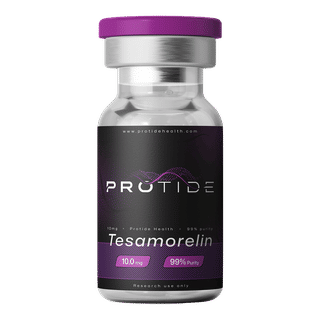
Tesamorelin
Tesamorelin is a growth hormone releasing factor analog that is more prone to gelling than most hydrophilic peptides, particularly when reconstituted at high concentration or agitated during mixing. A tesamorelin solution that has set into a gel usually reflects too little diluent combined with mechanical stress. Preparing at a more conservative concentration and swirling rather than shaking addresses most cases.
CJC-1295 and Ipamorelin
Shop research peptides
Live pricing from our top-rated vendor. Prices update as vendor listings change.
Both sequences are hydrophilic and should produce a fully clear solution in bacteriostatic water, individually or as a blended CJC and ipamorelin preparation. Cloudiness in a CJC or ipamorelin vial is almost always traceable to the diluent rather than the peptide, so the bacteriostatic water is the first thing to verify.
MOTS-c and Kisspeptin-10
MOTS-c dissolves readily in bacteriostatic water and should be clear. Kisspeptin-10 is somewhat more sensitive to solvent pH and concentration, so it benefits from a slightly larger reconstitution volume and gentle handling, but a persistently cloudy kisspeptin solution still indicates a problem rather than normal behavior.
How to Fix a Cloudy or Gelled Peptide
First work out whether the vial is fixable at all. If the cloud appeared the moment liquid touched the powder, it is a solubility problem and the fixes below usually work. If the solution was clear for days and then went cloudy, it has aggregated or been contaminated, and nothing you add will bring it back. The discard checklist further down covers that case.

If It Gelled or Clouded in Bacteriostatic Water
This is the hydrophobic peptide problem, most often AOD-9604 or hGH Fragment 176-191.
Add 0.6% acetic acid a few drops at a time, roughly 5 to 10% of the current volume per round.
Swirl gently after each addition. Do not shake.
Wait a minute, then hold the vial up to a light source. You are looking for full transparency.
Repeat until the solution turns clear. Most vials clear within two or three rounds.
If the gel is thick and sitting at the bottom of the vial, add volume alongside the acid. A gel network usually means high concentration combined with too little acidity, so more acid and more liquid together break it apart faster than acid alone.
If It Is Cloudy and the Peptide Is Not Hydrophobic
Try volume first. Add another 0.5 to 1 mL of bacteriostatic water, swirl gently, and let the vial sit at room temperature for ten minutes. If the haze clears, the vial was simply under-diluted and the peptide is fine.
If it stays cloudy after that, the cause is the water, the temperature, or contamination rather than solubility. Acid will not help, and the sample should be discarded rather than used.
If It Is Only Slightly Hazy
Let the vial sit at room temperature for ten to fifteen minutes without touching it. A faint haze is often just powder finishing its transition into solution, and it clears on its own. If it has not cleared after fifteen minutes, treat it as one of the two cases above.
When to Stop Trying
Stop if the solution has not cleared after two or three rounds of acid, if there are strands or clumps that will not disperse, if there is any yellow, pink, or brown tint, or if the cloudiness appeared days after a clear reconstitution. Each of those points to aggregation or contamination rather than a solvent mismatch, and neither reverses.
To avoid the problem entirely on the next vial, use the acid-first method below.
How to Reconstitute AOD-9604 Without It Gelling
AOD-9604, hGH Fragment 176-191, and any other water-repelling peptide reconstitute cleanly when the acid goes in before the water, in three stages. This sequence is a general laboratory reference for in vitro assay preparation and is provided for research purposes only.
Shop research peptides
Live pricing from our top-rated vendor. Prices update as vendor listings change.
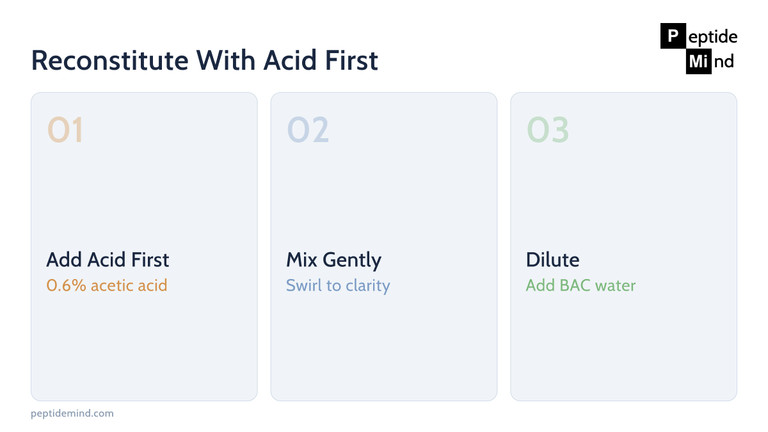
Step 1: Introduce the Acid First
Add a small volume of 0.6% acetic acid before any water, roughly 10 to 20% of your final target volume. Direct the liquid down the inside wall of the vial rather than onto the powder. Starting with acid breaks the hydrophobic interactions before the bulk solvent arrives, which is far more effective than adding water and trying to rescue a cloud afterward.
Step 2: Mix Gently and Watch for Clarity
Swirl the vial gently to encourage mixing. Do not shake or vortex aggressively, since shearing forces can damage peptide bonds. Visual clarity is your endpoint: a transparent solution means the peptide has entered the liquid phase. If turbidity or gelling persists, add acetic acid in small increments until the solution turns clear.
Step 3: Dilute to Final Concentration
Once the peptide is fully in solution in the acidic medium, add bacteriostatic water to reach your final target concentration. The initial acidification holds the peptide in solution even after neutral water is added, so the solution stays clear. To plan your acid-to-water ratio and final concentration, the peptide dosage calculator gives a quick reference for research calculations.
Why Some Peptides Will Not Dissolve in Bac Water
Hydrophobic peptides carry non-polar side chains that pull together to avoid contact with water. The more water-repelling residues a sequence has, the harder it clumps.
Two terms explain the rest. The isoelectric point, or pI, is the pH at which a peptide carries no net electrical charge. At that point nothing keeps the molecules apart, so they collapse together and crash out of solution as a cloud or gel. Protonation is the reverse: lowering the pH adds positively charged hydrogen ions to the side chains, so neighboring molecules share the same charge and push each other away instead of sticking together.
Laboratory work supports this. In a study of six designed peptides published in Macromolecules, researchers found that hydrophobic side chains, rather than sheet-forming tendency, determined whether the peptides assembled into a gel.
Why Acetic Acid Clears It
Acetic acid dissolves hydrophobic peptides by lowering the solvent's pH below the peptide's isoelectric point, which protonates the side chains and makes the molecules repel one another. Standard reconstitution with bacteriostatic water alone often fails for these sequences because neutral water leaves the peptide near the pH where it aggregates.
In research applications, 0.6% acetic acid is a frequent choice as the primary solvent for hydrophobic chains. The acidified environment adds positive charge to the peptide, and that shared charge creates electrostatic repulsion between molecules. The repulsion keeps them apart, prevents aggregation and gelling, and allows the powder to enter solution fully. There is direct evidence that acetate interacts with peptide aggregates: a 2022 study in Molecular Pharmaceutics using 1H NMR and molecular dynamics found that acetate counterions were incorporated into the aggregates of some peptides but not others, showing that the acid is an active participant in solution behavior rather than a passive diluent.
Why AOD-9604 Turns Cloudy or Gels
AOD-9604 is a clear example of a hydrophobic peptide that gels in neutral water. It is a modified C-terminal fragment of human growth hormone, specifically Tyr-hGH 176-191, meaning amino acids 176 to 191 of human growth hormone with a tyrosine residue added to the N-terminus. This identity is documented in a 2014 safety and metabolism study of AOD9604 in the Journal of Endocrinology and Metabolism. That paper reported no genotoxic findings across an Ames test, a chromosomal aberration assay, and a bone micronucleus assay in rodent models. These results are from preclinical research and have not been confirmed in human clinical trials.
Because of its specific C-terminal arrangement, AOD-9604 dissolves poorly in neutral bacteriostatic water. Researchers reconstituting AOD-9604 with water alone commonly observe a cloudy suspension, white floating particulates, or a semi-solid gel at the bottom of the vial. Introducing a mild acid shifts the peptide from a gelled suspension to a clear, stable liquid. That clarity is the expected behavior of the acetate salt form once the solvent pH is corrected, not a sign that anything was wrong with the powder.
Can You Still Use a Cloudy Peptide?
This is the question behind most cloudy vial searches, and the answer depends entirely on which of the two types of cloudiness you are looking at.
A solubility cloud can be corrected and the sample remains usable. If a hydrophobic peptide clouded because it met neutral water, or if any peptide clouded because the concentration was too high, correcting the solvent restores a clear, uniform solution. Nothing has been lost. The molecule was never damaged, it simply was not in solution.
Shop research peptides
Live pricing from our top-rated vendor. Prices update as vendor listings change.
An aggregation cloud cannot be corrected and the sample should be discarded. Once peptide molecules have unfolded and begun associating with one another, the process does not reverse under normal handling. The published aggregation literature treats this as a largely one-way pathway driven by agitation, thermal stress, interfacial exposure, and unfavorable solution chemistry. Two problems follow. Concentration becomes unknowable, because an unmeasured fraction of the material is no longer in solution and any calculation based on the label quantity is now wrong. And aggregated protein is recognized in the biopharmaceutical literature as a driver of unwanted immunogenicity, which is why aggregated material is unsuitable for research use rather than merely inconvenient.
Use the checklist below to decide.
Observation | Interpretation | Action |
|---|---|---|
Clears completely after adding 0.6% acetic acid | Hydrophobic solubility, corrected | Usable |
Clears completely after adding more diluent | Concentration was above the solubility limit | Usable |
Faint haze that resolves on standing at room temperature | Dissolution finishing | Usable |
Still cloudy after correcting solvent and concentration | Aggregation | Discard |
Was clear, then clouded days later | Degradation or contamination | Discard |
Visible strands, clumps, or floaters that do not disperse | Particulate aggregation | Discard |
Any yellow, pink, or brown discoloration | Chemical degradation or contamination | Discard |
Vial was reconstituted with plain sterile water and stored more than a day | Sterility compromised | Discard |
Needing to discard a vial does not mean the peptide was low quality to begin with. In most cases the cause sits in the diluent, the storage conditions, or the handling rather than in the powder. The practical safeguard is to remove the variables you control: verified bacteriostatic water, a conservative reconstitution volume, gentle mixing, and stable refrigerated storage.
How to Store Reconstituted Peptides So They Stay Clear
Acidified peptide solutions stay most stable when refrigerated and kept out of the freezer. Store reconstituted, acidified samples at 2 to 8°C, where they remain in a stable liquid phase for ongoing research use.
Avoid freezing acidified solutions. Freezing can cause freeze-concentration, where ice formation pushes the acid and peptide into shrinking pockets of liquid, concentrating the acid and damaging the peptide structure during the freeze-thaw process. This is a known consideration in freeze-dried and frozen formulation research, where excipients such as mannitol are studied specifically to protect molecules through these phase changes, as covered in the Journal of Pharmaceutical Sciences review cited above.
Frequently Asked Questions
Why is my peptide cloudy after reconstitution?
It depends on when the cloudiness appeared. Cloudiness that shows up the instant water meets the powder is usually a solubility problem, either a hydrophobic sequence in neutral water or a concentration above what the peptide will hold, and it is generally correctable. Cloudiness that appears hours later usually traces to the bacteriostatic water, whether that is sub-spec preservative, drifted pH, or a product that was mislabeled and is actually sterile water or saline. Cloudiness that appears days after a clear reconstitution indicates aggregation or contamination and is not reversible.
Can a cloudy peptide still be used?
Only if the cloudiness resolves when the solvent or concentration is corrected. A hydrophobic peptide that turns clear after adding 0.6% acetic acid was never damaged and remains usable. A solution that stays cloudy after those corrections has aggregated, which means the concentration can no longer be calculated accurately and the material is unsuitable for research use. Aggregated samples should be discarded rather than salvaged.
Why did my peptide turn to gel?
Gelling is aggregation taken to its structural extreme, where molecules link into a network that traps the solvent instead of dispersing through it. It has two common triggers: a hydrophobic sequence such as AOD-9604 reconstituted in neutral water, and any peptide reconstituted at too high a concentration, with tesamorelin being particularly prone. Hydrophobic gelling is corrected with an acidified first step. Concentration-driven gelling is corrected with additional diluent.
Is retatrutide supposed to be cloudy?
No. Retatrutide should reconstitute completely clear. A brief haze while the powder dissolves is normal and clears within minutes at room temperature, but persistent cloudiness, floaters, or a solution that turns cloudy after refrigeration is not expected behavior and points to the diluent, thermal cycling, or contamination.
Can bad bacteriostatic water make a peptide cloudy?
Yes, though it is worth ruling out the solvent and the volume first. Bacteriostatic water needs the correct 0.9% benzyl alcohol concentration, a pH inside the range most peptides tolerate, and genuine bacteriostatic rather than sterile composition. Check that the label reads "Bacteriostatic Water for Injection," that the preservative is named explicitly, that the lot number and expiry are visible, and that the container is a sealed glass vial.
What is the difference between sterile water and bacteriostatic water?
Sterile water for injection contains no preservative, so once the seal is punctured the sterility window is a matter of hours. Bacteriostatic water contains 0.9% benzyl alcohol, which suppresses microbial growth across repeated entries over a period of weeks under refrigeration. A peptide that was clear on day one and cloudy by day four or five was very often reconstituted with sterile water by mistake.
Shop research peptides
Live pricing from our top-rated vendor. Prices update as vendor listings change.
Why is my AOD-9604 cloudy or gelling after adding water?
AOD-9604 is a hydrophobic peptide, so it resists neutral bacteriostatic water and its molecules aggregate into a cloud or gel. The standard research approach is to dissolve it in a small volume of 0.6% acetic acid first to reach clarity, then dilute with bacteriostatic water. The clouding reflects solvent choice, not a defect in the powder.
Can I use household vinegar instead of acetic acid for peptides?
No. Laboratory-grade 0.6% acetic acid is sterile and filtered to a known concentration, while household vinegar contains impurities, flavor compounds, and organic matter that can contaminate a research sample and degrade the peptide. Vinegar also has an inconsistent acid concentration, which makes reproducible research preparation difficult.
Does the acetic acid affect the peptide once it is dissolved?
In standard research preparation, the small volume of 0.6% acetic acid is diluted heavily with bacteriostatic water, so the final acid concentration is very low. Evidence from a Molecular Pharmaceutics study shows acetate counterions can become part of peptide aggregates, so the acid plays a real role in solution behavior, but at the diluted concentrations used in reconstitution it primarily serves to keep the peptide clear and in solution. These observations come from in vitro analysis and should be interpreted within a research context.
Can I freeze the peptide after mixing it with acetic acid?
Freezing acidified solutions is generally avoided in research handling. The freezing process can drive freeze-concentration, where the acid and peptide separate into pockets that concentrate the acid and can damage the peptide structure during thawing. Storing at 2 to 8°C is the standard alternative for acidified samples.
How do I know if it is a solvent problem and not a bad product?
The clearest test is whether acidification resolves the cloud. If a hydrophobic peptide is cloudy in neutral water but turns transparent after adding 0.6% acetic acid, the original issue was solvent choice, not purity. A truly degraded sample will usually fail to clear even with added acid and gentle mixing.
References
Thakral S, Sonje J, Munjal B, Bhatnagar B, Suryanarayanan R. "Mannitol as an Excipient for Lyophilized Injectable Formulations." Journal of Pharmaceutical Sciences, vol. 112, no. 1, 2023, pp. 19-35. https://pubmed.ncbi.nlm.nih.gov/36030846/
Adams DJ, et al. "Influence of Hydrophobic Face Amino Acids on the Hydrogelation of β-Hairpin Peptide Amphiphiles." Macromolecules, 2015. https://www.ncbi.nlm.nih.gov/pmc/articles/PMC7679069/
"Aggregation Behavior of Structurally Similar Therapeutic Peptides Investigated by 1H NMR and All-Atom Molecular Dynamics Simulations." Molecular Pharmaceutics, 2022. https://pmc.ncbi.nlm.nih.gov/articles/PMC8905580/
Moré MI, Kenley D. "Safety and Metabolism of AOD9604, a Novel Nutraceutical Ingredient for Improved Metabolic Health." Journal of Endocrinology and Metabolism, vol. 4, no. 3, 2014, pp. 64-77. https://www.jofem.org/index.php/jofem/article/view/213
Sigma-Aldrich (Merck). "Peptide Solubility Guidelines: Hydrophobicity and Charge Analysis." Technical resource. https://www.sigmaaldrich.com/
Wang W. "Protein aggregation and its inhibition in biopharmaceutics." International Journal of Pharmaceutics, vol. 289, no. 1-2, 2005, pp. 1-30. https://pubmed.ncbi.nlm.nih.gov/15652195/
Mahler HC, Friess W, Grauschopf U, Kiese S. "Protein aggregation: pathways, induction factors and analysis." Journal of Pharmaceutical Sciences, vol. 98, no. 9, 2009, pp. 2909-2934. https://pubmed.ncbi.nlm.nih.gov/18823031/
Manning MC, Chou DK, Murphy BM, Payne RW, Katayama DS. "Stability of protein pharmaceuticals: an update." Pharmaceutical Research, vol. 27, no. 4, 2010, pp. 544-575. https://pubmed.ncbi.nlm.nih.gov/20143256/
Getting a Clear Solution Every Time
A cloudy peptide is a diagnostic question before it is a problem. Ask when the cloud appeared. If it arrived the moment water met the powder, you are looking at solubility, and either an acidified first step for hydrophobic sequences like AOD-9604 or a larger reconstitution volume will clear it. If the solution was clear and clouded later, you are looking at aggregation or contamination, and no amount of mixing will bring it back.
For everything other than the genuinely hydrophobic peptides, cloudiness is a signal that one of the controllable variables slipped: the bacteriostatic water, the concentration, the mixing technique, or the storage temperature. Getting those four right is what keeps a research solution clear. For the full preparation workflow, see the peptide reconstitution guide, and use the peptide dosage calculator to plan a reconstitution volume that stays comfortably inside the solubility range before the vial is opened.
Research Disclaimer
The information presented in this article is for educational and research purposes only. Peptide Mind provides evidence-based research summaries and does not offer medical advice, diagnosis, or treatment recommendations. All peptides discussed are intended for in vitro and preclinical research use only. Consult a qualified healthcare professional before making any health-related decisions. The research cited may not reflect the full body of available evidence, and findings from preclinical studies may not translate to human outcomes. By accessing this site, you confirm you are over the age of 21, waive any claims or liability arising from the use of the content portrayed, and fully indemnify Peptide Mind against any unauthorized usage, claims, or liability in accordance with our Terms of Service.
Add a comment
This will be publicly visible.
Your email address will not be published.
Your comment will be reviewed by an admin before it is published.