MOTS-c Peptide: A Beginner's Guide (Benefits & Dosage)
MOTS-c is a mitochondrial peptide studied for metabolism, fat loss, and endurance. A beginner's guide to how it works, benefits, dosage, and safety.

MOTS-c is a 16-amino-acid peptide that your own mitochondria produce, and it has become one of the most talked-about compounds in metabolic and longevity research. Scientists study it for its effects on blood sugar, body fat, and exercise capacity, which is why some people call it "exercise in a vial." Most of that evidence still comes from animals, so this guide separates what the research shows from what the marketing claims.
If you are new to peptides entirely, start with the beginner's guide to peptides first, then come back here for the MOTS-c specifics.
What is MOTS-c?
MOTS-c (Mitochondrial Open Reading Frame of the 12S rRNA Type-c) is a short peptide encoded not in your nuclear DNA but inside your mitochondria, the structures that turn food into usable energy. It belongs to a small family called mitochondrial-derived peptides, alongside humanin and the SHLP group. Researchers first described it in a 2015 Cell Metabolism paper led by Changhan Lee, and the field has grown quickly since.
The molecule itself is small and specific. It is 16 amino acids long, weighs about 2,175 daltons, and carries the sequence Met-Arg-Trp-Gln-Glu-Met-Gly-Tyr-Ile-Phe-Tyr-Pro-Arg-Lys-Leu-Arg. You do not need to memorize that. What matters is the idea behind it: your mitochondria are not just power plants, they also send out signaling molecules, and MOTS-c is one of them.
Attribute | Detail |
|---|---|
Type | Mitochondrial-derived peptide (MDP) |
Length | 16 amino acids (~2,175 Da) |
Discovered | 2015 (Lee et al., Cell Metabolism) |
Main pathway | Folate cycle to AICAR to AMPK activation |
Studied for | Metabolism, insulin sensitivity, fat, endurance, aging |
Administration | Subcutaneous injection (research context) |
Regulatory status | Not FDA approved; WADA-prohibited in sport |
Why people call it "exercise in a vial"
Here is the hook that made MOTS-c go viral. Physical exercise raises the amount of MOTS-c circulating in your body, and in one human dataset, a single bout of exercise drove an 11.9-fold increase in skeletal muscle MOTS-c. When researchers then gave the peptide to mice that did not exercise, those animals showed some of the same adaptations a workout produces, including better running capacity and improved fuel handling.
That is the origin of the "exercise mimetic" nickname. It is a useful mental model, but read it carefully. MOTS-c reproduces a slice of what exercise does to your metabolism in animal studies. It does not replace the cardiovascular, muscular, and mental benefits of actually training. No serious researcher frames it as a shortcut around the gym.
How MOTS-c works
The peptide works mainly through one master switch: AMPK, the enzyme your cells use to sense low energy and respond to it. When MOTS-c is active, it interferes with the folate cycle inside mitochondria, which causes a molecule called AICAR to build up. That accumulation flips on AMPK, which then tells cells to pull in glucose, burn fat for fuel, and restore metabolic balance. It is the same pathway that exercise and the diabetes drug metformin lean on.
There is a second, stranger mechanism. Under metabolic stress, such as glucose restriction, MOTS-c physically moves out of the mitochondria and travels to the cell nucleus. A 2018 study by Kim and colleagues showed it relocates within about 30 minutes and starts regulating stress-response genes, including ones tied to antioxidant defense through the NRF2 pathway. In plain terms, the peptide acts like a messenger between your mitochondria and the rest of the cell, helping the whole system adapt when energy runs short.

MOTS-c benefits: what the research actually shows
Before the list, one honest caveat. The most exciting MOTS-c findings come from cell and rodent studies. Human evidence is thin, limited mostly to observational data and a single small trial of a synthetic analog (more on that below). With that framing, here is where the research points.
Metabolism and insulin sensitivity
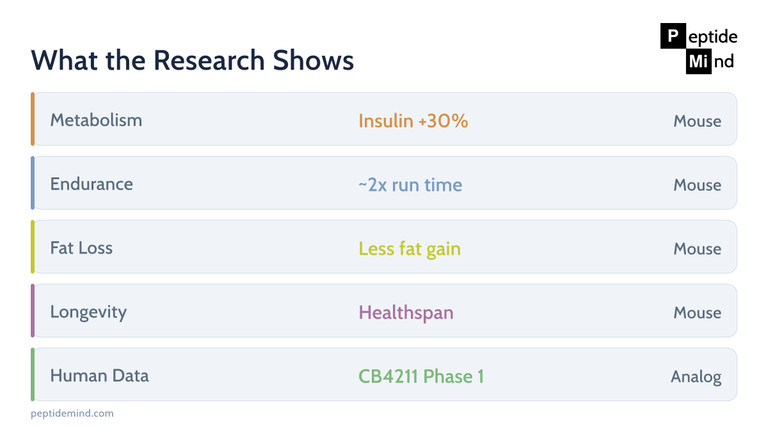
This is the strongest and oldest part of the MOTS-c story. In the original 2015 work, the peptide improved insulin sensitivity by roughly 30% in mice fed a high-fat diet and protected them from diet-induced and age-related insulin resistance. Because it targets skeletal muscle and the AMPK pathway, MOTS-c is often described as an insulin sensitizer, and researchers have flagged it as a candidate worth studying for type 2 diabetes and metabolic syndrome.
Body fat and weight
In the same line of research, MOTS-c-treated mice gained less fat than controls even when they ate the same number of calories, which points to a shift in how their bodies partitioned and burned fuel rather than simple appetite suppression. The peptide promoted fatty acid oxidation and, in some studies, encouraged browning of white fat. If you are mapping MOTS-c against other options, our peptides for fat loss puts it in context next to GLP-1s and other compounds.
Exercise capacity and endurance
Shop research peptides
Live pricing from our top-rated vendor. Prices update as vendor listings change.
The endurance data is the most quotable. In a 2021 Nature Communications study, MOTS-c improved physical performance in young, middle-aged, and old mice on treadmill tests.
Old mice ran roughly 2-fold longer and 2.16-fold farther after MOTS-c treatment, and 100% of young mice on the higher dose reached the final sprint stage versus only 16.6% of controls. (Reynolds et al., Nature Communications, 2021)
Treatment also restored "metabolic flexibility," the ability to switch cleanly between burning carbs and fat, in aged animals. A separate running study (Hyatt et al.) reported a single dose improving running time by about 12% and distance by about 15%.
Aging and longevity
MOTS-c levels fall as we get older, and they drop in certain tissues and in circulation with age. That decline, paired with the peptide's ability to reverse age-related physical decline in mice, is why it shows up on longevity research lists. It is studied as a tool for "healthspan," meaning the years you stay functional, rather than a proven life-extension drug. See how it ranks among the best longevity peptides.
Other research areas
Smaller bodies of work have looked at MOTS-c in bone metabolism, inflammation, and glucose control during gestational diabetes models. These are early and mostly preclinical. They are worth knowing about, but they are not the reason most people are interested in the peptide.
Does MOTS-c work in humans?
This is the question that separates careful researchers from hype accounts. As of 2026, there is no completed human trial of MOTS-c itself proving the benefits above. The closest evidence comes from CB4211, a modified MOTS-c analog developed by CohBar. It completed a Phase 1a/1b trial for NASH (a fatty liver disease) and obesity, and the company reported in 2021 that it was generally well tolerated, with reductions in liver enzymes (ALT and AST), lower glucose, and a trend toward reduced body weight after four weeks.
That is real early human data, but two limits matter. CB4211 is an engineered analog, not the natural peptide most vendors sell. And a four-week Phase 1 readout tells you about short-term safety and biomarkers, not whether MOTS-c delivers the fat loss or endurance results seen in mice. The human verdict is still open.
MOTS-c dosage in research
There is no FDA-approved or medically established human dose for MOTS-c. What follows is reference information drawn from the published animal studies and from protocols circulated in research and clinic settings. It is not a recommendation, and the standard disclaimer at the end applies in full.
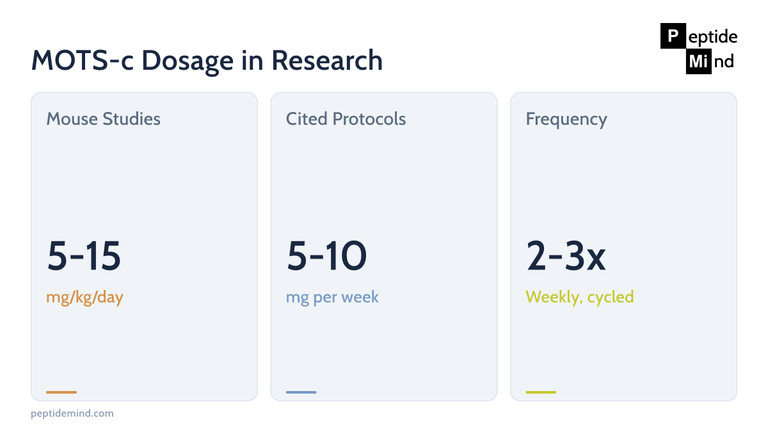
Animal studies typically used 5 to 15 mg per kilogram per day by injection, which does not translate directly to a human dose. In practice, research and clinic sources commonly reference a far smaller range for human-equivalent protocols, often cited around 5 to 10 mg per week of subcutaneous MOTS-c, split across 2 to 3 doses, run in short cycles of a few weeks with breaks in between.
Context | Reported range | Notes |
|---|---|---|
Mouse studies | 5–15 mg/kg/day | Injected; not a human dose |
Commonly cited human protocols | ~5–10 mg per week | Anecdotal; split into 2–3 SubQ doses |
Frequency | 2–3 times per week | Often cycled 2–4 weeks on, then off |
Timing | Morning or pre-exercise | To match AMPK signaling, per clinic notes |
Because MOTS-c comes as a freeze-dried powder, you also have to do reconstitution math to get from "milligrams in the vial" to "units in the syringe." The free peptide dosage calculator handles that conversion for you.
How MOTS-c is prepared and used
In research and clinic settings, MOTS-c is given as a subcutaneous injection, usually into the abdomen, often in the morning on an empty stomach or before exercise. It ships as a lyophilized (freeze-dried) powder that has to be reconstituted with bacteriostatic water before use.
The basic workflow looks like this:
Shop research peptides
Live pricing from our top-rated vendor. Prices update as vendor listings change.
Bring the vial and the bacteriostatic water to room temperature.
Swab both rubber stoppers with alcohol and let them dry.
Draw your bacteriostatic water and inject it slowly down the inside wall of the vial, never directly onto the powder.
Swirl gently until the powder dissolves. Do not shake.
Draw your calculated dose into an insulin syringe.
Refrigerate the reconstituted vial and use it within about 28 days.
If any of that is unfamiliar, the step-by-step reconstitution guide and the explainer on bacteriostatic water cover the technique in detail.
MOTS-c side effects and safety
Because no long-term human trials of the peptide have been completed, the safety picture is incomplete. The most reliable summary of reported effects comes from the U.S. Anti-Doping Agency, which catalogs what people who buy MOTS-c online have described.
Commonly reported issues include:
Increased heart rate or heart palpitations
Injection site irritation or redness
Insomnia or disrupted sleep
Fever or flu-like feelings
There is no published data on what chronic, long-term use does. Purity is a separate risk: research-grade vials are not made to pharmaceutical standards, so a certificate of analysis and third-party testing matter a great deal. Pregnancy, breastfeeding, and recurrent low blood sugar are situations where the limited safety data is a real concern.
Is MOTS-c legal?
The short answer is nuanced. MOTS-c is not a controlled substance, and vials are widely sold online labeled "for research purposes only." But three facts shape its real legal status:
Not FDA approved. It is an experimental peptide with no approved medical use, and the FDA has specifically flagged it as ineligible for use in compounded medications.
Not a dietary supplement. It cannot legally be sold as a supplement ingredient.
Banned in sport. MOTS-c is prohibited at all times under the World Anti-Doping Agency's metabolic modulators category as an AMPK activator, and athletes cannot get a therapeutic use exemption for it.
So buying it for research is a gray area that exists because "research only" products are hard to regulate, while using it as a drug or competing while using it is clearly off-limits. If you compete in a tested sport, treat MOTS-c as a hard no.
How MOTS-c compares to other longevity peptides
MOTS-c is one option among several that get grouped under metabolic and longevity research. It is not interchangeable with the others, because each works through a different mechanism.
If your interest is metabolic health and energy specifically, MOTS-c sits closer to the center of that target than most peptides. If your goal is recovery or skin, others fit better.
Frequently asked questions
What are the benefits of taking MOTS-c peptide?
In research, MOTS-c is studied for improved insulin sensitivity, reduced fat gain, better exercise endurance, and protection against age-related metabolic decline. The strongest evidence is in animals. One small human trial of a MOTS-c analog showed improvements in liver enzymes and glucose, but the peptide's headline benefits have not been confirmed in people.
How long should you take MOTS-c?
There is no medically established duration. Protocols circulated in research and clinic settings typically run in short cycles of two to four weeks, followed by an equal break, partly because cells can become less responsive to continuous signaling. Since there is no long-term human safety data, indefinite use is not supported by evidence.
Shop research peptides
Live pricing from our top-rated vendor. Prices update as vendor listings change.
Is MOTS-c legal to buy?
In most places you can buy MOTS-c online when it is labeled "for research purposes only," because that category is difficult to regulate. It is not FDA approved, cannot be sold as a supplement, and is banned in competitive sport. Buying it for research differs from using it as a drug, which is not an approved use.
What are the side effects of MOTS-c?
Reported side effects from people who use MOTS-c bought online include increased heart rate or palpitations, injection site irritation, insomnia, and fever. There is no data on long-term effects because no long-term human studies have been completed. Product purity is an added risk with research-grade vials.
Is MOTS-c the same as doing exercise?
No. Exercise raises your natural MOTS-c levels, and the peptide reproduces some exercise-like metabolic changes in animals, which is why it is nicknamed an exercise mimetic. It does not replicate the full cardiovascular, muscular, and cognitive benefits of training, and researchers do not present it as a substitute for it.
The bottom line
MOTS-c is a fascinating piece of mitochondrial biology with a real research foundation behind its metabolic and endurance claims. The animal data is consistent, the mechanism is well mapped, and one analog has cleared an early human safety trial. The honest gap is that the benefits people most want, fat loss and stamina, have not yet been proven in humans, and the long-term safety record does not exist. Treat it as a compound under active investigation, not a finished product, and weigh the WADA ban if you compete.
Disclaimer: The information provided on Peptide Mind is for educational purposes only and is not a substitute for professional medical advice. Many peptides discussed on this site are unapproved research chemicals intended strictly for laboratory and preclinical use. Furthermore, any dosage calculator provided is a theoretical tool for math visualization and does not represent medical dosing instructions. The FDA has not evaluated these statements, and nothing on this site is intended to diagnose, treat, cure, or prevent any disease.
References
Lee C, et al. The mitochondrial-derived peptide MOTS-c promotes metabolic homeostasis and reduces obesity and insulin resistance. Cell Metabolism. 2015. https://pubmed.ncbi.nlm.nih.gov/25738459/
Kim KH, et al. The mitochondrial-encoded peptide MOTS-c translocates to the nucleus to regulate nuclear gene expression in response to metabolic stress. Cell Metabolism. 2018. https://pmc.ncbi.nlm.nih.gov/articles/PMC6185997/
Reynolds JC, et al. MOTS-c is an exercise-induced mitochondrial-encoded regulator of age-dependent physical decline and muscle homeostasis. Nature Communications. 2021. https://www.nature.com/articles/s41467-020-20790-0
Zheng Y, et al. MOTS-c: A promising mitochondrial-derived peptide for therapeutic exploitation. Frontiers in Endocrinology. 2023. https://pmc.ncbi.nlm.nih.gov/articles/PMC9905433/
U.S. Anti-Doping Agency. What is the MOTS-c peptide? https://www.usada.org/spirit-of-sport/what-is-mots-c-peptide/
CohBar, Inc. Positive Topline Results from the Phase 1a/1b Study of CB4211. 2021. https://www.globenewswire.com/news-release/2021/08/10/2278324/0/en/CohBar-Announces-Positive-Topline-Results-from-the-Phase-1a-1b-Study-of-CB4211-Under-Development-for-NASH-and-Obesity.html
Add a comment
This will be publicly visible.
Your email address will not be published.
Your comment will be reviewed by an admin before it is published.