N-Acetyl Semax Amidate vs Semax: Key Research Differences (2026)
N-Acetyl Semax Amidate vs Semax compared: structure, terminal modifications, stability, the BDNF/TrkB mechanism, and preclinical research. A research-framed 2026 guide.

N-Acetyl Semax Amidate vs Semax is a comparison between a parent peptide and a chemically modified version of itself, not between two unrelated compounds. Semax is a synthetic heptapeptide built from the ACTH(4-7) fragment with a C-terminal Pro-Gly-Pro extension, while N-Acetyl Semax Amidate is the same core sequence with two added terminal modifications: an acetyl group on the N-terminus and an amide group on the C-terminus. Those two small changes are the entire basis of the comparison, because they alter how long the molecule resists enzymatic breakdown in research models. This guide examines what the published literature actually shows about their structure, shared mechanism, and stability, updated for 2026.
N-Acetyl Semax Amidate vs Semax: Quick Research Comparison
N-Acetyl Semax Amidate and Semax share an identical seven-residue core but differ at the two ends of the chain, which changes their resistance to proteolytic enzymes. Semax is the original, more heavily studied molecule; N-Acetyl Semax Amidate is the terminally protected analog associated with longer plasma stability in research settings. The table below summarizes the core distinctions before the sections that follow expand on each.
Characteristic | Semax | N-Acetyl Semax Amidate |
|---|---|---|
Type | Synthetic heptapeptide | Synthetic heptapeptide (terminally modified analog) |
Core sequence | Met-Glu-His-Phe-Pro-Gly-Pro (ACTH 4-7 + Pro-Gly-Pro) | Same core sequence |
N-terminus | Free (unmodified) | Acetylated |
C-terminus | Free carboxyl | Amidated |
Reported plasma stability | Short, on the order of minutes in research models | Extended relative to parent Semax in research models |
Primary research focus | Neurotrophin signaling, neuroprotection, cognition in rodents | Largely inferred from Semax; direct studies more limited |
Research stage | Preclinical | Preclinical |
A recurring point of confusion is that vendors describe N-Acetyl Semax Amidate as a more potent "upgrade," but the mechanistic research that justifies interest in either molecule was conducted almost entirely on the unmodified parent Semax. The analog's distinction is chemical stability, not a separate body of mechanism studies.
What Is Semax?
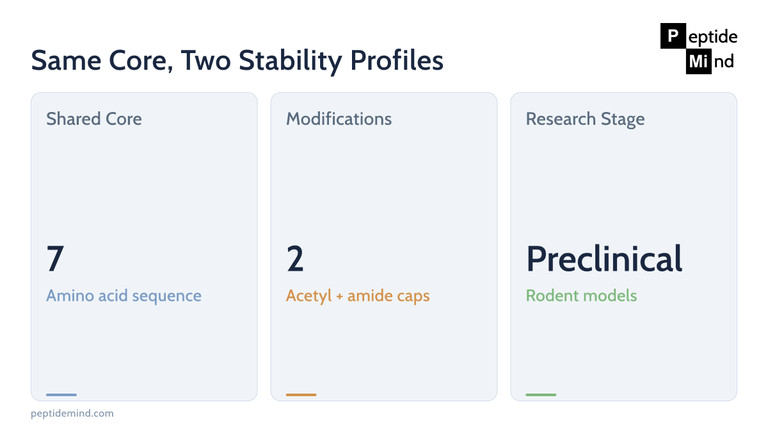
Semax is a synthetic heptapeptide with the sequence Met-Glu-His-Phe-Pro-Gly-Pro, designed as an analog of the adrenocorticotropic hormone (ACTH) fragment 4-10. It combines the ACTH(4-7) region with a C-terminal Pro-Gly-Pro tripeptide that was added specifically to slow enzymatic degradation of the original ACTH fragment. It was developed in Russia and has been studied there for several decades as a regulatory peptide in neuroscience research.
In research settings, Semax is investigated for its effects on neurotrophin signaling and neuronal activity in rodent models. Its most cited mechanistic feature is modulation of the brain-derived neurotrophic factor (BDNF) system, a family of signaling proteins involved in neuronal survival and synaptic plasticity. According to a 2006 study in Brain Research by Dolotov and colleagues, a single 50 micrograms per kilogram application of Semax was associated with a 1.4-fold increase in BDNF protein and a 1.6-fold increase in TrkB receptor phosphorylation in the rat hippocampus. These findings come from animal models and have not been established as approved uses in humans.
The Pro-Gly-Pro tail is the structural detail that matters most for the comparison ahead. It is a built-in stabilizing element in Semax itself, which is why the parent molecule already resists degradation better than the raw ACTH fragment it was derived from.
What Is N-Acetyl Semax Amidate?
N-Acetyl Semax Amidate is a chemically modified version of Semax that keeps the identical seven-residue core sequence but adds two protective groups: an acetyl group (CH3CO) on the N-terminus and an amide group (NH2) replacing the free carboxyl on the C-terminus. The molecule is sometimes abbreviated NA Semax Amidate or NASA in research-chemical listings. The core ACTH(4-7) Pro-Gly-Pro sequence is unchanged, so the modifications sit at the very ends of the chain rather than altering its active region.
The purpose of both modifications is to block the enzymes that normally trim peptides from their ends. Aminopeptidases attack the free N-terminus, and carboxypeptidases attack the free C-terminus. By capping both ends, N-Acetyl Semax Amidate is studied as a more proteolytically resistant analog. Direct published literature on the modified molecule is more limited than for the parent, so most mechanistic claims about N-Acetyl Semax Amidate are extrapolated from Semax research rather than demonstrated independently. This is an important caveat for any rigorous comparison.
N-Acetyl Semax Amidate vs Semax: Structural Differences
The structural difference between N-Acetyl Semax Amidate and Semax is entirely at the two terminal ends of an otherwise identical peptide. Both molecules contain the same Met-Glu-His-Phe-Pro-Gly-Pro core. Semax leaves both ends in their native chemical state: a free amino group at the N-terminus and a free carboxyl group at the C-terminus. N-Acetyl Semax Amidate caps the N-terminus with an acetyl group and converts the C-terminal carboxyl into an amide.
These are common peptide-engineering modifications used across the field to extend molecular stability, and they do not change the amino acid sequence itself. The functional consequence studied in research is resistance to exopeptidases, the enzymes that cleave amino acids one at a time from peptide ends. Terminal modification of this kind is a well-documented strategy for reducing proteolytic susceptibility, as reviewed in research on peptide stability and proteolytic cleavage. Because the changes are confined to the termini, the receptor-interacting core is expected to behave similarly, which is why the two are studied as close relatives rather than distinct compounds.
N-Acetyl Semax Amidate vs Semax: Shared Mechanism of Action
Both molecules are studied around the same proposed mechanism, because they share an identical active core. The most documented pathway is the BDNF/TrkB system. In the 2006 Brain Research study, Semax administration in rats was associated with a 3-fold increase in exon III BDNF mRNA and a 2-fold increase in TrkB mRNA in the hippocampus, alongside the protein-level changes noted earlier. The authors proposed that Semax influences cognitive function in their model by modulating the hippocampal BDNF/TrkB system. These results were observed under controlled laboratory conditions in animals and should be interpreted with caution.
Beyond neurotrophins, Semax has been studied for effects on monoamine systems. A 2005 study in rodents by Eremin and colleagues reported that Semax, described as an ACTH(4-10) analog with nootropic properties in their work, was associated with activation of dopaminergic and serotonergic brain systems, including increases in striatal serotonin metabolite levels. That framing places Semax squarely within the nootropic peptide category — compounds researched for cognitive rather than metabolic or hormonal effects. This data comes from animal models, and further controlled research is needed before any conclusions about human outcomes can be drawn.
In a rat model of cerebral ischemia, both Semax and its Pro-Gly-Pro fragment were associated with activated transcription of neurotrophins and their receptor genes in the cortex following middle cerebral artery occlusion. These observations were made in an experimental injury model and have not been confirmed in human clinical trials.
Shop research peptides
Live pricing from our top-rated vendor. Prices update as vendor listings change.

Because N-Acetyl Semax Amidate carries the same active core, researchers generally assume it engages these same pathways. That assumption is reasonable given the conserved sequence, but it remains largely an inference: the bulk of the mechanistic evidence rests on the parent Semax molecule, not the modified analog.
Where the Research Diverges: Stability and Duration
The practical distinction between N-Acetyl Semax Amidate and Semax is metabolic stability, not mechanism. Unmodified Semax is cleared rapidly; published and vendor-reported figures place its plasma persistence on the order of minutes in research models, even though the Pro-Gly-Pro tail already slows degradation compared with the raw ACTH fragment. The terminal acetylation and amidation in N-Acetyl Semax Amidate are intended to extend that window further by blocking exopeptidase access at both ends.
This is the source of the common claim that N-Acetyl Semax Amidate is "more potent." The more precise framing is that greater proteolytic resistance can mean a larger fraction of administered peptide remains intact in a research model, which is a pharmacokinetic difference rather than a difference in intrinsic receptor activity. It is worth noting that the strongest, most replicated mechanistic data, including the BDNF and neurotrophin findings, were generated with the parent Semax. The stability advantage of the analog is plausible from its chemistry, but the comparative pharmacokinetic literature directly measuring both molecules head to head is thin. Claims of superiority should therefore be treated as preliminary.
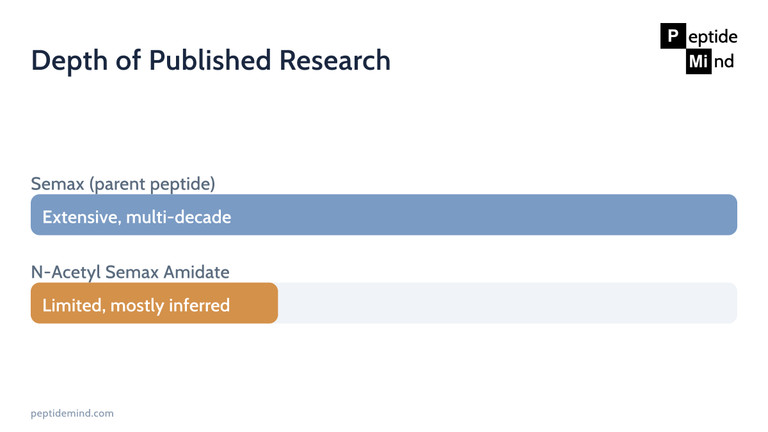
A second area of divergence is the depth of the evidence base itself. Semax has a multi-decade research record spanning neurotrophin signaling, ischemia models, and monoamine studies. N-Acetyl Semax Amidate, despite wide commercial availability, has far fewer dedicated peer-reviewed studies, so much of what is said about it is reasoned forward from Semax rather than independently established.
Research Dosages and Administration in Published Studies
Published preclinical studies of Semax have most often used intranasal administration in rodents, with the Dolotov BDNF work using a single 50 micrograms per kilogram application in rats. Other rodent studies have used comparable intranasal ranges to examine neurotrophin gene expression, as in a 2007 study on neurotrophin expression in rat brain. These figures describe what specific studies administered to animals; they are not recommendations, and no standardized human research dosing has been established for either Semax or N-Acetyl Semax Amidate.
Because N-Acetyl Semax Amidate is associated with greater proteolytic resistance, it is frequently described in research-chemical contexts as being studied at lower input quantities than the parent for an equivalent intact-peptide exposure. That relationship is inferred from its stability profile rather than from controlled comparative dosing studies. Researchers calculating working concentrations for either compound can use the Peptide Mind dosage calculator to convert vial size and diluent volume into concentration, and should confirm exact content against each product's certificate of analysis, since the two molecules differ in molecular weight.
N-Acetyl Semax Amidate vs Semax: Which Does the Research Support?
Neither molecule is "better" in a research sense; they suit different questions. Semax is the appropriate subject when the goal is to build on the established mechanistic literature, because the neurotrophin, ischemia, and monoamine findings were generated with the parent compound. N-Acetyl Semax Amidate is the appropriate subject when the research question is specifically about terminal modification and proteolytic stability, since that is the variable the analog changes. For studies that depend on the documented BDNF/TrkB mechanism, the parent Semax carries the stronger evidentiary foundation; for studies prioritizing metabolic stability of the molecule, the modified analog is the natural choice. As with any research peptide, the molecule and purity confirmed on a third-party certificate of analysis matter more than the marketing language attached to the vial. Researchers comparing options can review lab-tested Semax and N-Acetyl Semax Amidate at Protide Health.
Frequently Asked Questions
Is N-Acetyl Semax Amidate the same as Semax?
Not exactly. Both share the identical Met-Glu-His-Phe-Pro-Gly-Pro core sequence, so they are very closely related. N-Acetyl Semax Amidate adds an acetyl group at the N-terminus and an amide group at the C-terminus. Those terminal modifications do not change the active region of the peptide, but they are studied for increasing resistance to enzymatic breakdown in research models. In the scientific literature, the unmodified Semax is the far more extensively studied of the two.
Is N-Acetyl Semax Amidate stronger than Semax?
The common claim that it is "stronger" refers to proteolytic stability rather than intrinsic receptor activity. By capping both ends of the peptide, N-Acetyl Semax Amidate is designed to resist the enzymes that degrade Semax quickly, which in principle leaves more intact peptide available in a research model. This is a pharmacokinetic difference. The head-to-head comparative data directly measuring both molecules is limited, so claims of greater potency should be treated as preliminary.
What is the difference between Semax and N-Acetyl Semax Amidate structurally?
The difference is entirely at the two ends of an otherwise identical peptide. Semax has a free N-terminus and a free C-terminal carboxyl group. N-Acetyl Semax Amidate has an acetylated N-terminus and an amidated C-terminus. The seven-amino-acid core, including the Pro-Gly-Pro tail, is the same in both molecules.
What is the half-life of N-Acetyl Semax Amidate compared to Semax?
Shop research peptides
Live pricing from our top-rated vendor. Prices update as vendor listings change.
Unmodified Semax is cleared rapidly, with plasma persistence reported on the order of minutes in research models. N-Acetyl Semax Amidate is associated with longer stability because its terminal modifications block exopeptidase enzymes. Precise comparative half-life figures vary by source and model, and rigorous head-to-head pharmacokinetic studies are limited, so exact numbers should be interpreted cautiously.
Are Semax and N-Acetyl Semax Amidate approved for human use?
No. Both are research compounds intended for laboratory and preclinical investigation only. The studies discussed here were conducted in animal and cell-culture models, and findings from preclinical research may not translate to human outcomes.
References
Dolotov OV, Karpenko EA, Inozemtseva LS, et al. "Semax, an analog of ACTH(4-10) with cognitive effects, regulates BDNF and trkB expression in the rat hippocampus." Brain Research, 2006;1117(1):54-60. https://pubmed.ncbi.nlm.nih.gov/16996037/
Eremin KO, Kudrin VS, Saransaari P, et al. "Semax, an ACTH(4-10) analogue with nootropic properties, activates dopaminergic and serotoninergic brain systems in rodents." Neurochemical Research, 2005. https://pubmed.ncbi.nlm.nih.gov/16362768/
Stavchansky VV, Yuzhakov VV, Botsina AY, et al. "Semax and Pro-Gly-Pro activate the transcription of neurotrophins and their receptor genes after cerebral ischemia." Cellular and Molecular Neurobiology, 2010. https://pubmed.ncbi.nlm.nih.gov/19633950/
Agapova TY, Agniullin YV, Silachev DN, et al. "Neurotrophin gene expression in rat brain under the action of Semax, an analogue of ACTH 4-10." Neuroscience Letters, 2007. https://pubmed.ncbi.nlm.nih.gov/17353092/
van der Burgt YEM, Cobbaert CM, et al. "Differential stability of therapeutic peptides with different proteolytic cleavage sites in blood, plasma and serum." International Journal of Molecular Sciences, 2017. https://www.ncbi.nlm.nih.gov/pmc/articles/PMC5456363/
One Core Sequence, Two Stability Profiles
The N-Acetyl Semax Amidate vs Semax question comes down to chemistry at the ends of an identical peptide. Both molecules share the same Met-Glu-His-Phe-Pro-Gly-Pro core and the same proposed BDNF/TrkB mechanism, but N-Acetyl Semax Amidate adds N-terminal acetylation and C-terminal amidation to resist enzymatic breakdown, while the parent Semax carries the deeper and more replicated body of mechanistic research. For any rigorous study, the choice depends on whether the priority is the established evidence base or the modified molecule's stability profile, and the actual content confirmed by a certificate of analysis matters more than the label.
Research Disclaimer
The information presented in this article is for educational and research purposes only. Peptide Mind provides evidence-based research summaries and does not offer medical advice, diagnosis, or treatment recommendations. All peptides discussed are intended for in vitro and preclinical research use only. Consult a qualified healthcare professional before making any health-related decisions. The research cited may not reflect the full body of available evidence, and findings from preclinical studies may not translate to human outcomes. By accessing this site, you confirm you are over the age of 21, waive any claims or liability arising from the use of the content portrayed, and fully indemnify Peptide Mind against any unauthorized usage, claims, or liability in accordance with our Terms of Service.
Add a comment
This will be publicly visible.
Your email address will not be published.
Your comment will be reviewed by an admin before it is published.