Reviewed by the PeptideMind Team · Updated August 5, 2026
AICAR Peptide Dosage Guide, Benefits & Side Effects
AICAR peptide dosage guide: protocols, benefits, and side effects for bodybuilding and endurance use, with dosing charts backed by research data.
As seen on






AICAR Dosage Schedule
A daily research protocol exploring AMPK activation, the body's energy-sensing pathway, for glucose uptake and endurance support. Strictly for laboratory research, not approved for human use.
Five Week Metabolic Activation Protocol
5 weeks, focused on metabolic health.
Daily dosing
Taken daily.
3 mg per injection
3 mg per injection, given just under the skin in the abdomen or thigh.
AICAR is often called an exercise mimetic because it activates AMPK similarly to a workout. Researchers explore it for fat burning, glucose uptake, and endurance. It is not approved for human use and is sold strictly for research purposes.
What is AICAR?
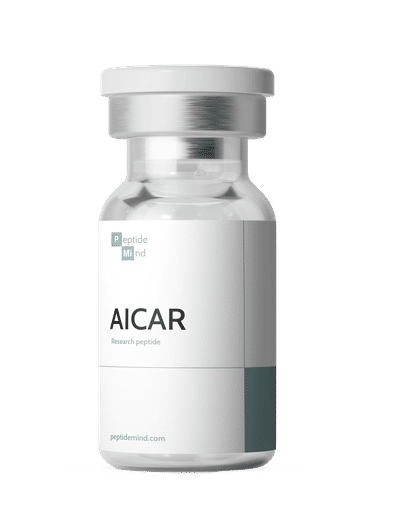
AICAR is a lab-made compound (not a true peptide) that makes your cells behave as if they're running low on energy, which switches on a key metabolic 'master switch' (AMPK). This has made it interesting for exercise science, metabolism research, and even heart protection; it was tested in a large human trial to protect the heart during bypass surgery. It isn't approved for any use and is banned in competitive sports because it can mimic the effects of training.
Performance
aic
Performance
Where to buy AICAR
Compare real-time AICAR prices from vendors with third-party lab testing (COA), purity, and legitimacy, so you know exactly who's trustworthy before you buy.
Dose size
1 of 5 vendors third-party tested, COA purity 99.83% across published labs. Prices re-checked 61 days ago.
What Does AICAR Do?
Once inside cells, it's converted into a molecule that tricks the cell into thinking its energy stores are low, which flips on AMPK, a master 'low-fuel' switch. That switch tells cells to burn more fat, pull in more sugar for fuel, and build new energy-producing mitochondria.
Mimics low energy
Converts inside cells into a molecule that looks like a low-fuel signal.
Activates AMPK
Flips on the body's master energy-sensing switch.
Shifts metabolism
Cells burn more fat, take in more sugar, and build new mitochondria.
AICAR Targeted areas
Frequently Asked Questions About AICAR
Straight answers on reconstitution, dosing, and safety, everything you need to research with confidence. For research reference only.
AICAR Reconstitution Guide
AICAR is supplied as a freeze-dried powder that must be mixed into a injectable solution before use. Available in 50mg sizes.
50 mg lyophilized vial
AICAR is supplied as a freeze-dried powder that must be mixed into a injectable solution before use. Available in 50mg sizes.
3 mL bacteriostatic water
Adding 3 mL of bac water to a 50 mg vial gives a workable concentration for syringe dosing. More water makes microdosing easier; less concentrates each draw.
Storage after mixing
The powder keeps in the freezer for up to three years, or in the fridge for up to three years if kept away from light. Once mixed with liquid, refrigerate it and use within about a month; extra portions can be frozen for a few months. After reconstitution, keep the vial refrigerated and use within 30 days.
Reconstitution steps
Remove caps & sanitize stoppers
Attach needle to syringe
Draw 3 mL bacteriostatic water
Insert needle into AICAR vial
Release water gently down the side
Swirl to dissolve — don't shake
Check for full dissolution
Refrigerate AICAR — good for 30 days
What Are the Benefits of AICAR?
What research says it may help with, and how it works in the body.
metabolic
Directly switches on the body's main metabolic control system (AMPK) by building up a molecule called ZMP.
Increases fat burning by activating the AMPK metabolic pathway.
Helps some tissues take in blood sugar without needing insulin.
performance
Studies in animals showed improved running endurance, though there isn't much research yet in humans.
Activating AMPK encourages cells to build new mitochondria (energy-producing parts) over time.
cardioprotection
First studied for its potential to protect heart tissue when blood flow to the heart is reduced.
What Are the Side Effects of AICAR?
Who should avoid it, warning signs to watch for, and what to know before combining it with other compounds.
Who Should Avoid It
Diabetes (risk of hypoglycemia)
Cardiac conditions
Pregnancy or breastfeeding
Competitive athletes (WADA prohibited)
Stop Right Away If You Notice
Severe hypoglycemia symptoms
Lactic acidosis symptoms (muscle pain, weakness, difficulty breathing)
Unusual cardiac symptoms
Severe fatigue or weakness
Milder Signs to Watch For
Is AICAR FDA approved?
AICAR is not an FDA-approved drug. It is intended for research purposes only and is not approved for human consumption, diagnostic, or therapeutic use.
Research Use Only
AICAR has not been evaluated by the FDA for safety or efficacy in humans.
No Clinical Oversight
Not manufactured under FDA-regulated quality or clinical standards.
Unregulated Sourcing
Purity, dosing, and sourcing are not verified through FDA testing or oversight.

AICAR Cycle Length: How Long Should It Last?
This breaks down how long a typical AICAR cycle runs and what research suggests happens at each stage. Research shows that staying on a peptide continuously, without a break, may make it less effective over time.
That's why most research protocols build in a break between cycles, often called a washout period, to let the body reset before starting again.
- Week 1-2
- Subtle changes in energy levels; body adjusting to AMPK activation
- Week 3-4
- Potential improvements in endurance capacity and metabolic markers
- Week 5-8
- Cumulative metabolic adaptations; enhanced fat oxidation
- Week 8-12
- Full effects on mitochondrial density and metabolic efficiency
AICAR Research References
It is a phase 3 compound
AICAR
AICAR is a phase 3 compound
Review of AMPK role in exercise-induced metabolic adaptations and AICAR as pharmacological activator.
2012
Mice treated with AICAR showed 44% increase in running endurance without training.
2008