How to Store Peptides: A Complete Guide for Researchers

Published at:

Learn how to store peptides properly, from lyophilized powder to reconstituted solutions. Covers storage temperatures, shelf life, and degradation prevention for researchers.

Updated at:

How to store peptides correctly is one of the most critical factors in maintaining peptide integrity for research applications. Improper storage conditions, including temperature fluctuations, moisture exposure, and light degradation, can compromise peptide structure within days, rendering research results unreliable. This guide covers storage requirements for lyophilized (freeze-dried) peptides, reconstituted peptide solutions, and long-term preservation strategies, supported by published stability data from peer-reviewed research.

How to Store Peptides: Temperature, Form, and Stability Overview

Reconstituted research peptides using bacteriostatic water should be used within 28 days.

Peptide storage requirements depend on two primary factors: the physical form of the peptide (lyophilized powder vs. reconstituted solution) and the intended duration of storage. Lyophilized peptides are significantly more stable than peptides in solution, and colder storage temperatures consistently extend shelf life across all peptide types.

The general principle is straightforward: keep peptides cold, dry, and dark. Published research from peptide manufacturers and academic laboratories converges on the same core recommendations. According to GenScript's peptide handling guidelines, lyophilized peptides stored at -20°C remain stable for several years, while reconstituted peptides in solution have a far shorter window of usability.

Storage Condition

Lyophilized Peptides

Reconstituted Peptides

Room temperature (20-25°C)

Days to weeks

Hours to days

Refrigerated (2-8°C)

Months

Approx 28 days (4 weeks)

Frozen (-20°C)

Years (3-5+)

N/A

Deep frozen (-80°C)

Decade+

N/A

These timelines are generalizations. The stability of each peptide is unique and depends on its amino acid sequence, with certain residues (cysteine, methionine, tryptophan, asparagine, glutamine) being more susceptible to degradation. Further research is needed to establish precise stability windows for individual peptide sequences under various conditions.

How to Store Lyophilized Peptides (not reconstituted)

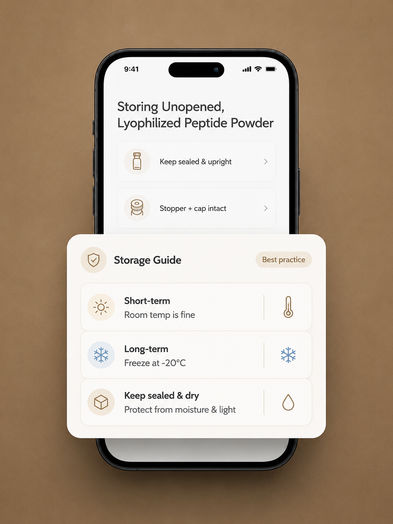
Lyophilized (freeze-dried) peptides represent the most stable form for long-term storage. The lyophilization process removes water from the peptide, dramatically reducing the chemical reactions that drive degradation. In this dried state, peptides are far less susceptible to hydrolysis, oxidation, and microbial contamination.

Three core peptide storage principles: keep cold, dry, and dark for stability

The recommended storage procedure for lyophilized peptides, as outlined by Bachem's handling guidelines, includes several key elements. Store lyophilized peptides at -20°C or colder in a sealed container. Include a desiccant packet in the storage container to absorb any residual moisture. Where possible, seal the container under an atmosphere of dry, inert gas such as nitrogen or argon to minimize oxidation.

Light exposure is another factor that warrants attention. In vitro characterization studies have shown that peptides containing tryptophan, tyrosine, or phenylalanine residues are particularly sensitive to photodegradation, though the rate of light-induced breakdown varies by sequence and concentration. Wrapping vials in aluminum foil or storing them in amber containers can reduce UV-induced breakdown. According to the NIBSC peptide storage reference, peptides should be stored in a dry, cool, dark place, with -20°C preferred for long-term preservation.

Research on solid-state stability of peptides has identified several degradation pathways that occur even in the lyophilized state. A review published in Advanced Drug Delivery Reviews documented that common solid-state degradation reactions include deamidation, peptide bond cleavage, oxidation, the Maillard reaction, beta-elimination, and dimerization. These reactions proceed much more slowly at reduced temperatures, which is why -20°C or -80°C storage is strongly recommended. These findings were observed across multiple peptide and protein formulations, and the rate of each degradation pathway varies by sequence and formulation.

According to data, many lyophilized peptides remain stable for 3 to 5 years at -20°C, with degradation minimal even after a decade at -80°C.

How to Store Peptides After Reconstitution

Reconstituted peptides, those dissolved in a solvent such as bacteriostatic water or sterile buffer, are substantially less stable than their lyophilized counterparts. Once in solution, peptides become vulnerable to hydrolysis, oxidation, aggregation, and microbial contamination. The shelf life of a reconstituted peptide is measured in days to weeks rather than years.

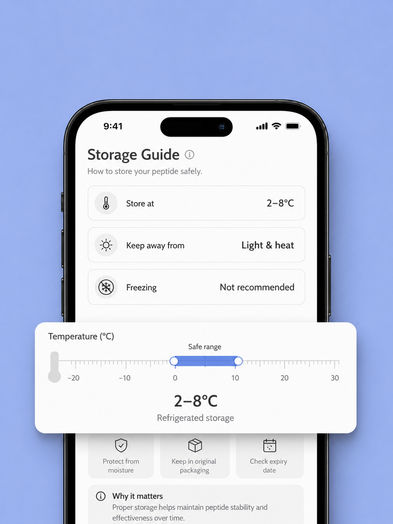
The primary guidelines for storing reconstituted peptides are consistent across the published literature. Store reconstituted peptides at 2-8°C (standard refrigerator temperature) for short-term use, typically within 2 to 4 weeks. For longer storage of reconstituted peptides, aliquot the solution into single-use portions and freeze at -20°C or colder. The Sigma-Aldrich handling guide recommends using sterile buffers at pH 5-6 and freezing aliquots to prolong storage life, with -20°C or colder as optimal.

The choice of reconstitution solvent also affects stability. Bacteriostatic water, which contains 0.9% benzyl alcohol as a preservative, allows for repeated withdrawals from a single vial for up to 28 days after the initial puncture. Standard sterile water, by contrast, should be used for single withdrawals only, as it lacks antimicrobial protection.

Reconstituted research peptides using bacteriostatic water should be used within 28 days.

The pH of the reconstitution buffer plays a measurable role in peptide degradation rates. Research published in the journal Pharmaceutical Research has demonstrated that degradation pathways in therapeutic peptides are pH-dependent, with deamidation accelerating under alkaline conditions and hydrolysis increasing at extreme pH values. These findings highlight the importance of selecting appropriate reconstitution buffers matched to each peptide's stability profile. While these studies examined specific therapeutic peptides, the underlying chemical mechanisms apply broadly across peptide sequences.

Peptide Degradation: What Causes Peptide Breakdown During Storage

Understanding the mechanisms of peptide degradation is essential for researchers who need to maintain sample integrity over extended periods. Peptides degrade through several distinct chemical pathways, each influenced by storage conditions in predictable ways.

Four peptide degradation pathways with triggers and vulnerable amino acid residues

Deamidation is one of the most common degradation pathways. It involves the nonenzymatic conversion of asparagine and glutamine residues to their corresponding acidic forms (aspartate and glutamate). This reaction proceeds faster at higher temperatures and alkaline pH. A comprehensive review in Pharmaceuticals documented that deamidation is a spontaneous, irreversible post-translational modification that can significantly alter peptide purity, bioactivity, and structural properties. These observations come from extensive in vitro characterization studies and may not fully represent degradation rates in all research contexts.

Oxidation primarily affects peptides containing methionine, cysteine, tryptophan, tyrosine, and histidine residues. Exposure to atmospheric oxygen, light, and metal ion contaminants accelerates oxidative degradation in laboratory settings. According to Sigma-Aldrich's peptide stability documentation, researchers should store oxidation-sensitive peptides under inert gas atmospheres and minimize exposure to light and air. The extent of oxidative damage varies significantly depending on the peptide's three-dimensional structure and solvent accessibility of vulnerable residues.

Hydrolysis involves the cleavage of peptide bonds by water molecules. This reaction is the primary reason reconstituted peptides degrade faster than lyophilized forms: the presence of water provides the substrate needed for hydrolytic reactions. Acidic conditions tend to accelerate hydrolysis at aspartate-proline bonds specifically.

Aggregation occurs when peptide molecules interact with each other, forming dimers, oligomers, or insoluble precipitates. Temperature fluctuations, particularly freeze-thaw cycles, are a significant driver of aggregation. Research has shown that repeated freeze-thaw cycles cause aggregation through multiple mechanisms, including protein adsorption to container surfaces and pH alterations from buffer crystallization during freezing. These findings were established in controlled laboratory studies examining protein behavior during thermal transitions.

Degradation Pathway

Primary Trigger

Vulnerable Residues

Prevention Strategy

Deamidation

Heat, alkaline pH

Asparagine, Glutamine

Store cold, use pH 5-6 buffers

Oxidation

O₂, light, metals

Methionine, Cysteine, Tryptophan

Inert gas, dark storage, metal-free containers

Hydrolysis

Water, acidic pH

Aspartate-Proline bonds

Minimize time in solution, freeze aliquots

Aggregation

Freeze-thaw cycles, agitation

Hydrophobic sequences

Aliquot before freezing, limit freeze-thaw to 3-5 cycles

Freeze-Thaw Cycles: Why Aliquoting Matters

Repeated freeze-thaw cycles are among the most damaging events for peptide stability. Each cycle subjects the peptide to mechanical stress from ice crystal formation, transient pH shifts as buffer components crystallize at different rates, and increased exposure to air-water interfaces where denaturation can occur.

The damage is often invisible. A peptide solution can appear clear and normal while containing a significant percentage of structurally compromised molecules. Research on protein freeze-thaw behavior indicates that slow freezing combined with fast thawing produces higher activity recovery, while fast freezing with slow thawing results in more severe structural damage. These observations were made in controlled laboratory settings using model proteins and may vary depending on specific peptide characteristics.

Most experienced researchers limit their peptides to no more than 3 to 5 freeze-thaw cycles. The practical solution is to aliquot reconstituted peptides into single-use portions immediately after reconstitution, before the first freeze. This approach means each portion is only frozen and thawed once, maximizing the integrity of every aliquot.

A study on the effects of freezing and thawing on protein stability found that slow freezing at approximately 1°C per minute combined with rapid thawing at rates exceeding 10°C per minute produced the highest activity recovery in protein samples. Source: PubMed

Aliquoting procedure for research applications:

  1. Reconstitute the lyophilized peptide with the appropriate solvent

  2. Calculate the volume needed per research session using the Peptide Mind dosage calculator

  3. Divide the total reconstituted volume into single-use aliquots using sterile, low-binding microcentrifuge tubes

  4. Label each tube with the peptide name, concentration, date, and aliquot number

  5. Flash-freeze aliquots by placing them in a -80°C freezer or on dry ice

  6. Transfer to -20°C for routine storage or keep at -80°C for long-term storage

  7. When needed, thaw one aliquot at a time in the refrigerator (2-8°C), not at room temperature

Peptide-Specific Storage Considerations

While the general storage principles apply across peptide types, certain peptide characteristics demand additional precautions. The amino acid composition of a peptide is the strongest predictor of its storage stability.

Cysteine-containing peptides are highly susceptible to oxidation, forming disulfide bonds that alter peptide structure in laboratory analyses. These peptides require strict oxygen exclusion during storage. Flushing vials with nitrogen or argon gas before sealing is particularly important for cysteine-rich sequences. The exact rate of cysteine oxidation depends on the surrounding amino acid environment and storage buffer composition.

Methionine-containing peptides undergo oxidation to methionine sulfoxide, which can alter biological activity in research assays according to in vitro characterization studies. Storage under inert gas with antioxidant additives (where compatible with the research application) can slow this process. The degree of activity change from methionine oxidation varies by peptide and should be assessed on a case-by-case basis.

Peptides with asparagine-glycine (Asn-Gly) sequences are especially prone to deamidation in solution, as the glycine residue's lack of a side chain facilitates the formation of a cyclic succinimide intermediate. This susceptibility has been documented in multiple in vitro stability studies. Researchers working with peptides containing Asn-Gly motifs should maintain acidic pH (5.0-6.0) during storage and minimize time in solution.

Large peptides (>25 amino acids) are generally more susceptible to aggregation than shorter sequences. For these peptides, adding carrier proteins such as 0.1% bovine serum albumin (BSA) to the storage buffer can reduce surface adsorption and aggregation. As noted by ProSpec Bio's stability documentation, adding a carrier protein (0.1% HSA or BSA) is recommended for long-term storage of reconstituted peptides.

For researchers working with BPC-157, one of the most widely studied research peptides, the BPC-157 research guide on Peptide Mind provides additional context on this peptide's research profile and handling considerations.

Practical Research Considerations for Peptide Storage

Beyond the chemistry of degradation, several practical factors affect peptide storage outcomes in real laboratory environments.

Container selection matters more than many researchers realize. Peptides can adsorb to glass and certain plastics, reducing the effective concentration in solution. Low-binding polypropylene microcentrifuge tubes are preferred over standard tubes for peptide storage. Siliconized glass vials also reduce surface adsorption. The container should be appropriately sized for the volume being stored, as excess headspace means more oxygen exposure.

Temperature monitoring is essential. A freezer that cycles between -15°C and -25°C provides a very different storage environment than one that maintains a steady -20°C. Researchers should verify that their storage equipment maintains consistent temperatures, particularly in shared-use freezers that are opened frequently.

Desiccation during storage of lyophilized peptides prevents moisture-driven degradation. Including silica gel packets or molecular sieve desiccants in the storage container creates a dry microenvironment that extends shelf life. After removing a portion of lyophilized peptide from the vial, the container should be resealed promptly under inert gas if available.

Shipping and transit represent a vulnerable period for peptide integrity. Lyophilized peptides shipped with cold packs or dry ice maintain better stability than those shipped at ambient temperature. When receiving peptide shipments, researchers should transfer vials to appropriate cold storage as quickly as possible. Researchers sourcing peptides from suppliers like Protide Health should inspect packaging upon arrival and confirm that cold chain integrity was maintained.

Record-keeping of storage conditions, reconstitution dates, freeze-thaw counts, and observed changes (turbidity, color shifts, precipitation) provides valuable data for troubleshooting research inconsistencies that may be storage-related rather than experimental.

Frequently Asked Questions

What is the recommended storage temperature for research peptides?

The recommended storage temperature depends on the form. Lyophilized peptides should be stored at -20°C or colder for long-term stability, with -80°C providing the greatest protection against degradation. Reconstituted peptides should be stored at 2-8°C for short-term use (up to 2-4 weeks) or aliquoted and frozen at -20°C for longer periods. Room temperature storage is acceptable for lyophilized peptides only for brief periods of days to weeks.

How long do lyophilized peptides remain stable?

Lyophilized peptides stored properly at -20°C can remain stable for 3 to 5 years, according to data from major peptide manufacturers including JPT Peptide Technologies and GenScript. At -80°C, stability extends further, with minimal degradation observed even after a decade in some cases. These timelines are based on manufacturer testing data and assume proper storage conditions: sealed containers, desiccant present, protection from light, and minimal temperature fluctuations. Actual shelf life varies by peptide sequence, and peptides containing oxidation-sensitive residues (cysteine, methionine, tryptophan) may have shorter effective shelf lives under the same conditions.

What conditions are recommended for reconstituted peptide storage?

Reconstituted peptides should be refrigerated at 2-8°C for immediate use within days to weeks. For longer-term storage, the solution should be divided into single-use aliquots and frozen at -20°C or -80°C. Using bacteriostatic water as the reconstitution solvent allows for repeated withdrawals from a single vial for up to 28 days. Avoid repeated freeze-thaw cycles by aliquoting before the first freeze. Sterile buffers at pH 5-6 generally provide better stability than pure water for most peptide sequences.

What causes peptide degradation during storage?

The four primary degradation pathways are deamidation, oxidation, hydrolysis, and aggregation. Deamidation is driven by heat and alkaline pH, affecting asparagine and glutamine residues. Oxidation results from exposure to oxygen, light, and metal ion contaminants, particularly affecting methionine and cysteine residues. Hydrolysis occurs when water cleaves peptide bonds, which is why reconstituted peptides degrade faster than lyophilized forms. Aggregation is accelerated by freeze-thaw cycles, agitation, and temperature fluctuations. Each pathway can be mitigated through appropriate storage conditions. These degradation mechanisms have been characterized primarily through in vitro stability studies, and the relative contribution of each pathway varies by peptide sequence.

How many freeze-thaw cycles can a peptide withstand?

Most researchers limit reconstituted peptides to 3 to 5 freeze-thaw cycles. However, damage from freeze-thaw is cumulative and often invisible, as a peptide solution can appear clear while containing structurally compromised molecules. The practical recommendation is to aliquot reconstituted peptides into single-use portions before the first freeze, ensuring each aliquot is thawed only once. Different peptide sequences have different tolerances, with shorter, simpler peptides generally more resilient than longer, more complex sequences.

Can peptides be stored at room temperature?

Lyophilized peptides can tolerate room temperature (20-25°C) for short periods of days to weeks without significant degradation, provided they are kept dry and away from light. This makes brief shipping and handling at ambient temperature acceptable for lyophilized forms. Reconstituted peptides, however, should not be stored at room temperature for more than a few hours, as degradation in solution proceeds much more rapidly. For any storage beyond immediate use, refrigeration or freezing is strongly recommended.

Research Disclaimer

The information presented in this article is for educational and research purposes only. Peptide Mind provides evidence-based research summaries and does not offer medical advice, diagnosis, or treatment recommendations. All peptides discussed are intended for in vitro and preclinical research use only. Consult a qualified healthcare professional before making any health-related decisions. The research cited may not reflect the full body of available evidence, and findings from preclinical studies may not translate to human outcomes.

References

  1. Manning, M.C. et al. "Stability of protein pharmaceuticals." Pharmaceutical Research, 6(11), 1989. PubMed

  2. Pace, C.N. et al. "Strategies for Improving Peptide Stability and Delivery." Molecules, 27(19), 2022. PubMed

  3. Akers, M.J. "Deamidation, Oxidation, and Other Modifications of Therapeutic Proteins." Pharmaceuticals, 2024. PMC

  4. Cao, E. et al. "Effect of freezing and thawing rates on denaturation of proteins in aqueous solutions." Biotechnology and Bioengineering, 82(6), 2003. PubMed

  5. GenScript. "Peptide Storage and Handling Guidelines." GenScript

  6. Bachem. "Handling and Storage Guidelines for Peptides." Bachem

  7. Sigma-Aldrich. "Handling and Storage Guidelines for Peptides and Proteins." Sigma-Aldrich

  8. NIBSC. "Peptide Handling, Dissolution & Storage." NIBSC

  9. JPT Peptide Technologies. "Peptide Stability: How Long Do Peptides Last?" JPT

The Future of Peptide Storage in Research Applications

How to store peptides effectively remains a foundational concern for any laboratory working with these compounds. The core principles, keeping peptides cold, dry, dark, and properly sealed, are well-established across the published literature and supported by decades of stability research. As peptide research continues to expand across fields from metabolic science to tissue biology, proper storage practices will become increasingly important for ensuring reproducible, reliable results. Peptide Mind's research profiles provide additional context on individual peptides and their research applications.

Add a comment

This will be publicly visible.

Your email address will not be published.

Your comment will be reviewed by an admin before it is published.