Peptide Therapeutics Market: Statistics & Market Size (2026)
Global peptide therapeutics market: roughly $50B-$141B in 2025-26 depending on scope, ~8% annual growth. Every estimate, GLP-1 sale, and FDA stat, fully sourced.

Key Peptide Therapy Statistics (2026)
The numbers below are the most-cited peptide market statistics for 2026, each one current, attributed to a named firm or company report, and written to stand on its own.
The global peptide therapeutics market was valued at $140.86 billion in 2025 and is projected to reach $294.58 billion by 2033, a compound annual growth rate of 8.73% (Grand View Research, 2025).
Narrower industry estimates put the 2025-2026 peptide therapeutics market closer to $50 billion: $52.59 billion (Precedence Research, 2025), $49.7 billion (Global Market Insights, 2025), and $49.68 billion (Mordor Intelligence, 2026).
Across all major firms, forecasts cluster at a 6% to 11% annual growth rate, fast enough for the market to roughly double within a decade (analyst consensus, 2025-2026).
Around 120 peptide drugs are on the market worldwide, more than 80 have regulatory approval, and over 170 peptides are in active clinical trials (Pharmaceuticals / MDPI, 2025).
Two molecules, semaglutide and tirzepatide, generated roughly $70 billion in combined 2025 sales, more than the entire narrow-scope peptide market (Novo Nordisk and Eli Lilly annual reports, 2025).
Tirzepatide (Mounjaro and Zepbound) brought Eli Lilly $36.5 billion in 2025, up from about $16.5 billion the year before (Eli Lilly, 2025).
Ozempic generated DKK 127.1 billion (about $18.7 billion) and Wegovy DKK 79.1 billion (about $11.6 billion) for Novo Nordisk in 2025 (Novo Nordisk Annual Report 2025).
North America holds the largest regional share of the peptide therapeutics market, estimated between 46% and 62% depending on the firm (Precedence Research; Grand View Research, 2025).
Injectable (parenteral) delivery accounts for about 84% of peptide therapeutic revenue, the dominant route of administration (Grand View Research, 2025).
Branded, innovator peptides represent roughly 69% to 80% of market value, with generics taking the rest (Global Market Insights, 2024; Grand View Research, 2025).
18% of US adults said they had used a GLP-1 drug as of late 2025, up from 12% in 2024; 12% were taking one at the time of the survey (KFF, 2025).
The FDA approved two new peptide drugs in 2024 among 50 novel approvals, part of 34 peptide approvals between 2016 and 2024 (Pharmaceuticals / MDPI, 2025).
The one number, and why it has a range
Ask "how big is the peptide therapeutics market?" and the honest answer is a range, not a point. For 2025 and 2026, credible firms land anywhere from about $50 billion to $141 billion, with the single most-cited figure, Grand View Research's $140.86 billion for 2025, sitting at the top of that band. The spread is almost threefold. It is not measurement error. It comes down to one decision each firm makes about what counts as a peptide therapeutic, and we walk through that below so you can pick the number that fits your context and cite it with confidence.
Growth is the part everyone agrees on. Whichever base they start from, analysts forecast the peptide therapeutics market to expand at roughly 6% to 11% a year through the early 2030s. That pace doubles the market inside a decade, and the engine behind it is no mystery: GLP-1 receptor agonists for diabetes and obesity.
How big is the peptide therapeutics market?
Depending on scope, the global peptide therapeutics market is worth between about $50 billion and $141 billion in 2025-2026. Here is what the major research firms actually publish, side by side. Every figure is the firm's own most recent estimate, linked to the source.
Research firm | Current market size | Forecast | By year | CAGR |
|---|---|---|---|---|
$140.86B (2025) | $294.58B | 2033 | 8.73% | |
$131.95B (2025) | $334.95B | 2034 | 10.91% | |
$88.7B (2025) | $200.9B | 2035 | ~8.5% (implied) | |
$52.59B (2025) | $87.21B | 2035 | 5.19% | |
$51.6B (2026) | ~$144B | 2036 | ~10.8% | |
$49.68B (2026) | $70.20B | 2031 | 7.16% | |
$46.4B (2024) | $100B | 2034 | 8.1% |
Note: base years range from 2024 to 2026 and forecast horizons from 2031 to 2036, so the headline figures are not strictly like-for-like. CAGR periods follow each firm's own report.
Peptide Mind's consolidated read: across the major firms, the global peptide therapeutics market sits at roughly $50 billion to $141 billion in 2025-2026, with a consensus growth rate near 8% a year. The estimates split into two camps, and the gap between them is driven almost entirely by scope.

Why the estimates disagree by almost 3x
The firms are not measuring different worlds. They are drawing the boundary in different places. Two questions decide which camp a forecast lands in.
First, do you count the GLP-1 metabolic blockbusters? Ozempic, Wegovy, Mounjaro, and Zepbound are peptides by chemistry. Folding their combined sales into the market lifts the 2025 total toward $130-141 billion, which is where Grand View Research and Fortune Business Insights sit. Leave the largest GLP-1 franchises out, or treat them as a separate metabolic category, and the "core" peptide therapeutics market falls back near $50 billion, where Precedence Research, Mordor Intelligence, Global Market Insights, and Future Market Insights cluster. Roots Analysis lands in the middle at $88.7 billion.
Second, do you count insulins and older peptide hormones? Some models include the full legacy peptide pharmacopeia; others focus on modern innovator drugs. That choice moves the base by tens of billions on its own.
The practical guidance for anyone citing a number: if you mean the broad market including the GLP-1 obesity and diabetes giants, use roughly $130-141 billion (2025). If you mean the core peptide therapeutics market excluding those franchises, use roughly $50 billion (2025-2026). State which one you mean, and the figure will hold up.
A short market-size timeline
The trend matters more than any single year. Tracking the narrower-scope definition over time shows the climb clearly: the peptide market was estimated near $41.4 billion in 2023, about $46.4 billion in 2024 (Global Market Insights), and roughly $50-53 billion across 2025-2026. The broad-scope definition, carried up by GLP-1 sales, reached about $132-141 billion in 2025. Two scopes, one direction. The line goes up either way, and it steepens right when semaglutide and tirzepatide volumes take off.
Market by segment: type, application, route, and synthesis
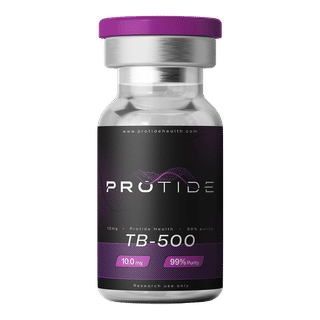
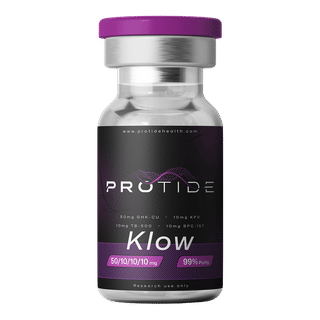
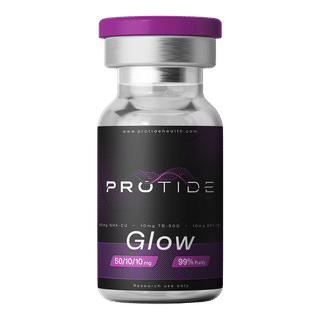
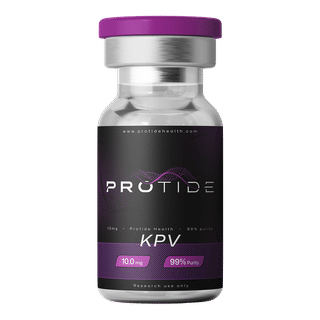
Shop research peptides
Live pricing from our top-rated vendor. Prices update as vendor listings change.
Branded, innovator peptides dominate value, injectables dominate delivery, and metabolic disease dominates demand. The segment splits are where the GLP-1 story shows up in the data.
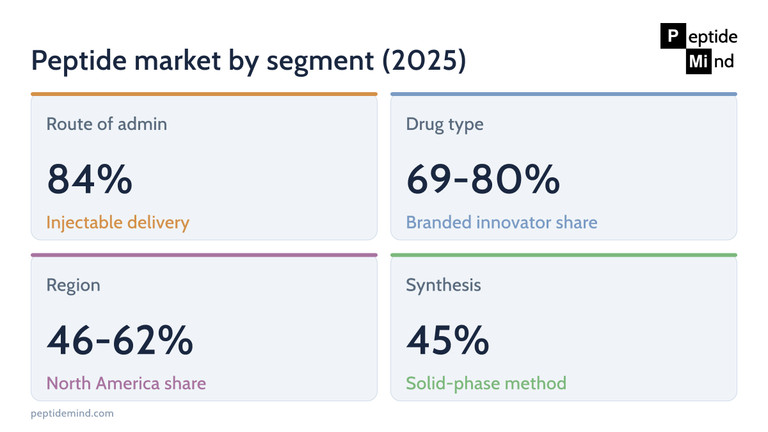
By type: Branded and innovator peptides account for roughly 69% to 80% of market value. Global Market Insights put the branded segment at 69.2% in 2024, while Grand View Research put the innovator segment at 80.08% in 2025. Generic and biosimilar peptides make up the remainder, a share set to grow as patents on older molecules expire.
By application: Metabolic and diabetes indications are the largest application area, pulled there by GLP-1 receptor agonists for type 2 diabetes and obesity. Oncology is the established second pillar, with cardiovascular and rare endocrine disorders rounding out the major categories.
By route of administration: Parenteral (injectable) delivery represented about 83.99% of the market in 2025 (Grand View Research). Oral peptides are the fast-growing minority, and the launch of an oral semaglutide pill in January 2026 is the clearest sign of where formulation work is heading.
By synthesis type: Solid-phase peptide synthesis held about 45.13% of production in 2025, while recombinant expression is the fastest-growing method at a double-digit CAGR (Mordor Intelligence).
Market by region
North America is the largest peptide therapeutics market, and Asia-Pacific is the fastest-growing. The regional share estimates vary with the same scope differences as the headline numbers, but the ranking is consistent across firms.
North America's share of the global market is estimated between about 38% and 62%, with Precedence Research at 45.96%, Grand View Research at 61.99%, and Mordor Intelligence at 38.34% for 2025. The gap reflects how much GLP-1 revenue, heavily concentrated in the United States, each firm pulls into the total. Asia-Pacific is the consensus growth leader, forecast to expand faster than any other region, with estimates running from about 6.2% (Precedence Research) to 12.8% (Mordor Intelligence) a year. Europe remains a solid second market by size.
GLP-1 and the flagship peptide drugs
Two GLP-1 molecules, semaglutide and tirzepatide, generated roughly $70 billion in combined 2025 sales. No other class comes close, and these drugs are the reason the broad-scope market sits where it does.
Eli Lilly's tirzepatide, sold as Mounjaro for diabetes and Zepbound for obesity, reached $36.5 billion in 2025, about 56% of the company's total revenue. Mounjaro alone brought in $22.97 billion (up 99% year over year) and Zepbound $13.54 billion (up 175%), per Eli Lilly's full-year 2025 results.
Novo Nordisk's semaglutide franchise is the other half of the story. In 2025, Ozempic generated DKK 127.1 billion (about $18.7 billion), Wegovy DKK 79.1 billion (about $11.6 billion), and the oral version Rybelsus DKK 22.1 billion (about $3.3 billion), per the Novo Nordisk Annual Report 2025. That is roughly $33-34 billion for semaglutide, on top of Lilly's $36.5 billion for tirzepatide.
Put the two franchises together and you reach about $70 billion from a single drug class in one year. For scale, that figure exceeds the entire narrow-scope peptide therapeutics market and equals roughly half of the broad-scope estimate. Novo Nordisk holds a 59.6% branded volume share of the global GLP-1 obesity market, and Global Market Insights estimated Novo's overall peptide market share above 17% in 2024, with the top five players (Novo Nordisk, Eli Lilly, Bristol-Myers Squibb, Ferring, and Merck) holding about 60% combined.
This is the same wave that has reshaped consumer demand for GLP-1 weight loss drugs and the broader category of peptides studied for fat loss, and it is why peptides are the most-watched drug class in pharma right now.

FDA-approved peptide drugs and the pipeline
Around 120 peptide drugs are on the market worldwide, with more than 80 holding regulatory approval and over 170 in active clinical trials. Peptides sit between small molecules and biologics, offering high target specificity with lower immunogenicity, and regulators have steadily added to the approved list.
A 2025 analysis in Pharmaceuticals counted around 120 peptide drugs on the market and 34 FDA peptide approvals between 2016 and 2024. In 2024, the FDA approved 50 novel drugs in total, of which two were new peptides. More than 170 peptide candidates are in active clinical development, and the next wave of obesity and metabolic candidates, including retatrutide, is already in late-stage trials. For a fuller picture of the science behind these molecules, see our guide to what peptides are used for.
A note on the count: published figures range from "more than 80 approved" to "around 120 on the market" because some tallies count only FDA approvals while others count drugs marketed anywhere in the world, and a few approved peptides have since been withdrawn. Either way, the pipeline is deeper than the approved list, which is what keeps the growth forecasts high.
Real-world adoption: how the market reaches people
18% of US adults said they had used a GLP-1 drug as of late 2025, up from 12% in 2024. Market size is one lens; actual use is another, and the adoption curve has bent sharply upward.
In its November 2025 health tracking poll, KFF found that nearly one in five adults (18%) had ever used a GLP-1 agonist, with 12% currently taking one. That is double the 6% who were current users in KFF's May 2024 survey. Use runs highest among people with diabetes (45% currently using), adults aged 50 to 64 (22%), and women (15% versus 9% for men). Among adults not yet taking a GLP-1, about 22% said they would be interested in one for weight loss, which points to further demand ahead even as affordability remains a barrier.
Shop research peptides
Live pricing from our top-rated vendor. Prices update as vendor listings change.
What is driving growth
The market's growth is concentrated, not broad-based, and four forces explain most of it.
The GLP-1 obesity wave. Demand for semaglutide and tirzepatide is the single largest driver, and competing candidates are racing toward approval.
Oral peptide delivery. Injectables still dominate, but the January 2026 launch of an oral semaglutide pill signals a formulation shift that could widen the patient base.
A deep pipeline. With over 170 peptides in clinical trials, the approved list will keep growing across metabolic disease, oncology, and rare conditions.
Manufacturing buildout. Capacity is the bottleneck. Novo Nordisk's 2025 capital expenditure ran near DKK 60 billion, and Eli Lilly has committed to multibillion-dollar new sites, both aimed squarely at peptide supply.
Headwinds are real too: lower realized prices, US pricing reform, and looming patent expirations on the semaglutide molecule in some markets are all expected to slow reported growth in 2026, even as patient volumes keep climbing.
Frequently asked questions
How big is the peptide therapeutics market?
The global peptide therapeutics market is worth roughly $50 billion to $141 billion in 2025-2026, depending on scope. The most-cited single figure is Grand View Research's $140.86 billion for 2025, which includes the GLP-1 metabolic blockbusters. Estimates that exclude those franchises cluster near $50 billion.
Is the peptide market growing?
Yes. Every major firm forecasts growth, with annual rates clustered between 6% and 11%. At that pace the market roughly doubles within a decade. GLP-1 receptor agonists for diabetes and obesity are the primary engine.
How many peptide drugs are FDA-approved?
More than 80 peptide drugs hold regulatory approval, and around 120 are on the market worldwide as of 2025. The FDA approved two new peptides in 2024, part of 34 peptide approvals between 2016 and 2024. Over 170 more peptides are in active clinical trials.
What is the fastest-growing peptide segment?
By application, metabolic and obesity peptides are growing fastest, led by GLP-1 drugs. By route, oral peptides are the fastest-growing delivery format off a small base. By region, Asia-Pacific is the fastest-growing geography.
What is the best-selling peptide drug?
By 2025 revenue, tirzepatide (sold as Mounjaro and Zepbound) led at $36.5 billion, ahead of Novo Nordisk's Ozempic at about $18.7 billion. Both are GLP-1 receptor agonist peptides.
Why do peptide market estimates vary so much?
The main reason is scope. Firms differ on whether to count the GLP-1 obesity and diabetes giants and older insulins as peptide therapeutics. Including them pushes the 2025 market toward $130-141 billion; excluding them brings it near $50 billion.
Sources and methodology
All figures were gathered and verified on June 14, 2026. Where a source published a figure older than about two years, we replaced it with the firm's most recent estimate. Market-size figures are each firm's own published number; where currencies were reported in Danish kroner, USD conversions are approximate at about 6.8 DKK per USD and labeled as such. Company drug-sales figures come directly from 2025 annual reports.
Grand View Research, Peptide Therapeutics Market: https://www.grandviewresearch.com/industry-analysis/peptide-therapeutics-market (accessed June 14, 2026)
Fortune Business Insights, Peptide Therapeutics Market: https://www.fortunebusinessinsights.com/industry-reports/peptide-therapeutics-market-101420 (accessed June 14, 2026)
Roots Analysis, Peptide Therapeutics Market: https://www.rootsanalysis.com/reports/peptid-therapeutics-market.html (accessed June 14, 2026)
Precedence Research, Peptide Therapeutics Market: https://www.precedenceresearch.com/peptide-therapeutics-market (accessed June 14, 2026)
Future Market Insights, Peptide Therapeutics Market: https://www.futuremarketinsights.com/reports/peptide-therapeutics-market (accessed June 14, 2026)
Mordor Intelligence, Peptide Therapeutics Market: https://www.mordorintelligence.com/industry-reports/peptide-therapeutics-market (accessed June 14, 2026)
Global Market Insights, Peptide Therapeutics Market: https://www.gminsights.com/industry-analysis/peptide-therapeutics-market (accessed June 14, 2026)
Eli Lilly, Fourth-Quarter and Full-Year 2025 Results: https://investor.lilly.com/news-releases/news-release-details/lilly-reports-fourth-quarter-2025-financial-results-and-provides (accessed June 14, 2026)
Novo Nordisk, Annual Report 2025 (Financial performance): https://annualreport.novonordisk.com/2025/strategic-aspirations/financial-performance.html (accessed June 14, 2026)
KFF, Health Tracking Poll on GLP-1 use, November 2025: https://www.kff.org/public-opinion/poll-1-in-8-adults-say-they-are-currently-taking-a-glp-1-drug-for-weight-loss-diabetes-or-another-condition-even-as-half-say-the-drugs-are-difficult-to-afford/ (accessed June 14, 2026)
KFF, Health Tracking Poll on GLP-1 use, May 2024: https://www.kff.org/health-costs/kff-health-tracking-poll-may-2024-the-publics-use-and-views-of-glp-1-drugs/ (accessed June 14, 2026)
Al Shaer et al., 2024 FDA TIDES Harvest, Pharmaceuticals (MDPI), 2025: https://www.mdpi.com/1424-8247/18/3/291 (accessed June 14, 2026)
Wang et al., Advances in peptide-based drug development, Signal Transduction and Targeted Therapy (Nature), 2024: https://www.nature.com/articles/s41392-024-02107-5 (accessed June 14, 2026)
Shop research peptides
Live pricing from our top-rated vendor. Prices update as vendor listings change.
Figures are presented as published by each source and are not investment advice. Market-research estimates reflect each firm's methodology and scope, which differ; we report them side by side rather than averaging across incompatible definitions.
How to cite this report
Peptide Mind Research Team. (2026). Peptide Therapeutics Market: Statistics & Market Size (2026): The Complete Data Report. Peptide Mind. https://peptidemind.com/peptide-therapeutics-market-statistics
You are welcome to cite or quote any statistic on this page with attribution and a link back to Peptide Mind.
Add a comment
This will be publicly visible.
Your email address will not be published.
Your comment will be reviewed by an admin before it is published.