How Long Is BAC Water Good For? (28-Day Shelf Life Guide)
BAC water lasts 28 days after opening, 2–3 years sealed. See fridge vs. room-temp storage, signs it's gone bad, and how long a mixed peptide vial lasts.
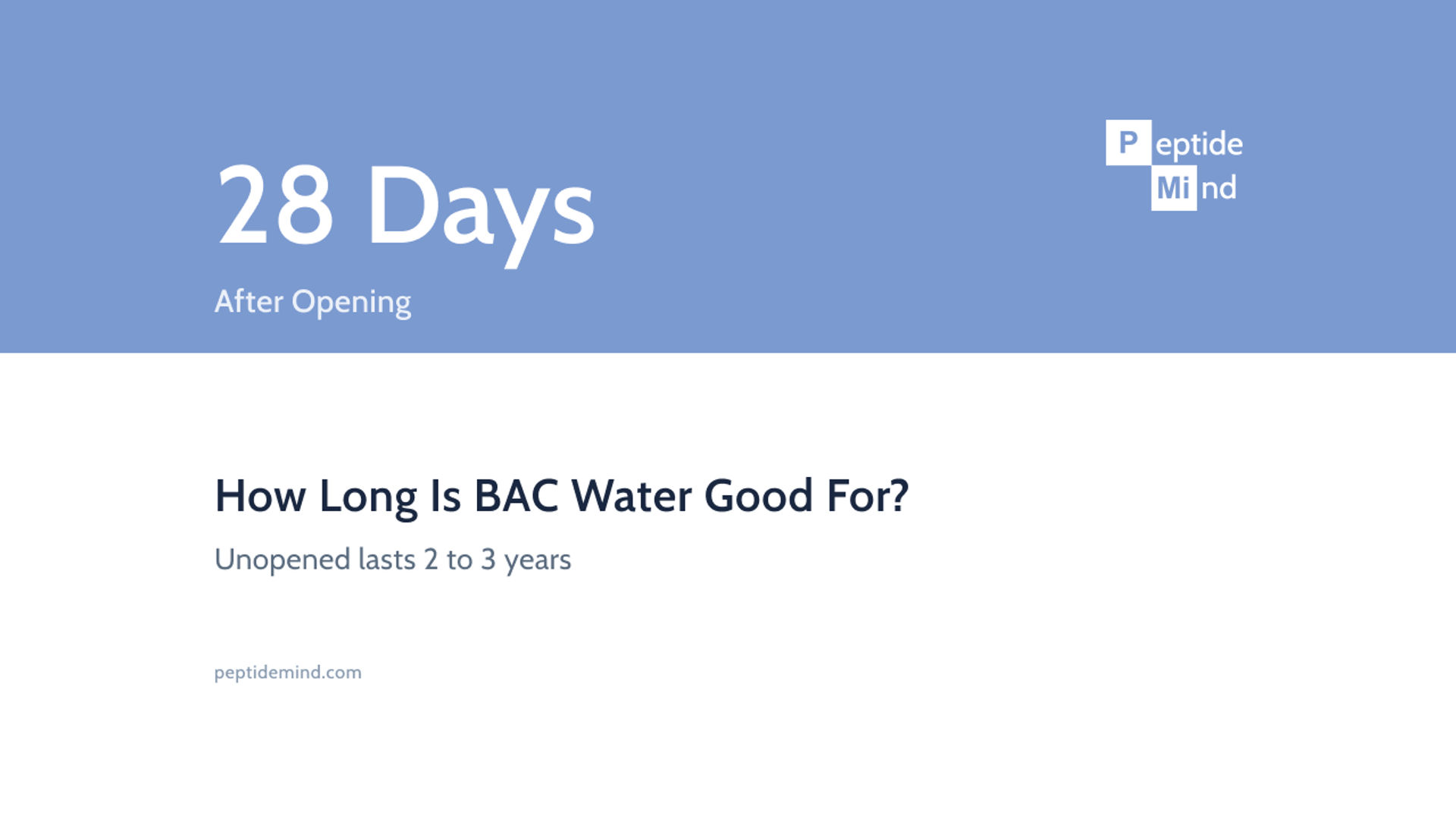

BAC water is good for 28 days once opened, and until the expiration date printed on the label while it stays sealed, typically 2 to 3 years from manufacture. The 28-day clock starts at the first puncture of the stopper, not at first real use. Refrigeration is optional at every stage, and putting the vial in the fridge does not extend that window.
The part that catches people out is mixing. A peptide reconstituted with BAC water gets the shorter of two windows: its own stability in solution, and the days left on the BAC water vial. Open a vial on the 1st, reconstitute a peptide on the 15th, and that solution is good for 14 days, not 28. The water's clock started at first puncture, and the mixed vial inherits whatever is left of it.
That is why the answer is rarely just 28. Below is the window for every situation the label and published guidance actually cover: sealed, opened, refrigerated, frozen, heat-exposed, reused and reconstituted, plus what the benzyl alcohol preservative does not protect against.

How Long Is BAC Water Good For? (Quick Answer)
Opened BAC water is good for 28 days from the first puncture. Unopened BAC water is good until the expiration date printed on the label, which is typically 2 to 3 years from the date it was manufactured.
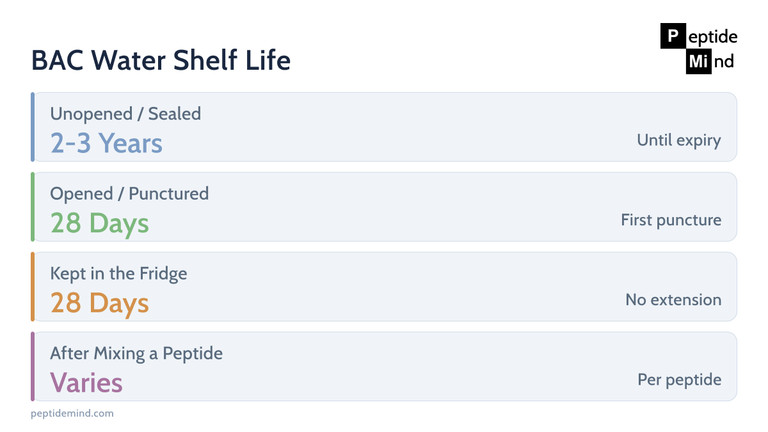
The table below covers every situation people actually run into.
Situation | How long it stays good | Where to keep it |
|---|---|---|
Sealed, never punctured | Until the printed expiration date, usually 2 to 3 years from manufacture | 20 to 25°C, out of direct light |
Opened, first puncture | 28 days from that puncture, and never past the printed expiry | Room temperature or fridge, either is acceptable |
Opened and refrigerated | Still 28 days. Cold storage does not extend the window | 2 to 8°C |
Opened and left at room temperature | 28 days | 20 to 25°C, out of direct light |
Frozen at any point | Discard. Freezing is not a supported storage condition | Not recommended |
Exposed to heat well above 30°C | Inspect closely, discard if the solution is not perfectly clear | Not recommended |
Seal or stopper damaged | Discard immediately, regardless of the date | Not applicable |
After mixing with a peptide | The shorter of the peptide's stability and the days left on the water vial | 2 to 8°C |
Two rules override everything in that table. The opened-vial window can never run past the printed expiration date, and any vial that stops looking perfectly clear gets discarded no matter what the calendar says.
What Is BAC Water, and What Is It Used For?
BAC water is sterile, nonpyrogenic water containing benzyl alcohol as a bacteriostatic preservative, supplied in a multiple-dose vial you can draw from repeatedly. The Hospira label lists the preservative at either 0.9% (9 mg/mL) or 1.1% (11 mg/mL) depending on the presentation, with a pH of 5.7 in a range of 4.5 to 7.0.
"Bacteriostatic" describes exactly what the benzyl alcohol does. It slows bacterial multiplication rather than killing organisms outright. That preservative is the entire reason you can open one vial, draw from it, and return to it over the following weeks instead of discarding it after a single use.
In research settings, BAC water is the diluent used to reconstitute freeze-dried peptides and other lyophilized compounds so they can be studied. Peptide Mind's guide to bacteriostatic water for peptides covers that use case in more depth. It is not interchangeable with plain sterile water, which contains no preservative and is packaged for single use.
Where the 28-Day Rule Actually Comes From
The 28-day figure does not come from the bacteriostatic water label. It comes from United States Pharmacopeia General Chapter 797, which sets a default beyond-use date for opened multi-dose vials of any kind. CDC summarizes that guidance directly in its injection safety recommendations:
"Once a multi-dose vial is opened (e.g., needle-punctured) the vial should be dated and discarded within 28 days unless the manufacturer states another date for that opened vial. The beyond-use-date should never exceed the manufacturer's original expiration date."
Does the Hospira label say 28 days?
The Hospira and Pfizer prescribing label contains no 28-day statement at all. It gives you the composition, the storage temperature ("Store at 20 to 25°C") and the visual standard ("Do not use unless the solution is clear and seal intact"). The 28 days comes from USP and CDC, applied to the whole multi-dose vial category. So it is not a measurement of how long benzyl alcohol stays effective. It is a conservative default.
So the correct sourcing is layered. The label gives you the composition, the storage temperature and the visual standard. USP 797 and CDC give you the 28-day opened-vial window.
Shop research peptides
Live pricing from our top-rated vendor. Prices update as vendor listings change.
What happens if you use BAC water after 28 days?
Nothing detectable happens on day 29, which is exactly why the question keeps getting asked. The 28-day mark is not a chemical cliff, and a vial punctured twice with good technique is not meaningfully different on day 30 than on day 27.
What changes is accumulated risk and your ability to justify the vial. Every puncture is an opportunity for organisms to enter, and the preservative limits growth rather than undoing a contamination event. Past 28 days you have no published standard to point to, only a guess. That is the honest answer to the argument you will find in forum threads: the rule is conservative and administrative rather than empirical, and it is still the number to use, because the alternative is having no number at all.
Does BAC Water Need to Be Refrigerated?
No. BAC water does not need to be refrigerated, before or after opening. The label specifies storage at 20 to 25°C (68 to 77°F), which is USP Controlled Room Temperature. A cupboard or drawer away from direct sunlight meets that requirement.

Does unopened BAC water need to be refrigerated?
No. A sealed vial belongs at room temperature until you open it. Refrigerating it gains you nothing and introduces condensation on the stopper and label.
Does BAC water need to be refrigerated after opening?
No, and this is the answer most people are surprised by. An opened vial stays in the same 20 to 25°C range. USP Controlled Room Temperature also permits brief excursions between 15 and 30°C, so a slightly warm or cool room is not a problem.
Can you refrigerate BAC water even though you do not have to?
Yes, refrigerating an opened vial at 2 to 8°C is acceptable and will not damage it. It simply buys you nothing on the calendar. Pick one location and stay with it, because moving a vial in and out of the fridge creates condensation on the stopper, and a wet stopper is harder to disinfect properly.
How Long Does BAC Water Last in the Fridge?
Opened BAC water lasts 28 days in the fridge, the same as it lasts at room temperature. The limit is not driven by temperature at all. It is set by how many times the container has been entered, which is why cold storage does not move it. An unopened vial in the fridge is likewise still governed by its printed expiration date.
How Long Is BAC Water Good For After Opening?
BAC water is good for 28 days after opening, counted from the first puncture of the rubber stopper. The clock starts at first entry, not at first meaningful use. A vial you punctured once in January and forgot about is expired by February, even if it looks untouched and is still nearly full. Volume remaining has no bearing on it.
The habit that solves this is writing the puncture date directly on the vial the first time you enter it. An undated opened vial is an unusable vial, because you cannot establish where it sits in the window.
CDC flags one specific mistake here. Do not leave a needle inserted in the stopper between uses, because this "creates a direct route for microorganisms to enter the vial and contaminate the fluid."
How Long Is Unopened BAC Water Good For? Does It Expire?
An unopened vial of BAC water is good until the expiration date printed on the label, typically 2 to 3 years from the manufacturing date. Yes, BAC water expires, and the printed date is the only date that governs a sealed vial.
Shop research peptides
Live pricing from our top-rated vendor. Prices update as vendor listings change.
That date assumes the vial stayed sealed and stayed within its labeled storage range. Once it passes, replace the vial rather than opening it. Check the date on arrival rather than on the day you plan to use it, so a vial with only a few months left does not surprise you later.
Room Temperature, Heat and Freezing
Room temperature is the correct storage condition for BAC water. Heat and freezing are not, and both can end a vial's usable life well before its printed date.
Can you freeze BAC water?
No, freezing BAC water is not recommended. Water expands as it freezes, which stresses the seal and the container, and any compromise to the seal ends the vial regardless of how the water looks afterward. If a vial has frozen accidentally, discard it.
What happens if BAC water gets hot?
Brief warmth within the USP excursion range of 15 to 30°C is fine. Sustained heat above that is not. A vial left in a hot car has been outside its labeled conditions, and you cannot assess from the outside what that did to the seal. Inspect it against the label standard: clear solution, intact seal. If it passes but you know it spent a day above 30°C, replacing it is the cheaper decision.
Does BAC Water Go Bad? Signs to Discard the Vial
Yes, BAC water goes bad, and the label sets a clear visual standard: "Do not use unless the solution is clear and seal intact." Properly stored BAC water is perfectly clear and completely colorless. Anything else means discard.

Cloudiness or haze. The single most common warning sign. Clear water turning milky or hazy points to microbial growth or a compatibility problem.
Floating particles or specks. Any visible material, fibers, flecks or debris, means the vial is done.
Color change. The solution should be colorless. Yellow, pink or any tint at all is a discard signal.
Precipitate at the bottom. Solid material settling out indicates something has come out of solution.
Damaged or lifted seal, or a compromised stopper. This fails the label standard directly, independent of how the liquid looks.
Past 28 days open, or past the printed expiry. Time alone is sufficient reason.
The uncomfortable part is that visual inspection catches only the obvious failures. Bacterial contamination at low levels is invisible in a clear solution. That is why the date rule exists alongside the visual check rather than instead of it.
What the Benzyl Alcohol Preservative Actually Does, and Does Not Do
Benzyl alcohol is bacteriostatic, not bactericidal. It slows bacterial growth inside the vial. It does not sterilize the vial, and it does not kill everything that enters. That distinction is the reason bacteriostatic water has a beyond-use date at all.
CDC is direct about the limits of preservatives in multi-dose vials:
"The preservative does not have an effect on viruses nor does it provide complete protection against bacterial contamination."
Some organisms are considerably harder to control than others. The Burkholderia cepacia complex is the documented example, a group of water-borne species with intrinsic resistance to preservatives and antiseptics. The practical implication is straightforward. The preservative is a safety margin on top of good technique, not a substitute for it. Swab the stopper every time, use a new needle every time, and do not treat the benzyl alcohol as a reason to be relaxed about either.
Can You Use the Same BAC Water Vial More Than Once?
Yes. Repeated withdrawals are the entire reason bacteriostatic water exists. The Hospira label calls it "a multiple-dose container from which repeated withdrawals may be made" and instructs users to "use aseptic technique for single or multiple entry."
There is no limit on the number of withdrawals. The limit is the calendar and the condition of the vial.
Shop research peptides
Live pricing from our top-rated vendor. Prices update as vendor listings change.
How Long Do Peptides Last After Mixing With BAC Water?
A reconstituted peptide runs on two clocks at once, and the shorter one always wins. One is the peptide's stability in solution. The other is the time left on the BAC water vial you drew from, because that vial's 28-day window started when you first punctured it, not when you mixed.
The mixed vial inherits the water's remaining days
Open a vial of BAC water on day 0, reconstitute a peptide on day 14, and that peptide solution gets 14 days, not 28. The water you draw carries whatever accumulated risk its parent vial holds at that moment. Moving it into a new container does not reset it.
This is standard beyond-use dating practice. As the American Society of Health-System Pharmacists puts it in its guide to assigning beyond-use dates:
"Ultimately the assigned BUD should default to the more conservative dating after an assessment of sterility and stability."
Stability is the peptide chemistry. Sterility is the water. Assess both, take the lower number.
BAC water first punctured | Peptide reconstituted | Days left on the mixed vial |
|---|---|---|
Day 0, fresh vial | Day 0 | Up to 28 |
Day 0 | Day 7 | 21 |
Day 0 | Day 14 | 14 |
Day 0 | Day 21 | 7 |
Day 0 | Day 28 | None. Open a new BAC water vial |
So if you want a full window on a reconstituted peptide, mix from a freshly opened vial. Drawing from a vial that has been sitting open for three weeks is the most common way people quietly cut a peptide's usable life to a few days without noticing. It is also the best argument for buying smaller BAC water vials rather than one large one, since a 10 mL vial opened fresh for each mix beats a 30 mL vial slowly running down its clock in a drawer.
Worth knowing: the benzyl alcohol itself does not wear off, and preservative concentration holds steady well beyond 28 days. What accumulates is entry history, and that is what the mixed vial inherits.
What controls the stability half
Peptides break down in water in ways they never do as a dry powder. Water slowly cleaves the peptide chain, oxygen and light attack vulnerable amino acids, and molecules clump together. A lyophilized peptide can hold up for years as a powder and lose real potency in weeks once it is in solution.
Factor | Why it matters | What to do |
|---|---|---|
Temperature | Degradation speeds up sharply with heat | Refrigerate the mixed vial at 2 to 8°C |
Light | Accelerates oxidative damage | Keep the vial in a box or opaque container |
The peptide itself | Some sequences are simply more fragile | Follow compound-specific guidance over generic rules |
Preservative | Benzyl alcohol limits microbial growth in the mixed vial | Sterile water gives a shorter window than BAC water |
Agitation | Shaking causes clumping and damage | Swirl gently, never shake |
A short healing peptide such as BPC-157 and a long metabolic sequence such as GLP-3 do not behave the same way in solution, and treating them as if they do is how people end up with a vial that looks fine and no longer works.
The Hospira label declines to assign the mixed vial any window at all: "Do not store reconstituted solutions of drugs for injection unless otherwise directed by the manufacturer of the solute." That is the manufacturer saying the water's dating does not transfer, which is exactly why you assess both clocks yourself.
Peptide Mind's guide to storing peptides covers the handling side, and the reconstitution guide walks through the process end to end. For working out concentration before you mix, the peptide dosage calculator handles the math.
Does BAC water need to be cold before reconstituting?
No. BAC water should be at room temperature when you reconstitute a peptide, not chilled. Room-temperature liquid dissolves lyophilized material more readily. What matters more is how the water goes in: aim the stream at the glass wall and let it run down the side rather than firing it onto the powder, then swirl gently until dissolved.
BAC Water vs Sterile Water: Which One and When

Shop research peptides
Live pricing from our top-rated vendor. Prices update as vendor listings change.
The difference is one ingredient. BAC water contains benzyl alcohol as a preservative; sterile water for injection contains none. That single difference determines whether the vial supports repeated entries.
Feature | Bacteriostatic water | Sterile water for injection |
|---|---|---|
Preservative | 0.9% or 1.1% benzyl alcohol | None |
Container class | Multiple-dose, repeated withdrawals | Single-dose, discard after first use |
Opened-vial window | 28 days from first puncture | Use immediately, do not retain |
Typical use case | Multi-use reconstitution over weeks | Single preparation, or where preservative is contraindicated |
Sterile water is not a worse product, it is a different one. For a vial you intend to draw from repeatedly across several weeks, bacteriostatic water for peptides is the format built for that pattern.
Does the Brand Matter? Hospira, Pfizer and Generics
No. The shelf life rules are identical across brands, because they come from the product class rather than from any individual manufacturer. Hospira, now part of Pfizer, is simply the most widely referenced label in the United States.
The one detail that varies is preservative concentration, listed at 9 mg/mL in the 30 mL vial and 11 mg/mL in the 20 mL vial. Neither changes the 28-day window or the storage temperature. If a vendor's product page contradicts the label, trust the vial.
How to Store BAC Water: Step by Step
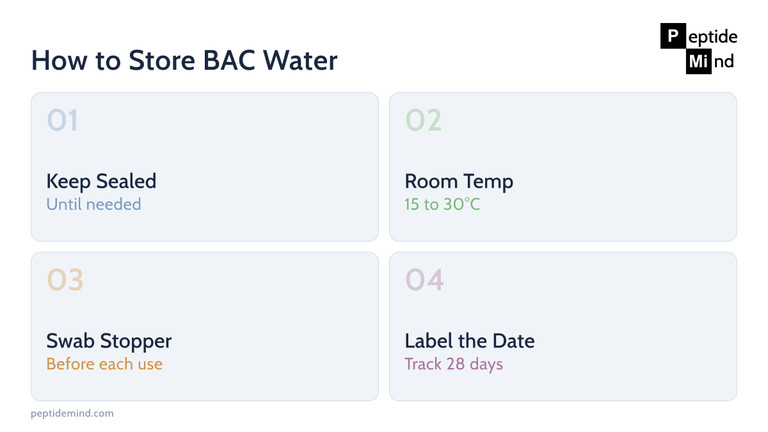
Keep it sealed until you need it. An unopened vial has the longest possible window. Do not pre-open a vial you are not about to use.
Store at 20 to 25°C, out of direct light. A drawer or cupboard is ideal. Not the windowsill, not the car, not the freezer.
Write the puncture date on the vial the first time you enter it. This is the single habit that makes the 28-day rule usable.
Swab the rubber stopper with alcohol before every entry and let it dry. A wet stopper has not been disinfected.
Use a fresh sterile needle for every withdrawal. Never leave a needle parked in the stopper between uses.
Inspect before each use. Clear solution, intact seal, date within window. Any failure means discard.
When in doubt, discard. A replacement vial costs a fraction of what a contaminated preparation costs you.
Frequently Asked Questions
How do I know if BAC water is bad?
Hold the vial up to good light and check three things: the solution must be completely clear and colorless, the seal and stopper must be undamaged, and the vial must be within 28 days of its first puncture and inside its printed expiry. Failing any one means discard it. Low-level contamination is invisible, so the date rule matters even when a vial looks perfect.
Can bacteria grow in bacteriostatic water?
Yes, under the wrong conditions. Benzyl alcohol is bacteriostatic rather than bactericidal, so it inhibits bacterial multiplication rather than killing organisms. CDC states the preservative "does not provide complete protection against bacterial contamination." Some water-borne organisms, notably the Burkholderia cepacia complex, resist preservatives outright. Aseptic technique and the 28-day limit exist precisely because the preservative alone is not sufficient.
If I reconstitute a peptide with an already-opened vial, how long does it last?
Only as long as the water vial has left. The 28-day window starts at the water vial's first puncture, not when you mix. Reconstitute on day 14 of a vial's life and the peptide solution is capped at 14 days, even if the peptide would otherwise stay stable longer. To get a full window, mix from a freshly opened vial.
Can I use unrefrigerated BAC water?
Yes. Room temperature is the labeled storage condition, not a compromise. The Hospira label specifies 20 to 25°C, with brief excursions between 15 and 30°C permitted. A vial that has never been refrigerated is stored correctly.
How long is BAC water good for at room temperature?
Sealed at room temperature, until the printed expiration date. Opened at room temperature, 28 days from the first puncture. Leaving the vial on a shelf gives you exactly the same window as refrigerating it.
Shop research peptides
Live pricing from our top-rated vendor. Prices update as vendor listings change.
What does Reddit say about how long BAC water lasts?
Forum threads generally land on the same 28-day figure, though the recurring argument is whether that number is real or arbitrary. The debate is more reasonable than it looks: the 28 days is not printed on the label, it is the default beyond-use date USP General Chapter 797 assigns to any opened multi-dose vial. It is an administrative standard rather than a measured expiry, and still the best number available.
Does bacteriostatic water go bad?
Yes. Sealed vials expire on the printed date, usually 2 to 3 years from manufacture. Opened vials get 28 days from the first puncture, and that date can never run past the printed expiry. Any vial that turns cloudy or particulate, or whose seal is compromised, is bad regardless of the calendar.
Does BAC have to be refrigerated?
No. Neither sealed nor opened BAC water requires refrigeration. You may refrigerate an opened vial at 2 to 8°C if you prefer, but it does not extend the 28-day window.
Can I use BAC water after 28 days?
It is not recommended. Past that point you have no published standard supporting the vial, only the assumption that nothing went wrong across every prior entry. Replace it.
How long is a vial of BAC water good for once punctured?
28 days from that first puncture, whether the vial sits at room temperature or in the fridge, and regardless of how much liquid remains. The clock is driven by container entry, not by volume used.
Is BAC water still good after the expiration date?
No. Once a sealed vial passes its printed expiration date, replace it. Sterility and preservative concentration are only warranted up to that date.
What to Remember About BAC Water Shelf Life
Three numbers cover almost every situation. A sealed vial is good until its printed date, usually 2 to 3 years out. An opened vial is good for 28 days from the first puncture. And a peptide reconstituted with that water gets the shorter of its own stability and whatever days the water vial has left, which is why mixing from a freshly opened vial matters more than most people realize.
The refrigerator is the piece people consistently get wrong: optional, harmless, and irrelevant to the timeline. What actually decides whether a vial stays good is technique. A date written on the label, a swabbed stopper, a fresh needle every time, and a willingness to discard anything that is not perfectly clear. The benzyl alcohol buys you a margin, not a pass. If you are setting up a workflow around repeated withdrawals, start with a vial you can verify, such as research-grade bacteriostatic water, and date it the moment you open it.
References
Hospira, Inc. (Pfizer). Bacteriostatic Water for Injection, USP prescribing information. Revised November 2019.
DailyMed, U.S. National Library of Medicine. Bacteriostatic Water injection, solution (Hospira, Inc.).
Centers for Disease Control and Prevention. Preventing Unsafe Injection Practices. Reviewed March 2024.
United States Pharmacopeia. General Chapter 797, Pharmaceutical Compounding, Sterile Preparations.
Tavares M, Kozak M, Balola A, Sá-Correia I. Burkholderia cepacia Complex Bacteria: a Feared Contamination Risk in Water-Based Pharmaceutical Products. Clinical Microbiology Reviews, 2020.
Sigma-Aldrich. Peptide Stability and Potential Degradation Pathways.
StatPearls, NCBI Bookshelf. Benzyl Alcohol.
American Society of Health-System Pharmacists. The Pharmacist Guide to Assigning a Beyond-Use Date to a Compounded Sterile or Nonsterile Preparation (PDF).
United States Pharmacopeia. USP Compounding Standards and Beyond-Use Dates (BUDs) (PDF).
Disclaimer: The information provided on Peptide Mind is for educational purposes only and is not a substitute for professional medical advice. Peptides discussed are unapproved research chemicals intended for laboratory use only. These statements have not been evaluated by the FDA and are not intended to diagnose, treat, cure, or prevent any disease. By using this site, you confirm you are 21+, waive related claims, and agree to our Terms of Service.
Add a comment
This will be publicly visible.
Your email address will not be published.
Your comment will be reviewed by an admin before it is published.