Weight
GLP-1
Metabolic
31
Amino acids
Molecular weight
Peptide
Type
Semaglutide is a GLP-1 receptor agonist approved under the trade names Ozempic, Wegovy, and Rybelsus for the treatment of type 2 diabetes and chronic weight management. It mimics endogenous glucagon-like peptide-1 to suppress appetite, slow gastric emptying, and stimulate glucose-dependent insulin secretion. It is widely used in clinical settings and has demonstrated significant cardiovascular and metabolic benefits in large-scale trials.
Top researched benefits
Overview of GLP-1
Semaglutide binds and activates the GLP-1 receptor (GLP1R), a G-protein-coupled receptor expressed in the pancreas, brain, and gastrointestinal tract. Receptor activation stimulates glucose-dependent insulin secretion, suppresses glucagon release, slows gastric emptying, and acts on hypothalamic appetite centers to reduce caloric intake.
weight loss
- FDA-approved for chronic weight management with average 15-20% body weight loss in clinical trials.
- Reduces hunger and food cravings through central nervous system GLP-1 receptor activation.
- Long-term studies show maintained weight loss with continued treatment over 2+ years.
diabetes
- FDA-approved for type 2 diabetes with HbA1c reductions of 1.5-2% in clinical trials.
- Proven 26% reduction in cardiovascular death, MI, or stroke in high-risk diabetes patients.
- Improves insulin secretion and may preserve pancreatic beta cell function.
metabolic
- Addresses multiple components: weight, glucose, blood pressure, and lipids.
- Emerging evidence for improvements in non-alcoholic fatty liver disease.
- Decreases systemic inflammation markers independent of weight loss.
Typical Dose
0.25mg starting dose, escalating to 2.4mg maintenance
Frequency
once weekly subcutaneous injection
Cycle Duration
Escalate by 0.25–0.5mg every 4 weeks; long-term continuous use for weight management
Storage
Lyophilized/powder: store desiccated at -18°C or below for long-term; stable at 2–8°C up to 36 months. Reconstituted: refrigerate at 2–8°C for up to 28–30 days. Pre-filled pens (Ozempic/Wegovy): store at 2–8°C before first use; after first use, keep at room temperature (up to 30°C) or refrigerated for up to 56 days.
Chemical Makeup
Key benefits
Produces average body weight reductions of 10–15% over 68 weeks in adults with obesity, with 54% of patients achieving at least 15% total body weight loss
Reduces major adverse cardiovascular events (MACE) by 20% in adults with overweight/obesity and pre-existing cardiovascular disease (SELECT trial, n=17,604)
Lowers HbA1c by up to 2 percentage points on average in type 2 diabetes, improving glycemic control beyond most comparator agents
Improves physical function and reduces pain in obesity-related knee osteoarthritis, with a 41.5-point improvement in WOMAC physical function score versus 26.7 for placebo
Community interest
This peptide is still gaining traction in the community.
GLP-1 Receptor Agonist | Weight Loss & Diabetes
This overview is informational and based on aggregated descriptions from studies and user reports.
Was it helpful?YesNoGLP-1 Molecular Information
View the scientifc details of GLP-1.
31
Amino Acids
GLP-1
His
His
Position 1
Sec
Sec
Position 2
Glu
Glu
Position 3
Gly
Gly
Position 4
Thr
Thr
Position 5
Phe
Phe
Position 6
Thr
Thr
Position 7
Ser
Ser
Position 8
Asp
Asp
Position 9
Val
Val
Position 10
Ser
Ser
Position 11
Ser
Ser
Position 12
Tyr
Tyr
Position 13
Leu
Leu
Position 14
Glu
Glu
Position 15
Gly
Gly
Position 16
Gln
Gln
Position 17
Ala
Ala
Position 18
Ala
Ala
Position 19
Lys
Lys
Position 20
Glu
Glu
Position 21
Phe
Phe
Position 22
Ile
Ile
Position 23
Ala
Ala
Position 24
Trp
Trp
Position 25
Leu
Leu
Position 26
Val
Val
Position 27
Arg
Arg
Position 28
Gly
Gly
Position 29
Arg
Arg
Position 30
Gly
Gly
Position 31
Molecular Weight
4113.641DaChain Length
31Amino AcidsType
PeptideGLP-1 Protocols
Subcutaneous injection is the primary route for semaglutide, achieving 89–100% bioavailability compared to approximately 1% for the oral formulation. Injections are administered once weekly into the abdomen, thigh, or upper arm, rotating sites each week to avoid lipohypertrophy.
| Goal | Dosage | Frequency | Route |
|---|---|---|---|
| Initial dose to establish GLP-1 receptor tolerance and minimize GI side effects | 0.25 | 1 week range | SubQ |
| Dose escalation after 4 weeks at 0.25 mg to improve tolerability and begin therapeutic effect | 0.5 | 1 week range | SubQ |
| Continued dose escalation after 4 weeks at 0.5 mg toward target maintenance dose | 1 | 1 week range | SubQ |
| Penultimate titration step after 4 weeks at 1.0 mg; may serve as maintenance if 2.4 mg is not tolerated | 1.7 | 1 week range | SubQ |
| Target maintenance dose for chronic weight management in adults with obesity or overweight with comorbidity | 2.4 | 1 week range | SubQ |
| Standard weekly dose for blood glucose control in type 2 diabetes (Ozempic dosing) | 1 | 1 week range | SubQ |
| Maximum approved weekly dose for type 2 diabetes glycemic management when 1.0 mg is insufficient | 2 | 1 week range | SubQ |
Reconstitution Instructions
Materials needed:
Steps to reconstitute
- Allow the lyophilized semaglutide vial and bacteriostatic water (BAC water) to reach room temperature before handling
- Wipe the rubber stopper of both vials with an alcohol swab and allow to air-dry for approximately 10 seconds
- Draw the appropriate BAC water volume into a sterile syringe: 2.0 mL for a 5 mg vial, 4.0 mL for a 10 mg vial (yields 2.5 mg/mL concentration)
- Insert the needle into the semaglutide vial at an angle and inject the BAC water slowly down the inside wall of the vial — do not spray it directly onto the powder
- Gently swirl the vial until the powder is fully dissolved — do not shake, as agitation can degrade the peptide
- Label the vial with the peptide name, concentration (e.g. 2.5 mg/mL), and reconstitution date
- Refrigerate the reconstituted vial at 2–8°C (35–46°F) and use within 28 days — do not freeze the reconstituted solution
- To draw a dose, use a fresh insulin syringe; at 2.5 mg/mL concentration, 0.25 mg = 10 units, 0.5 mg = 20 units, 1.0 mg = 40 units, 1.7 mg = 68 units, 2.4 mg = 96 units
- Pinch the skin at the injection site (abdomen, front of thigh, or outer upper arm), insert the needle at a 45–90 degree angle, and inject slowly
- Rotate injection sites each week; do not inject into the same spot consecutively
GLP-1 Cycle
The GLP-1 Cycle section explains how long a typical cycle lasts and what to expect during each phase. Over time, your body can become less responsive with continuous use.
Taking breaks between cycles may help maintain effectiveness and support better overall results.
- Week 1-4
- Mild appetite reduction, possible nausea during initial dose
- Month 2-3
- Noticeable weight loss (5-10% typical), improved satiety
- Month 4-6
- Continued weight loss (10-15% common), stable glucose levels
- Week 0-0
- Weight loss plateau possible, focus on maintenance
- Week 0-0
- Blood sugar improvements within 1-2 weeks
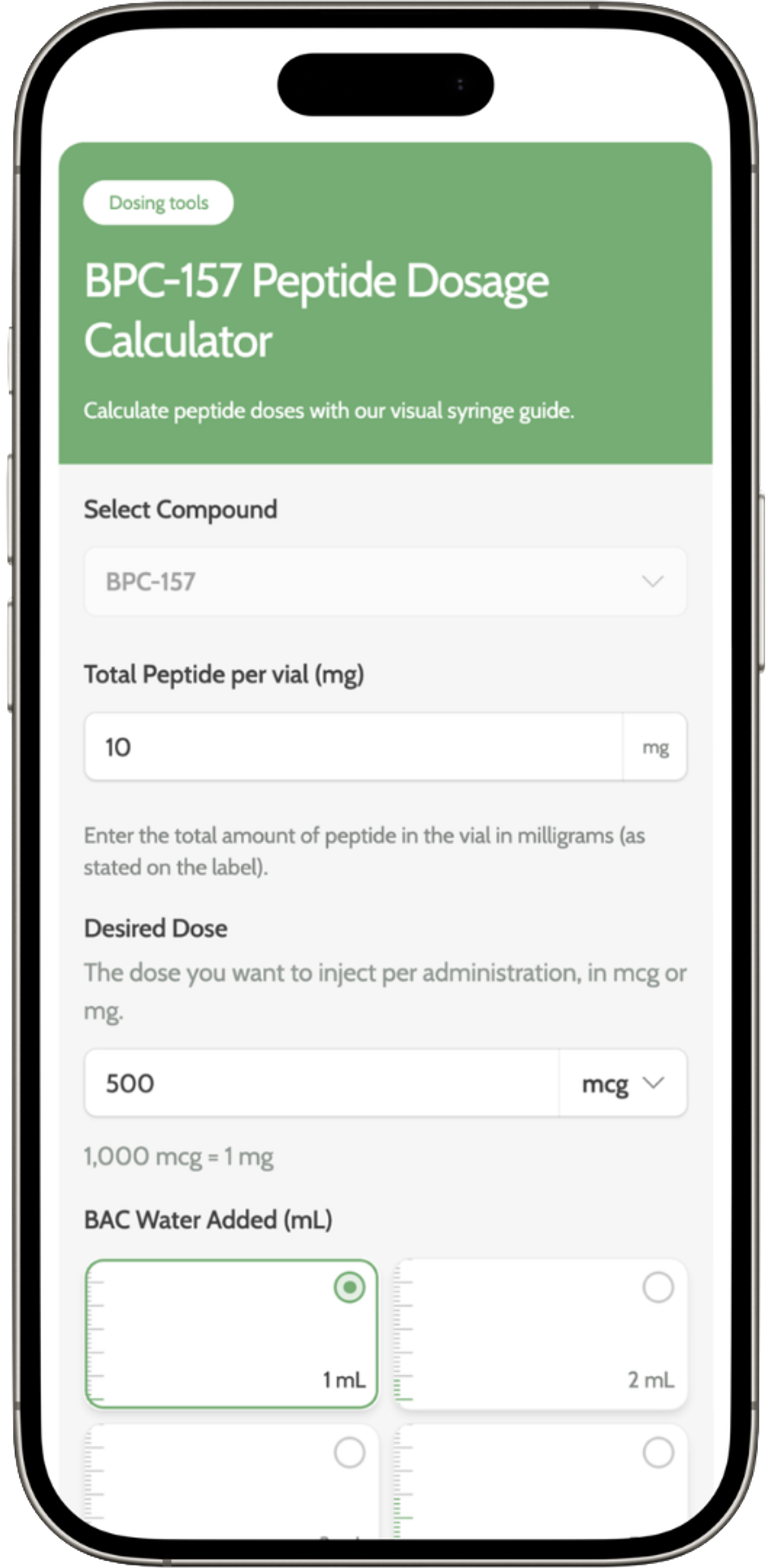
Dosing tools
GLP-1 Peptide Dosage Calculator
Calculate peptide doses with our visual syringe guide.
mg
Enter the total amount of peptide in the vial in milligrams (as stated on the label).
The dose you want to inject per administration, in mcg or mg.
1,000 mcg = 1 mg
1 mL
2 mL
3 mL
5 mL
Custom
Volume of bacteriostatic water you add to reconstitute the powder. Use BAC water for preservation.
Injection Results
Based on your vial and dilution inputs.
GLP-1
SINGLE COMPOUNDVolume per injection
0.05
mL
Concentration
10.00
mg/mL
Doses per vial
20
doses
Total injections per vial
20 injections
How it works
Based on a 10 mg GLP-1 vial diluted with 1 mL of bacteriostatic water, each 500 mcg injection equals 0.05 mL.
1mL / 100 units
5 units
0.050 mL
Reference Guide
Dosing Cycle
- Peptide
- GLP-1
- Dosing
- 0.25mg starting dose, escalating to 2.4mg maintenance
- Dosing Frequency
- once weekly subcutaneous injection
- Cycle Duration
- Escalate by 0.25–0.5mg every 4 weeks; long-term continuous use for weight management
- Storage
- Lyophilized/powder: store desiccated at -18°C or below for long-term; stable at 2–8°C up to 36 months. Reconstituted: refrigerate at 2–8°C for up to 28–30 days. Pre-filled pens (Ozempic/Wegovy): store at 2–8°C before first use; after first use, keep at room temperature (up to 30°C) or refrigerated for up to 56 days.
Note: Triple agonist; microdose for fewer side effects
Reconstitution Tips
- Use bacteriostatic water (BAC) — contains 0.9% benzyl alcohol for preservation
- Inject water slowly — aim down the vial wall, not directly onto powder
- Never shake — gently swirl or roll the vial until dissolved
- Store properly — refrigerate at 2-8°C after reconstitution
- Use within 28 days — most reconstituted peptides remain stable for about 4 weeks
- Keep sterile — always clean vial tops with alcohol before drawing
Peptide Interactions
Research suggestions of GLP-1 interactions with other common peptides and substances.
Weight
cag
Metabolic
Cagrilintide
SYNERGISTIC
Combined as CagriSema in clinical trials for enhanced weight loss efficacy.
Side effects
Contraindications
Personal or family history of medullary thyroid cancer
Multiple Endocrine Neoplasia syndrome type 2 (MEN 2)
Pregnancy or breastfeeding
History of pancreatitis
Stop signs
Severe persistent abdominal pain (possible pancreatitis)
Persistent vomiting preventing fluid intake
Signs of thyroid tumor (neck lump, hoarseness, trouble swallowing)
Severe allergic reaction (rash, itching, difficulty breathing)
Vision changes (possible diabetic retinopathy progression)
Severe hypoglycemia (if combined with insulin/sulfonylureas)
Kidney problems (decreased urination, swelling)
Bad signs
Comments
0.0
0 reviews
5
4
3
2
1
No comments yet
Be the first to share your experience. Your review helps others make more informed decisions.
Frequently asked questions
What is a peptide dosage calculator?
A peptide dosage calculator is a free tool that converts your vial size, bacteriostatic water volume, and target dose into an exact syringe draw volume. Instead of doing the reconstitution math by hand, you enter three inputs and instantly get the concentration of your solution and how many milliliters or syringeunits to draw. This calculator works for single peptide compounds and multi-peptide blends.
How do I calculate peptide dosage from a vial?
To calculate your peptide dose, divide the total peptide content of your vial in micrograms by the volume of bacteriostatic water you added in milliliters. This gives you your solution concentration in mcg/mL. Then divide your target dose by that concentration to get your draw volume. For example, a 5mg (5,000 mcg) vial reconstituted with 2mL of BAC water gives a concentration of 2,500 mcg/mL. A 250 mcg dose would require drawing 0.1mL. This calculator automates all of those steps instantly.
How much Bacteriostatic water should I add to a peptide vial?
Most people add 2mL to 3mL of bacteriostatic water per vial, but the right amount depends on the dose you want to draw and the syringe size you are using. Adding 1mL to a 5mg vial gives you a concentration of 5,000 mcg/mL, making each dose very small in volume. Adding 2mL gives you 2,500 mcg/mL, which is easier to measure on a standard insulin syringe. A general guideline is to choose a volume that puts your typical dose somewhere between 10 and 30 units on a U-100 syringe. Use the calculator above to test different water volumes and find what works for your dose.
How are peptides different from proteins?
Both are made of amino acids, but peptides are much smaller than proteins. Because of their tiny size, peptides can act like tiny messengers in the body, sending specific signals to your cells to tell them exactly what to do.
GLP-1Research References
GLP-1 is a fda approved compound
GLP-1
GLP-1 is a fda approved compound
STEP 1 Trial - Weight Management
14.9% average weight loss versus 2.4% with placebo over 68 weeks with 2.4mg weekly.
2021
SELECT Cardiovascular Outcomes
20% reduction in major adverse cardiovascular events over 5 years with 2.4mg weekly.
2023
SUSTAIN Diabetes Program
Average HbA1c reductions of 1.5-1.8% across multiple trials.
2016
STEP 5 Two-Year Maintenance
Sustained weight loss of 15.2% at week 104 with 2.4mg weekly.
2022
PIONEER Oral Semaglutide
Oral efficacy comparable to injectable formulations at 3-14mg daily.
2019
STEP TEENS Adolescent Study
16.1% BMI reduction in adolescent population over 68 weeks.
2022
Calculate peptide dosages
Learning how to calculate a peptide dose? Use our beginner-friendly peptide dosage, blend, and accumulation calculators. Enter vial size, reconstitution volume, and target dose to get exact draw volumes instantly. No guesswork, just clear guidance that helps prevent common mistakes.