Reviewed by the PeptideMind Team · Updated August 5, 2026
Cagrilintide Dosage Calculator, Benefits & Side Effects
Use our free Cagrilintide dosage calculator to plan your injection schedule and titration, plus benefits and side effects—alone or with semaglutide (CagriSema).
As seen on






Cagrilintide Dosage Schedule
A steady twice weekly protocol that leans on your body's own amylin pathway to help take the edge off appetite. Ideal for anyone who wants a simple, low frequency routine over a multi month stretch.
Cagrilintide Appetite Support Protocol
10 weeks, focused on weight management.
2 days per week
Taken Monday and Thursday.
0.38 mg per injection
0.38 mg per injection, given just under the skin in the abdomen or thigh.
Cagrilintide is a long acting amylin analog studied for reducing appetite and supporting weight loss, often paired with GLP-1 peptides for a combined effect.
What is Cagrilintide?
Cagrilintide is a lab-made, long-acting version of a natural hormone called amylin that your pancreas releases alongside insulin. It works in the brain to reduce appetite, slow down digestion, and help you feel full longer, needing just one injection a week. It's being studied on its own and combined with semaglutide (as 'CagriSema') as a treatment for obesity.
Weight
cag
Metabolic
Where to buy Cagrilintide
Compare real-time Cagrilintide prices from vendors with third-party lab testing (COA), purity, and legitimacy, so you know exactly who's trustworthy before you buy.
Dose size
Chosen on COA purity, third-party testing, and service, no paid placements.

4 of 5 vendors third-party tested, COA purity 99.76–99.873% across published labs. Prices re-checked 62 days ago.
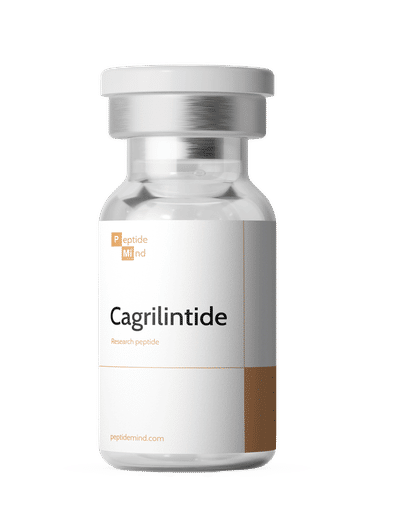
What Does Cagrilintide Do?
It attaches to hunger- and fullness-signaling receptors in the brain, telling the body it's full, slowing down digestion, and reducing a hormone that would otherwise raise blood sugar after meals. A fat molecule attached to it lets it stick to a blood protein, which keeps it circulating for about a week so it only needs to be injected weekly.
Signals fullness in the brain
Attaches to hunger and fullness receptors, telling the body it's full.
Slows digestion
Reduces a hormone that would otherwise raise blood sugar after meals.
Lasts about a week
A fat molecule lets it stick to a blood protein for once-weekly dosing.
Cagrilintide Targeted areas
Frequently Asked Questions About Cagrilintide
Straight answers on reconstitution, dosing, and safety, everything you need to research with confidence. For research reference only.
Cagrilintide Reconstitution Guide
Cagrilintide is supplied as a freeze-dried powder that must be mixed into a injectable solution before use. Available in 5mg, 10mg sizes.
10 mg lyophilized vial
Cagrilintide is supplied as a freeze-dried powder that must be mixed into a injectable solution before use. Available in 5mg, 10mg sizes.
3 mL bacteriostatic water
Adding 3 mL of bac water to a 10 mg vial gives a workable concentration for syringe dosing. More water makes microdosing easier; less concentrates each draw.
Storage after mixing
Freeze the dry powder. Once mixed with liquid, keep it in the fridge and use within about a month, and don't refreeze it. After reconstitution, keep the vial refrigerated and use within 30 days.
Reconstitution steps
Remove caps & sanitize stoppers
Attach needle to syringe
Draw 3 mL bacteriostatic water
Insert needle into Cagrilintide vial
Release water gently down the side
Swirl to dissolve — don't shake
Check for full dissolution
Refrigerate Cagrilintide — good for 30 days
Chemical Makeup
38
Amino Acids
Cagrilintide
?
XPosition 1
Lys
KPosition 2
Cys
CPosition 3
Asn
NPosition 4
Thr
TPosition 5
Ala
APosition 6
Thr
TPosition 7
Cys
CPosition 8
Ala
APosition 9
Thr
TPosition 10
Gln
QPosition 11
Arg
RPosition 12
Leu
LPosition 13
Ala
APosition 14
Glu
EPosition 15
Phe
FPosition 16
Leu
LPosition 17
Arg
RPosition 18
His
HPosition 19
Ser
SPosition 20
Ser
SPosition 21
Asn
NPosition 22
Asn
NPosition 23
Phe
FPosition 24
Gly
GPosition 25
Pro
PPosition 26
Ile
IPosition 27
Leu
LPosition 28
Pro
PPosition 29
Pro
PPosition 30
Thr
TPosition 31
Asn
NPosition 32
Val
VPosition 33
Gly
GPosition 34
Ser
SPosition 35
Asn
NPosition 36
Thr
TPosition 37
Pro
PPosition 38
What Are the Benefits of Cagrilintide?
What research says it may help with, and how it works in the body.
weight loss
Late-stage clinical trials show it leads to significant weight loss.
When combined with another drug in a treatment called CagriSema, it produced 22.7% weight loss, more than existing treatments achieve.
In patients with diabetes, it led to 15.7% weight loss while also improving blood sugar control.
metabolic
The CagriSema combination lowered a long-term blood sugar marker called HbA1c by 2.2%, more than semaglutide used on its own.
By activating a hormone receptor called the amylin receptor, it makes the body more responsive to insulin and improves how it processes sugar.
appetite control
Reduces appetite through two separate hormone pathways, the amylin and calcitonin receptors, working together.
What Are the Side Effects of Cagrilintide?
Who should avoid it, warning signs to watch for, and what to know before combining it with other compounds.
Who Should Avoid It
Not recommended in pregnancy or breastfeeding
Not yet commercially available (FDA approval expected Q1 2026)
Stop Right Away If You Notice
Severe persistent nausea/vomiting preventing hydration
Pancreatitis signs (severe abdominal pain radiating to back)
Severe allergic reactions or anaphylaxis
Significant injection site reactions or abscess formation
Milder Signs to Watch For
Is Cagrilintide FDA approved?
Cagrilintide is not an FDA-approved drug. It is intended for research purposes only and is not approved for human consumption, diagnostic, or therapeutic use.
Research Use Only
Cagrilintide has not been evaluated by the FDA for safety or efficacy in humans.
No Clinical Oversight
Not manufactured under FDA-regulated quality or clinical standards.
Unregulated Sourcing
Purity, dosing, and sourcing are not verified through FDA testing or oversight.

Cagrilintide Cycle Length: How Long Should It Last?
This breaks down how long a typical Cagrilintide cycle runs and what research suggests happens at each stage. Research shows that staying on a peptide continuously, without a break, may make it less effective over time.
That's why most research protocols build in a break between cycles, often called a washout period, to let the body reset before starting again.
- Week 1-2
- Gastrointestinal adaptation; mild nausea possible during dose escalation
- Week 4-8
- Early weight loss (2-5%); noticeable appetite reduction
- Week 12-26
- Significant weight loss acceleration (10-15%); improved satiety signals
- Week 0-0
- Peak efficacy (15-23% weight loss); sustained maintenance with continued therapy
Cagrilintide Research References
It is a phase 3 compound
Cagrilintide
Cagrilintide is a phase 3 compound
3,417 adults with obesity; 22.7% weight loss with CagriSema vs 2.4% placebo. New England Journal of Medicine.
2025
1,206 adults; 15.7% weight loss; 73.5% achieved HbA1c ≤6.5%. New England Journal of Medicine.
2025
32 weeks; 15.6% weight loss; 2.2% HbA1c reduction with CagriSema. The Lancet.
2023
Browse user-created protocols
Real protocols from the community that include Cagrilintide
Weight
GLP-3
METABOLIC
Mtp
Growth
tes