Semax vs Selank: Which Nootropic Peptide Is Better?
Semax vs Selank compared for beginners: how the two Russian nootropic peptides differ in structure, the BDNF and GABA mechanisms, focus versus calm, and what the published research shows.

Semax vs Selank is a comparison between two synthetic peptides from the same Russian research lineage that are studied for two different things: Semax is investigated mainly as a cognitive and neuroprotective compound, while Selank is investigated mainly as an anxiolytic, meaning an anti-anxiety compound, in research models. Neither is "better" in a general sense. They are built differently, act on different brain signaling systems, and are studied for different research questions. This beginner-friendly guide explains what each peptide is, how they differ, what the published research actually shows, and how to think about which one fits a given research goal, updated for 2026. Together, they anchor what's broadly known as the nootropic peptide category — compounds studied for cognitive effects rather than metabolic or hormonal ones.
Semax vs Selank: Quick Research Comparison
Semax and Selank are both short synthetic peptides developed in Russia, and both end in the same Pro-Gly-Pro tail that helps them resist breakdown, but their cores are completely different and they engage separate pathways. Semax is studied around the brain-derived neurotrophic factor (BDNF) system and is associated with focus and neuroprotection in rodent models. Selank is studied around the GABA and serotonin systems and is associated with reduced anxiety-like behavior in rodent models. The table below summarizes the core distinctions before the sections that follow explain each one in plain language.
Characteristic | Semax | Selank |
|---|---|---|
Type | Synthetic heptapeptide (7 amino acids) | Synthetic heptapeptide (7 amino acids) |
Derived from | ACTH(4-7) fragment of adrenocorticotropic hormone | Tuftsin, a natural immune-signaling peptide |
Core sequence | Met-Glu-His-Phe-Pro-Gly-Pro | Thr-Lys-Pro-Arg-Pro-Gly-Pro |
Main research focus | Cognition, attention, neuroprotection | Anxiety-like behavior, stress response |
Most-cited mechanism | Raises BDNF and NGF neurotrophins | Modulates GABA and serotonin signaling |
Studied effect profile | Stimulating, focus-oriented | Calming, without sedation in studies |
Research stage | Preclinical and early clinical (Russia) | Preclinical and early clinical (Russia) |
FDA approval | None | None |
A useful way to picture the difference: Semax is studied as the compound that may sharpen and protect, and Selank is studied as the compound that may calm and stabilize. Both descriptions come from animal models and a small number of Russian clinical studies, and neither has been established as an approved use in humans.

What Is Semax?
Semax is a synthetic heptapeptide, which simply means a chain of seven amino acids made in a lab, with the sequence Met-Glu-His-Phe-Pro-Gly-Pro. It was designed as an analog of a small fragment of adrenocorticotropic hormone (ACTH), specifically the ACTH(4-7) region, with a Pro-Gly-Pro tail added to the end to slow enzymatic breakdown. It was developed in Russia and has been studied there for several decades as a regulatory peptide in neuroscience research.
In research settings, Semax is investigated for its effects on neurotrophins, which are signaling proteins that help neurons survive and form new connections. Its most cited mechanism is an increase in brain-derived neurotrophic factor (BDNF). According to a 2006 study in Brain Research by Dolotov and colleagues, a single 50 micrograms per kilogram application of Semax was associated with a 1.4-fold increase in BDNF protein and a 1.6-fold increase in TrkB receptor activation in the rat hippocampus. These findings come from animal models and have not been established as approved uses in humans.
Semax has also been studied for effects on the brain's monoamine systems, which include dopamine and serotonin. A 2005 rodent study by Eremin and colleagues reported that Semax was associated with activation of dopaminergic and serotonergic brain systems. Because of this profile, Semax is generally described in the research literature as the more stimulating, focus-oriented of the two peptides. As always, these observations were made in controlled animal experiments and should be interpreted with caution.
What Is Selank?
Selank is also a synthetic heptapeptide, with the sequence Thr-Lys-Pro-Arg-Pro-Gly-Pro. Instead of coming from a hormone fragment like Semax, it is built from tuftsin, a small natural peptide involved in immune signaling. Researchers added the same Pro-Gly-Pro tail seen in Semax to improve its stability. Like Semax, it was developed at a Russian research institute and has been studied for several decades.
Selank is investigated primarily as an anxiolytic, a compound studied for reducing anxiety-like behavior, rather than as a cognitive stimulant. Its proposed mechanism centers on the GABA system, the brain's main calming or inhibitory signaling network, along with the serotonin system. A 2017 gene-expression study by Kolomin and colleagues found that Selank administration changed the expression of dozens of genes involved in GABA signaling in the rat frontal cortex, with significant changes in 45 genes one hour after administration. These results were observed in laboratory animals and have not been confirmed as human outcomes.
Selank is also studied for its effect on enkephalins, which are the body's own pain- and stress-regulating peptides. A 2008 Russian clinical study by Zozulia and colleagues reported that Selank produced anxiolytic effects comparable to the benzodiazepine medazepam in 62 participants studied for generalized anxiety, while also showing an antiasthenic, mildly activating quality rather than sedation. This was an early-stage clinical study conducted in Russia, and Selank is not approved by the FDA or established for human use.
How Semax and Selank Work: Two Different Pathways
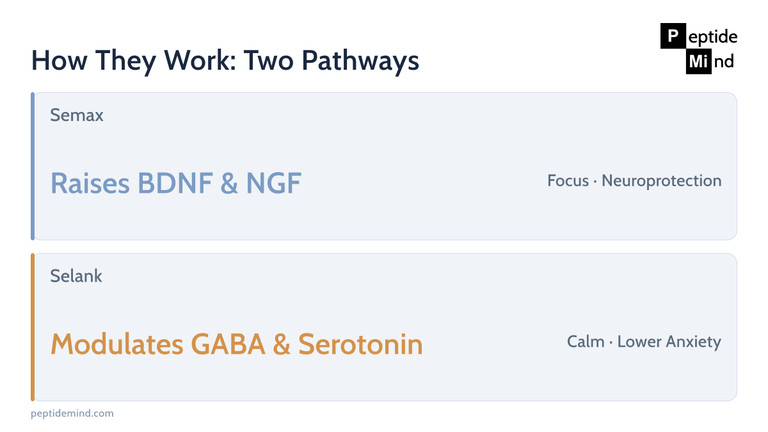
The clearest way to understand Semax vs Selank is that they act on two largely separate brain systems. Semax is studied around growth and protection signals, while Selank is studied around calming and stress-regulating signals. This is the core reason they are investigated for different research questions.
Semax is most associated with the neurotrophin pathway. By raising BDNF and a related factor called nerve growth factor (NGF), it is studied for supporting neuroplasticity, the brain's ability to adapt and form connections, in animal models. In a rat model of cerebral ischemia, Semax and its Pro-Gly-Pro fragment were associated with activated transcription of neurotrophins and their receptor genes following an induced stroke. These observations were made in an experimental injury model and have not been confirmed in human clinical trials.
Selank, by contrast, is most associated with the GABA and serotonin pathways. Rather than driving growth signals, it is studied for dampening the stress response. In the prefrontal cortex and hippocampus, Selank has been associated with increased serotonin turnover and changes in GABA-related gene expression in rodents. A 2017 study in Behavioural Neurology by Kasian and colleagues reported that Selank enhanced the anxiety-reducing effect of diazepam under chronic mild stress conditions in rats. This finding comes from an animal stress model, and further controlled research is needed before any conclusions about humans can be drawn.
Interestingly, one study examined both peptides side by side. A 2020 functional connectivity study by Myasoedov and colleagues used brain imaging to compare how Selank and Semax each altered communication between brain regions, including the amygdala, which is central to processing fear and anxiety. The researchers reported both shared and distinct effects on brain connectivity, supporting the idea that the two peptides overlap slightly but mainly act through different routes. This was an early imaging study, and its findings remain preliminary.
Shop research peptides
Live pricing from our top-rated vendor. Prices update as vendor listings change.
Semax vs Selank for Focus and Cognition
For research questions centered on focus, attention, and cognition, Semax is the more heavily studied of the two. Its documented increases in BDNF and its activation of dopamine and serotonin systems are the kind of signals researchers associate with attention and mental processing in animal models. This is why Semax, not Selank, is usually the subject when the research goal involves cognitive performance or neuroprotection.
Selank does have a studied cognitive dimension, but it is generally described as secondary to its calming profile. Because reducing anxiety can itself remove a barrier to concentration, Selank is sometimes studied for an indirect effect on focus under stressful conditions. A 2019 rodent study reported that Selank protected against memory impairment by regulating BDNF content in the hippocampus and prefrontal cortex of rats exposed to a memory-disrupting challenge, which shows it touches some of the same neurotrophin signaling as Semax. Even so, the memory finding here comes from a specific animal model and does not establish a cognitive benefit in humans.
In short, the research literature positions Semax as the more direct cognitive subject and Selank as the calm-focused subject whose cognitive effects are studied mostly as a downstream consequence of lower anxiety. Researchers comparing the two for an attention-related question generally start with Semax. For background on a closely related Semax variant, see our guide to N-Acetyl Semax Amidate versus Semax.
Semax vs Selank for Anxiety and Stress
For research questions centered on anxiety and the stress response, Selank is the more relevant and more directly studied peptide. Its GABA and serotonin modulation, its enkephalin effects, and its head-to-head comparison with a benzodiazepine in an early clinical study all point to anxiety-related research as its primary focus. The 2008 Zozulia study found Selank comparable to medazepam for anxiety measures while showing a mildly activating rather than sedating quality. That distinction, calming without the drowsiness associated with benzodiazepines, is the feature most often highlighted in Selank research. These results are from an early Russian clinical study and have not been replicated at scale or established for human use.
Semax is not primarily an anxiety-focused compound, although its effects on stress hormones and monoamines mean it is occasionally studied in stress-related contexts. Its stimulating profile, however, makes it a poor fit for research questions where the goal is to reduce arousal or calm the stress response. For that kind of question, Selank is the natural subject.
This is the cleanest split in the whole comparison: when the research target is anxiety-like behavior or stress reactivity, Selank leads; when the target is focus, learning, or neuroprotection, Semax leads.
Can Semax and Selank Be Studied Together?
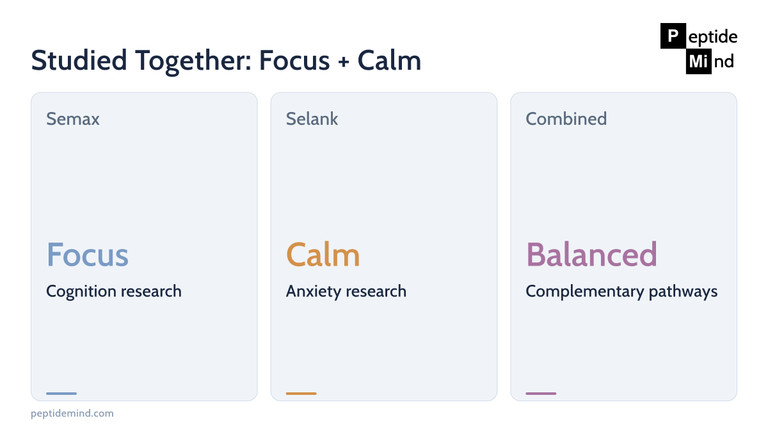
Semax and Selank are frequently studied as a pair because their profiles are complementary rather than overlapping. Since Semax is associated with a stimulating, focus-oriented effect and Selank with a calming, anxiety-reducing effect, the combination is investigated for a balanced "alert but calm" profile in research settings. This is the basis for the popular Semax and Selank blend products sold for research use.
The rationale is mechanistic: the two peptides act on largely separate systems, so combining them is studied for engaging both the neurotrophin pathway and the GABA and serotonin pathways at once. The 2020 functional connectivity study showed the two produce both shared and distinct effects on brain communication, which is part of why they are examined together. That said, controlled studies directly measuring the combination are limited compared with studies of each peptide alone, so the case for the pairing rests more on their complementary mechanisms than on a deep body of combination data. Any conclusion about the blend should be treated as preliminary.
Research Amounts and Administration in Published Studies
Published studies of both peptides have most often used intranasal administration, meaning delivery through the nose, in rodents and in the small clinical studies conducted in Russia. The Dolotov BDNF work used a single 50 micrograms per kilogram application of Semax in rats. The Zozulia clinical study administered Selank intranasally at 450 micrograms three times daily in its participant group. These figures describe what specific studies administered to their subjects; they are not recommendations, and no standardized human research amounts have been established for either peptide.
Because both peptides are typically supplied as a lyophilized, or freeze-dried, powder that must be reconstituted before use in research, anyone calculating working concentrations can use the Peptide Mind dosage calculator to convert vial size and diluent volume into a concentration, and should confirm exact content against each product's certificate of analysis. Semax and Selank have different molecular weights, so the same volume of liquid will not produce the same concentration for both.
Semax vs Selank: Which Nootropic Peptide Is Better for Research?
Neither Semax nor Selank is universally "better"; the right choice depends entirely on the research question. Semax is the stronger subject when the goal involves cognition, attention, neuroplasticity, or neuroprotection, because the BDNF, monoamine, and ischemia findings were generated with it. Selank is the stronger subject when the goal involves anxiety-like behavior, stress reactivity, or a calm profile, because its GABA, serotonin, and clinical anxiety data point that way. For research questions that span both, the complementary blend is the option studied for a balanced profile.
Two practical points matter for any comparison. First, much of the strongest evidence for both peptides comes from Russian preclinical and early clinical work, so independent large-scale replication remains limited and claims should stay research-framed. Second, as with any research peptide, the molecule and purity confirmed on a third-party certificate of analysis matter more than the marketing language on the vial. Researchers comparing options can review lab-tested Semax and Selank at Protide Health, or the combined Semax and Selank blend for studies examining both together.
Frequently Asked Questions
What is the difference between Semax and Selank?
Shop research peptides
Live pricing from our top-rated vendor. Prices update as vendor listings change.
Both are synthetic seven-amino-acid peptides developed in Russia that share a Pro-Gly-Pro stabilizing tail, but their cores and effects differ. Semax comes from a fragment of adrenocorticotropic hormone and is studied mainly for cognition and neuroprotection through the BDNF system. Selank comes from the immune peptide tuftsin and is studied mainly for reducing anxiety-like behavior through the GABA and serotonin systems. In short, Semax is the focus-oriented subject and Selank is the calm-oriented subject.
Is Semax or Selank better for studying and focus?
In the research literature, Semax is the more direct subject for focus and cognition because of its documented effects on BDNF and on dopamine and serotonin systems in animal models. Selank is studied more for calm than for raw cognitive output, although by lowering anxiety it is sometimes examined for an indirect effect on concentration. For an attention-focused research question, Semax is usually the starting point. These are research observations, not established human outcomes.
Which is better for anxiety, Semax or Selank?
Selank is the more relevant peptide for anxiety-related research. It is studied as an anxiolytic acting on GABA and serotonin signaling, and an early Russian clinical study found it comparable to a benzodiazepine for anxiety measures while showing a mildly activating rather than sedating quality. Semax, by contrast, has a stimulating profile that does not suit anxiety-reduction research questions. These findings are preliminary and have not been established for human use.
Can you take Semax and Selank together?
In research contexts, the two are frequently studied together because their effects are complementary: Semax is associated with focus and Selank with calm, so the pair is investigated for a balanced profile. They act on largely separate brain systems, which is the mechanistic basis for the combination. However, controlled data on the blend specifically is more limited than data on each peptide alone, so the pairing should be considered preliminary rather than proven.
Does Selank work immediately?
In the early Russian clinical research, Selank's anxiolytic effects were reported within days of beginning administration rather than instantly, though the timing varied by study and model. Because most of the data comes from rodent models and small clinical studies, precise onset figures should be interpreted cautiously, and none of this establishes an approved human use.
References
Dolotov OV, Karpenko EA, Inozemtseva LS, et al. "Semax, an analog of ACTH(4-10) with cognitive effects, regulates BDNF and trkB expression in the rat hippocampus." Brain Research, 2006;1117(1):54-60. https://pubmed.ncbi.nlm.nih.gov/16996037/
Eremin KO, Kudrin VS, Saransaari P, et al. "Semax, an ACTH(4-10) analogue with nootropic properties, activates dopaminergic and serotoninergic brain systems in rodents." Neurochemical Research, 2005. https://pubmed.ncbi.nlm.nih.gov/16362768/
Stavchansky VV, Yuzhakov VV, Botsina AY, et al. "Semax and Pro-Gly-Pro activate the transcription of neurotrophins and their receptor genes after cerebral ischemia." Cellular and Molecular Neurobiology, 2010. https://pubmed.ncbi.nlm.nih.gov/19633950/
Zozulia AA, Neznamov GG, Siuniakov TS, et al. "Efficacy and possible mechanisms of action of a new peptide anxiolytic selank in the therapy of generalized anxiety disorders and neurasthenia." Zhurnal Nevrologii i Psikhiatrii imeni S.S. Korsakova, 2008;108(4):38-48. https://pubmed.ncbi.nlm.nih.gov/18454096/
Kolomin T, Shadrina M, Andreeva L, et al. "Selank administration affects the expression of some genes involved in GABAergic neurotransmission." Frontiers in Pharmacology, 2014. https://www.ncbi.nlm.nih.gov/pmc/articles/PMC4757669/
Kasian A, Kolomin T, Andreeva L, et al. "Peptide Selank enhances the effect of diazepam in reducing anxiety in unpredictable chronic mild stress conditions in rats." Behavioural Neurology, 2017;2017:5091027. https://onlinelibrary.wiley.com/doi/10.1155/2017/5091027
Myasoedov NF, Lyapina LA, Grigorjeva ME, et al. "Functional connectomic approach to studying Selank and Semax effects." Doklady Biological Sciences, 2020;490(1):1-4. https://pubmed.ncbi.nlm.nih.gov/32342318/
Volkova A, Shadrina M, Kolomin T, et al. "Selank, peptide analogue of tuftsin, protects against ethanol-induced memory impairment by regulating BDNF content in the hippocampus and prefrontal cortex in rats." Bulletin of Experimental Biology and Medicine, 2019. https://link.springer.com/article/10.1007/s10517-019-04588-9
Two Peptides, Two Different Jobs
The Semax vs Selank question is less about which peptide is stronger and more about which research question is being asked. Semax and Selank share a Russian origin and a Pro-Gly-Pro tail, but Semax is built from a hormone fragment and studied for focus and neuroprotection through BDNF, while Selank is built from the immune peptide tuftsin and studied for calm and reduced anxiety-like behavior through GABA and serotonin. For cognition-focused research, Semax leads; for anxiety-focused research, Selank leads; and for studies wanting both, the complementary blend is the natural subject. As with any research peptide, the content confirmed by a certificate of analysis matters more than the label, and every finding here remains preliminary and research-only.
Disclaimer: The information provided on Peptide Mind is for educational purposes only and is not a substitute for professional medical advice. Many peptides discussed on this site are unapproved research chemicals intended strictly for laboratory and preclinical use. The FDA has not evaluated these statements, and nothing on this site is intended to diagnose, treat, cure, or prevent any disease. By accessing this site, you confirm you are over the age of 21, waive any claims or liability arising from the use of the content portrayed, and fully indemnify Peptide Mind against any unauthorized usage, claims, or liability in accordance with our Terms of Service.
Add a comment
This will be publicly visible.
Your email address will not be published.
Your comment will be reviewed by an admin before it is published.