5-Amino-1MQ Peptide: Benefits, Dosage & Safety (2026)
5-Amino-1MQ is a small-molecule NNMT inhibitor studied for fat loss and NAD+, not a true peptide. A research guide to its benefits, dosage, and side effects.


The compound sold as the 5-Amino-1MQ peptide is a synthetic small molecule that blocks an enzyme called NNMT, and early research ties that action to faster fat loss and higher cellular NAD+. It sells under the "peptide" label almost everywhere, yet it is not one. There are no amino acids in it and no peptide bonds. This guide walks through what the molecule is, how it works, what the studies found, how it gets dosed in research, and where the safety picture still has holes.
One frame before the details. Almost all of the evidence comes from cells and mice. Read every benefit below as "studied in the lab," not "proven in people."
What is 5-Amino-1MQ?
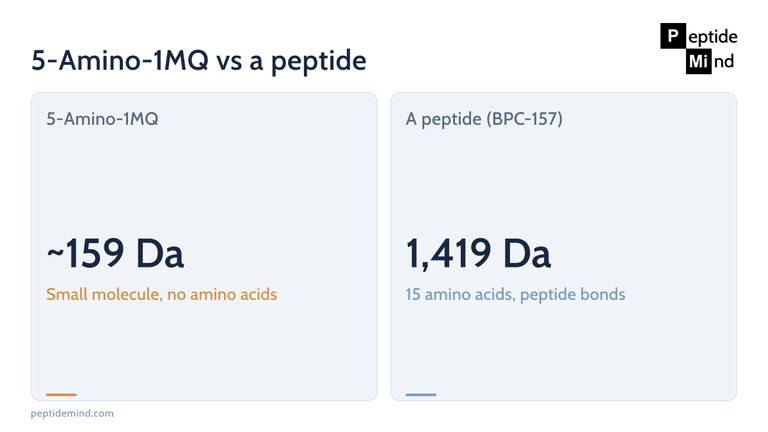
5-Amino-1MQ is a small-molecule inhibitor of nicotinamide N-methyltransferase, an enzyme almost always shortened to NNMT. Its full chemical name is 5-amino-1-methylquinolinium, it carries the CAS number 685079-15-6, and it weighs roughly 159 daltons. That is tiny. A research peptide like BPC-157 weighs about 1,419 daltons and is built from 15 amino acids; this compound is a single ring system with none. Suppliers sell the reference standard as an iodide salt, and the literature describes it as a selective NNMT inhibitor with an IC50 near 1.2 micromolar, meaning it shuts the enzyme down at low concentrations without hitting related enzymes.
Attribute | Detail |
|---|---|
Compound type | Small-molecule NNMT inhibitor (not a peptide) |
Chemical name | 5-amino-1-methylquinolinium |
CAS number | 685079-15-6 |
Molecular weight | ~159 daltons |
Mechanism | Inhibits NNMT; indirectly raises NAD+ and SAM |
Studied for | Fat loss, metabolic health, NAD+ support |
Form sold | Oral capsules and powder (labeled research use only) |
Evidence level | Preclinical: cell and animal; no human trials |
Regulatory status | Research chemical; not FDA approved |
Is 5-Amino-1MQ a peptide?
No. A peptide is a short chain of amino acids joined by peptide bonds, which is the entire definition of what a peptide is. This molecule has neither. It belongs to the quinoline family, a class of small aromatic ring compounds, and sits far closer in size to caffeine than to insulin. So why the label? It gets sold beside injectable peptides in the same clinics and research catalogs, and "peptide" has drifted into a wellness catch-all for anything in that space. The same confusion follows NAD around, which is a coenzyme, not a peptide either. The mislabel does not change what the compound does. It changes which shelf it belongs on.
Feature | 5-Amino-1MQ | A peptide (e.g., BPC-157) |
|---|---|---|
Molecule type | Small molecule (quinolinium) | Short chain of amino acids |
Building blocks | One ring system | Amino acids |
Peptide bonds | None | Yes |
Approx. weight | ~159 Da | ~1,000 to 3,000+ Da |
Contains amino acids? | No | Yes |
How 5-Amino-1MQ works: NNMT, NAD+, and the SAM cycle
The whole mechanism runs through one enzyme. NNMT takes nicotinamide, a form of vitamin B3, and attaches a methyl group to it, using SAM (S-adenosylmethionine) as the methyl donor. That single reaction does two things at once. It burns through nicotinamide, which your cells would otherwise recycle into NAD+, and it spends SAM, the body's main methyl currency. When NNMT runs hot, as it tends to in enlarged fat cells, more nicotinamide gets pushed toward a dead-end waste product instead of being salvaged back into NAD+.
Block the enzyme and the math flips. With NNMT inhibited:
Nicotinamide is spared and routed back into the NAD+ salvage pathway, nudging NAD+ upward.
SAM stops being drained by the methylation step, so methyl-group supply recovers.
Higher NAD+ feeds sirtuins such as SIRT1 and the mitochondrial reactions that convert fuel into usable energy.
NAD+ is the hinge. It is the coenzyme at the center of energy metabolism and a great deal of aging research, and the reason it is a coenzyme rather than a peptide is worth understanding before you read the longevity claims. The key distinction: an NNMT inhibitor raises NAD+ indirectly, by protecting its raw material, rather than supplying it directly the way an NMN or NR supplement does.
In fat cells, 5-amino-1MQ lowered the NNMT byproduct 1-methylnicotinamide (EC50 near 2.3 micromolar) and cut fat storage, without disturbing the other enzymes in the NAD+ salvage pathway. (Neelakantan et al., Biochemical Pharmacology, 2018)

5-Amino-1MQ benefits: what the research shows
Nearly every benefit pinned to this compound traces back to two ideas: less active NNMT in fat tissue, and more available NAD+. The cell and animal data line up reasonably well. Human data, so far, does not exist.
Fat loss and body composition
This is the headline, and it has two anchor studies. The first is a 2014 Nature paper in which researchers knocked down NNMT in the fat and liver of mice. Those animals resisted diet-induced obesity, stayed leaner than controls, and burned more energy even on a high-fat diet (Kraus et al., 2014). The follow-up that matters for this specific compound landed in 2018, when a small-molecule NNMT inhibitor was given to obese mice.
Shop research peptides
Live pricing from our top-rated vendor. Prices update as vendor listings change.
Treated mice lost body weight and white fat mass without eating less, alongside lower plasma cholesterol and smaller fat cells. (Neelakantan et al., Biochemical Pharmacology, 2018)
That "without eating less" line is the part worth sitting with. It suggests a shift in how the body spends energy rather than appetite suppression, which is the opposite of how GLP-1 drugs drive weight loss. For where this compound sits among other options, see our ranking of the best peptides for fat loss.
Metabolic health and insulin sensitivity
NNMT activity climbs in the fat tissue of people with obesity and type 2 diabetes, which is exactly why the enzyme drew interest as a target for metabolic syndrome in the first place. In the animal models, inhibiting or knocking down NNMT improved markers tied to glucose handling and lowered cholesterol. The thread connecting these effects is energy expenditure: cells with more NAD+ and less NNMT appear to run their metabolism a little hotter. Whether that carries over to human blood sugar or waistlines is untested.
Energy, muscle, and longevity signals
Because the pathway ends at NAD+ and SIRT1, 5-Amino-1MQ gets grouped with longevity research. The logic is real but indirect: NAD+ falls with age, sirtuins depend on it, and propping up NAD+ is a recurring theme across the longevity peptides and compounds people study. There is also early work in a mouse muscle-injury model, where the inhibitor supported repair. Treat the "anti-aging" framing as a hypothesis built on mechanism, not a demonstrated outcome.

5-Amino-1MQ dosage
There is no established or approved human dose for 5-Amino-1MQ. Everything circulating online is extrapolated from animal studies or copied between vendor sites. The published mouse work that showed fat-loss effects delivered the compound by injection, at roughly 20 mg per kilogram per day, which does not convert cleanly to a human capsule. The consumer market, meanwhile, has settled on 50 to 150 mg per day in oral form, usually in short cycles with breaks. Those numbers come from clinic notes and product labels, not from dosing trials.
Context | Reported amount | Notes |
|---|---|---|
Mouse obesity studies | ~20 mg/kg/day | By injection; not a human dose |
Mouse muscle-injury model | 5 to 10 mg/kg twice daily | By injection |
Consumer capsules | 50 to 150 mg/day | Oral; anecdotal, not established |
Cycle length (clinic notes) | ~4 to 8 weeks | Often cycled with rest periods |
Researchers working with reconstituted material can run the conversions with the free peptide dosage calculator, keeping in mind the disclaimer below: the tool is for math, not medical dosing.
Oral capsules versus the injected studies
Here is a gap most product pages skip. The studies that produced the fat-loss results used injection, while the market sells oral capsules and credits the compound with "high oral bioavailability." The small size and membrane permeability that let it slip into cells make oral absorption plausible, and that is the rationale vendors lean on. But there is no published human study measuring how much of an oral dose actually reaches the bloodstream. So the oral route is reasonable on paper and unverified in practice. Worth knowing before you read a label as settled science.
5-Amino-1MQ side effects and safety
Reported side effects are mild and mostly anecdotal: occasional hives or allergic-type reactions, digestive upset, and headache. The honest summary is thinner than that list makes it sound, because no long-term human safety study has been run. Nobody can yet say what daily use does over months or years, because that data is not in the literature.
A few practical points carry more weight than the short side-effect list:
No use in pregnancy or breastfeeding. This is the standard precaution for any unstudied research compound, and it applies here.
Purity is a real variable. These are research-grade products, not pharmaceuticals. A 2025 wave of social-media posts even flagged mislabeled vials and dose errors in this exact compound. A certificate of analysis and third-party testing matter, which is the whole point of choosing third-party tested suppliers.
Drug interactions are unmapped. With no human trials, interactions with medications or other compounds are unknown rather than ruled out.
How 5-Amino-1MQ compares to other metabolic compounds
People rarely research this molecule in isolation. It usually comes up next to other metabolic research compounds, and the differences matter because each one works through a separate mechanism.
Compound | Type | Main mechanism | Route |
|---|---|---|---|
5-Amino-1MQ | Small molecule | NNMT inhibition raises NAD+ | Oral (marketed) |
Peptide (16 aa) | AMPK activation | Injection | |
Peptide | Appetite control, insulin | Injection | |
NMN / NR | Nucleotide precursor | Direct NAD+ precursor | Oral |
Shop research peptides
Live pricing from our top-rated vendor. Prices update as vendor listings change.
The cleanest contrast is with GLP-1 drugs. Those work largely by curbing appetite, and they have years of human trials behind them. 5-Amino-1MQ aims at a metabolic enzyme and shows its effects without reducing food intake in animals, but it has zero human trials. MOTS-c and the NAD+ precursors sit somewhere between, with strong mechanisms and limited human data of their own.
Frequently asked questions
What does 5-Amino-1MQ do?
In research, it blocks the enzyme NNMT. That action spares nicotinamide for NAD+ production and preserves SAM, which in cell and animal studies translates to reduced fat storage, smaller fat cells, and higher cellular energy output. Those effects are documented in mice and cultured cells, not in people.
Does 5-Amino-1MQ really work?
In animals, yes, the fat-loss and metabolic effects are real and repeatable. In humans, the answer is unknown, because no clinical trial has tested it. Anyone claiming proven human results is going beyond the published evidence.
How long does it take to see results from 5-Amino-1MQ?
There is no reliable timeline, because the human data does not exist. The mouse studies ran for a matter of weeks before changes in body weight and fat mass appeared. Anecdotal consumer reports mention several weeks, but those are not controlled observations and should be read with skepticism.
Is 5-Amino-1MQ worth it?
That depends entirely on your tolerance for unproven compounds. The mechanism is well mapped and the animal data is encouraging, which is more than many trending compounds can claim. The catch is the complete absence of human trials and long-term safety data. For most people, it is an early-stage research compound, not a finished product.
Is 5-Amino-1MQ a peptide?
No. It is a small molecule called 5-amino-1-methylquinolinium, with no amino acids and no peptide bonds. It is marketed as a peptide because it is sold alongside them, but chemically it belongs to a different family entirely.
What is the best peptide for belly fat?
There is no single answer, and the honest version is that most "belly fat" compounds act on whole-body metabolism rather than one region. 5-Amino-1MQ, MOTS-c, and the GLP-1 class all get studied for fat loss through different mechanisms. Our best peptides for fat loss guide compares them by evidence level.
What should you not mix with 5-Amino-1MQ?
Because there are no human interaction studies, the safe answer is that nothing has been cleared to combine with it. It is frequently stacked with NAD+ precursors in consumer protocols on the theory that both support NAD+, but that pairing is anecdotal, not tested. Caution beats assumption here.
References
Kraus D, et al. "Nicotinamide N-methyltransferase knockdown protects against diet-induced obesity." Nature. 2014;508:258-262. https://www.nature.com/articles/nature13198
Neelakantan H, et al. "Selective and membrane-permeable small molecule inhibitors of nicotinamide N-methyltransferase reverse high fat diet-induced obesity in mice." Biochemical Pharmacology. 2018;147:141-152. https://pmc.ncbi.nlm.nih.gov/articles/PMC5826726/
"Nicotinamide N-methyltransferase (NNMT): a novel therapeutic target for metabolic syndrome." Frontiers in Pharmacology. 2024. https://www.frontiersin.org/journals/pharmacology/articles/10.3389/fphar.2024.1410479/full
Sigma-Aldrich. "5-Amino-1-methylquinolinium iodide, product SML2832." https://www.sigmaaldrich.com/US/en/product/sigma/sml2832
The bottom line
The 5-Amino-1MQ peptide is not a peptide, and that small correction sets up everything else. It is a tiny NNMT inhibitor that raises NAD+ by protecting its raw materials, and in cells and mice that mechanism produces real fat loss without appetite suppression. The science underneath it is legitimate and well documented. What is missing is the human half of the story: no clinical trials, no long-term safety record, and an oral route that makes sense but has not been measured in people. Treat it as a compound under active investigation, weigh the purity and labeling risks, and keep the lab-versus-life distinction front of mind.
Shop research peptides
Live pricing from our top-rated vendor. Prices update as vendor listings change.
Disclaimer: The information provided on Peptide Mind is for educational purposes only and is not a substitute for professional medical advice. Many peptides discussed on this site are unapproved research chemicals intended strictly for laboratory and preclinical use. Furthermore, any dosage calculator provided is a theoretical tool for math visualization and does not represent medical dosing instructions. The FDA has not evaluated these statements, and nothing on this site is intended to diagnose, treat, cure, or prevent any disease.
Add a comment
This will be publicly visible.
Your email address will not be published.
Your comment will be reviewed by an admin before it is published.