KLOW Peptide: Blend Ingredients, Research & Dosage Chart
KLOW peptide is a 4-in-1 research blend of GHK-Cu, BPC-157, TB-500, and KPV. See what is inside, why it is blue, KLOW vs GLOW, and a dosage reference chart.

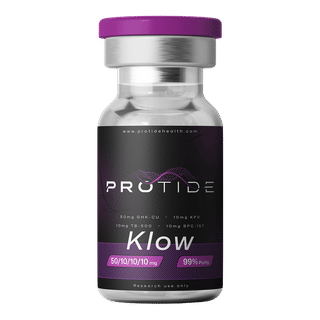
KLOW peptide is a four-in-one research blend that combines four separately studied peptides into a single vial: GHK-Cu, BPC-157, TB-500, and KPV. In its most common format, the 80 mg "KLOW blend" vial, the four are present at a fixed ratio of 50 mg GHK-Cu, 10 mg BPC-157, 10 mg TB-500, and 10 mg KPV. That fixed-ratio design is exactly what separates a peptide blend from a single-compound vial: the four components can't be dosed independently once mixed. The name is a direct extension of the older GLOW blend: GLOW contains the first three peptides, and adding KPV (the "K") produces KLOW.
The compound has gained rapid interest in 2026. Most of that interest is informational: people want to know what is in it, what each component has been studied for, how the blend is reconstituted, and how it differs from GLOW. This guide answers those questions using primary preclinical literature rather than marketing claims. KLOW and its components are sold strictly as research-use-only (RUO) materials and are not approved for human use.
Disclaimer: This guide is for educational and research purposes only. Peptides referenced are research chemicals, not for human consumption. By accessing this site, you agree to our Terms of Service and the full disclaimer at the bottom of this page.
What Is the KLOW Peptide Blend?
KLOW is a combination of four research peptides formulated together so that each contributes a distinct, well-characterized mechanism. Three of the four (GHK-Cu, BPC-157, and TB-500) are studied mainly in tissue and wound models, while the fourth (KPV) is studied mainly in inflammation models. Combining peptides with overlapping but non-identical pathways is what researchers refer to when they describe the blend as "synergistic," though it is worth noting that the synergy of the specific four-peptide combination has not itself been validated in controlled human trials. Our breakdown of the most-studied peptide pairings covers how far that same synergy reasoning holds across other combinations, and which of them have comparison data behind the claim.
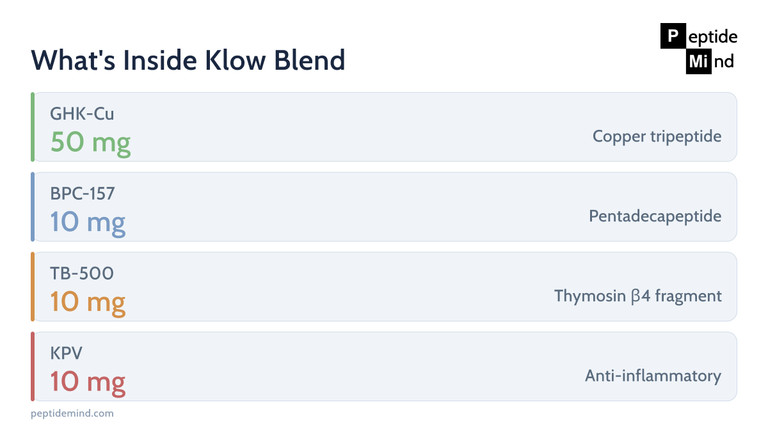
The standard commercial format is labeled "KLOW", or "KLOW 80", where 80 refers to the total lyophilized (freeze-dried) peptide mass across all four components in a single vial. The component breakdown below reflects the ratio most widely listed by research suppliers.
Component | Amount per 80 mg vial | Share of blend |
|---|---|---|
GHK-Cu | 50 mg | 62.5% |
BPC-157 | 10 mg | 12.5% |
TB-500 | 10 mg | 12.5% |
KPV | 10 mg | 12.5% |
Total | 80 mg | 100% |
Note: not every vial labeled "KLOW" uses the 50/10/10/10 ratio. Some suppliers list different totals or split the four peptides evenly, so the certificate of analysis for a specific vial is the only reliable source for its exact composition.
What Is in KLOW Peptide? The Four Components Explained
Each peptide in KLOW has its own chemistry, its own body of research, and its own mechanism. Understanding the blend means understanding the four parts.
GHK-Cu (the copper tripeptide)
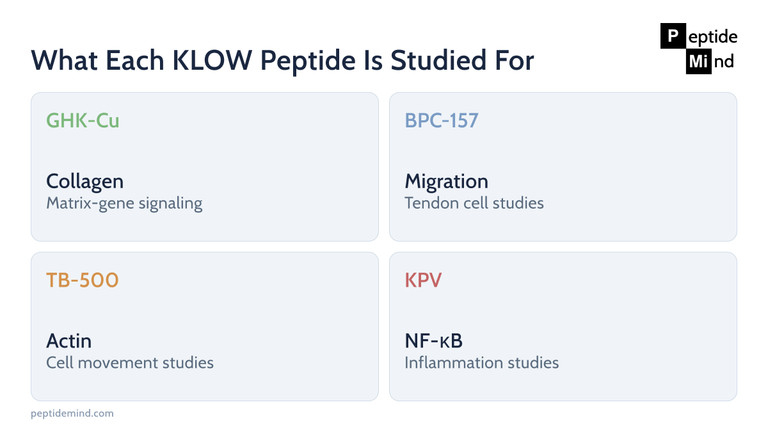
GHK-Cu is glycyl-L-histidyl-L-lysine bound to a copper(II) ion, a tripeptide first isolated from human plasma in 1973 by Loren Pickart. In cultured fibroblasts, it has been studied for its effect on extracellular matrix signaling: one classic in vitro series reported that GHK-Cu stimulated collagen synthesis in fibroblast cultures beginning at concentrations around 10⁻¹² M and reaching maximal stimulation near 10⁻⁹ M. Later bioinformatic analyses by Pickart and colleagues reported that GHK can shift the expression of more than 4,000 human genes, many tied to matrix remodeling. These are laboratory observations in cell and gene-expression models, not demonstrated outcomes in humans. GHK-Cu also appears in other recovery-focused blends covered in our injury-recovery peptide research guide.
BPC-157 (the pentadecapeptide)
BPC-157 is a stable pentadecapeptide, a 15-amino-acid sequence derived from a protein found in gastric juice. In rodent tendon and muscle models it has been studied for its effect on cell migration and angiogenesis (new blood-vessel formation). In one in vitro study, BPC-157 increased the outgrowth and migration of tendon fibroblasts in a dose-dependent manner and up-regulated the growth-hormone receptor in those cells. In rodent healing models, researchers reported that BPC-157 modulated angiogenesis through the VEGFR2-Akt-eNOS signaling pathway. Evidence for BPC-157 remains preclinical, and no large controlled human trials have confirmed these findings.
TB-500 (a thymosin beta-4 fragment)
TB-500 is a synthetic peptide based on a segment of thymosin beta-4 (Tβ4), a 43-amino-acid protein present in most cells. Its best-characterized mechanism is actin regulation: through the LKKTET binding motif it sequesters G-actin and influences how cells build and dismantle their internal scaffolding, which is central to cell migration. In scratch-assay and keratinocyte models, Tβ4 has been reported to accelerate cell migration roughly two- to three-fold over controls at very low concentrations. As with the other components, these are findings in cultured cells and animal models rather than approved human results.
KPV (the anti-inflammatory tripeptide)
KPV is a tripeptide made of lysine, proline, and valine, corresponding to residues 11 to 13 at the C-terminal end of alpha-melanocyte-stimulating hormone (alpha-MSH). It is the component that distinguishes KLOW from GLOW. In inflammation models, KPV has been studied for its ability to enter cells through the PepT1 transporter and reduce NF-κB nuclear translocation, with some models reporting reductions of up to roughly 80 percent and corresponding drops in pro-inflammatory cytokines such as TNF-alpha and IL-6. In murine colitis models, orally delivered KPV reduced measured colitis severity. This research is concentrated in gut-inflammation models and has not been extended to approved human use.
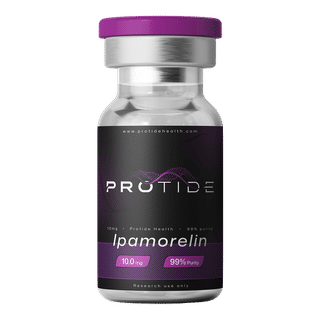
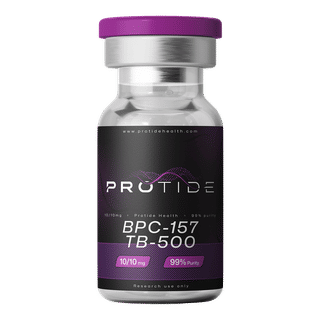
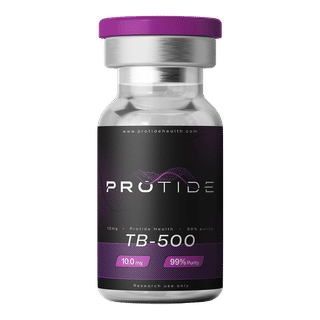
Shop research peptides
Live pricing from our top-rated vendor. Prices update as vendor listings change.
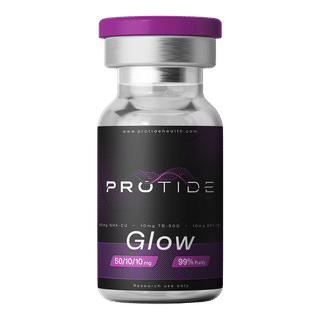
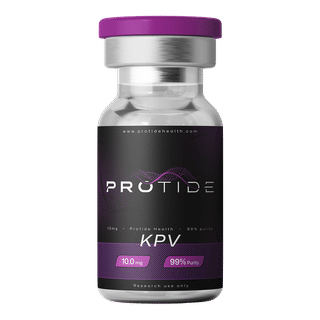
KLOW Peptide Benefits: What the Component Research Actually Shows
Because KLOW itself has not been tested as a fixed four-peptide blend in controlled human trials, any discussion of "benefits" is really a summary of what each separate component has been studied for in preclinical settings. Grouped by research theme, the documented effects of the individual peptides include:
Connective-tissue and wound models: BPC-157 and TB-500 are studied for cell migration and angiogenesis, and GHK-Cu for collagen and matrix-gene signaling, in rodent and cell-culture experiments.
Skin and matrix models: GHK-Cu is the most-studied component for fibroblast and extracellular-matrix activity in vitro.
Inflammation models: KPV is studied for NF-κB and cytokine modulation, particularly in gut-inflammation experiments.
Each of these is an observation from a specific model system. None has been established as a clinical outcome for the KLOW blend in humans, and reported social-media "before and after" results are anecdotal rather than controlled data.
KLOW vs GLOW Peptide: What Is the Difference?
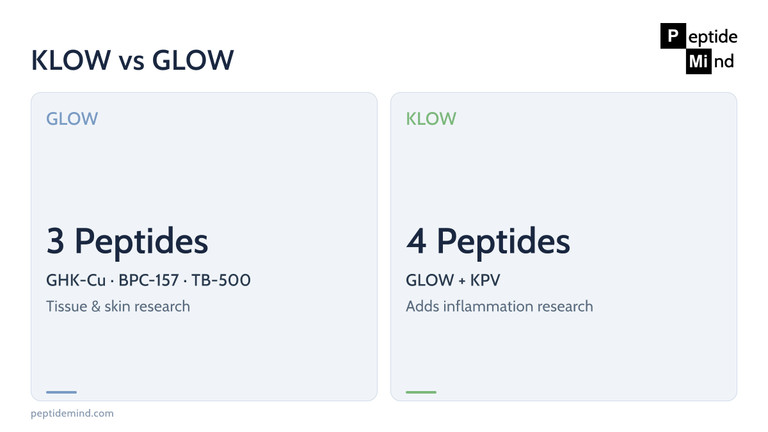
The difference between KLOW and GLOW is one peptide. GLOW is a three-peptide blend of GHK-Cu, BPC-157, and TB-500. KLOW is the same three plus KPV. In practical research terms, KLOW adds a dedicated anti-inflammatory tripeptide to a blend that is otherwise focused on tissue and matrix models. Our full KLOW vs GLOW comparison breaks down the two blends side by side, including ratios, research themes, and how the added KPV changes what each formulation is used to study.
Feature | GLOW | KLOW |
|---|---|---|
Components | GHK-Cu, BPC-157, TB-500 | GHK-Cu, BPC-157, TB-500, KPV |
Number of peptides | 3 | 4 |
Added peptide | None | KPV (anti-inflammatory tripeptide) |
Primary research themes | Tissue, skin, matrix models | Same, plus gut and immune inflammation models |
Vial color | Blue (from copper in GHK-Cu) | Blue (from copper in GHK-Cu) |
KLOW Peptide Dosage Chart and Reconstitution (Research Reference)
The figures researchers reference for KLOW follow directly from the 80 mg ratio. Reconstitution is the process of adding sterile or bacteriostatic water to the freeze-dried powder to create a measurable liquid. The chart below shows how the four components distribute when a standard KLOW 80 vial is reconstituted, and is provided only as a laboratory reference for handling research materials, not as guidance for human use.
Reconstitution example | Total in 0.1 mL | Notes |
|---|---|---|
Add 3 mL water to 80 mg vial | 2.67 mg total peptide | 26.67 mg/mL working concentration |
Per-component in 0.1 mL | 1.67 mg GHK-Cu | from the 50 mg fraction |
0.333 mcg BPC-157 | from the 10 mg fraction | |
0.333 mcg TB-500 | from the 10 mg fraction | |
0.333 mcg KPV | from the 10 mg fraction |
On a standard U-100 insulin syringe, 0.1 mL equals 10 units, which is why supplier charts often describe amounts in "units." The exact figures change with the volume of water used: adding 1 mL instead of 2 mL doubles the concentration. Because KLOW is a research-use-only material, these calculations are intended for laboratory measurement accuracy and not as a dosing recommendation for people.

KLOW Blend Reconstitution Guide
Learn how to reconstitute KPV, GHK-Cu, BPC-157, TB-500 (KLOW).
Materials Needed
KLOW blend vial (80 mg lyophilized powder: 50 mg GHK-Cu, 10 mg BPC-157, 10 mg TB-500, 10 mg KPV)
Bacteriostatic water (3 mL per vial)
Insulin syringes (0.5 to 1 mL, 29 to 31 gauge)
Sterile syringe for reconstitution (3 to 5 mL, 18 to 21 gauge drawing needle)
Alcohol swabs
Sharps disposal container
Step-by-Step Klow Blend Reconstitution Guide
Remove the KLOW vial from the refrigerator and allow it to reach room temperature for 5 to 10 minutes before reconstitution.
Wipe the vial stopper with an alcohol swab and allow it to dry completely.
Draw 3 mL of bacteriostatic water into a sterile syringe.
Tilt the vial at an angle and inject the bacteriostatic water slowly down the inner glass wall; do not aim directly at the lyophilized powder.
Remove the syringe, then gently roll the vial between your palms for 30 to 60 seconds until the powder dissolves; never shake or vortex the vial.
Inspect the solution: it should be clear or very slightly blue-tinted from GHK-Cu copper. Discard if cloudy or if particulate matter is visible.
Label the vial with the reconstitution date and refrigerate immediately at 2 to 8°C; use within 28 days.
For each injection, draw 0.10 mL (10 units on an insulin syringe), the commonly cited starting amount. With the 3 mL reconstitution above (about 26.7 mg/mL total), this delivers roughly 1.67 mg GHK-Cu, 333 mcg BPC-157, 333 mcg TB-500, and 333 mcg KPV, about 2.67 mg of total peptide.
Wipe the injection site (abdomen, thigh, or near the target injury) with an alcohol swab and allow to dry.
Pinch a fold of skin and insert the needle at a 45-degree angle into subcutaneous fat. Inject slowly and steadily, then withdraw and apply gentle pressure without massaging.
Learn more about the Klow blend here!
Shop research peptides
Live pricing from our top-rated vendor. Prices update as vendor listings change.
Why Is KLOW Peptide Blue, and Why Does It Sometimes Sting?
KLOW is blue because of GHK-Cu. The copper(II) ion bound to the GHK tripeptide gives copper-peptide solutions their characteristic blue-to-teal color, and because GHK-Cu is the largest fraction of the blend (50 of 80 mg), reconstituted KLOW takes on that blue tint. A blue color is therefore expected for a correctly made KLOW solution and is not a sign of contamination on its own.
Reports that reconstituted KLOW can sting on contact are usually attributed to two factors: the relatively high total peptide concentration of the blend, and the acidity that some peptide solutions carry after reconstitution. These are general observations from research handling and do not change the fact that KLOW is not intended for human use.
KLOW Peptide Side Effects and Safety Considerations
As a research-use-only material, KLOW has no established human safety profile, and there are no controlled human trials defining its side-effect rate. The most relevant safety information comes from the individual components and from general handling practice:
Copper load: GHK-Cu contributes copper, and copper balance is the variable most often discussed in GHK-Cu research, which is why studies that involve sustained exposure reference monitoring.
Local reactions: stinging or transient redness at the contact site is the most commonly reported observation in informal use, consistent with concentration and pH rather than a specific peptide.
Unknown blend interactions: because the four-peptide combination has not been formally studied together in humans, interactions between components are not characterized.
Anyone evaluating peptide research materials should treat purity and third-party testing as the primary safety factors, since unverified or contaminated material is a larger practical risk than the peptides themselves.
KLOW Peptide FAQ
What is KLOW peptide?
KLOW peptide is a research-use-only blend of four peptides: GHK-Cu, BPC-157, TB-500, and KPV. The common KLOW 80 vial contains 50 mg GHK-Cu and 10 mg each of the other three. It is an extension of the three-peptide GLOW blend, with KPV added.
What does KLOW peptide do?
In preclinical research, each component is studied for a different mechanism: GHK-Cu for collagen and matrix-gene signaling, BPC-157 and TB-500 for cell migration and angiogenesis, and KPV for NF-κB and cytokine modulation. These are model-system findings, not confirmed human effects of the blend.
What is in KLOW peptide?
Four peptides: GHK-Cu (a copper tripeptide), BPC-157 (a pentadecapeptide), TB-500 (a thymosin beta-4 fragment), and KPV (a tripeptide from alpha-MSH). The standard ratio is 50/10/10/10 mg for a total of 80 mg.
What is the difference between KLOW and GLOW?
GLOW contains three peptides (GHK-Cu, BPC-157, TB-500). KLOW contains those same three plus KPV, an anti-inflammatory tripeptide. KLOW is essentially GLOW with one additional component.
Why is KLOW peptide blue?
The blue color comes from the copper in GHK-Cu. Copper-peptide solutions are naturally blue, and since GHK-Cu makes up the largest share of the blend, reconstituted KLOW appears blue.
How is KLOW peptide reconstituted?
In a research setting, bacteriostatic or sterile water is added to the freeze-dried powder. For example, 3 mL of water in an 80 mg vial yields a 26.67 mg/mL solution, where 0.1 mL contains 2.67 mg of total peptide. The exact concentration depends on the volume of water used. This is reference information for laboratory handling, not human dosing guidance.
Shop research peptides
Live pricing from our top-rated vendor. Prices update as vendor listings change.
Is KLOW peptide approved for human use?
No. KLOW and its components are sold as research-use-only materials and are not approved by the FDA or any equivalent body for human consumption, administration, or clinical use.
References
Maquart FX, et al. Stimulation of collagen synthesis in fibroblast cultures by the tripeptide-copper complex glycyl-L-histidyl-L-lysine-Cu2+. FEBS Letters, 1988. https://www.sciencedirect.com/science/article/pii/001457938880509X
Pickart L, Margolina A. The potential of GHK as an anti-aging peptide (regenerative and protective actions of GHK-Cu). https://pmc.ncbi.nlm.nih.gov/articles/PMC8789089/
Chang CH, et al. The promoting effect of pentadecapeptide BPC 157 on tendon healing involves tendon outgrowth, cell survival, and cell migration. Journal of Applied Physiology, 2011. https://journals.physiology.org/doi/full/10.1152/japplphysiol.00945.2010
Hsieh MJ, et al. Modulatory effect of gastric pentadecapeptide BPC 157 on angiogenesis in muscle and tendon healing, 2010. https://pubmed.ncbi.nlm.nih.gov/20388964/
Chang CH, et al. Pentadecapeptide BPC 157 and the growth hormone receptor in tendon fibroblasts. https://www.ncbi.nlm.nih.gov/pmc/articles/PMC6271067/
Philp D, et al. The actin binding site on thymosin beta4 promotes angiogenesis, 2003. https://pubmed.ncbi.nlm.nih.gov/14500546/
Dalmasso G, et al. PepT1-mediated tripeptide KPV uptake reduces intestinal inflammation. Gastroenterology, 2008. https://www.gastrojournal.org/article/S0016-5085(07)01852-5/fulltext
Viennois E, et al. Critical role of PepT1 and the anti-inflammatory PepT1-mediated tripeptide KPV in a murine model, 2016. https://pmc.ncbi.nlm.nih.gov/articles/PMC4957955/
Local and systemic peptide therapies for soft tissue regeneration: a narrative review, 2024. https://pmc.ncbi.nlm.nih.gov/articles/PMC11426299/
Research Disclaimer
The information presented in this article is for educational and research purposes only. Peptide Mind provides evidence-based research summaries and does not offer medical advice, diagnosis, or treatment recommendations. All peptides discussed are intended for in vitro and preclinical research use only. Consult a qualified healthcare professional before making any health-related decisions. The research cited may not reflect the full body of available evidence, and findings from preclinical studies may not translate to human outcomes. By accessing this site, you confirm you are over the age of 21, waive any claims or liability arising from the use of the content portrayed, and fully indemnify Peptide Mind against any unauthorized usage, claims, or liability in accordance with our Terms of Service.
Add a comment
This will be publicly visible.
Your email address will not be published.
Your comment will be reviewed by an admin before it is published.