What Is Glow Peptide? The GHK-Cu, BPC-157 and TB-500 Blend (2026)
Glow peptide is a three-compound research blend of GHK-Cu, BPC-157, and TB-500. A research-framed guide to what it is, the components, study dosages, and the literature, updated for 2026.


Glow peptide is a three-compound research blend that combines GHK-Cu (a copper-binding tripeptide), BPC-157 (a synthetic gastric pentadecapeptide), and TB-500 (a fragment of Thymosin Beta-4). It is sometimes called the "Glow stack" or "Glow blend," and it appears across the research-chemical market under near-identical formulations. For a plain definition of what makes something a blend rather than a stack of separate vials, see Peptide Mind's peptide blend glossary entry. This guide explains what each component is, what the published literature actually reports about them, and how the blend is described in preclinical research, and reconstitution and dosage frameworks.
Disclaimer: This guide is for educational and research purposes only. Peptides referenced are research chemicals, not for human consumption. By accessing this site, you agree to our Terms of Service and the full disclaimer at the bottom of this page.
What Is Glow Peptide?
Glow peptide refers to a single research blend containing three separate peptides: GHK-Cu, BPC-157, and TB-500. It is not one molecule. The name is a market label applied to a fixed combination of compounds that are each studied individually in connective-tissue, vascular, and skin research, then sold together in one vial or as a kit. Because the three are grouped under one name, searches for "glow blend peptide," "glow stack peptide," and "the glow peptide" all describe the same formulation.
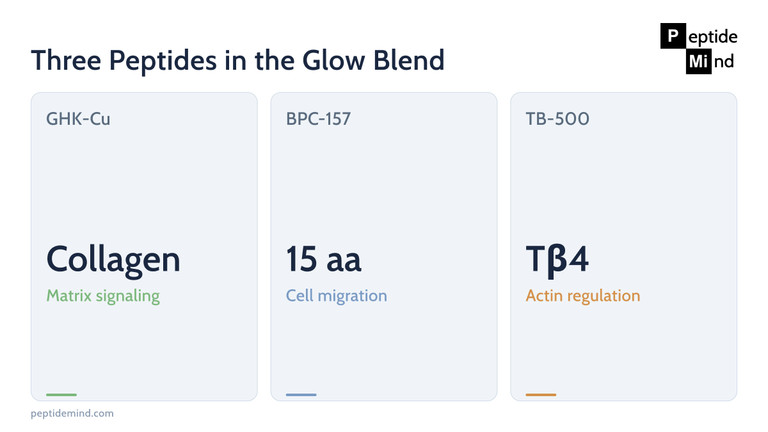
The logic behind grouping them is that each peptide is investigated for a different part of the tissue-repair process: extracellular matrix and collagen signaling (GHK-Cu), cell migration and vascular response (BPC-157), and actin regulation during cell movement (TB-500). The table below summarizes the three components before the sections that follow examine each in detail.
Component | Type | Studied primarily for |
|---|---|---|
GHK-Cu | Naturally occurring copper-binding tripeptide (glycyl-L-histidyl-L-lysine) | Collagen and extracellular matrix signaling in skin and fibroblast research |
BPC-157 | Synthetic 15-amino-acid peptide ("pentadecapeptide") | Cell migration, angiogenesis, and the nitric oxide system in preclinical models |
TB-500 | Synthetic peptide based on the actin-binding region of Thymosin Beta-4 | Actin regulation and cell migration in tissue-repair models |
A frequent point of confusion is that "Glow" has two unrelated meanings online. One is this injectable research blend. The other is topical cosmetic skincare, such as peptide "glazing" serums sold for at-home use. This article addresses the research-compound blend, not cosmetic products.
What Is in the Glow Peptide Blend?
The Glow peptide blend contains GHK-Cu, BPC-157, and TB-500 in fixed proportions that vary slightly by supplier. Each is a distinct compound with its own research record, and understanding the blend means understanding the three molecules separately rather than treating "Glow" as a single agent.
GHK-Cu
GHK-Cu is a naturally occurring tripeptide, glycyl-L-histidyl-L-lysine, that binds copper ions and is present in human plasma. In research, it is the component most associated with the extracellular matrix. According to a 2018 review in the International Journal of Molecular Sciences by Pickart and Margolina, GHK has been reported to stimulate collagen, elastin, and glycosaminoglycan synthesis in cell and tissue studies, and to modulate a broad set of genes involved in tissue remodeling. The same review describes anti-inflammatory and antioxidant activity in laboratory models. These findings come from in vitro and preclinical work and have not been established as outcomes in humans.
The copper-binding property is central to how GHK-Cu is studied, because the copper complex itself appears to participate in the signaling associated with fibroblast activity and matrix turnover. This is the mechanistic reason GHK-Cu is grouped into a blend marketed around skin and connective tissue.
BPC-157
BPC-157 is a synthetic peptide of 15 amino acids, derived from a sequence identified in a protein found in gastric juice, which is why it is often called a "stable gastric pentadecapeptide." In the Glow blend it is the component most associated with cell migration and vascular response. A 2011 study in the Journal of Applied Physiology by Chang and colleagues reported that BPC-157 increased the migration of cultured tendon fibroblasts in a dose-dependent manner and was associated with greater cell survival under oxidative stress, acting through the focal adhesion kinase (FAK)-paxillin signaling pathway. These observations were made in cultured cells and rat models and should be interpreted with caution.
A separate line of research connects BPC-157 to the vascular system. A review of the BPC-157 and nitric oxide relationship by Sikiric and colleagues describes its reported participation in angiogenesis, endothelial activity, and the regulation of the NO system in injury models. This data comes from animal and laboratory systems, and further controlled research is needed before any conclusions about human physiology can be drawn.
TB-500
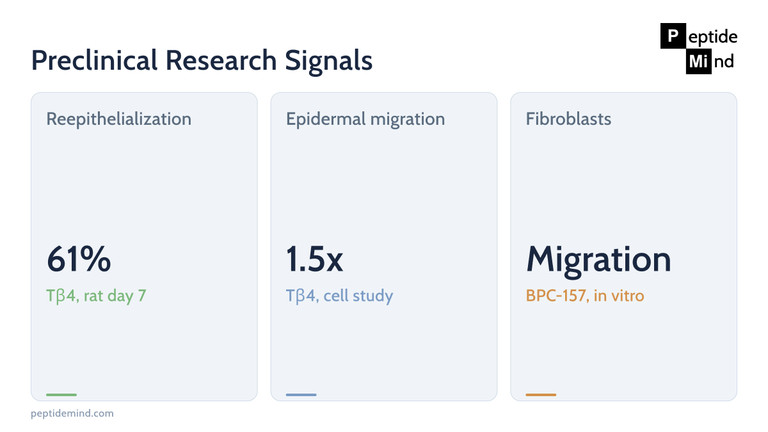
TB-500 is a synthetic peptide built around the actin-binding region of Thymosin Beta-4 (Tβ4), the major actin-sequestering protein in mammalian cells. In the blend it represents the actin-regulation and cell-motility component. As described in a 2005 review in Trends in Molecular Medicine by Goldstein, Hannappel, and Kleinman, Tβ4 is a 43-amino-acid protein that binds monomeric actin and has been investigated in tissue-repair signaling. In a controlled rat wound study published in 1999, Thymosin Beta-4 was associated with a 42% increase in reepithelialization at four days and as much as 61% at seven days compared with saline controls, alongside increased angiogenesis. These results were observed under controlled laboratory conditions in animals and may not translate to human outcomes. For a fuller breakdown of the fragment-versus-protein distinction, see the Peptide Mind guide to TB-500 vs Thymosin Beta-4.
What Does Glow Peptide Do in Research?
In research, the Glow peptide blend is studied as a way to investigate three overlapping repair pathways at once: matrix and collagen signaling, cell migration with vascular response, and actin regulation. The premise behind combining GHK-Cu, BPC-157, and TB-500 is that each compound is documented in a different part of the tissue-repair literature, so a blend lets researchers examine whether their mechanisms interact. No controlled human trial has established that the three-peptide combination produces a defined clinical result, so the blend remains a preclinical research subject.
Shop research peptides
Live pricing from our top-rated vendor. Prices update as vendor listings change.
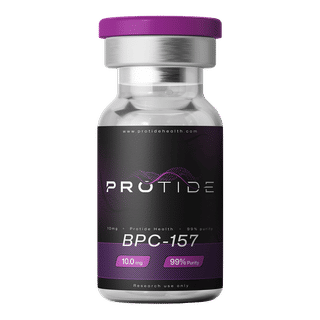
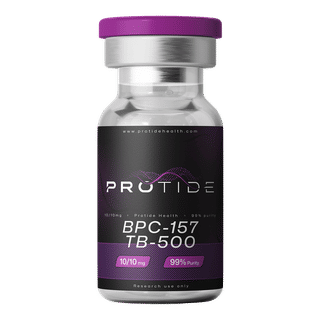
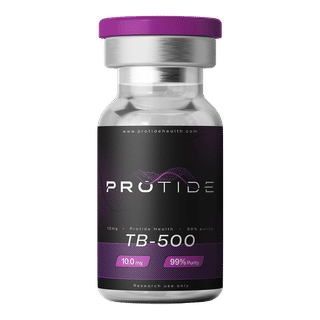
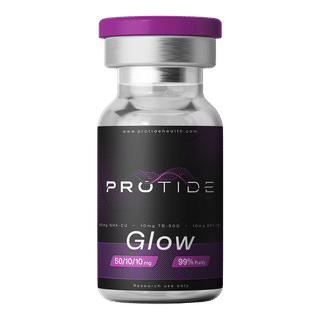
Most of what is claimed for "Glow" online combines the separately documented activities of its components. GHK-Cu has been examined in skin and fibroblast research for its association with collagen and elastin signaling, BPC-157 in migration and angiogenesis models, and TB-500 in actin-dependent cell movement. Each of these observations comes from isolated studies of single compounds, and the marketed combination has not itself been validated in controlled human research. Any description of the blend "working" should be read as a summary of preclinical findings on the individual peptides, not as a demonstrated outcome of the stack.
In the foundational rat wound study, Thymosin Beta-4 was associated with roughly 11% greater wound contraction by day 7 and a statistically significant 1.5-fold increase in epidermal cell migration after topical application. These outcomes were observed in an animal model and have not been confirmed in humans.
Glow Peptide Dosage in Research: What Published Studies Used
There is no standardized dosage for the Glow peptide blend, because the combination has not been the subject of controlled dosing studies; the figures circulating online come from vendor marketing rather than peer-reviewed research. Published studies that inform the blend used the individual peptides separately, across different species, routes, and concentrations, which makes any single "Glow dosage chart" scientifically unsupported. The amounts below describe what isolated component studies used in animals and are reported for context only, not as instructions.
In the BPC-157 tendon research, the compound was applied to cultured cells and delivered to rats at microgram-per-kilogram ranges that varied by experiment. In the Thymosin Beta-4 wound studies, the protein was applied topically and intraperitoneally in rats over several days. GHK-Cu research has used topical and in vitro concentrations in skin and fibroblast models. Because the three molecules differ substantially in size and potency, the same milligram quantity represents very different molar amounts, which is one reason a blended "dose per day" figure has no rigorous basis.
Researchers calculating working concentrations from a lyophilized vial can use the Peptide Mind dosage calculator to convert vial size and diluent volume into a concentration per unit. This is a measurement tool for laboratory handling, not a recommendation for any living subject. Marketed "Glow" kits frequently advertise a fixed multi-week schedule, but that schedule reflects commercial packaging rather than validated research dosing.
How to Reconstitute Glow Peptide
Learn how to reconstitute Glow Protocol from a lyophilized 70 mg vial, store it correctly, and administer a measured dose. The Glow Protocol vial contains BPC-157 (10 mg), TB-500 (10 mg), and GHK-Cu (50 mg). Reconstituting with 3 mL of bacteriostatic water yields a concentration of about 23.33 mg per mL, so a 0.10 mL draw delivers roughly 2.31 mg of the combined blend.
Broken down that's:
330 mcg of BPC-157
330 mcg of TB-500
1.65mg of GHK-Cu
When taking blends, calculate the dosage based on the anchor compound you are targeting. Learn more by utilizing the peptide blend calculator.
The full step-by-step method, including diluent selection and volume math, is covered in the Peptide Mind peptide reconstitution guide and the worked example in how to reconstitute BPC-157.
Materials Needed
Insulin syringes (0.5–1 mL, 29–31 gauge)
3 mL syringe with 18–21 gauge needle (for reconstitution)
Bacteriostatic water (BAC water), 3 mL per 70 mg vial
Alcohol swabs
Lyophilized Glow Protocol vial (70 mg: BPC-157 10 mg, TB-500 10 mg, GHK-Cu 50 mg)
Sharps disposal container
Step-by-Step Reconstitution Guide for Glow Peptide
Allow the lyophilized Glow Protocol vial (70 mg) to come to room temperature before reconstitution.
Draw 3 mL of bacteriostatic water (BAC water) into a 3 mL syringe.
Wipe the vial's rubber stopper with an alcohol swab and allow it to dry for 10 seconds.
Insert the syringe needle at an angle against the inside glass wall of the vial. Never point it directly at the powder.
Inject the BAC water slowly down the side of the vial to avoid foaming or denaturing the peptides.
Gently swirl the vial in a circular motion until the powder is fully dissolved. Do not shake.
Label the vial with the reconstitution date and store refrigerated at 2–8 °C, protected from light. Use within 4 weeks.
Draw the desired dose (for example, 0.10 mL for 2.31 mg of blend) into an insulin syringe.
Select an injection site on the abdomen at least 2 inches from the navel and clean it with an alcohol swab.
Pinch the skin, insert the needle at a 45-degree angle, and inject slowly over 2–3 seconds. Do not aspirate.
Withdraw the needle and apply gentle pressure with a clean cotton swab. Do not rub.
Rotate injection sites each day across at least four quadrants of the abdomen.
Glow Peptide Side Effects and Safety Considerations
Because the Glow peptide blend has not been evaluated in controlled human trials, its side-effect profile in people is not established, and any safety discussion is limited to what is reported for the individual compounds in research settings. The most commonly discussed observations in the wider peptide literature involve localized reactions at the site of administration in animal studies and the general uncertainty that accompanies any unapproved research compound. The absence of documented serious effects in preclinical work is not the same as demonstrated safety in humans.
Two factors specific to a blend deserve attention in any research context. Combining three compounds increases the number of variables and potential interactions, which makes isolating cause and effect harder and is itself a reason controlled data is thin. Purity and identity also matter more for a blend: a product that mislabels the ratio of GHK-Cu to BPC-157 to TB-500, or that contains impurities, introduces risks unrelated to the peptides themselves. Third-party testing and a certificate of analysis are the practical safeguards researchers rely on. None of this constitutes medical or safety advice for human use.
Shop research peptides
Live pricing from our top-rated vendor. Prices update as vendor listings change.
GLOW vs KLOW Peptide
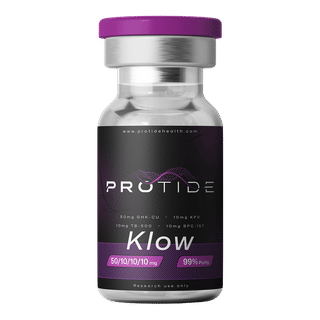
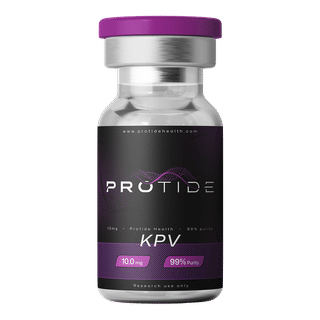
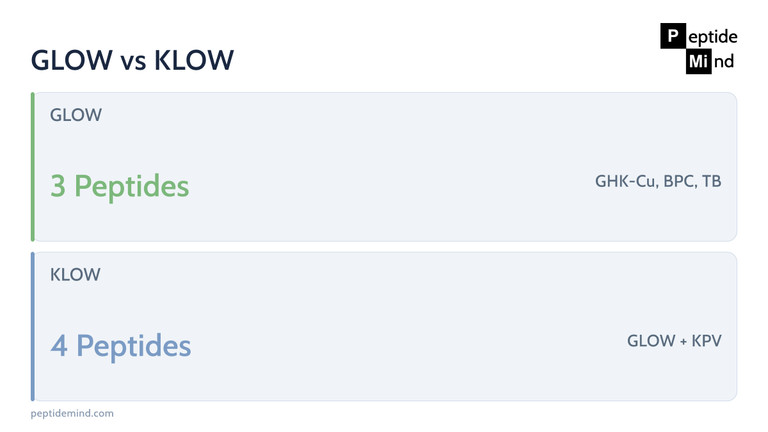
The difference between GLOW and KLOW is one ingredient: KLOW is the same three-peptide blend as GLOW (GHK-Cu, BPC-157, TB-500) with a fourth peptide, KPV, added. KPV is a short tripeptide fragment studied mainly for its association with inflammatory signaling in preclinical models. In practice, suppliers position GLOW as the three-component formulation and KLOW as the four-component version, which is why "klow vs glow peptide" is a common comparison search. A detailed KLOW vs GLOW breakdown covers the component ratios and research differences between the two blends. If KLOW is the formulation you are weighing up, our guide to KLOW peptide benefits grades each of its four components against the research and against what users actually report.
For research purposes, the distinction matters because adding a fourth compound adds another variable. A study designed around GLOW examines three overlapping pathways; adding KPV in the KLOW formulation introduces a separate inflammatory-signaling element. Neither blend has been validated as a combination in controlled human research, so the choice between them in a research setting comes down to which compounds the work is designed to investigate, confirmed against each product's certificate of analysis. For wider context on how multi-compound pairings are grouped by research objective, the Peptide Mind overview of eight peptide stacks and what each is studied for covers the repair-focused blends alongside the growth hormone and metabolic pairings.
Glow Peptide Before and After: What the Research Actually Shows
Searches for "glow peptide before and after" are looking for outcome photos, but there is no controlled human trial of the blend that produced peer-reviewed before-and-after data, so the images circulating online are anecdotal and unverified. What the published literature offers instead is mechanistic and animal-model evidence for the individual components: GHK-Cu's association with collagen signaling in fibroblast studies, BPC-157's documented effect on cell migration, and Thymosin Beta-4's measured changes in reepithelialization in rat wounds. These are laboratory observations, not human results, and they cannot be assumed to predict any visible change in a person.
Anecdotal reports, including community discussions on forums such as Reddit, describe self-reported timelines over multi-week periods. These accounts are not controlled data, lack verification of the product's contents, and are subject to placebo and reporting bias. They should be treated as informal commentary rather than evidence of an effect.
Where Glow Peptide Research Stands
The Glow peptide blend sits in a familiar position for combination research compounds: its individual components have meaningful preclinical literature, while the blend itself has none of the controlled human data that would make outcome claims legitimate. That gap is the single most important thing to understand about it. The honest summary is that GHK-Cu, BPC-157, and TB-500 are each real subjects of published research, and that combining them is a commercial and exploratory choice rather than a clinically validated one.
For researchers sourcing material, identity and purity are the variables that matter, since a "Glow" label tells you nothing about the actual ratio or quality inside the vial. A third-party certificate of analysis with mass-spectrometry confirmation is the reliable check. For broader context on how these compounds compare with others studied in the same space, the Peptide Mind guide to peptides studied for injury recovery covers BPC-157, GHK-Cu, and TB-500 individually, and the BPC-157 research guide goes deeper on the most-discussed component.
Frequently Asked Questions
What does glow peptide do?
In research, glow peptide is studied as a combination of three compounds that each act on a different repair pathway: GHK-Cu on collagen and matrix signaling, BPC-157 on cell migration and the vascular system, and TB-500 on actin regulation. The blend itself has not been validated in controlled human trials, so any description of what it "does" is a summary of preclinical findings on the individual peptides rather than a demonstrated outcome of the stack.
How often is glow peptide used in research?
There is no established frequency, because the combination has not been studied in controlled dosing trials. Component research used the individual peptides on varying schedules across different animal models. Marketed "Glow" kits advertise fixed multi-week schedules, but those reflect commercial packaging rather than validated research dosing, and they are not instructions for human use.
What are the side effects of glow peptide?
Because the blend has not been evaluated in controlled human trials, its side-effect profile in people is not established. Discussion in the wider research literature centers on localized reactions in animal studies and on the general uncertainty of unapproved compounds. Purity and correct labeling are practical concerns for any blend, which is why third-party testing matters. This is not medical or safety guidance.
Are glow peptides legit?
The individual peptides in the blend (GHK-Cu, BPC-157, and TB-500) are genuine compounds with published preclinical research. The blend as a marketed product is a commercial formulation, not a clinically validated treatment, and outcome claims attached to it are not supported by controlled human data. The reliable check on whether a specific product is what it claims to be is a third-party certificate of analysis.
How long is a glow peptide cycle in marketed protocols?
Shop research peptides
Live pricing from our top-rated vendor. Prices update as vendor listings change.
Vendors commonly advertise a multi-week schedule, often around six weeks, but this is marketing language rather than a research-derived parameter. No controlled study has established a duration for the blend in any subject. Reported timelines should be understood as commercial or anecdotal, not as validated research findings.
What is the difference between the glow stack and the glow blend?
They are the same thing. "Glow stack," "glow blend," and "the glow peptide" are interchangeable market terms for the GHK-Cu, BPC-157, and TB-500 combination. The word "stack" reflects the practice of grouping multiple peptides, while "blend" emphasizes that they are supplied together. Exact ratios vary by supplier and are listed on the certificate of analysis.
What should glow peptide not be mixed with?
In a research context, the relevant caution is that combining additional compounds adds variables and makes results harder to interpret, which is the same reason the KLOW formulation (Glow plus KPV) is studied as a separate blend. Questions about combining research compounds with anything intended for a living subject fall outside research framing and should be directed to a qualified professional.
References
Pickart L, Margolina A. "Regenerative and Protective Actions of the GHK-Cu Peptide in the Light of the New Gene Data." International Journal of Molecular Sciences, 2018;19(7):1987. https://pubmed.ncbi.nlm.nih.gov/29986520/
Chang CH, Tsai WC, Lin MS, Hsu YH, Pang JS. "The promoting effect of pentadecapeptide BPC 157 on tendon healing involves tendon outgrowth, cell survival, and cell migration." Journal of Applied Physiology, 2011;110(3):774-780. https://journals.physiology.org/doi/full/10.1152/japplphysiol.00945.2010
Sikiric P, Seiwerth S, Brcic L, et al. "Stable gastric pentadecapeptide BPC 157-NO-system relation." Current Pharmaceutical Design, 2014. https://pubmed.ncbi.nlm.nih.gov/23755725/
Goldstein AL, Hannappel E, Kleinman HK. "Thymosin β4: actin-sequestering protein moonlights to repair injured tissues." Trends in Molecular Medicine, 2005. https://pubmed.ncbi.nlm.nih.gov/16099219/
Malinda KM, Sidhu GS, Mani H, et al. "Thymosin beta4 accelerates wound healing." Journal of Investigative Dermatology, 1999. https://pubmed.ncbi.nlm.nih.gov/10469335/
Three Peptides, One Label
Glow peptide is best understood as a label, not a molecule: a fixed blend of GHK-Cu, BPC-157, and TB-500, each with its own preclinical research record and none with controlled human data as a combination. The individual compounds are genuine research subjects studied for matrix signaling, cell migration, and actin regulation, while the stack itself remains exploratory. For any rigorous work, the certificate of analysis confirming the identity and ratio of the three peptides matters far more than the name on the vial.
Research Disclaimer
The information presented in this article is for educational and research purposes only. Peptide Mind provides evidence-based research summaries and does not offer medical advice, diagnosis, or treatment recommendations. All peptides discussed are intended for in vitro and preclinical research use only. Consult a qualified healthcare professional before making any health-related decisions. The research cited may not reflect the full body of available evidence, and findings from preclinical studies may not translate to human outcomes. By accessing this site, you confirm you are over the age of 21, waive any claims or liability arising from the use of the content portrayed, and fully indemnify Peptide Mind against any unauthorized usage, claims, or liability in accordance with our Terms of Service.
Add a comment
This will be publicly visible.
Your email address will not be published.
Your comment will be reviewed by an admin before it is published.