How to Reconstitute Glow Peptide: The 70 mg Vial, Step by Step
How to reconstitute Glow peptide step by step: BAC water for a 70 mg vial, what 10 units delivers at each dilution, storage limits, and the mistakes people report.
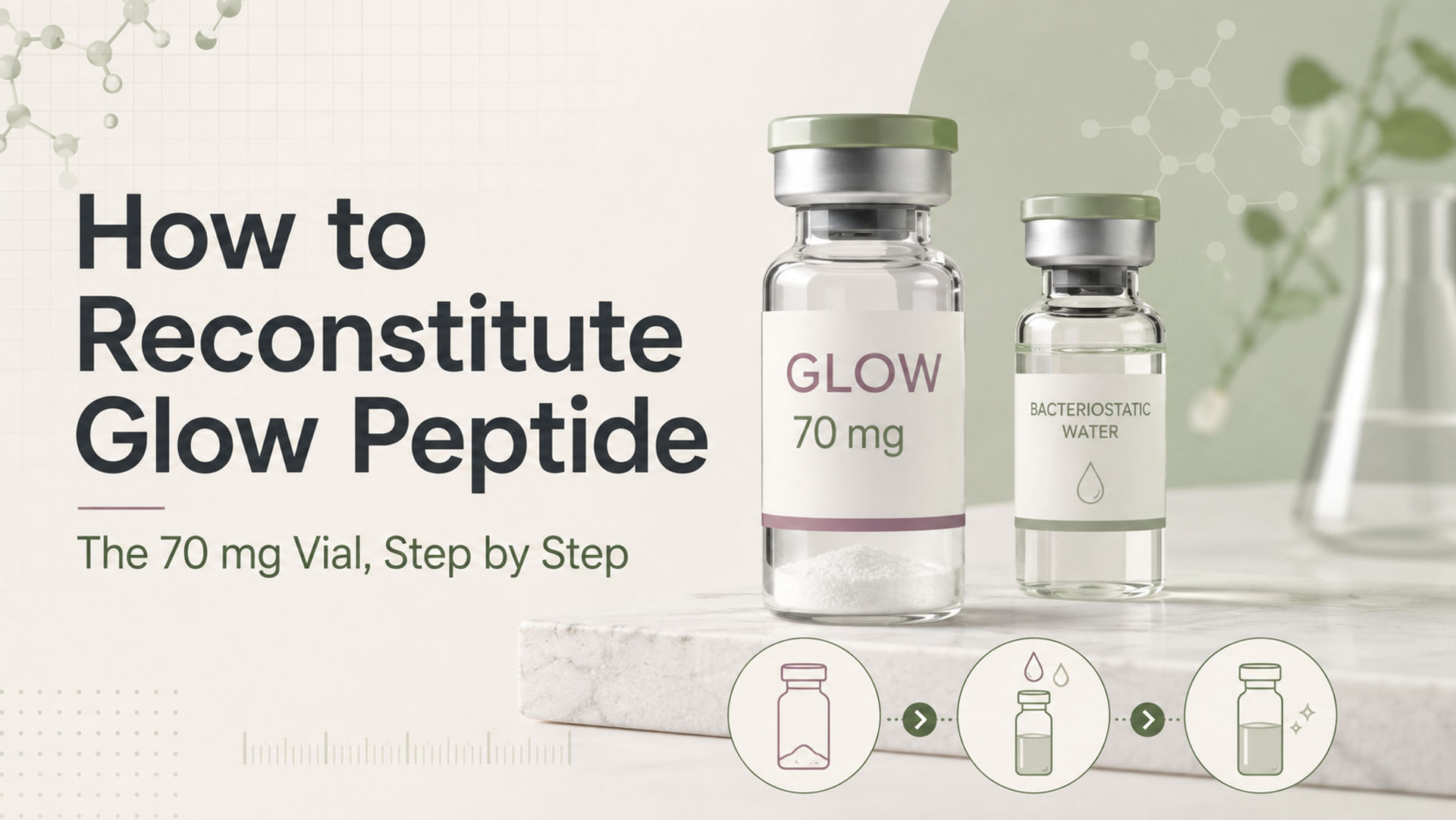

Knowing how to reconstitute Glow peptide comes down to one decision and four habits: add 2 to 3 mL of bacteriostatic water to the 70 mg vial, aim the stream at the glass wall, swirl until the powder dissolves into a clear, faintly blue solution, then label and refrigerate. This guide covers the supplies, the math behind each dilution, the five steps in order, storage limits, and the mistakes people run into most often with Glow peptide.
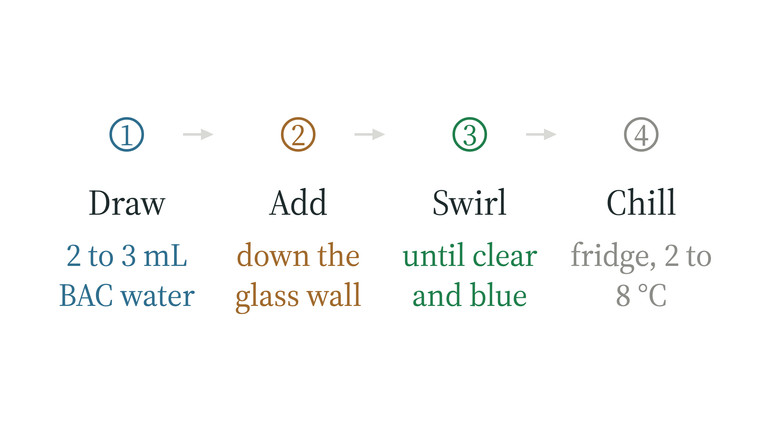
How to Reconstitute Glow Peptide: What You Need First
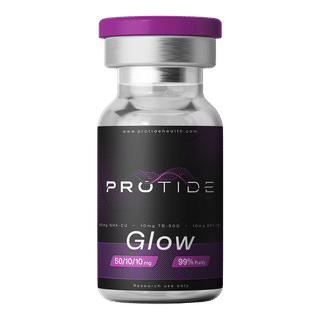
Glow is a pre-mixed research blend of three peptides in one lyophilized vial, most often 50 mg of GHK-Cu, 10 mg of BPC-157, and 10 mg of TB-500, for 70 mg total. Because the three are already combined, you reconstitute the vial once and every draw contains all three in the same 5:1:1 ratio. The only decision is how much water to add. If you have never mixed a vial before, Peptide Mind's general guide to reconstituting peptides covers the basics; this article covers what is specific to the Glow blend.
Supplies
One 70 mg Glow vial, brought to room temperature
Bacteriostatic water (BAC water), at least 3 mL
A 3 mL syringe for the water transfer
An 18 to 21 gauge needle for the transfer syringe
U-100 insulin syringes (0.5 or 1 mL, 29 to 31 gauge) for drawing doses
Alcohol swabs
A label or marker (optional)
Sharps container (optional)

BAC Water vs Sterile Water
Use bacteriostatic water. It is sterile water with 0.9% benzyl alcohol, a preservative that lets you puncture the same vial repeatedly for weeks. Plain sterile water has no preservative, so a vial mixed with it should be used within a day, which does not work for a 20 to 30 dose vial. Peptide Mind's guide to bacteriostatic water for peptides covers the differences in detail.
Step 1: Choose Your BAC Water Volume and Do the Math
Add 2 mL, 2.5 mL, or 3 mL of BAC water to a 70 mg Glow vial. The water volume does not change how much peptide is in the vial; it only sets the concentration, and therefore how many syringe units deliver a given dose. All three volumes are common, and each has a reason to pick it.
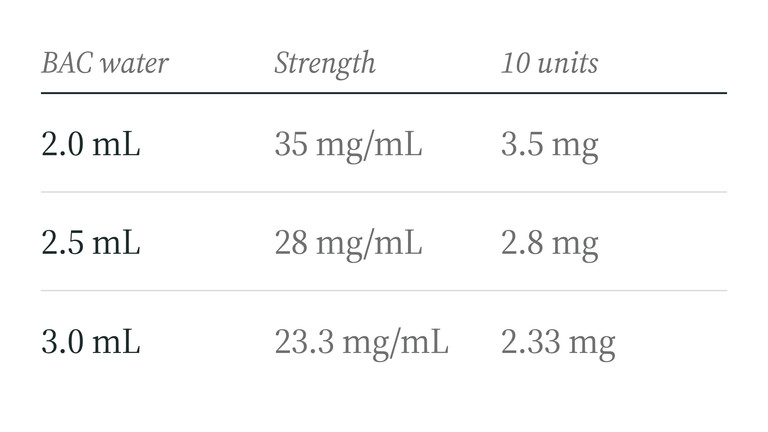
BAC water added | Concentration | 10 units (0.10 mL) delivers |
|---|---|---|
2.0 mL | 35 mg/mL | 3.5 mg blend: 2.5 mg GHK-Cu, 500 mcg BPC-157, 500 mcg TB-500 |
2.5 mL | 28 mg/mL | 2.8 mg blend: 2.0 mg GHK-Cu, 400 mcg BPC-157, 400 mcg TB-500 |
3.0 mL | 23.3 mg/mL | 2.33 mg blend: 1.67 mg GHK-Cu, 333 mcg BPC-157, 333 mcg TB-500 |
The formula: concentration (mg/mL) equals total peptide (70 mg) divided by water added (mL). Units to draw equals target dose (mg) divided by concentration, multiplied by 100, because one unit on a U-100 insulin syringe is 0.01 mL.
Which Volume Should You Pick?
Choose 2.5 mL if you want the dose on Peptide Mind's Glow protocol page, 2.8 mg of blend containing 2 mg of GHK-Cu, to land on exactly 10 units. Choose 3 mL for the cleanest per-unit math (about 233 mcg of blend per unit) and the most doses per vial: 30 draws of 10 units. Choose 2 mL if you dose at the top of the range and want small injection volumes. The peptide blend calculator works this out for any vial ratio and target dose.
Two checks before you draw water. First, look at the vial size. Many 70 mg Glow vials are 3 mL glass, so 3 mL fills them to the stopper and 4 mL will not fit; one user on r/Peptides reconstitutes in 4 mL by transferring to a 5 mL sterile vial. Second, decide which number you are dosing from. The most common calculator mistake in that thread is entering 50 mg (the GHK-Cu alone) when the field asks for total vial contents, or the reverse, which throws every draw off by 30 to 40% depending on the direction of the error.
Step 2: Prepare the Vials and Draw the Water
Let the Glow vial sit at room temperature for 15 to 20 minutes, then wipe both rubber stoppers with an alcohol swab and let them dry fully. A vial pulled straight from the fridge collects condensation on the stopper, and a wet stopper is the easiest way to carry contamination into the vial on the needle.
Draw the chosen volume of BAC water into the 3 mL syringe with the 18 to 21 gauge needle. If you only have insulin syringes, draw 1 mL at a time and repeat. Pull slightly more than you need, tap the barrel to move air bubbles to the top, and push the plunger to the exact mark.
Shop research peptides
Live pricing from our top-rated vendor. Prices update as vendor listings change.

Technique matters more than most guides admit. A hospital study that cultured 40 in-use multidose vials found a 25% contamination rate, with skipped stopper disinfection and needles left sitting in the stopper among the practices blamed. A Glow vial you will puncture 20 to 30 times is a multidose vial in every sense, so the swab-and-dry step is not optional.
Step 3: Add the Water Down the Glass Wall
Push the needle through the Glow vial stopper at an angle so the tip rests against the inside of the glass, then depress the plunger slowly, over 20 to 30 seconds, so the water runs down the wall and pools under the powder. Never aim the stream at the cake and never inject fast enough to create foam.
The reason applies to every peptide. Agitation-induced protein aggregation is driven mainly by protein adsorbing at air-water interfaces, where molecules unfold and stick together into particles, according to interfacial rheology work in the Journal of Pharmaceutical Sciences. Foam is nothing but air-water interface, so a jet that froths the powder creates exactly the conditions that turn dissolved peptide into insoluble aggregate.
The components tolerate the water itself well. A 2026 review in Pharmaceutics on BPC-157 formulation notes the sequence contains no methionine, cysteine, asparagine, or glutamine, giving it a favourable oxidation and deamidation profile, with the aspartate pair at positions 10 and 11 the main hydrolysis risk under acidic and neutral conditions.
GHK-Cu was stable in water in the pH range 4.5 to 7.4 for at least two weeks at 60 °C, according to Pickart, Vasquez-Soltero and Margolina in BioMed Research International (2015). Bacteriostatic water sits at a pH of roughly 5.7, well inside that window.
Step 4: Swirl, Inspect, and Expect a Blue Tint
Withdraw the transfer needle, then roll or swirl the vial gently between your fingers for one to two minutes until no powder remains, and hold it up to the light. A correctly mixed Glow vial is clear, free of particles, and tinted blue or blue-green. Do not shake it, and do not use a vortex mixer.
The colour comes from copper. GHK-Cu is a copper(II) complex, and copper(II) in solution reads as blue to the eye. The tint scales with concentration, so a 2 mL mix looks darker than a 3 mL mix of the same vial. A 50/10/10 vial that stays colourless after mixing is unusual and worth raising with the vendor, though a low-copper ratio like 30/10/5 will be paler.
Most of the cake dissolves on contact; flecks that persist usually clear with another minute of swirling. If the solution is cloudy, gelled, or has visible strands after five minutes, something is wrong. Peptide Mind's guide to cloudy and gelled peptide solutions walks through the causes. Glow is not one of the hydrophobic peptides prone to gelling, so persistent cloudiness in this blend points to a contamination or quality problem.
Step 5: Label, Refrigerate, and Draw Each Dose
Write the reconstitution date on the vial and put it in the fridge at 2 to 8 °C, upright and out of light, within minutes of mixing. From this point the vial is a multidose container with a preservative, and the standard convention for such vials is 28 days from first puncture. Plan the vial around that number.
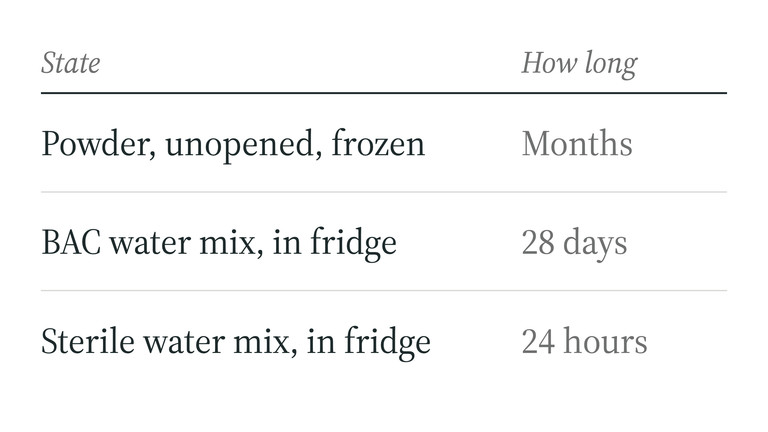
State | Where to keep it | How long |
|---|---|---|
Lyophilized powder, unopened | Freezer at -20 °C (fridge is acceptable short term) | Months; long-term storage is best frozen |
Reconstituted with BAC water | Fridge at 2 to 8 °C, protected from light | 28 days by multidose vial convention |
Reconstituted with sterile water | Fridge at 2 to 8 °C | Use within 24 hours |
The guidance on the powder comes from laboratory practice. A 2016 consensus paper in Clinical Chemistry recommends that peptides stored longer than six months be kept lyophilized at -20 to -80 °C, with solutions held at 4 °C only short term and repeated freeze-thaw avoided. Do not freeze a reconstituted Glow vial; ice crystals and freeze concentration damage peptides.
Drawing a Dose
Swab the stopper, draw the dose into a fresh insulin syringe, and return the vial to the fridge immediately. Every puncture gets a new needle; a needle that has been through skin is dull and carries skin flora back into the vial. If you pull three separately reconstituted vials into one syringe, which many people do, use one needle to draw and a fresh one to inject.
The 28-day figure is a convention, and community experience runs well past it. In an r/Peptides thread on Glow and KLOW shelf life, users call 28 days the official answer while reporting 10 to 12 weeks, and in one case 16 weeks, on a single vial with no visible change. No published study has measured Glow blend potency over time in BAC water, so nobody in those threads can say how much activity was left. A cleanly handled vial does not become dangerous on day 29; potency past a month is simply unmeasured.
Common Mistakes and How to Avoid Them
Shop research peptides
Live pricing from our top-rated vendor. Prices update as vendor listings change.
The mistakes that keep coming up in the threads below are more useful than theoretical ones. Most are avoidable with one extra check before the water goes in.
Calculating from the wrong number. Users on r/Peptides repeatedly ask whether to enter 70 mg or 50 mg into a calculator. Enter 70 mg if the calculator asks for total vial contents and you want the blend dose. Enter 50 mg only if it treats the vial as a single peptide and you want to dose off the GHK-Cu, as many experienced users do.
Assuming every Glow vial is 50/10/10. One user found their vial was 70 mg GHK-Cu, 12.5 mg BPC-157 and 11 mg TB-500. The same 3 mL of water gives a different per-unit dose for every ratio. Read the label.
Shaking to speed up dissolution. Foam means aggregate. Swirl, wait, swirl again.
Using sterile water because it was on hand. Without the preservative the vial should be used within a day; adding BAC water afterward does not fix it. Peptide Mind's BAC water shelf life guide covers how long an opened BAC vial itself stays usable.
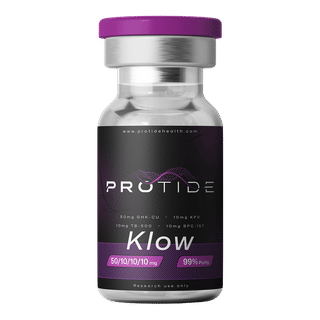
Mixing up Glow and KLOW. KLOW is the four-peptide version with KPV added, usually an 80 mg vial, so the same water volume gives a different concentration. Label both if they share a fridge; Peptide Mind's KLOW guide covers the differences.
Blaming the mix for injection site reactions. Pain, redness, and welts hours after a pin are the most common complaint in Glow threads, and they are usually a GHK-Cu response, not a reconstitution error. In one detailed r/Peptides thread, a user whose reactions began after a month of trouble-free use listed what helped: more BAC water to lower concentration, a 20 to 30 second push, and an 8 mm needle instead of 6 mm. A first-time user reported delayed site pain at 6 units on a 3 mL mix that disappeared once the next injection went deeper. The opposite is also common: people taking 10 to 12 units on a 3 mL mix describe no sting at all, with the consensus that BPC-157 and TB-500 blunt the copper burn. A painless injection does not mean the vial is fake.
Panicking over a vial left out. When a user asked about a reconstituted Glow vial left on the counter for 24 hours, the consistent answer across a dozen replies was to keep using it, with a minority suggesting a small dose increase. That fits the GHK-Cu heat stability data above, though it is a community judgment rather than a measurement. A day is recoverable; a week is not worth the gamble.
Frequently Asked Questions
How much BAC water do you add to a 70 mg Glow vial?
Add 2 to 3 mL. For most people asking how to reconstitute Glow peptide, 3 mL is the answer: it gives 23.3 mg/mL and about 233 mcg of blend per unit, so 10 units delivers 2.33 mg. Use 2.5 mL (28 mg/mL) if you want the 2.8 mg dose on Peptide Mind's Glow protocol page to land on exactly 10 units. Check that the vial can hold the volume.
How many units of Glow peptide do I inject?
It depends on dilution and target dose. At 3 mL, 10 units is 2.33 mg of blend (1.67 mg GHK-Cu, 333 mcg each of BPC-157 and TB-500). At 2.5 mL, 10 units is 2.8 mg. Users in Glow threads most often describe 10 to 12 unit draws on a 3 mL mix, starting at 5 or 6 units for the first few days.
Why is Glow peptide blue after reconstitution?
Because of the copper in GHK-Cu. GHK binds a copper(II) ion, and copper(II) in solution is blue. The tint is expected, scales with concentration, and is not a sign of degradation. A colourless 50/10/10 vial is more of a concern than a blue one, while low-copper ratios such as 30/10/5 will naturally be paler.
How long does reconstituted Glow peptide last in the fridge?
Plan on 28 days at 2 to 8 °C, the standard beyond-use convention for a preserved multidose vial. Users on r/Peptides report 10 to 16 weeks on a single vial without visible change, but no study has measured Glow potency in BAC water over time. Discard any vial that turns cloudy or grows particles.
Do I enter 70 mg or 50 mg in a peptide calculator for Glow?
Enter 70 mg if the calculator asks for total peptide in the vial and you want a total blend dose. Enter 50 mg only when you are deliberately dosing off the GHK-Cu and the calculator treats the vial as a single peptide. Mixing the two conventions is the most common error in Glow threads; the blend calculator avoids it by taking each component separately.
Can I reconstitute Glow with sterile water instead of BAC water?
You can, but the vial should then be used within about 24 hours because sterile water has no preservative. Bacteriostatic water contains 0.9% benzyl alcohol, which is what allows repeated punctures over four weeks. For a 20 to 30 dose vial, BAC water is the only practical choice.
What if my reconstituted Glow was left out overnight?
Put it back in the fridge and keep using it. The consensus in the r/Peptides thread on a 24-hour lapse is that potency loss is negligible, and GHK-Cu, the bulk of the vial, has been shown stable in water for two weeks at 60 °C. Repeated or multi-day lapses are a different matter; refrigerate between every draw.
Reconstituting Glow Comes Down to Three Numbers
The three numbers are 70 mg in the vial, 2 to 3 mL of BAC water, and 10 units per typical draw. Once you know how to reconstitute Glow peptide with those fixed, the rest is careful handling: water down the wall, a slow swirl, a dated label, and a fresh needle every time. Explore the full Glow protocol research profile for dosing schedules, cycle lengths, and the evidence behind each component.
Disclaimer: The information on Peptide Mind is for educational purposes only and is not a substitute for professional medical advice, diagnosis, or treatment. The peptides discussed are unapproved research chemicals for laboratory and research use only, not for human consumption. These statements have not been evaluated by the FDA, and nothing on this site is intended to diagnose, treat, cure, or prevent any disease. By accessing this site, you confirm you are 21 or older and agree to our Terms of Service.
Add a comment
This will be publicly visible.
Your email address will not be published.
Your comment will be reviewed by an admin before it is published.