Peptides for Eczema: Research, Topical Options, and Community Reports
Peptides for eczema, graded by evidence. Topical peptides with human trial data, injectable research peptides like KPV and GHK-Cu, and what community reports say.


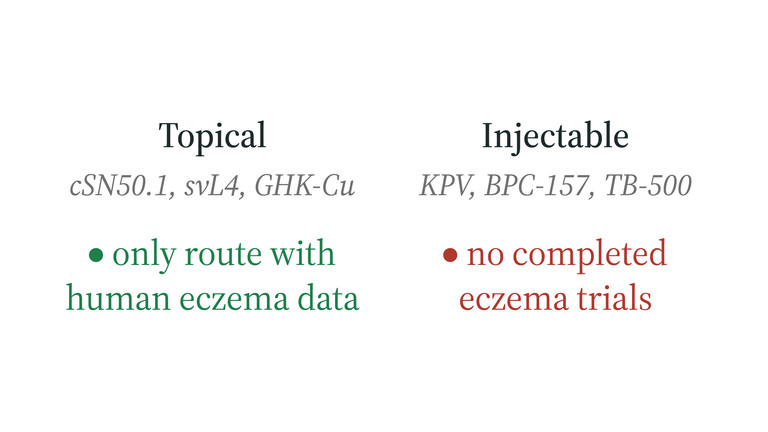
Peptides for eczema fall into two very different categories, and confusing them is the most common mistake people make. Topical peptides have produced real human trial data in atopic dermatitis, while the injectable research peptides discussed online, KPV and GHK-Cu among them, have no completed human eczema trials at all. This guide separates the two, grades what each one actually rests on, and reports what people using them are describing.
Why Eczema Is a Peptide Target in the First Place
Eczema, clinically called atopic dermatitis, involves three problems at once: a skewed immune response, a leaky skin barrier, and bacterial overgrowth. Peptides attract research interest because a single small molecule can touch more than one of those pathways instead of blocking a single receptor.
The immune side
Atopic dermatitis is driven by a type 2 immune response, dominated by the cytokines IL-4, IL-13, and TSLP. TSLP, thymic stromal lymphopoietin, is the alarm signal keratinocytes release that starts the cascade. It is the reason approved biologics like dupilumab target IL-4 and IL-13 receptors, and it is the target several investigational peptides aim at directly.
The barrier side
Loss-of-function mutations in filaggrin, the protein that helps bind skin cells into a sealed layer, are the strongest known genetic risk factor for atopic dermatitis. A weakened barrier lets water out and irritants in, which is why emollients help symptomatically without changing the underlying disease.
The bacterial side
Staphylococcus aureus colonizes eczema skin at rates far above normal. A systematic review of 95 observational studies found a pooled colonization prevalence of 70% on lesional skin, against 39% on non-lesional skin, with colonization rates rising alongside disease severity. Some peptide articles cite 90% for this figure; the meta-analytic number is 70%.
Part of why that happens is a peptide deficiency. In a study published in the New England Journal of Medicine, Ong and colleagues found that lesional skin from atopic dermatitis patients contained significantly lower levels of LL-37 and human beta-defensin 2 than psoriasis lesions, and that the two antimicrobial peptides together killed S. aureus synergistically. More recent work has complicated the picture: a 2023 analysis in Acta Dermato-Venereologica reported that broad antimicrobial peptide loss is not characteristic of atopic dermatitis, with LL-37 the notable exception.
Peptides for Eczema: Where the Evidence Actually Stands
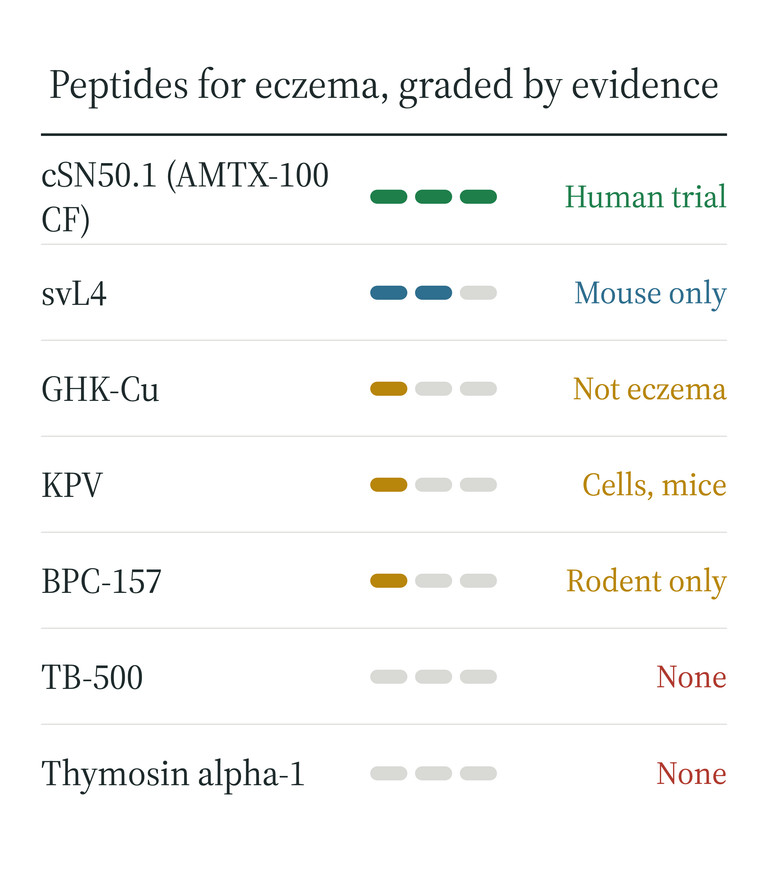
The honest summary is that only topical peptides have human eczema data, and the peptides people talk about most online have the least. The table below grades every peptide covered in this guide by the strongest evidence that exists for eczema specifically, not for wound healing, gut inflammation, or general skin aging.
Peptide | Strongest eczema evidence | Route studied |
|---|---|---|
cSN50.1 (AMTX-100 CF) | Completed Phase 2 human trial | Topical |
svL4 | Mouse eczema models | Topical only |
GHK-Cu | Human skin trials, none in eczema | Topical, injected |
Rodent colitis, cell culture | Oral, injected, iontophoresis | |
Rodent burn and wound models | Topical, injected | |
Wound healing trials, none in eczema | Injected | |
No eczema studies | Injected |
Note what is missing. No peptide in the injectable research category has a completed human trial in atopic dermatitis. That does not make the mechanisms implausible; it means the confidence people express online outruns the published record.
Topical Peptides With Real Eczema Data
Two topical peptides have produced actual eczema results, and neither is a peptide sold as a research chemical. Both were developed as drugs and tested as drugs.
cSN50.1, the peptide furthest along
cSN50.1 is a cell-penetrating peptide developed by Jacek Hawiger's group at Vanderbilt University Medical Center, formulated as AMTX-100 CF. It works as a nuclear transport checkpoint inhibitor, blocking the importin shuttles that carry inflammatory transcription factors into the cell nucleus. Instead of blocking one cytokine, it stops the genes for many of them from switching on.
In human primary keratinocytes, the peptide suppressed at least six inflammatory genes and significantly reduced production of TSLP, GM-CSF, and IL-8 at both 24 and 48 hours. The earlier animal work, published in Scientific Reports, showed genomic control of inflammation in experimental atopic dermatitis with lesion healing and no apparent toxicity.
Shop research peptides
Live pricing from our top-rated vendor. Prices update as vendor listings change.
A Phase 2 trial of topical AMTX-100 CF in adults with mild to moderate atopic dermatitis (NCT04313400) has been completed. The developer reported that in the earlier Phase 1 protocol, 50% of patients reached total or near-total clearance of treated lesions after one week of application, with improvement continuing through a two-week follow-up. Those Phase 1 figures are company-reported rather than peer-reviewed.
svL4 and the delivery lesson
svL4 is a tetravalent peptide of 6,826 daltons tested in mice with eczema induced two ways: topical lipopolysaccharide, and a combination of staphylococcal enterotoxin B with house dust mite extract. Applied topically at 1 μM daily, it returned epidermal thickness to 16.1 μm against a normal value near 17.5 μm within 14 days, and essentially cleared neutrophils from the dermis.
The detail worth carrying forward is the negative result inside the same paper. Subcutaneous injection at 1 nmol per gram of body weight did not work. Topical did. For at least one peptide with genuine eczema data, injecting it was the wrong route.
Cosmetic peptides in eczema-prone skincare
Cosmetic peptide creams are a separate category with a separate purpose. Signal peptides such as palmitoyl pentapeptide-4 and copper tripeptide are formulated to support collagen and barrier proteins, not to suppress the immune response driving a flare. The National Eczema Association's Seal of Acceptance, which several peptide-containing products carry, evaluates whether a formula is free of common irritants and suitable for sensitive skin. It is not a finding of efficacy against eczema.
For most people with eczema-prone skin, the barrier ingredients in those products, ceramides, glycerin, and occlusives, are doing more of the work than the peptides. Peptide Mind's guide to the best skincare peptides covers what each cosmetic peptide class is actually formulated to do.
The Research Peptides for Eczema
This is where nearly all the community activity sits, and where the published evidence is thinnest. Each of the peptides below has real mechanistic research behind it. None of it is eczema research in humans.
KPV
KPV is a tripeptide of lysine, proline, and valine, the C-terminal fragment of alpha-melanocyte stimulating hormone. It keeps the anti-inflammatory activity of the parent hormone without the pigmentation effects, which is why it draws interest for inflammatory skin conditions.
The mechanistic case is genuinely strong. Dalmasso and colleagues at Emory showed that nanomolar concentrations of KPV inhibit NF-κB and MAP kinase signaling, and that KPV delivered at 100 μM in drinking water reduced myeloperoxidase activity by roughly 50% in a DSS mouse colitis model. KPV is transported by PepT1, a peptide transporter that is upregulated in inflamed tissue, which gives it a degree of self-targeting. Separately, alpha-MSH and its KPV fragment show antimicrobial activity against Staphylococcus aureus and Candida albicans, which is mechanistically interesting given the S. aureus problem in eczema.
That is colitis data, cell culture data, and antimicrobial data. There is no published human trial of KPV in atopic dermatitis. The full research picture is covered in Peptide Mind's KPV peptide benefits guide.
GHK-Cu
GHK-Cu is a copper-binding tripeptide first characterized by Loren Pickart in 1973. Its dermatological record is the strongest of any peptide in this section, but it is a cosmetic and wound healing record. Pickart and Margolina reported that GHK-Cu cream applied for 12 weeks improved collagen production in 70% of treated women, compared with 50% for vitamin C cream and 40% for retinoic acid. GHK-Cu also blocks NF-κB p65 and p38 MAPK activation, reducing TNF and IL-6 production.
None of those studies enrolled eczema patients. Peptide Mind's GHK-Cu peptide guide covers topical and injected dosing in the published literature.
BPC-157 and TB-500
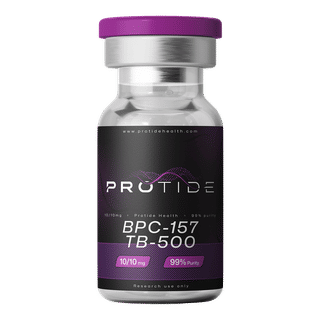
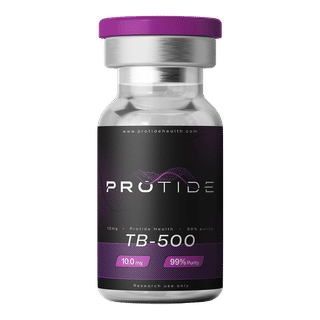
BPC-157 is a 15-amino acid peptide derived from a protein in human gastric juice. Its skin data is real and entirely preclinical: topical BPC-157 accelerated closure in an alkali burn rat model with better re-epithelialization, collagen deposition, and VEGF expression than controls. TB-500, a synthetic fragment of thymosin beta-4, has wound healing data of its own but nothing in atopic dermatitis.
Both appear in eczema discussions mainly because they are anti-inflammatory and appear in popular blends. The gut-skin axis argument, that repairing intestinal barrier function reduces systemic inflammation showing up in skin, is a reasonable hypothesis and not a demonstrated eczema treatment mechanism. Peptide Mind's guide to the best peptides for healing covers the underlying repair research.
Shop research peptides
Live pricing from our top-rated vendor. Prices update as vendor listings change.
Thymosin alpha-1 and LL-37
Thymosin alpha-1 is a 28-amino acid immune-modulating peptide approved in some countries for hepatitis B and used as an adjuvant elsewhere. The theoretical case for eczema is Th1/Treg rebalancing against a Th2-dominant disease. There are no published trials in atopic dermatitis.
LL-37 is the more interesting case, because it is the peptide eczema skin is actually short of. That cuts both ways: LL-37 levels also run high in rosacea, where the peptide drives inflammation rather than resolving it, so supplementing it is not the straightforward fix the deficiency data suggests.
The blends: GLOW and KLOW
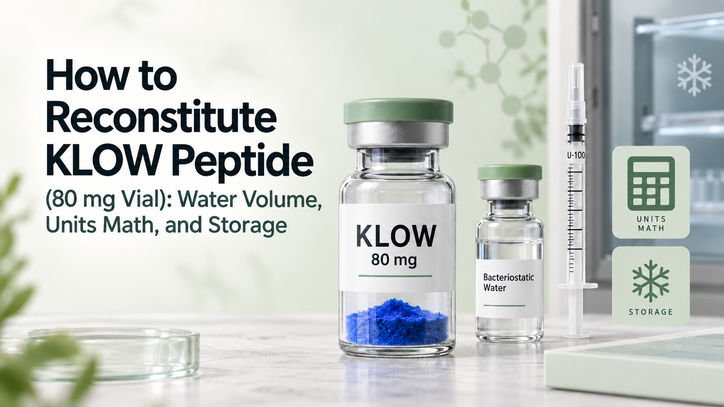
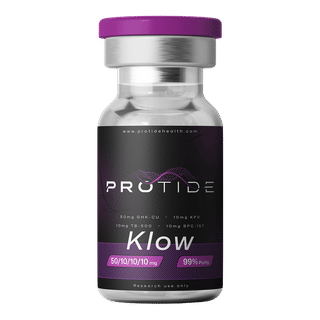
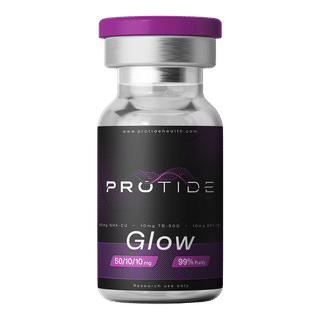
GLOW combines GHK-Cu, BPC-157, and TB-500. KLOW adds KPV to the same three. Neither blend has been studied as a blend for anything, in any model. Everything known about them is inferred from the individual components. Peptide Mind covers what is inside each in the KLOW peptide guide and the GLOW peptide benefits breakdown.

The Delivery Problem Nobody Mentions
KPV does not passively cross intact human skin, which undercuts most homemade topical protocols. In a 2017 study in the Journal of Pharmaceutical Sciences, Pawar and colleagues tested KPV permeation across dermatomed human skin and found that passive diffusion produced permeation below detectable levels. Measurable delivery required microneedle or laser microporation combined with iontophoresis.
KPV permeation across dermatomed human skin by simple passive diffusion was below the limit of detection. A sharp increase in flux appeared only when skin microporation was combined with iontophoresis. Pawar et al., Journal of Pharmaceutical Sciences, 2017.
That matters directly. The community protocol of mixing reconstituted KPV into hyaluronic acid serum and applying it twice daily is, on intact skin, likely delivering very little. There is a real caveat in the other direction: eczematous skin has a compromised barrier by definition, and a broken stratum corneum may permit absorption that healthy skin does not. That has not been measured for KPV.
GHK-Cu is the opposite case. It is small, has decades of topical formulation work behind it, and is used topically in the studies that produced its dermatological data.
What Community Reports Actually Say
Community reports are anecdote, not evidence. They come from people with no control group, no blinding, and no way to separate a peptide from a seasonal change, a diet change, or the natural remitting course of eczema. They are still worth reading carefully, because they are currently the only human record for these compounds in this condition, and because they include outcomes the enthusiastic write-ups leave out.
The positive reports
KPV by subcutaneous injection generates the most consistent positive reports, and the recurring theme is itch reduction arriving before visible skin change. Reports on r/eczema and r/Biohackers describe itching easing within two to three days at doses in the 300 to 1,000 mcg per day range, with skin appearance following weeks later. One user with long-standing hand eczema described roughly 70% skin repair at 0.5 mg daily over ten days. Another reported dyshidrotic eczema clearing after about six weeks of daily injection. Improved sleep, secondary to less night scratching, comes up repeatedly.
Reports on the GLOW blend follow a slower curve. A user running a 50/10/10 mix at 5 units, five days on and two days off, described fewer and shorter flares at four weeks and explicitly called it "not a magic cure." Experienced users in the same threads put the window for noticeable change at eight to ten weeks.
The negative and paradoxical reports
These are the reports most other guides leave out, and they are the reason to treat the positive ones cautiously.
Multiple posts from one user across r/Biohacking and peptide research forums describe KPV appearing to cause eczema: dry red patches on the eyelids and face, then a new patch on the leg, in someone with no prior eczema history.
A recurring context worth naming: many people posting about peptides for eczema arrive after failing dupilumab, JAK inhibitors, or both. That is a population with severe disease and few options, not a population testing a first-line option.
Shop research peptides
Live pricing from our top-rated vendor. Prices update as vendor listings change.
What community reports suggest | What they cannot establish |
|---|---|
Itch may respond faster than visible skin | Whether the effect exceeds placebo |
Doses cluster at 250 to 1,000 mcg KPV daily | Any safe or effective dose |
Some users react badly, including new eczema | How common adverse reactions are |
Timelines run 2 days to 10 weeks | Whether improvement was caused by the peptide |
Practical Considerations
Sourcing is the variable most within a reader's control, and for a three-amino-acid peptide like KPV it matters more than usual. At that size, identity and purity are difficult to eyeball and easy to misrepresent, so a batch-specific certificate of analysis with HPLC purity data is the minimum documentation worth accepting. Mass spectrometry confirming molecular weight is better.
A few things the research record supports saying plainly:
Route is not interchangeable. The svL4 work showed topical succeeding where subcutaneous failed. The KPV permeation work showed topical failing on intact skin where injection would not. Assume nothing about a route that has not been tested.
Blends have no blend data. GLOW and KLOW are combinations assembled by vendors, not protocols validated in any study.
Nothing here replaces treatment that works. Dupilumab and JAK inhibitors have large randomized trials behind them. Peptides in this category have none for eczema.
Track one variable at a time. Several community reports lost interpretability by adding GHK-Cu to a working KPV protocol and then not knowing which compound caused the change.
For converting a vial to a specific concentration, the peptide dosage calculator handles reconstitution math.

Frequently Asked Questions
Do peptides actually work for eczema?
Topical peptides developed as drugs have human evidence. AMTX-100 CF completed a Phase 2 trial in mild to moderate atopic dermatitis. The injectable research peptides discussed online, including KPV, GHK-Cu, and BPC-157, have no completed human eczema trials. Community reports for KPV are frequently positive but include clear negative outcomes.
Which peptide is best for eczema?
By evidence, cSN50.1 in the AMTX-100 CF formulation has the strongest record, but it is an investigational drug and not commercially available. Among peptides people can obtain, KPV has the most relevant anti-inflammatory mechanism data and the most community reports, though all of its published research is in colitis models and cell culture rather than skin disease.
Can peptides cause eczema?
Community reports describe exactly this. Multiple posts document new eczema patches on the eyelids, face, and legs after starting KPV, including in a person with no prior eczema history, with the pattern recurring on rechallenge. Others report initial worsening of existing inflammation before improvement. No controlled study has measured how often this happens.
Are copper peptides good for eczema?
GHK-Cu has strong topical evidence for collagen production and barrier protein support, with one 12-week study showing improved collagen synthesis in 70% of treated subjects. None of that research enrolled eczema patients. Some community reports describe GHK-Cu causing temporary dryness and returning itch when added to an existing protocol.
Are collagen peptides good for eczema?
Oral collagen peptides are a different product class from the research peptides in this guide. They have some trial data for skin hydration and elasticity in healthy adults, but no controlled trials in atopic dermatitis. There is no published evidence that oral collagen affects eczema severity, flare frequency, or itch.
How long does KPV take to work for eczema?
Community reports place itch reduction at two to three days and visible skin change at four to six weeks, with dyshidrotic eczema reports running about six weeks to clearance. Blend protocols like GLOW are described as slower, with users citing eight to ten weeks. These are self-reported timelines with no control comparison.
Shop research peptides
Live pricing from our top-rated vendor. Prices update as vendor listings change.
Is topical or injectable better for peptides and eczema?
It depends entirely on the peptide, and the research contradicts the intuition. svL4 cleared eczema in mice topically but failed when injected subcutaneously. KPV shows the opposite constraint: passive permeation across intact human skin is below detection, so injection or oral dosing bypasses a real delivery barrier. Neither route has been compared head to head in humans with eczema.
What This Means for Anyone Researching Peptides for Eczema
Peptides for eczema are best understood as two separate stories: a small group of topical drug candidates with genuine human trial data, and a much larger group of research peptides carrying strong mechanistic rationale, meaningful community interest, and no eczema trials at all. The gap between those two is the thing worth keeping straight, especially when community reports include people whose skin got worse. Explore the KPV peptide research to see what the underlying studies actually measured.
References
Totté JEE, van der Feltz WT, Hennekam M, et al. "Prevalence and odds of Staphylococcus aureus carriage in atopic dermatitis: a systematic review and meta-analysis." British Journal of Dermatology, 175(4), 2016. PMID 26994362.
Ong PY, Ohtake T, Brandt C, et al. "Endogenous Antimicrobial Peptides and Skin Infections in Atopic Dermatitis." New England Journal of Medicine, 347(15), 2002. PMID 12374875.
Clausen ML, Edslev SM, Andersen PS, et al. "Antimicrobial Peptide Loss, Except for LL-37, is not Characteristic of Atopic Dermatitis." Acta Dermato-Venereologica, 103, 2023. PMC10326740.
Liu Y, Qiao H, Zienkiewicz J, Hawiger J. "Anti-inflammatory control of human skin keratinocytes by targeting nuclear transport checkpoint." Skin Health and Disease, 4(3), 2024. PMC11150741.
Qiao H, Zienkiewicz J, Liu Y, Hawiger J. "Genomic control of inflammation in experimental atopic dermatitis." Scientific Reports, 12, 2022.
Eggink LL, Hoober JK. "Resolution of Eczema with Multivalent Peptides." JID Innovations, 2(5), 2022. PMC9418603.
Dalmasso G, Charrier-Hisamuddin L, Nguyen HTT, et al. "PepT1-Mediated Tripeptide KPV Uptake Reduces Intestinal Inflammation." Gastroenterology, 134(1), 2008. PMC2431115.
Singh M, Mukhopadhyay K. "Antimicrobial Properties of α-MSH and Related Synthetic Melanocortins." The Scientific World Journal, 2014. PMC5917254.
Pickart L, Margolina A. "Regenerative and Protective Actions of the GHK-Cu Peptide in the Light of the New Gene Data." International Journal of Molecular Sciences, 19(7), 2018. PMC6073405.
Huang T, Zhang K, Sun L, et al. "Body protective compound-157 enhances alkali-burn wound healing in vivo and promotes proliferation, migration, and angiogenesis in vitro." Drug Design, Development and Therapy, 9, 2015. PMID 25995620.
Pawar K, Kolli CS, Rangari VK, Babu RJ. "Transdermal Iontophoretic Delivery of Lysine-Proline-Valine (KPV) Peptide Across Microporated Human Skin." Journal of Pharmaceutical Sciences, 106(7), 2017. PMID 28343991.
Disclaimer: The information on Peptide Mind is for educational purposes only and is not a substitute for professional medical advice, diagnosis, or treatment. The peptides discussed are unapproved research chemicals for laboratory and research use only, not for human consumption. These statements have not been evaluated by the FDA, and nothing on this site is intended to diagnose, treat, cure, or prevent any disease. By accessing this site, you confirm you are 21 or older and agree to our Terms of Service.
Add a comment
This will be publicly visible.
Your email address will not be published.
Your comment will be reviewed by an admin before it is published.