Best Peptides for Osteoporosis: 6 Options and the Bone Density Data
Peptides for osteoporosis ranked by human trial data. Teriparatide, abaloparatide, collagen peptides, calcitonin and GH secretagogues compared on real BMD numbers.
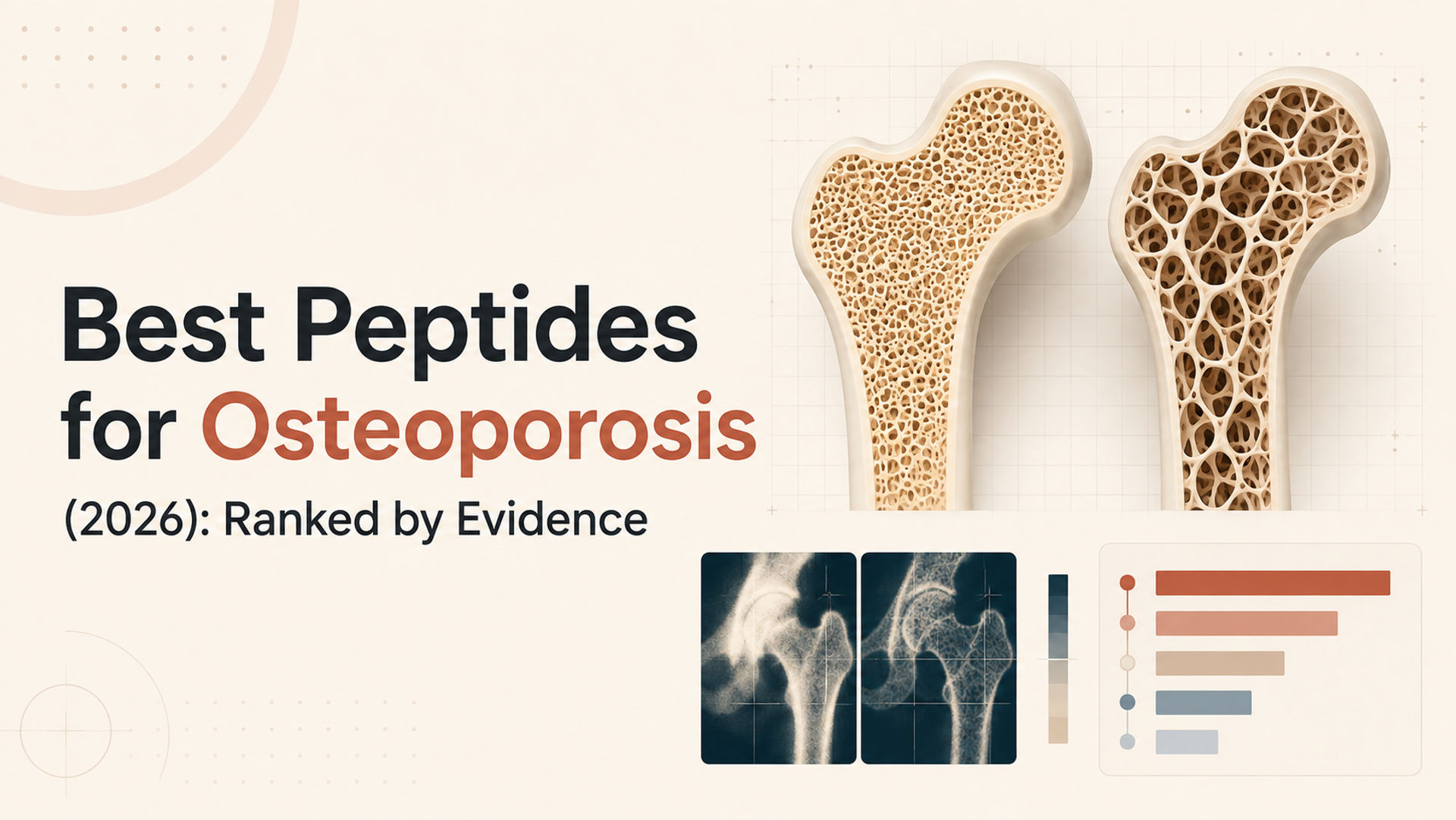

The best peptides for osteoporosis, ranked by what human trials actually measured, are teriparatide, abaloparatide, specific collagen peptides, and calcitonin. This guide ranks each option by the bone mineral density and fracture data behind it, then covers the growth hormone peptides people ask about, the early-stage candidates worth watching, and the one peptide class that measurably lowers bone density.

Why Most "Bone Peptides" Are Not What Searchers Expect
Peptides for osteoporosis fall into two groups that have almost nothing in common: prescription peptide drugs with Phase 3 fracture data, and research peptides sold for laboratory use with no human bone trials at all. Searchers usually arrive looking for the second group and find the first.
The confusion is understandable. Teriparatide and abaloparatide are peptides in the strict biochemical sense: short amino acid chains, 34 residues each, manufactured synthetically. So is calcitonin, at 32 residues. These are the compounds with the outcome data, and they are the ones a physician prescribes.
The compounds circulating in peptide communities, BPC-157, TB-500, ipamorelin, have either preclinical bone data or none. That does not make them uninteresting. It makes them a different category, and any guide that blends the two is misleading you about what the evidence supports.
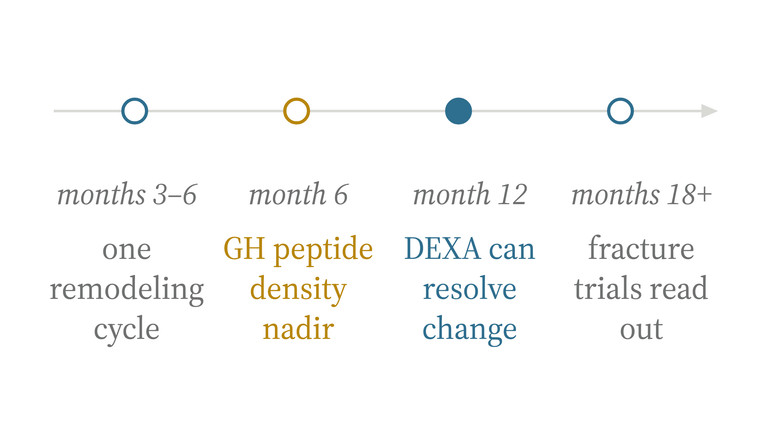
Bone is a slow-turnover tissue, which is why this distinction matters more here than in other categories. A complete bone remodeling cycle takes roughly three to six months. A DEXA scan cannot reliably detect a change in under a year. Any peptide claiming to affect osteoporosis needs data measured over that horizon, and most research peptides have never been studied that long in humans.
How the ranking below was built
Each peptide is placed by the strongest human endpoint published for it, in this order: fracture reduction, then measured bone mineral density change, then bone turnover markers, then animal data, then mechanism alone. Fracture reduction is the endpoint that matters clinically, because bone density is a proxy for the thing patients actually care about, which is not breaking a hip.
Best Peptides for Osteoporosis, Ranked by Evidence
Ranked by the strength of published human bone outcomes, the order is teriparatide, abaloparatide, specific collagen peptides, calcitonin, the growth hormone secretagogues, then BPC-157 and TB-500. The first two have Phase 3 fracture data. The last two have neither fracture data nor human bone density data of any kind.
Peptide | Strongest human bone evidence | Availability |
|---|---|---|
Teriparatide (PTH 1-34) | 65% fewer vertebral fractures, n=1,637 | FDA approved |
Abaloparatide (PTHrP 1-34) | 86% fewer vertebral fractures, n=2,463 | FDA approved |
Specific collagen peptides | +3.0% spine BMD at 12 months, n=131 | Oral supplement |
Calcitonin | 33% fewer vertebral fractures, n=1,255 | FDA approved |
GH secretagogues | Bone turnover markers only, no BMD endpoint met | Research use only |
BPC-157 / TB-500 | None in humans | Research use only |
1. Teriparatide (PTH 1-34): The Reference Standard
Teriparatide is the 34-amino acid N-terminal fragment of human parathyroid hormone and the most thoroughly documented anabolic bone peptide in existence. It works by a counterintuitive mechanism: continuous parathyroid hormone exposure breaks bone down, but intermittent daily pulses stimulate osteoblasts more than osteoclasts, tipping the remodeling balance toward formation.
The pivotal evidence comes from the Fracture Prevention Trial run by Neer and colleagues and published in the New England Journal of Medicine in 2001. The trial randomized 1,637 postmenopausal women with at least one existing vertebral fracture, and 20 micrograms of teriparatide daily reduced new vertebral fractures by 65% over a median 21 months of follow-up.
Teriparatide reduced new vertebral fracture risk by 65% at the 20 mcg dose and 69% at 40 mcg, and cut nonvertebral fragility fractures by 53%. Lumbar spine bone mineral density rose 9% and 13% at the two doses, and femoral neck density rose 2% to 5% over placebo. (Neer et al., New England Journal of Medicine, 2001, as summarized by Bodenner et al., 2007)
One detail from the follow-up analyses explains why BMD is an imperfect scorecard for this whole category. A 2006 analysis by Chen and colleagues found that increases in spine bone density accounted for only 30% to 41% of teriparatide's fracture risk reduction. The rest came from changes in bone quality a DEXA scan does not measure: trabecular architecture, cortical thickness, and collagen cross-linking.
Teriparatide is administered by daily subcutaneous injection and is typically limited to a 24-month course. It is a prescription drug in the United States, Canada, and the European Union.
2. Abaloparatide (PTHrP 1-34): Larger Effect, Shorter Course
Abaloparatide is a synthetic 34-amino acid analog of parathyroid hormone-related protein and produced the largest vertebral fracture reduction of any peptide in this guide. It binds the same PTH1 receptor as teriparatide but favors a different receptor conformation, which appears to shift the balance further toward bone formation.
Shop research peptides
Live pricing from our top-rated vendor. Prices update as vendor listings change.
The Phase 3 ACTIVE trial, published by Miller and colleagues in JAMA in 2016, randomized 2,463 postmenopausal women over 18 months. Abaloparatide reduced new vertebral fractures by 86% against placebo and nonvertebral fractures by 43%, with lumbar spine bone mineral density rising roughly 9% and total hip roughly 3%.
The head-to-head comparison with teriparatide is closer than those numbers suggest, because the two trials enrolled different populations and ran for different durations. What is clear is that abaloparatide reaches a comparable effect in 18 months rather than 24, and produces less hypercalcemia. Like teriparatide, it is prescription-only and given by daily subcutaneous injection.

3. Specific Collagen Peptides: The Strongest Non-Prescription Evidence
Specific collagen peptides are the only orally available option in this guide with randomized controlled bone mineral density data in postmenopausal women, and they carry the highest search volume of any term in this category. They are short peptide fragments produced by enzymatic hydrolysis of collagen, absorbed intact as di- and tripeptides, and studied at 5 grams per day.
The foundational trial was run by König and colleagues at the University of Freiburg and published in Nutrients in 2018. It randomized 131 postmenopausal women with reduced bone density to 5 grams of specific collagen peptides or placebo for 12 months.
After 12 months, spine bone mineral density rose 3.0% in the collagen peptide group and fell 1.3% in the placebo group. Femoral neck density rose 6.7% versus a 1.0% decline on placebo. Bone formation marker P1NP rose significantly in the treatment group (p=0.007), while resorption marker CTX-1 rose only in the placebo group (p=0.011). (König et al., Nutrients, 2018)
The direction of both markers is what makes this result credible rather than a measurement artifact. Formation went up in the treated group and breakdown went up in the untreated one, which is the signature you would expect if the intervention worked.
A four-year follow-up published in the Journal of Bone Metabolism in 2021 tracked 31 of those women through continued supplementation. Spine bone density rose 5.79% and 8.16% in the two groups over the full period, femoral neck density rose 4.21% and 1.23%, and no participant sustained an osteoporotic fracture during follow-up.
The honest limitation is heterogeneity across the wider literature. A 2025 meta-analysis in Frontiers in Nutrition pooled five bone density trials and found substantial variation between them, with an I-squared of 80.1%. Effect sizes ranged from a standardized mean difference of 0.49 to 2.67 at the spine. The direction is consistent; the magnitude is not settled.
Trials pairing collagen peptides with calcium and vitamin D showed effects in the same range, suggesting the combination is a reasonable default rather than a redundancy.

4. Calcitonin: Approved, Modest, and Largely Superseded
Calcitonin is a 32-amino acid hormone that suppresses osteoclast activity, approved as a nasal spray for postmenopausal osteoporosis, with a real but modest fracture effect. Salmon calcitonin is used clinically because it binds the human receptor more avidly than the human sequence does.
The five-year PROOF trial enrolled 1,255 postmenopausal women with established osteoporosis. The 200 IU nasal dose reduced new vertebral fractures by 33% against placebo, with lumbar spine bone density rising 1% to 1.5% from baseline.
The result comes with a caveat most articles omit: neither the 100 IU nor the 400 IU dose separated from placebo, which is not the dose-response pattern a real drug effect produces. Calcitonin now sits well behind bisphosphonates and the PTH analogs in treatment guidelines, and its more durable use is short-term pain relief after an acute vertebral compression fracture.
5. Growth Hormone Secretagogues: Real Bone Signal, Unmet Endpoints
Growth hormone secretagogues including ipamorelin, sermorelin, and MK-677 consistently raise bone turnover markers in human trials but have never met a bone mineral density endpoint. This is the category most peptide users are actually asking about, and the honest answer is that the mechanism is sound and the outcome data is not there.
The clearest human dataset is the two-year trial by Nass and colleagues published in Annals of Internal Medicine in 2008, which randomized 65 healthy adults aged 60 to 81 to oral MK-677 at 25 mg daily or placebo. Bone density changes in the treated group were consistent with increased bone remodeling rather than with net bone gain. Earlier work by Murphy and colleagues across 187 elderly adults found MK-677 raised osteocalcin and bone-specific alkaline phosphatase, both formation markers, alongside the resorption marker N-telopeptide.
Raising formation and resorption together is not the same as building bone. That is the difference between these compounds and teriparatide, which decouples the two.
Shop research peptides
Live pricing from our top-rated vendor. Prices update as vendor listings change.
There is a second reason short trials on this class look like failures. Growth hormone produces a biphasic bone density curve: resorption rises first, density falls to a nadir around month six, and only then begins to climb as the newly formed bone mineralizes. A study measuring at 6 or 12 months captures the dip. Growth hormone deficiency studies running past 18 months show the increase, and it is larger at the lumbar spine than the hip.
The practical implication is that a 12-week course of ipamorelin will not change a DEXA scan, and if it did anything measurable in that window the change would likely be downward. Anyone reading a bone scan against a growth hormone peptide protocol needs a two-year horizon, not a two-month one.
6. BPC-157 and TB-500: Fracture Healing, Not Osteoporosis
BPC-157 and TB-500 have preclinical bone healing data and no human bone density research whatsoever. They belong in this guide because searchers expect them here, and the accurate answer is that they address a different problem.
BPC-157 is a synthetic 15-amino acid peptide derived from a protein sequence in human gastric juice, first characterized by Sikiric and colleagues at the University of Zagreb. The relevant bone work is a 1999 study in the journal Bone, in which BPC-157 healed a 0.8 cm segmental defect in the rabbit radius with osteogenic activity comparable to autologous bone marrow grafts and cortical bone implants. Controls did not heal completely over six weeks.
That is a fracture repair model. Osteoporosis is a systemic loss of bone mass across the whole skeleton, driven mostly by estrogen withdrawal and age-related remodeling imbalance. A compound that accelerates repair at a defect site has not been shown to raise density everywhere else, and no study has tested it.
TB-500, a synthetic fragment of thymosin beta-4, sits in the same position with less bone-specific data than BPC-157. Both are sold for research use only and are not approved for human use in any jurisdiction. Peptide Mind covers the repair literature on both in its guide to peptides studied for injury recovery.
Peptides for Bone Growth Still in Early Research
Three peptide candidates have produced compelling preclinical bone data and are worth tracking, though none has entered human osteoporosis trials. All three act on bone formation pathways that current approved drugs do not target.
PEPITEM is a naturally circulating peptide identified at the University of Birmingham in 2015. Research published in Cell Reports Medicine in 2024 showed it enhances bone mineralization, formation, and strength and reverses bone loss in animal disease models. Its mechanism is unusual: it acts directly on osteoblasts through NCAM-1 signaling while prompting them to release osteoprotegerin, a decoy receptor that sequesters RANKL and limits osteoclast activity. Normal remodeling continues, which is a meaningful contrast with drugs that shut resorption down wholesale.
CK2.3 is a mimetic peptide of the BMP type I receptor. In ovariectomized Sprague Dawley rats, the standard rodent model for postmenopausal bone loss, work by Sequeira and colleagues at the University of Delaware found trabecular bone density recovered to 0.23 g/cm³ against 0.19 in controls at week 12, with trabecular number rising to 4.50 per mm from 3.89.
rhBMP-7 and rhPDGF-BB are recombinant growth factors rather than short peptides, and both increased bone volume and density in oophorectomized rat models. Their clinical use so far is local application in spinal fusion and dental surgery, not systemic osteoporosis treatment.
Preclinical bone results translate to humans inconsistently. Rodent bone remodels far faster, and ovariectomized rats model estrogen withdrawal cleanly in a way that a 68-year-old with 20 years of accumulated bone loss does not. Treat all three as research to watch.
The Peptides That Lower Bone Density
GLP-1 receptor agonists reduce bone mineral density during active weight loss, which makes them the one peptide class in this article that works against bone. Given how many people now take them, this belongs in any honest guide to peptides and bone health.
A randomized two-center Phase 2 trial by Hansen and colleagues, published in eClinicalMedicine in 2024, gave 64 adults at increased fracture risk 1.0 mg of semaglutide weekly or placebo for 52 weeks. Total hip bone mineral density ended 0.020 g/cm² lower in the semaglutide group (p=0.001) and lumbar spine 0.018 g/cm² lower (p=0.007), roughly 2.6% and 2.1% below placebo. Bone resorption rose with no compensating rise in formation.
The mechanism is not mysterious and is not unique to these drugs. Rapid weight loss by any route reduces mechanical loading on the skeleton and reduces bone density with it. The distinguishing feature in the trial data is the absence of a formation response, meaning the skeleton adapted downward without rebuilding.
Fracture data is more reassuring than the density data. A 2025 systematic review and meta-analysis found no significant association between GLP-1 receptor agonists and fracture risk in type 2 diabetes, and cardiovascular outcome data on semaglutide showed similar fracture rates against placebo. Lower density without more fractures is a genuinely unresolved picture at this point.
The practical reading is that anyone with osteopenia or osteoporosis running a GLP-1 protocol has a reason to pair it with resistance training and adequate protein, both of which blunt loading-related bone loss. It is not a reason to avoid the drug class.
How Bone Peptides Are Dosed in Published Research
Shop research peptides
Live pricing from our top-rated vendor. Prices update as vendor listings change.
Dosing for the peptides with real bone data is well established because all four went through registration trials. The figures below are the doses those trials used, not recommendations.
Peptide | Dose used in trials | Route and duration |
|---|---|---|
Teriparatide | 20 mcg daily | Subcutaneous, up to 24 months |
Abaloparatide | 80 mcg daily | Subcutaneous, 18 months |
Specific collagen peptides | 5 g daily | Oral, 12 to 48 months |
Calcitonin (salmon) | 200 IU daily | Nasal spray, up to 5 years |
Two patterns are worth noticing. The PTH analogs are dosed once daily because the pulse is the mechanism; steady exposure reverses the effect and breaks bone down instead. And every effective protocol here runs for a year or longer, because bone does not remodel faster than that.
For research peptides where doses are expressed in micrograms per vial and reconstitution math gets in the way, Peptide Mind's peptide dosage calculator converts vial concentration to syringe units.
What the Evidence Does Not Support Yet
Three claims circulate widely in this category with nothing published behind them. Naming them is more useful than repeating them.
That research peptides can substitute for approved osteoporosis drugs. No research peptide has a human bone mineral density trial, let alone a fracture trial. The gap between "raises bone turnover markers" and "prevents a hip fracture" is the entire distance from mechanism to outcome.
That collagen peptides reverse established osteoporosis. The trials enrolled women with reduced bone density, and the four-year follow-up showed continued gains, but no trial has demonstrated a fracture reduction. Bone density and fracture risk are related, not interchangeable.
That any peptide works without the nutritional substrate. Every positive trial in this guide ran on top of adequate calcium and vitamin D. Bone formation is limited by available mineral, and an anabolic signal into a deficient system has less to work with. Resistance and impact loading, protein intake, and corrected vitamin D were the background in every study, and are the parts of this that are free.
Frequently Asked Questions
Can peptides reverse osteoporosis?
Teriparatide and abaloparatide can rebuild bone and reduce fracture risk substantially, which is closer to reversal than any other drug class achieves. Teriparatide raised spine bone density 9% and cut vertebral fractures 65% in its pivotal trial. Research peptides sold online have no human data showing anything comparable.
Which peptide increases bone density the most?
Abaloparatide and teriparatide produce the largest measured gains, both raising lumbar spine bone mineral density roughly 9% over 18 to 24 months. Among non-prescription options, specific collagen peptides at 5 grams daily raised spine density 3.0% and femoral neck density 6.7% over 12 months in a 131-woman randomized trial.
Do collagen peptides help with bone density?
Yes, in postmenopausal women with reduced bone density, based on randomized controlled data. The 2018 König trial found a 3.0% spine increase against a 1.3% placebo decline over 12 months, alongside a rise in the bone formation marker P1NP. A 2025 meta-analysis confirmed the direction while noting substantial variation in effect size between trials.
Are injectable peptides for osteoporosis legal?
Teriparatide, abaloparatide, and calcitonin are FDA-approved prescription drugs and legal with a prescription. BPC-157, TB-500, ipamorelin, and similar compounds are sold for research use only, are not approved for human use, and are not legal to market for treating osteoporosis or any other condition.
How long before bone peptides change a DEXA scan?
Shop research peptides
Live pricing from our top-rated vendor. Prices update as vendor listings change.
Twelve months minimum, and often longer. A full bone remodeling cycle takes three to six months, and DEXA cannot reliably resolve smaller changes below about a year. Growth hormone peptides are a special case: bone density typically dips to a nadir around month six before rising, so scans before 18 months can read as a loss.
Can peptides cause osteoporosis?
GLP-1 receptor agonists reduce bone mineral density during weight loss. A 2024 randomized trial found 52 weeks of semaglutide lowered hip density 2.6% and spine density 2.1% versus placebo. Fracture data has not shown a matching increase in risk so far, and resistance training appears to offset much of the loss.
Choosing Among Peptides for Osteoporosis
The best peptides for osteoporosis are the ones with fracture data behind them, and today that means teriparatide, abaloparatide, and calcitonin by prescription, with specific collagen peptides as the strongest evidence-backed option available without one. The growth hormone peptides have a plausible mechanism and a two-year timeline nobody tests them over, and the repair peptides address a different problem entirely.
Explore Peptide Mind's research profiles on ipamorelin and readers navigating bone loss around menopause may also want the guide to peptides studied for perimenopause.
References
Bodenner D, Redman C, Riggs A. "Teriparatide in the management of osteoporosis." Clinical Interventions in Aging, 2(4), 2007. PMC2686338. Reviews the Neer et al. Fracture Prevention Trial, New England Journal of Medicine, 344(19), 2001.
Chen P, Miller PD, Delmas PD, et al. "Change in lumbar spine BMD and vertebral fracture risk reduction in teriparatide-treated postmenopausal women with osteoporosis." Journal of Bone and Mineral Research, 21(11), 2006. PMID 17002571.
Miller PD, Hattersley G, Riis BJ, et al. "Effect of Abaloparatide vs Placebo on New Vertebral Fractures in Postmenopausal Women With Osteoporosis: A Randomized Clinical Trial (ACTIVE)." JAMA, 316(7), 2016. NCT01343004.
König D, Oesser S, Scharla S, Zdzieblik D, Gollhofer A. "Specific Collagen Peptides Improve Bone Mineral Density and Bone Markers in Postmenopausal Women: A Randomized Controlled Study." Nutrients, 10(1), 2018. PMC5793325.
Zdzieblik D, Oesser S, König D. "Specific Bioactive Collagen Peptides in Osteopenia and Osteoporosis: Long-Term Observation in Postmenopausal Women." Journal of Bone Metabolism, 28(3), 2021. PMC8441532.
"Efficacy of collagen peptide supplementation on bone and muscle health: a meta-analysis." Frontiers in Nutrition, 12, 2025.
Chesnut CH, Silverman S, Andriano K, et al. "A randomized trial of nasal spray salmon calcitonin in postmenopausal women with established osteoporosis: the PROOF study." American Journal of Medicine, 109(4), 2000. PMID 10996576.
Nass R, Pezzoli SS, Oliveri MC, et al. "Effects of an oral ghrelin mimetic on body composition and clinical outcomes in healthy older adults: a randomized trial." Annals of Internal Medicine, 149(9), 2008. PMID 18981485.
"Effects of 18 Months of Growth Hormone Replacement Therapy on Bone Mineral Density in Patients with Adult Growth Hormone Deficiency." Endocrinology and Metabolism, 38(2), 2023. PMC10081901.
Hansen MS, Wolfel EM, Jeromdesella S, et al. "Once-weekly semaglutide versus placebo in adults with increased fracture risk: a randomised, double-blinded, two-centre, phase 2 trial." eClinicalMedicine, 72, article 102624, 2024. PMID 38737002.
"Effect of GLP-1 receptor agonists on bone mineral density, bone metabolism markers, and fracture risk in type 2 diabetes: a systematic review and meta-analysis." Frontiers in Endocrinology, 2025. PMID 39985672.
Lewis JW, Frost K, Neag G, et al. "New therapeutic avenues in bone repair: the anabolic osteopeptide PEPITEM." Cell Reports Medicine, 5(5), article 101574, 2024. University of Birmingham summary.
Sequeira L, Nguyen J, Wang L, Nohe A. "A Novel Peptide, CK2.3, Improved Bone Formation in Ovariectomized Sprague Dawley Rats." International Journal of Molecular Sciences, 21(14), 2020. PMC7402306.
Sebecić B, Nikolić V, Sikirić P, et al. "Osteogenic effect of a gastric pentadecapeptide, BPC-157, on the healing of segmental bone defect in rabbits." Bone, 24(3), 1999.
Disclaimer: The information on Peptide Mind is for educational purposes only and is not a substitute for professional medical advice, diagnosis, or treatment. The peptides discussed are unapproved research chemicals for laboratory and research use only, not for human consumption. These statements have not been evaluated by the FDA, and nothing on this site is intended to diagnose, treat, cure, or prevent any disease. By accessing this site, you confirm you are 21 or older and agree to our Terms of Service.
Add a comment
This will be publicly visible.
Your email address will not be published.
Your comment will be reviewed by an admin before it is published.