Sermorelin vs Ipamorelin vs Tesamorelin: Key Differences (2026)
Sermorelin vs ipamorelin vs tesamorelin compared for beginners: how these three growth hormone peptides differ in structure, receptor, mechanism, and published research.

Sermorelin vs ipamorelin vs tesamorelin is one of the most common comparisons in growth hormone peptide research, and the core difference is straightforward: sermorelin and tesamorelin are GHRH analogs, while ipamorelin is a ghrelin mimetic. That single distinction, the receptor each one targets, explains almost everything else about how these three peptides behave in published studies. This guide breaks down each peptide, compares their structure, mechanism, and research status side by side. Updated for 2026.
If you are completely new to this space, the beginner's guide to peptides is a useful starting point before diving into the comparisons below.
Sermorelin vs Ipamorelin vs Tesamorelin: Quick Comparison
Sermorelin, ipamorelin, and tesamorelin all increase the secretion of growth hormone (GH) from the pituitary gland, but they fall into two different peptide families that reach that result through different receptors. The table below summarizes how the three compare across the characteristics researchers look at most.
Characteristic | Sermorelin | Ipamorelin | Tesamorelin |
|---|---|---|---|
Peptide class | GHRH analog | Ghrelin mimetic (GHRP) | Stabilized GHRH analog |
Amino acids | 29 | 5 (pentapeptide) | 44 |
Receptor target | GHRH receptor | Ghrelin receptor (GHS-R1a) | GHRH receptor |
Reported half-life | Very short (minutes) | Around 2 hours | Longer than native GHRH |
Regulatory status | FDA approved 1997, later discontinued | Research compound only | FDA approved 2010 |
Main research focus | GH and IGF-1 signaling | Selective GH release | Visceral adipose tissue, metabolic markers |
The sections that follow explain each row in beginner-friendly terms, starting with what each peptide actually is.
What Is Sermorelin?
Sermorelin is a 29-amino acid peptide that copies the first 29 amino acids of human growth hormone-releasing hormone (GHRH), the natural signal your hypothalamus uses to tell the pituitary gland to release growth hormone. Because it is the active fragment of a hormone your body already makes, sermorelin is often described in the literature as the prototypical growth hormone secretagogue, a term for any compound that triggers GH secretion. Peptide Mind's glossary entry on growth hormone secretagogues breaks down how this umbrella category groups GHRH analogs and GHRPs together. It binds the GHRH receptor on pituitary cells and works through the Gs protein and cyclic AMP pathway, as outlined in a review of growth hormone secretagogues.
A practical detail for beginners: sermorelin has a very short half-life, on the order of minutes, which researchers have characterized in pharmacokinetic studies of GHRH(1-29). Because it relies on the pituitary's own machinery, the GH release it produces follows the body's natural pulsing rhythm rather than overriding it. Sermorelin was approved by the U.S. FDA in 1997 in the context of pediatric growth hormone deficiency, and the original product was later discontinued for commercial reasons around 2008. These observations come from clinical and preclinical research and should not be read as guidance for human use.
What Is Ipamorelin?
Ipamorelin is a synthetic pentapeptide, meaning a chain of just five amino acids (Aib-His-D-2Nal-D-Phe-Lys-NH2), and it belongs to a different family than sermorelin. Rather than copying GHRH, it mimics ghrelin, the so-called hunger hormone, and binds the growth hormone secretagogue receptor (GHS-R1a), also called the ghrelin receptor. When it activates that receptor on pituitary cells, calcium is mobilized inside the cell and a short, controlled pulse of growth hormone follows. Ipamorelin was introduced by Raun and colleagues as the first selective growth hormone secretagogue in 1998.
The word "selective" is the headline feature researchers associate with ipamorelin. In that original characterization, ipamorelin raised growth hormone without meaningfully raising cortisol, adrenocorticotropic hormone (ACTH), or prolactin, which separated it from earlier growth hormone-releasing peptides such as GHRP-6 and GHRP-2. Its activity as a ghrelin mimetic has also been examined in a rodent model of postoperative ileus. These findings come from animal and in vitro research and have not been confirmed in controlled human trials. For a deeper single-compound breakdown, see the dedicated ipamorelin peptide guide.
What Is Tesamorelin?
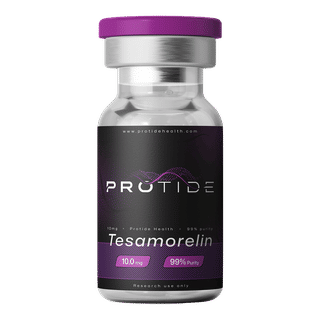
Tesamorelin is a stabilized GHRH analog built on the full 44-amino acid GHRH sequence with a chemical modification (a trans-3-hexenoic acid group) added to its N-terminus. That modification is the key engineering trick: it makes the molecule more resistant to the enzymes that would normally break GHRH down quickly, giving tesamorelin a longer working window than sermorelin while still acting on the same GHRH receptor. Like sermorelin, it prompts the pituitary to release growth hormone in a pulsatile pattern.
Tesamorelin is the most clinically studied of the three. It was approved by the U.S. FDA in 2010 for reducing excess visceral adipose tissue (VAT), the deep abdominal fat around the organs, in adults with HIV-associated lipodystrophy. In a 2007 randomized controlled trial and later work summarized in a review of tesamorelin research, the compound was associated with selective reductions in visceral adipose tissue while subcutaneous fat stayed relatively stable. These results were observed in a specific clinical population under controlled conditions and may not generalize to other groups.
In two pivotal randomized, double-blind, placebo-controlled trials, tesamorelin was associated with reductions in visceral adipose tissue of roughly 15 to 20% over 26 weeks, a finding documented in a randomized clinical trial. These data come from a defined clinical population and have not been established as outcomes for the general public.
GHRH Analogs vs Ghrelin Mimetics: How They Actually Differ
The cleanest way to understand sermorelin vs ipamorelin vs tesamorelin is to group them by mechanism: two are GHRH analogs and one is a ghrelin mimetic. GHRH analogs (sermorelin and tesamorelin) imitate the body's own releasing hormone and bind the GHRH receptor, so the pituitary responds the way it would to a natural signal. Ghrelin mimetics like ipamorelin bind a separate receptor, the ghrelin receptor, and act through a different intracellular pathway. Both routes end in growth hormone release, but they start from different doors.
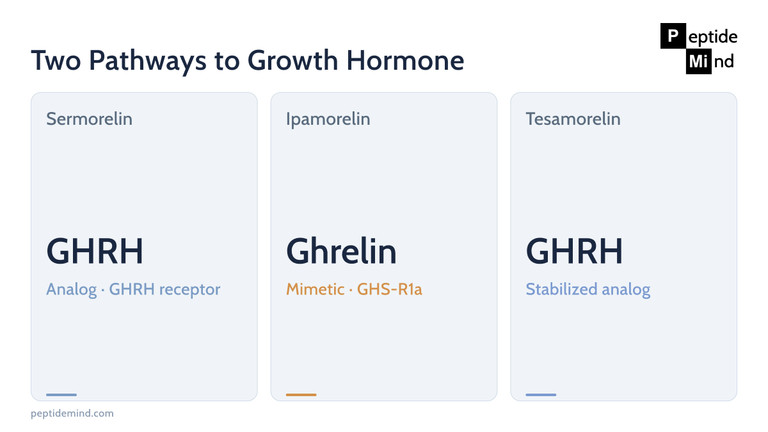
This two-pathway design is why the three peptides are often studied side by side. Because GHRH analogs and ghrelin mimetics act on different receptors, research has examined whether combining the two produces a larger, more synchronized growth hormone pulse than either route alone, as discussed in research on growth hormone secretagogues. This is a mechanistic observation from preclinical work, not a recommendation for human use. For beginners, the takeaway is that "GHRH analog vs ghrelin mimetic" is the real dividing line, and the peptide names simply sit on one side or the other.
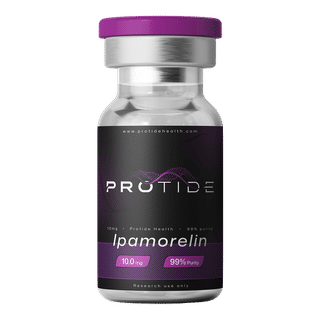
Shop research peptides
Live pricing from our top-rated vendor. Prices update as vendor listings change.
Sermorelin vs Ipamorelin vs Tesamorelin: The Key Research Differences
Beyond receptor family, three practical differences separate these peptides in the literature: structure, half-life, and how much human data exists.

Structure and size differ widely. Ipamorelin is a five-amino acid pentapeptide, sermorelin is a 29-amino acid fragment of GHRH, and tesamorelin is a modified 44-amino acid molecule. The selectivity profile is the standout for ipamorelin, which did not significantly raise cortisol or prolactin in the foundational animal studies. Tesamorelin's modified structure gives it the longest practical half-life of the three GH-axis peptides, while sermorelin's is the shortest. Depth of evidence is where tesamorelin stands apart: it carries multiple randomized controlled trials and an FDA approval, whereas ipamorelin remains a research compound with primarily preclinical data, and sermorelin sits between them with older clinical history. None of these comparisons should be interpreted as evidence of safety or efficacy for human use outside the studied contexts.
Ipamorelin's defining trait in the 1998 characterization was selectivity: it released growth hormone without the cortisol and prolactin spikes seen with earlier growth hormone-releasing peptides. This selectivity was demonstrated in animal models and has not been fully characterized in long-term human studies.
Why Researchers Study These Peptides Together
A frequent question from beginners is whether sermorelin, ipamorelin, and tesamorelin are studied in combination, and the answer is yes, precisely because they hit different receptors. Pairing a GHRH analog with a ghrelin mimetic is a recurring theme in the literature, and it is also why blended research compounds exist, such as the tesamorelin and ipamorelin blend studied as a single preparation. A related and widely referenced pairing combines a longer-acting GHRH analog, CJC-1295, with ipamorelin.
The rationale is mechanistic rather than additive marketing language: a GHRH analog primes the pituitary while a ghrelin mimetic adds a separate, selective pulse, and researchers study whether the two together change the size or timing of growth hormone release. These are open research questions, and the combination data come largely from preclinical and short-term studies that have not been validated in large human trials. Readers exploring how compounds are paired more broadly can review the overview of peptide stacks studied by goal, and those interested in the GH axis within aging science can see the longevity peptide research summary.
Research Dosages Reported in Published Studies
Published studies report dosages in micrograms (mcg) for these peptides, and the figures vary by the research model, the species, and the question being asked. Reporting what a study used is different from recommending a quantity, and nothing here is a dosing instruction. Sermorelin and tesamorelin research has typically administered subcutaneous amounts in animal and clinical settings, while ipamorelin's animal studies often expressed dosing relative to body weight. Because concentration math is where most beginners make mistakes, the peptide dosage calculator is the easiest way to convert a vial size and target concentration into reconstitution volumes for laboratory record-keeping.
When reviewing the literature, you will find that half-life shapes how often a peptide was administered in a given study design. Tesamorelin's longer half-life and ipamorelin's roughly two-hour window are reflected in how those compounds were scheduled in research, whereas sermorelin's very short half-life shaped its own study designs. These are descriptions of published research conditions, not protocols for personal use.
Frequently Asked Questions
What is the main difference between sermorelin, ipamorelin, and tesamorelin?
The main difference is the receptor each one targets. Sermorelin and tesamorelin are GHRH analogs that bind the GHRH receptor, while ipamorelin is a ghrelin mimetic that binds the ghrelin receptor (GHS-R1a). All three increase growth hormone secretion in research, but through two different pathways. This distinction is structural and mechanistic, and it has been characterized only in preclinical and clinical research settings.
Which of these peptides has the most human clinical data?
Tesamorelin has the most human clinical data of the three. It holds an FDA approval from 2010 and has been examined in multiple randomized controlled trials for visceral adipose tissue in adults with HIV-associated lipodystrophy. Sermorelin has older clinical history tied to its 1997 approval, while ipamorelin remains primarily a preclinical research compound. The depth of evidence differs sharply, and findings in one population may not translate to others.
What does it mean that ipamorelin is "selective"?
In its original 1998 characterization, ipamorelin released growth hormone without significantly raising cortisol, ACTH, or prolactin, which set it apart from earlier growth hormone-releasing peptides such as GHRP-6 and GHRP-2. Researchers describe that profile as selective. This selectivity was observed in animal models and has not been fully established in long-term human studies.
Are sermorelin and ipamorelin studied together?
Yes. Because sermorelin (a GHRH analog) and ipamorelin (a ghrelin mimetic) act on different receptors, they are frequently examined in combination in the research literature, as are tesamorelin with ipamorelin and CJC-1295 with ipamorelin. The idea studied is whether two pathways together change the growth hormone pulse compared with one alone. This combination data is largely preclinical and short-term and has not been validated in large human trials.
Shop research peptides
Live pricing from our top-rated vendor. Prices update as vendor listings change.
Is sermorelin or tesamorelin the longer-acting GHRH analog?
Tesamorelin is the longer-acting GHRH analog. Its N-terminal trans-3-hexenoic acid modification makes it more resistant to enzymatic breakdown than sermorelin's GHRH(1-29) fragment, giving it a longer half-life. Both act on the same GHRH receptor, so the difference is stability and duration rather than mechanism. These are pharmacological observations from published research.
Why are these peptides sold as research compounds?
Sermorelin and tesamorelin both have histories as FDA-approved compounds for specific clinical contexts, while ipamorelin has only ever been studied as a research compound and is not approved for human use. Today all three are commonly sold for laboratory and research purposes. Regulatory status is not a measure of safety for general use, and the research framing reflects how these compounds are legally classified.
References
Raun K, Hansen BS, Johansen NL, et al. Ipamorelin, the first selective growth hormone secretagogue. European Journal of Endocrinology, 1998;139(5):552-561. https://academic.oup.com/ejendo/article-abstract/139/5/552/6748390
Pharmacokinetics of growth hormone-releasing hormone(1-29)-NH2 and stimulation of growth hormone secretion in healthy subjects. PubMed, 1993. https://pubmed.ncbi.nlm.nih.gov/8329825/
The Safety and Efficacy of Growth Hormone Secretagogues. Sexual Medicine Reviews, 2018. https://pmc.ncbi.nlm.nih.gov/articles/PMC5632578/
Beyond the androgen receptor: the role of growth hormone secretagogues in body composition in hypogonadal males. PMC, 2020. https://pmc.ncbi.nlm.nih.gov/articles/PMC7108996/
Efficacy of ipamorelin, a novel ghrelin mimetic, in a rodent model of postoperative ileus. PubMed, 2009. https://pubmed.ncbi.nlm.nih.gov/19289567/
Falutz J, et al. Metabolic Effects of a Growth Hormone-Releasing Factor in Adults with HIV. New England Journal of Medicine, 2007;357:2359-2370. https://www.nejm.org/doi/full/10.1056/NEJMoa072375
Growth hormone and tesamorelin in the management of HIV-associated lipodystrophy. PMC, 2011. https://pmc.ncbi.nlm.nih.gov/articles/PMC3218714/
Effect of Tesamorelin on Liver Fat and Visceral Fat in HIV-Infected Adults With Abdominal Fat Accumulation: A Randomized Clinical Trial. PMC, 2014. https://pmc.ncbi.nlm.nih.gov/articles/PMC4363137/
Choosing Between Three Growth Hormone Peptides
For anyone weighing sermorelin vs ipamorelin vs tesamorelin, the comparison comes down to receptor family, structure, and depth of evidence: sermorelin and tesamorelin are GHRH analogs, ipamorelin is a selective ghrelin mimetic, and tesamorelin carries the most human clinical data of the three. Understanding that framework makes every other detail, from half-life to study design, easier to place.
Research Disclaimer
The information presented in this article is for educational and research purposes only. Peptide Mind provides evidence-based research summaries and does not offer medical advice, diagnosis, or treatment recommendations. All peptides discussed are intended for in vitro and preclinical research use only. Consult a qualified healthcare professional before making any health-related decisions. The research cited may not reflect the full body of available evidence, and findings from preclinical studies may not translate to human outcomes.
Add a comment
This will be publicly visible.
Your email address will not be published.
Your comment will be reviewed by an admin before it is published.