Best Peptides for Libido and Sex Drive: What Works and What Doesn't
The best peptides for libido ranked by what human trials measured. PT-141, kisspeptin, melanotan II, oxytocin and GH peptides compared on evidence and safety.
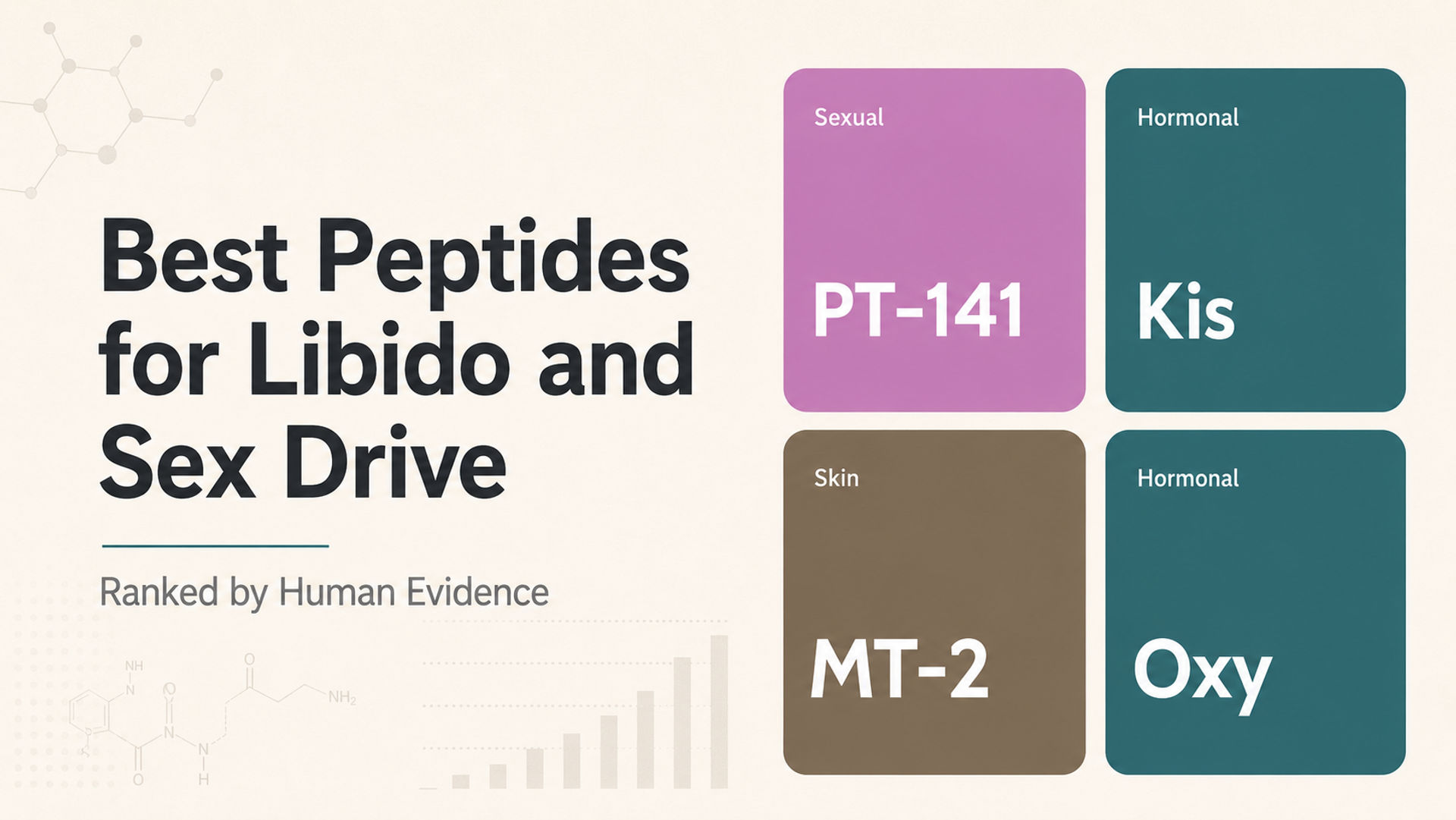

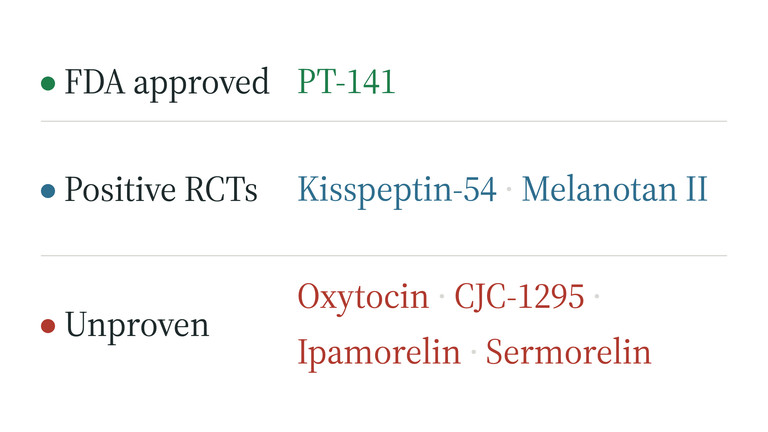
The best peptides for libido are the melanocortin agonists and kisspeptin, and the distance between them and everything else sold for sex drive is large. PT-141 is the only one with a completed Phase 3 program and an FDA approval behind it. Kisspeptin has two rigorous crossover trials in people diagnosed with low desire. This guide ranks each option by what published human trials actually measured, then covers dosing, side effect rates, and the compounds sold for libido that have never been tested against a sexual endpoint.
Why Some Peptides Affect Sex Drive and Others Do Not
Peptides that change sexual desire act on the brain, not on blood flow. That is the single most important distinction in this category, and it is what separates them from sildenafil and tadalafil, which work on the vascular side and do nothing for desire itself.
Three central pathways account for every peptide with real human sexual data behind it.
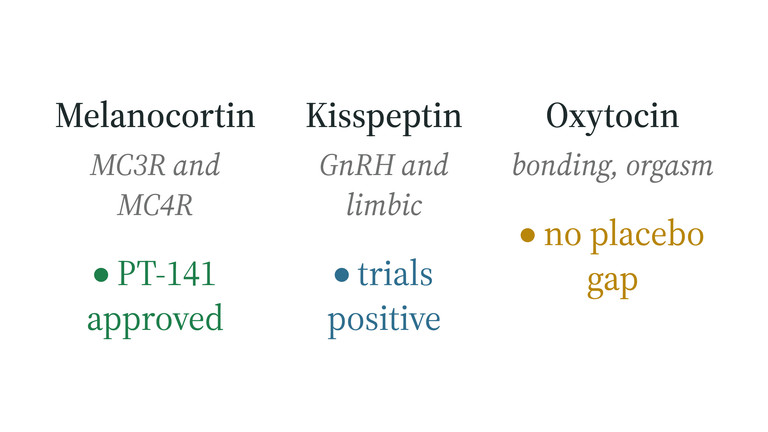
The melanocortin pathway is the best characterized. Melanocortin receptors, particularly MC3R and MC4R, sit in the hypothalamus and regulate sexual arousal upstream of any physical response. PT-141 and melanotan II both act here. This is a desire pathway: it changes whether you want sex, not whether the plumbing works.
The kisspeptin-GnRH pathway sits one level higher. Kisspeptin neurons in the hypothalamus trigger gonadotropin-releasing hormone, which drives luteinizing hormone and downstream sex hormone production. Kisspeptin also has a direct effect on the limbic structures that process sexual stimuli, independent of its hormonal role.
The oxytocin and vasopressin pathway governs bonding, trust, and the post-orgasmic response. It is the most heavily marketed of the three and, as the evidence below shows, the least supported by controlled data.
Anything sold for libido that does not act on one of these three systems is being sold on a chain of inference rather than a measured outcome.
Best Peptides for Libido, Ranked by Evidence
Ranked by the strength of published human data on measured sexual outcomes, the order is PT-141, kisspeptin, melanotan II, oxytocin, then the growth hormone secretagogues. That ranking looks different from most clinic lists because it ignores what is easiest to prescribe and weighs only what has been measured in people.
Peptide | Pathway | Strongest human evidence |
|---|---|---|
PT-141 (bremelanotide) | MC4R agonist | Two Phase 3 trials, 1,267 women, FDA approved 2019 |
Kisspeptin-54 | GnRH and limbic | Two randomized crossover trials, 32 men and 32 women with HSDD |
Melanotan II | Non-selective melanocortin | RigiScan erection data in 20 men, 1990s, never advanced |
Oxytocin | Oxytocin receptor | Multiple RCTs, no separation from placebo on sexual endpoints |
CJC-1295, ipamorelin, sermorelin | GH axis | No trial has measured a sexual outcome |
1. PT-141 (Bremelanotide): The Only Approved Option
PT-141, also called bremelanotide, is a synthetic seven-amino-acid melanocortin receptor agonist and the only peptide on this list with a completed Phase 3 program behind it. The FDA approved it in 2019 under the brand name Vyleesi for generalized acquired hypoactive sexual desire disorder in premenopausal women.
The approval rests on the two RECONNECT trials, identical 24-week randomized, double-blind, placebo-controlled studies pooling 1,267 premenopausal women. Both were run by Palatin Technologies and published in Obstetrics & Gynecology in 2019.
Across the two RECONNECT trials, bremelanotide 1.75 mg improved Female Sexual Function Index desire scores by 0.35 points more than placebo and reduced sexual distress scores by 0.33 points more than placebo, both at P < 0.001, in 1,267 premenopausal women over 24 weeks.
Read those numbers carefully. The effect is statistically real and it is small: both endpoints cleared significance comfortably, and both represent a fraction of a point on scales that run several points wide. PT-141 works. It is not a transformation.
The evidence in men is thinner and older. Early trials in healthy men and in men with erectile dysfunction found statistically significant erectile responses versus placebo at doses above 7 mg, with erections beginning around 30 minutes after dosing. Development for male indications never reached Phase 3, so every male use of PT-141 today is off-label or gray market.
2. Kisspeptin: The Cleanest Data in the Category
Shop research peptides
Live pricing from our top-rated vendor. Prices update as vendor listings change.
Kisspeptin is a naturally occurring hypothalamic neuropeptide encoded by the KISS1 gene, and it has the second-strongest human evidence for libido and by some distance the cleanest safety profile. The two trials that matter were run by Alexander Comninos and Waljit Dhillo's group at Imperial College London and published in JAMA Network Open in 2022 and 2023.
Both used the same design: a randomized, double-blind, two-way crossover with a 75-minute intravenous infusion of kisspeptin-54 at 1 nmol/kg/h versus placebo, with fMRI imaging during sexual stimuli.
In the male trial, 32 men with hypoactive sexual desire disorder showed modulated activity across the sexual brain network versus placebo, with a Cohen's d of 0.81 on whole-brain analysis. Penile tumescence in response to visual sexual stimuli rose by up to 56 percent, and self-reported happiness about sex increased by 0.63 points.
The female trial found the same directional effect through slightly different neural routes. In 32 premenopausal women with HSDD, kisspeptin-54 changed activity in the inferior frontal gyrus and temporoparietal junction, and posterior cingulate activation correlated with reduced sexual aversion. Self-reported feelings of being sexy rose by 0.5 points.
Both trials reported no adverse events at all. That is unusual and worth weighing against PT-141's side effect profile below.
The gap between this evidence and how kisspeptin is sold is the problem. These were intravenous infusions in a research setting, dosed by body weight over 75 minutes. What people buy is a subcutaneous vial of kisspeptin-10, a shorter fragment, self-administered at a fixed dose. The mechanism carries over. The dosing does not.
3. Melanotan II: The Oldest Human Erection Data
Melanotan II is a non-selective melanocortin receptor agonist and the compound PT-141 was derived from. It has genuine human sexual data, all of it from the 1990s, and it was never developed for this purpose because of what else it does.
Hunter Wessells and colleagues at the University of Arizona ran the defining studies. In 20 men with erectile dysfunction monitored by RigiScan for six hours, 17 of 20 developed erections with no sexual stimulation at all, averaging 41 minutes of tip rigidity above 80 percent. In the earlier double-blind crossover in men with psychogenic ED, mean tip rigidity above 80 percent ran 38 minutes on melanotan II versus 3 minutes on placebo, at P = 0.0045.
Increased sexual desire was reported after 68 percent of melanotan II doses versus 19 percent of placebo doses, at P < 0.01.
Those are the strongest erection numbers on this page. Melanotan II ranks third rather than first because it is a non-selective agonist: it hits MC1R and drives melanogenesis alongside the sexual effects. That is why it is sold as a tanning peptide and why it carries the risks covered in Peptide Mind's guide to tanning peptides, including new and changing moles. Nausea and yawning were frequent in the trials, and 12.9 percent of subjects had severe nausea at 0.025 mg/kg.
PT-141 exists precisely because researchers wanted the sexual effect without the pigmentary one.
4. Oxytocin: The Marketing Outruns the Data
Oxytocin is a nine-amino-acid neuropeptide central to bonding and orgasm, and it appears in most compounded libido nasal sprays. It has been tested repeatedly against sexual endpoints in controlled trials, and it has not beaten placebo in any of them.
A 22-week randomized, double-blind, placebo-controlled crossover trial gave 30 pre- and postmenopausal women with sexual dysfunction 32 IU of intranasal oxytocin or placebo before intercourse. Both arms improved sexual function and depressive symptoms over time, with no treatment effect, no sequence effect, and no interaction. A separate prospective study of male partners of women treated for HSDD found improvements in male sexual quality of life on both arms, again with no difference between oxytocin and placebo on any outcome.
A separate randomized trial in breastfeeding women reached the same conclusion: no significant effect on the primary sexual function outcome.
This is a case where the mechanism is real and the clinical result is not. Giving oxytocin intranasally to people with low desire has not, so far, changed their desire more than a saline spray did.
5. Growth Hormone Secretagogues: No Sexual Endpoint Has Ever Been Measured
CJC-1295, ipamorelin, sermorelin, and tesamorelin are growth hormone secretagogues, and they are widely marketed for libido on a chain of reasoning rather than a trial result. No published study has measured a sexual outcome with any of them.
The argument runs: these compounds raise GH and IGF-1, better GH status improves sleep, body composition, and mood, and those support sex hormone production and desire. Every link is defensible. None has been measured against a libido endpoint.
Shop research peptides
Live pricing from our top-rated vendor. Prices update as vendor listings change.
CJC-1295 acts on the GH axis, not the testes, and there is no evidence it raises testosterone directly. If you want the fuller picture on this class, Peptide Mind's guide to the best peptides for energy covers what the GH secretagogue trials did measure.
That does not make them useless. If low desire is downstream of poor sleep and low energy, treating those may help. It does mean that ranking them alongside PT-141, which most clinic pages do, misrepresents what is known.
Peptides for Libido in Women vs Men

The evidence for peptides for libido is stronger in women than in men. PT-141 is approved for premenopausal women and for no male indication, kisspeptin has been trialed in both sexes with comparable results, and melanotan II's human sexual data comes almost entirely from men.
Where the evidence sits for women: PT-141 has the only completed Phase 3 program and the only regulatory approval, specifically for generalized acquired HSDD in premenopausal women. That approval does not extend to postmenopausal women, where it was never tested. Kisspeptin's female trial showed measurable changes in sexual brain processing and self-reported arousal in 32 premenopausal women. Women navigating desire changes around hormonal transitions should also read Peptide Mind's guide to peptides for perimenopause, where the mechanisms overlap but the evidence base is different.
Where the evidence sits for men: kisspeptin's male trial is the strongest single result, with the 56 percent tumescence increase and a large effect size on brain imaging. Melanotan II's RigiScan data is older but produced the largest measured physical effect of anything here. PT-141 showed significant erectile responses in early male trials that were never followed to Phase 3.
The practical read: a woman asking about peptides for sex drive has one approved option and one well-trialed experimental one. A man asking the same question has two experimental options and none approved. Peptide Mind's roundup of the best peptides for women covers where the rest of this category splits by sex.
The PT-141 Nasal Spray Problem
Most PT-141 sold outside a pharmacy is a nasal spray. That formulation was tested, and it was abandoned during development for a safety reason that rarely reaches the people buying it.
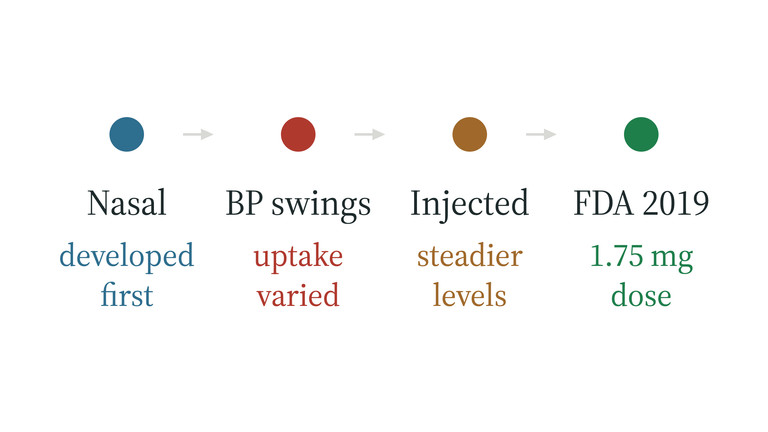
Palatin developed intranasal PT-141 first. A double-blind, placebo-controlled study of intranasal PT-141 in men with erectile dysfunction confirmed the compound worked by that route. The problem was consistency: intranasal bioavailability varied too much between doses and between people, producing unpredictable plasma levels and correspondingly unpredictable blood pressure responses. Palatin reformulated to subcutaneous injection, which produced lower and steadier plasma concentrations, and that is the form the FDA approved in 2019.
So when a compounding pharmacy or a gray market vendor sells a PT-141 nasal spray, often blended with oxytocin, they are selling the formulation the developer walked away from, at a dose nobody validated, frequently combined with a compound that has never beaten placebo. The approved product carries a contraindication for uncontrolled hypertension and known cardiovascular disease for exactly this reason.
How Libido Peptides Are Dosed in Published Research
Dosing for peptides for libido varies enormously by compound, and only PT-141 has a validated protocol. The others were dosed in research settings under conditions that do not translate to self-administration.
Peptide | Protocol used in research | Notes |
|---|---|---|
PT-141 | 1.75 mg subcutaneous, 45 min before activity | Max 1 dose/24h, 8 doses/month |
Kisspeptin-54 | 1 nmol/kg/h IV infusion, 75 minutes | Research setting only, weight-based |
Melanotan II | 0.025 mg/kg subcutaneous | Severe nausea in 12.9% at this dose |
Oxytocin | 32 IU intranasal before intercourse | No sexual endpoint separated from placebo |
The approved PT-141 protocol is specific: 1.75 mg subcutaneously via autoinjector at least 45 minutes before anticipated sexual activity, no more than one dose in 24 hours, and no more than eight doses per month. That monthly ceiling exists because the trials did not test beyond it.
Kisspeptin's research dosing is the hardest to translate. Both Imperial College trials used weight-based intravenous infusion of kisspeptin-54 over 75 minutes. What is sold to researchers is kisspeptin-10, a different fragment with a shorter half-life, in fixed-milligram vials. There is no published protocol converting one to the other. Anyone reconstituting a vial should run the numbers through the peptide dosage calculator rather than estimating, and should understand that the target itself is an extrapolation.
Side Effects and Safety
Shop research peptides
Live pricing from our top-rated vendor. Prices update as vendor listings change.
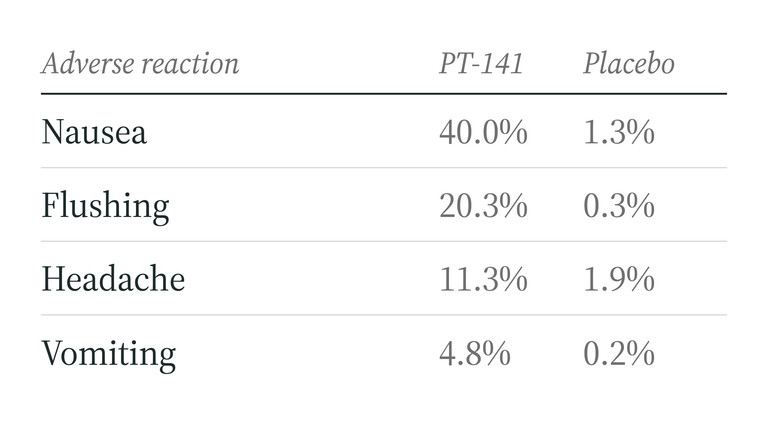
PT-141 has the best-documented side effect profile in this category because it went through a full approval process, and the numbers are higher than most clinic pages suggest.
From the Vyleesi prescribing information, drawn from the Phase 3 population:
Adverse reaction | PT-141 (1.75 mg) | Placebo |
|---|---|---|
Nausea | 40.0% | 1.3% |
Flushing | 20.3% | 0.3% |
Injection site reactions | 13.2% | 8.4% |
Headache | 11.3% | 1.9% |
Vomiting | 4.8% | 0.2% |
Nausea affected 40 percent of women receiving bremelanotide versus 1.3 percent on placebo, and 8 percent of treated patients discontinued because of it, compared with none in the placebo group.
That discontinuation rate is the number to hold onto. Roughly one in twelve people who started PT-141 in a monitored clinical trial quit over nausea alone.
PT-141 is contraindicated in uncontrolled hypertension and known cardiovascular disease. It causes transient increases in blood pressure and decreases in heart rate after each dose.
Kisspeptin's profile is the opposite. Both Imperial trials reported no adverse events beyond a flushing response, in participants receiving intravenous infusions under monitoring. It is the cleanest safety signal of any compound discussed here, from the smallest sample.
Melanotan II carries the melanocortin side effects plus the pigmentary ones: nausea, yawning, spontaneous erections, and darkening or proliferation of moles.
Practical Considerations Before Choosing Anything
Low desire is a symptom, not a diagnosis, and the peptide question is usually the wrong first one. Thyroid dysfunction, low testosterone, SSRIs, hormonal contraceptives, sleep debt, and relationship distress all suppress libido, and none respond to a melanocortin agonist. The RECONNECT trials screened women for exactly these confounders.
Purity matters more here than in most categories because the effective doses are small and the side effects are dose-dependent. Any vial should come with a batch-specific certificate of analysis from a third-party lab, not a generic vendor-supplied document. Peptide Mind tracked 177 live vendor offers and found the same vial varying more than eightfold in price, which tells you how little the market is standardized.
Blends deserve particular skepticism in this category. A PT-141 and oxytocin nasal spray combines the abandoned formulation of one compound with a second compound that has never separated from placebo, at doses nobody published. The blend exists because it sells, not because it was tested. For context on what else is moving in this market, Peptide Mind's list of the most popular peptides covers the sexual health category alongside the rest.
Frequently Asked Questions
What peptides are best for libido?
PT-141 (bremelanotide) and kisspeptin have the strongest human evidence. PT-141 completed two Phase 3 trials in 1,267 women and holds FDA approval for hypoactive sexual desire disorder in premenopausal women. Kisspeptin-54 showed measurable changes in sexual brain processing and arousal in randomized crossover trials in 32 men and 32 women, with no adverse events reported.
Do peptides actually increase sex drive?
Some do, by a measured but modest amount. Bremelanotide improved sexual desire scores by 0.35 points more than placebo and reduced sexual distress by 0.33 points more than placebo across two Phase 3 trials, both statistically significant. Kisspeptin increased penile tumescence by up to 56 percent versus placebo in men with low desire. Most other peptides marketed for libido have no sexual endpoint data at all.
Is PT-141 safe?
PT-141 has a documented but significant side effect profile. In the approval trials, nausea affected 40 percent of patients versus 1.3 percent on placebo, flushing 20.3 percent, and headache 11.3 percent. Eight percent discontinued because of nausea. It is contraindicated in uncontrolled hypertension and known cardiovascular disease, and causes transient blood pressure increases after each dose.
How long does PT-141 take to work and how long does it last?
Shop research peptides
Live pricing from our top-rated vendor. Prices update as vendor listings change.
The approved protocol calls for dosing at least 45 minutes before anticipated sexual activity. In early male trials, erectile responses began around 30 minutes after administration. Users commonly report effects lasting 6 to 12 hours, though the clinical trials measured desire and distress over 24 weeks rather than tracking a per-dose duration window.
PT-141 vs kisspeptin: which is better?
They answer different questions. PT-141 has an approval, a validated dose, and a 40 percent nausea rate. Kisspeptin has cleaner safety data and stronger male results, but was only ever given as a weight-based intravenous infusion in a research setting, and the kisspeptin-10 vials sold to researchers are a different fragment with no published protocol behind them.
Does ipamorelin or CJC-1295 increase libido?
No published trial has measured a sexual outcome with either compound. Both are growth hormone secretagogues that act on the GH axis rather than the testes, and there is no evidence CJC-1295 raises testosterone directly. Any libido effect would be indirect, through improved sleep, body composition, and energy, and has not been tested against a desire endpoint.
Does oxytocin increase libido?
Not in controlled trials. Intranasal oxytocin has been tested against sexual function endpoints in premenopausal and postmenopausal women, in breastfeeding women, and in male partners of women treated for HSDD. In every case both oxytocin and placebo improved outcomes over time, with no significant difference between them. It remains a common ingredient in compounded libido sprays regardless.
What peptides increase libido in women?
PT-141 is the only peptide approved for female sexual desire, specifically generalized acquired HSDD in premenopausal women. It was not tested in postmenopausal women. Kisspeptin-54 is the strongest experimental option, having altered sexual brain processing and increased self-reported arousal in 32 premenopausal women with HSDD in a randomized crossover trial.
Matching a Libido Peptide to What Is Actually Wrong
The best peptides for libido are PT-141 if you want the option with an approval and a known effect size, and kisspeptin if you want the cleaner safety profile and can accept that the research dosing does not translate cleanly to what is sold. Everything else in this category is either a tanning peptide with sexual side effects, a compound that has never beaten placebo, or a growth hormone peptide that nobody has tested against a sexual endpoint. Explore Peptide Mind's PT-141 research profile to see the full evidence file before deciding anything.
References
Kingsberg SA, Clayton AH, Portman D, et al. "Bremelanotide for the Treatment of Hypoactive Sexual Desire Disorder: Two Randomized Phase 3 Trials." Obstetrics & Gynecology, 134(5), 2019. PubMed 31599840.
"VYLEESI (bremelanotide injection) prescribing information." DailyMed, U.S. National Library of Medicine, 2019.
Mills EG, Ertl N, Wall MB, et al. "Effects of Kisspeptin on Sexual Brain Processing and Penile Tumescence in Men With Hypoactive Sexual Desire Disorder: A Randomized Clinical Trial." JAMA Network Open, 6(2), 2023. PMC9898824.
Thurston L, Hunjan T, Mills EG, et al. "Effects of Kisspeptin Administration in Women With Hypoactive Sexual Desire Disorder: A Randomized Clinical Trial." JAMA Network Open, 5(10), 2022. PMC9606846.
Wessells H, Levine N, Hadley ME, et al. "Melanocortin receptor agonists, penile erection, and sexual motivation: human studies with Melanotan II." International Journal of Impotence Research, 12 Suppl 4, 2000. PubMed 11035391.
Wessells H, Fuciarelli K, Hansen J, et al. "Synthetic melanotropic peptide initiates erections in men with psychogenic erectile dysfunction: double-blind, placebo controlled crossover study." Journal of Urology, 160(2), 1998. PubMed 9679884.
Diamond LE, Earle DC, Rosen RC, et al. "Double-blind, placebo-controlled evaluation of the safety, pharmacokinetic properties and pharmacodynamic effects of intranasal PT-141, a melanocortin receptor agonist, in healthy males and patients with mild-to-moderate erectile dysfunction." International Journal of Impotence Research, 16(1), 2004. PubMed 14963471.
Muin DA, Wolzt M, Marculescu R, et al. "Effect of long-term intranasal oxytocin on sexual dysfunction in premenopausal and postmenopausal women: a randomized trial." Fertility and Sterility, 104(3), 2015. PubMed 26151620.
Disclaimer: The information on Peptide Mind is for educational purposes only and is not a substitute for professional medical advice, diagnosis, or treatment. The peptides discussed are unapproved research chemicals for laboratory and research use only, not for human consumption. These statements have not been evaluated by the FDA, and nothing on this site is intended to diagnose, treat, cure, or prevent any disease. By accessing this site, you confirm you are 21 or older and agree to our Terms of Service.
Add a comment
This will be publicly visible.
Your email address will not be published.
Your comment will be reviewed by an admin before it is published.