10 Most Popular Peptides People Take (by Category) 2026
The 10 most popular peptides people take in 2026, sorted by category: healing, weight loss, growth hormone, skin, cognition, and sexual health.

The most popular peptides people take cluster into six jobs: healing and recovery, weight loss and metabolism, growth hormone support, skin and anti-aging, cognition, and sexual health. Know the category and the rest gets simple. This guide ranks the ten compounds drawing the most interest and clinical use in 2026, names the category each one belongs to, and explains what people take it for, with citations to the research and a clear note on what is FDA-approved versus research-only.
The 10 most popular peptides at a glance
Here is the full list with each peptide's category, what people take it for, and its regulatory status. Approved status matters more than most lists admit: four of these are prescription drugs, and the rest are sold for research only.
Peptide | Category | Commonly taken for | Status (2026) |
|---|---|---|---|
BPC-157 | Healing & gut | Tendon, ligament, and gut repair; inflammation | Research only |
TB-500 (Thymosin β4) | Healing & recovery | Soft-tissue repair, mobility, wound healing | Research only |
Semaglutide & Tirzepatide (GLP-1) | Weight loss & metabolic | Appetite control, blood sugar, fat loss | FDA-approved (Rx) |
CJC-1295 + Ipamorelin | Growth hormone | Muscle, recovery, sleep, fat loss | Research / compounded |
Sermorelin | Growth hormone & anti-aging | GH support, sleep, recovery | Compounded (Rx) |
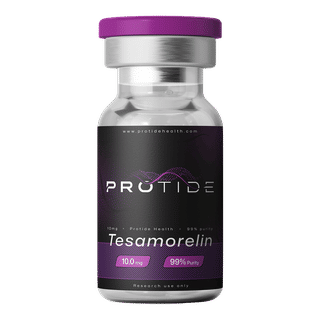
Tesamorelin | Metabolic / visceral fat | Belly fat, body composition | FDA-approved (Rx) |
GHK-Cu | Skin & anti-aging | Collagen, hair, wound repair | Cosmetic / research |
MOTS-c | Metabolic & longevity | Energy, insulin sensitivity, endurance | Research only |
Semax & Selank | Cognitive | Focus, memory, stress and mood | Research only |
PT-141 (Bremelanotide) | Sexual health | Libido in men and women | FDA-approved (Rx) |
Want the short version? Skip ahead to any peptide below, or use the peptide dosage calculator once you know what you are working with. For the science behind the whole class, start with what peptides are used for.
What "most popular" actually means here
Popularity is not one number. We weighed three signals: monthly Google search demand, documented clinical or compounded use, and how often each compound comes up in research and community discussion. Search interest alone tells a lopsided story, because the two prescription weight-loss peptides dwarf everything else.
Tirzepatide draws roughly 1,000,000 U.S. searches a month and semaglutide around 450,000. BPC-157, the most-searched research peptide, sits near 301,000. Sermorelin and tesamorelin follow at 165,000 and 135,000.
That gap is the real headline. When people say "peptides" in 2026, most of them mean a GLP-1 drug. The research-peptide world, where BPC-157 and TB-500 live, is smaller but growing fast, and it is where Peptide Mind spends most of its time.
Looking to source the most popular peptides? Check out our verified peptide vendor rankings.
1. BPC-157: the healing peptide
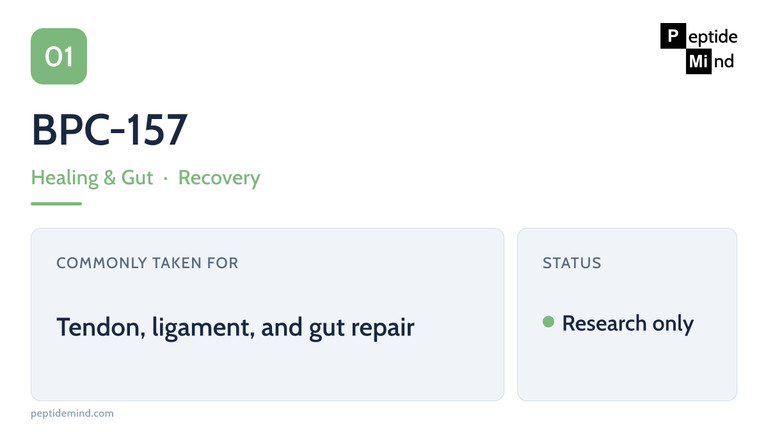
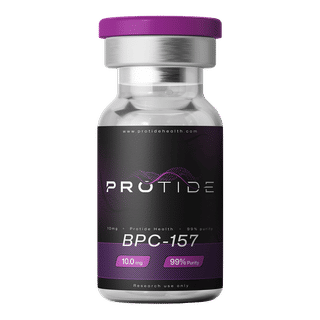
BPC-157 is the body-repair peptide, studied for tendons, ligaments, and the gut. It is the single most-searched research peptide of the group, and the one most people name first.
BPC-157 is a synthetic 15-amino-acid sequence derived from a protein found in gastric juice. In animal models it speeds the repair of transected tendon and muscle, calms inflammation, and protects the gut lining, which is why its category spans recovery and gut health at once. People take it for sports injuries, joint pain, and digestive issues. The catch is that the human evidence is thin. Strong preclinical data, almost no controlled clinical trials. It is sold for research use, not approved as a drug.
If you are looking at it for an injury, the BPC-157 research guide covers mechanism and study dosages, and many people pair it with the next peptide on this list.
2. TB-500: tissue repair and mobility

TB-500 is the other half of the recovery conversation, used for soft-tissue repair and flexibility. It belongs in the same healing category as BPC-157 and is frequently stacked with it.
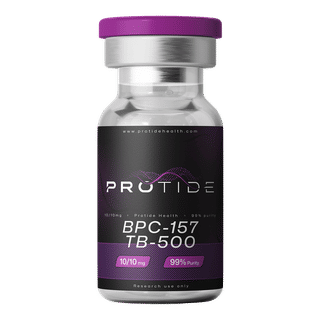
TB-500 is a synthetic fragment of thymosin beta-4, a natural peptide that acts as the main actin-sequestering protein in cells. By regulating actin, it supports cell migration, new blood vessel formation, and wound repair. Researchers study it for muscle and tendon injuries, and users report better range of motion. Like BPC-157, the evidence base is mostly animal and in-vitro work, and it remains a research compound rather than an approved medicine. The two together are nicknamed the Wolverine stack for a reason.
3. GLP-1 peptides (semaglutide and tirzepatide): weight loss
Shop research peptides
Live pricing from our top-rated vendor. Prices update as vendor listings change.
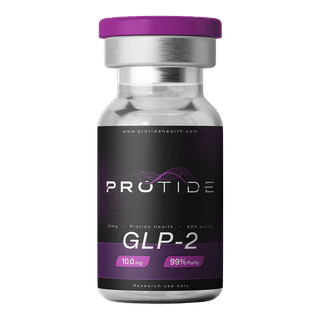
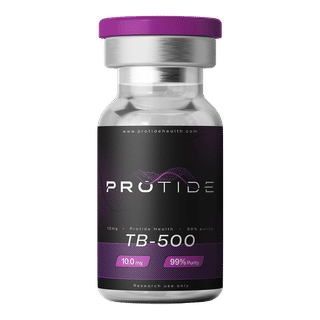
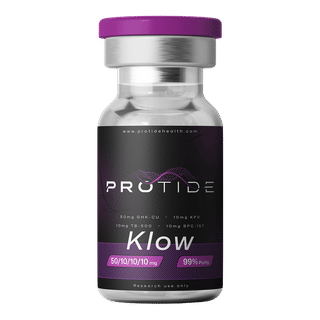
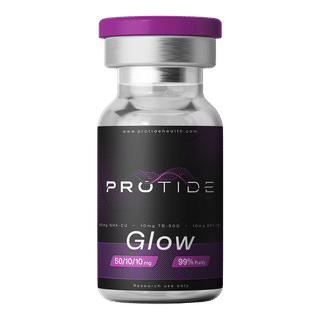
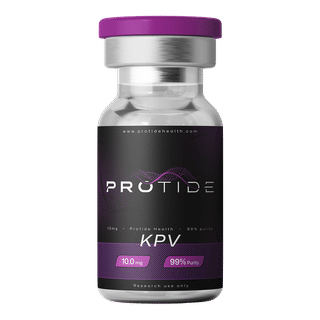

Semaglutide and tirzepatide are the most-taken peptides in the world, prescribed for weight loss and blood sugar. They define the weight and metabolic category and account for the bulk of all peptide demand.
These GLP-1 receptor agonists work on appetite and insulin signaling. The clinical results are large and well documented. In the STEP 1 trial, weekly semaglutide produced a mean 14.9% body-weight loss over 68 weeks. Tirzepatide, a dual GLP-1/GIP agonist, reached up to 20.9% weight loss in SURMOUNT-1. Both are FDA-approved prescription drugs, which sets them apart from most of this list. For how they stack up against the research-grade fat-loss options, see the best peptides for weight loss guide.
4. CJC-1295 and Ipamorelin: the growth hormone stack

CJC-1295 with Ipamorelin is the most popular growth-hormone stack, taken for muscle, recovery, and sleep. People rarely run one without the other, so it earns a single spot.
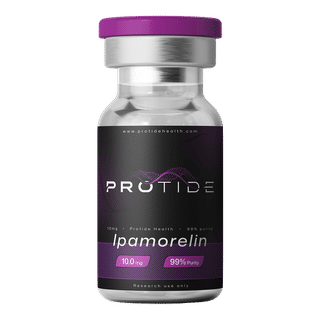
This pairing sits in the growth hormone category. CJC-1295, a long-acting GHRH analog, produced 2- to 10-fold rises in growth hormone in healthy adults in a 2006 study, with IGF-1 staying elevated for days. Ipamorelin adds a clean, selective GH pulse without the hunger or cortisol spikes of older secretagogues. Together they aim to raise the body's own growth hormone instead of injecting it. Both are research or compounded compounds, not over-the-counter supplements. The CJC-1295 and Ipamorelin protocol page breaks down how the combination is studied, and the best peptide stacks guide shows where it fits among goal-based protocols. Both peptides fall under the umbrella term growth hormone secretagogue (GHS), covered in Peptide Mind's GHS glossary entry.
5. Sermorelin: growth hormone for anti-aging and sleep
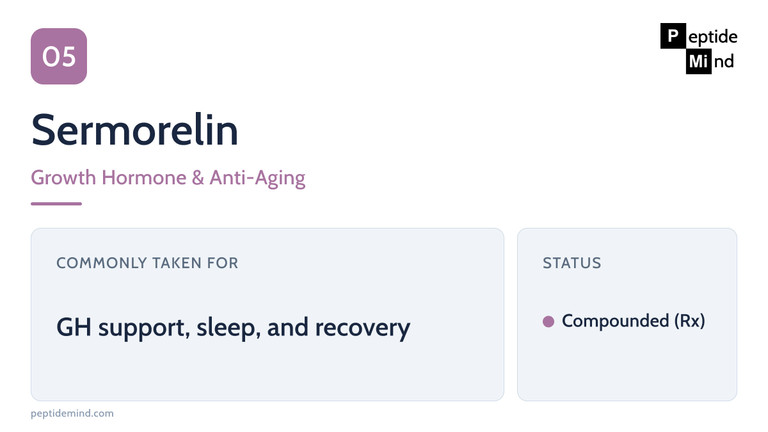
Sermorelin is the longest-standing growth-hormone peptide, taken for recovery, sleep, and healthy aging. Its search demand, near 165,000 a month, puts it among the most popular of all.
Sermorelin is a synthetic version of the first 29 amino acids of growth hormone-releasing hormone. That fragment keeps nearly full activity, prompting the pituitary to make and release its own GH in a natural, pulsing rhythm. It was originally FDA-approved in 1990 under the brand Geref to diagnose GH deficiency, then withdrawn commercially in 2008 for business reasons, and today it lives on through compounding pharmacies. People in their 40s and beyond take it for sleep quality, recovery, and body composition. To see how it differs from its cousins, read sermorelin vs ipamorelin vs tesamorelin.
6. Tesamorelin: targeted belly-fat reduction

Tesamorelin is the peptide for visceral fat, the deep belly fat around the organs. It shares the growth-hormone mechanism but earns its own category for body composition.
Tesamorelin is a stabilized GHRH analog. It is FDA-approved to reduce excess visceral abdominal fat in adults with HIV-associated lipodystrophy, where Phase 3 work showed roughly a 15% drop in visceral fat over six months. That approval makes it one of the few peptides here with a regulated label, and its 135,000 monthly searches reflect interest well beyond its narrow indication. Off-label, people use it for stubborn abdominal fat and metabolic support, though that use sits outside its approved purpose.
7. GHK-Cu: skin, hair, and collagen
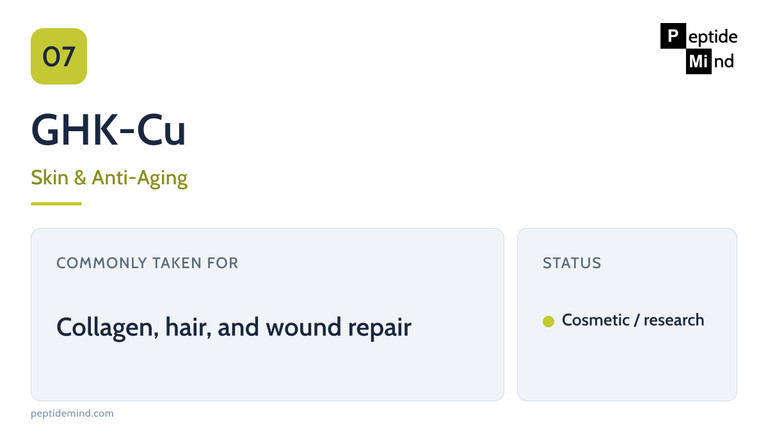
GHK-Cu is the skin peptide, the copper complex behind the collagen-boosting trend. It owns the skin and anti-aging category and shows up in both injectable protocols and serums.
GHK-Cu is a small peptide bound to copper that the body produces naturally, with levels falling as we age. Research credits it with stimulating collagen, elastin, and skin repair while acting as an anti-inflammatory and antioxidant. People take it, topically or by injection, for firmer skin, fewer fine lines, faster wound healing, and hair support. It is the backbone of the best skincare peptides and appears throughout the peptides studied for hair growth. The GHK-Cu guide covers topical versus injectable use.
8. MOTS-c: the exercise-mimic for metabolism
Shop research peptides
Live pricing from our top-rated vendor. Prices update as vendor listings change.
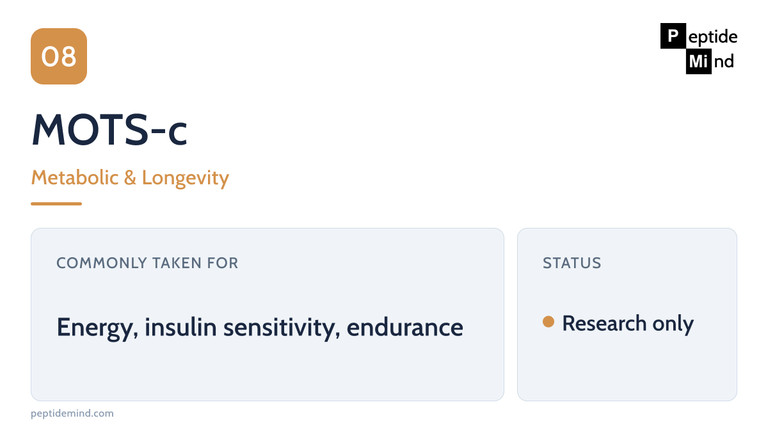
MOTS-c is the mitochondrial peptide, taken for energy, metabolism, and endurance. It bridges the metabolic and longevity categories.
MOTS-c is a 16-amino-acid peptide encoded inside mitochondrial DNA. It behaves like an exercise signal: studies show it regulates muscle and fat metabolism, activates AMPK, and improves insulin sensitivity in aged and obese mice. Levels rise with exercise and fall with age, which is why the longevity crowd pays attention. People take it for energy, fat metabolism, and workout capacity. Human data is limited and it remains research-only, but it earns a place among the best peptides for longevity.
9. Semax and Selank: the nootropic pair
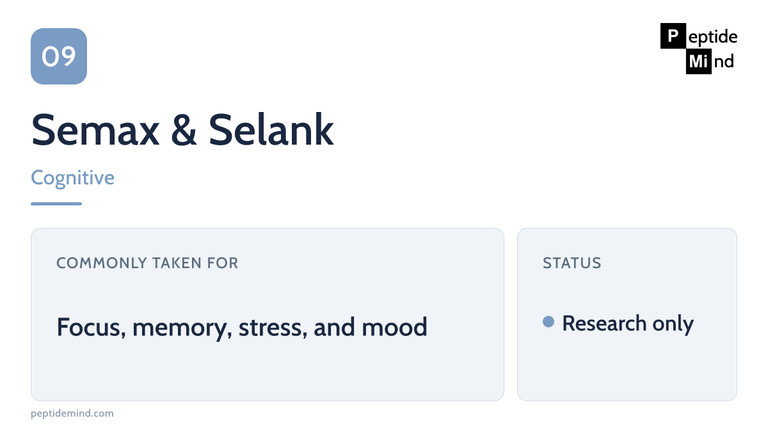
Semax and Selank are the brain peptides, taken for focus, memory, and stress. Two compounds, one cognitive category: Semax leans toward focus, Selank toward calm. That shared category is often referred to as the nootropic peptide class.
Semax is a Russian-developed peptide that raises BDNF and nerve growth factor in the brain, supporting memory, attention, and neuroprotection. Selank is its anti-anxiety counterpart, used to take the edge off stress without sedation. Both are prescription drugs in Russia but sold only as research compounds in North America. People reach for them during heavy workloads or for mood support. If you are deciding between them, Semax vs Selank lays out the differences.
10. PT-141 (Bremelanotide): libido
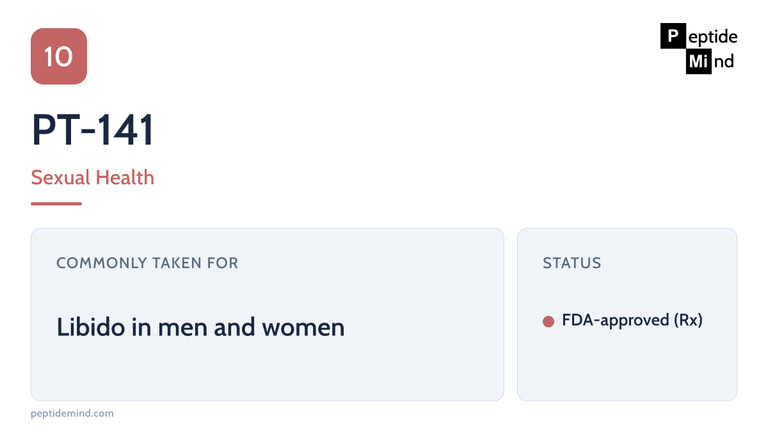
PT-141 is the libido peptide, taken by both men and women for sexual desire. It rounds out the list as the sexual-health category, and unlike most desire treatments it works through the brain rather than blood flow.
PT-141, known generically as bremelanotide, activates melanocortin receptors in the central nervous system. The FDA approved it in 2019 as Vyleesi for premenopausal women with hypoactive sexual desire disorder, and it is used off-label by men as well. That approval, plus 40,500 monthly searches, keeps it firmly on the popular list. It is a prescription product, taken before anticipated activity rather than daily.
Looking to procure the most popular peptides? Check out our verified peptide vendor rankings.
Other popular peptides worth knowing
Ten spots leaves a few favorites out. These come up often enough to deserve a mention:
Epitalon and NAD+: longevity staples, studied for telomeres, circadian rhythm, and cellular energy. NAD+ is a coenzyme, not a peptide, a distinction the longevity peptides guide explains.
Retatrutide: a next-generation triple-agonist for weight loss, often called the successor to tirzepatide, with strong early data.
Thymosin Alpha-1: an immune-support peptide used in some clinical settings.
Melanotan 2: the tanning peptide, popular but higher-risk; the Melanotan 1 vs 2 guide covers why.
KPV: an anti-inflammatory tripeptide for gut and skin.
How to match a peptide to your goal
Start with the outcome, not the molecule. The category tells you most of what you need.
Heal an injury or gut issue: BPC-157, TB-500, or both together.
Lose fat: a GLP-1 (semaglutide, tirzepatide) for appetite, tesamorelin or MOTS-c for metabolic support.
Build muscle and recover: CJC-1295 with Ipamorelin, or sermorelin.
Better skin and hair: GHK-Cu.
Sharper focus or calmer mood: Semax or Selank.
Libido: PT-141.
Once you have picked a direction, the how to use peptides walkthrough and the peptide dosage calculator handle the practical side: reconstitution, dosing, and storage.
Frequently asked questions
Shop research peptides
Live pricing from our top-rated vendor. Prices update as vendor listings change.
What is the number one peptide people take?
By raw demand, tirzepatide is the most-taken peptide, with roughly a million U.S. searches a month, followed by semaglutide. Among research peptides rather than prescription drugs, BPC-157 leads.
What are the top 3 peptides?
It depends on the goal. For overall popularity: the GLP-1 drugs (semaglutide and tirzepatide) for weight loss, BPC-157 for healing, and the CJC-1295 with Ipamorelin stack for muscle and recovery. Those three categories cover most of what people use peptides for.
What peptides do bodybuilders take?
Bodybuilders gravitate toward growth-hormone peptides: CJC-1295 with Ipamorelin, sermorelin, and sometimes tesamorelin, usually paired with BPC-157 and TB-500 for recovery. The best peptide stacks guide details the common protocols.
Are these peptides legal?
The four FDA-approved ones (semaglutide, tirzepatide, tesamorelin, PT-141) are legal with a prescription. The rest are legal to buy and sell for research use, but they are not approved for human consumption. Legal status and approval are not the same thing.
Which peptide should I take first?
Pick by goal, then start with the most-studied option in that category, usually BPC-157 for healing or a prescribed GLP-1 for weight loss under medical supervision. The beginner's guide to peptides is the right starting point.
The bottom line
The most popular peptides people take map cleanly onto six goals: healing, weight loss, growth hormone, skin, cognition, and libido. Four are approved prescription drugs and the rest are research compounds, so the category tells you what a peptide is for and the status tells you how seriously the evidence has been tested. Match the goal to the category, check the research, and start with the best-studied option you can access responsibly.
Disclaimer
Peptide Mind publishes research and educational content only. The compounds above are discussed in the context of preclinical research or, where noted, approved medical use. This is not medical advice, several of these peptides are not approved for human use, and you should consult a licensed healthcare provider before considering any of them.
References
Wilding JPH, et al. Once-Weekly Semaglutide in Adults with Overweight or Obesity (STEP 1). NEJM, 2021. https://www.nejm.org/doi/full/10.1056/NEJMoa2032183
Jastreboff AM, et al. Tirzepatide Once Weekly for the Treatment of Obesity (SURMOUNT-1). NEJM, 2022. https://www.nejm.org/doi/full/10.1056/NEJMoa2206038
Stable Gastric Pentadecapeptide BPC 157 as a Therapy for Disabled Myotendinous Junctions. PubMed, 2021. https://pubmed.ncbi.nlm.nih.gov/34829776/
Goldstein AL. Thymosin beta4: actin-sequestering protein moonlights to repair injured tissues. Trends Mol Med, 2005. https://pubmed.ncbi.nlm.nih.gov/16099219/
Teichman SL, et al. Prolonged Stimulation of GH and IGF-I Secretion by CJC-1295. JCEM, 2006. https://academic.oup.com/jcem/article-abstract/91/3/799/2843281
FDA approves tesamorelin for reduction of central fat accumulation. HIV i-Base. https://i-base.info/htb/14188
Pickart L, Margolina A. Regenerative and Protective Actions of the GHK-Cu Peptide. PMC, 2018. https://pmc.ncbi.nlm.nih.gov/articles/PMC6073405/
MOTS-c: A novel mitochondrial-derived peptide regulating muscle and fat metabolism. PubMed. https://pubmed.ncbi.nlm.nih.gov/27216708/
NGF and BDNF gene expression in rat brain under Semax. PubMed. https://pubmed.ncbi.nlm.nih.gov/19662538/
Vyleesi (bremelanotide) FDA Approval History. Drugs.com. https://www.drugs.com/history/vyleesi.html
Sermorelin: GHRH (1-29) analog overview. ScienceDirect Topics. https://www.sciencedirect.com/topics/medicine-and-dentistry/sermorelin
Add a comment
This will be publicly visible.
Your email address will not be published.
Your comment will be reviewed by an admin before it is published.