Tanning Peptides: What They Are, Results & Risks (2026)
Tanning peptides explained: how melanotan I and II work, what before and after results really look like, documented side effects, legal status, and safety.


Tanning peptides are injectable analogues of a hormone your body already makes to control skin pigment. They work, and that part is not in dispute. The disputes are about everything else: how much risk comes with them, what the results actually look like, and whether the versions sold online contain what the label says. This guide covers the mechanism, the evidence, the documented harms, and the alternatives, with sources for each.
Disclaimer: This article is for educational and research purposes only. Nothing here is medical advice, and none of the compounds discussed are approved for cosmetic tanning.
What Are Tanning Peptides? (The Short Answer)
Tanning peptides are synthetic analogues of alpha-melanocyte-stimulating hormone (α-MSH), a hormone that binds melanocortin receptors on the pigment-producing cells in your skin and triggers eumelanin production. Injected, they darken skin without requiring ultraviolet exposure to start the process, which is exactly why people seek them out.
Three compounds account for nearly all real-world use:
Melanotan II (MT-2) is the one people almost always mean by "tanning peptides." It is unapproved everywhere, and sold online through research peptide suppliers.
Melanotan I, known pharmaceutically as afamelanotide, is the same family developed properly: tested in randomised trials, and FDA-approved in 2019 for a rare photosensitivity disorder. It is not approved for cosmetic tanning.
Bremelanotide (PT-141) is a close relative that people frequently mistake for a tanning peptide. It is not one, and we explain why below.

You will also see these called the "Barbie drug," the "Barbie peptide," or "tan jabs." Those are media nicknames for melanotan II, not separate compounds. The nickname is old enough to appear in the dermatology literature: a 2010 British Journal of Dermatology review is literally titled "Melanotropic peptides: more than just 'Barbie drugs' and 'sun-tan jabs'?"
The short version of the regulatory picture, expanded further down: no tanning peptide is approved anywhere in the world for cosmetic tanning. One member of the family is an approved prescription drug, for a condition that has nothing to do with looking tan.
How Do Tanning Peptides Work? Melanocortin Receptors Explained
Tanning peptides bind melanocortin receptors, a family of five receptors spread across your skin, brain, and glands. Activating MC1R on melanocytes shifts pigment production toward eumelanin, the dark brown pigment. The catch is that melanotan II does not stop at MC1R, and that single fact explains its entire side-effect profile.
Receptor | Where it lives | What activation does | Melanotan I (afamelanotide) | Melanotan II | Bremelanotide (PT-141) |
|---|---|---|---|---|---|
MC1R | Melanocytes (skin) | Eumelanin synthesis, producing tanning | Yes, dominant clinical effect | Yes | Minimal |
MC3R | CNS, periphery | Energy balance, inflammation | Not clinically prominent | Yes | Yes |
MC4R | CNS | Appetite suppression, nausea, sexual arousal | Not clinically prominent | Yes | Yes, primary target |
MC5R | Sebaceous glands | Sebum production | Not clinically prominent | Yes | No |
Melanotan II is a cyclic peptide and a broadly non-selective agonist. It activates MC1R, MC3R, MC4R and MC5R. Melanotan I (Afamelanotide) is a linear α-MSH analogue whose clinical effect is dominated by MC1R-driven melanogenesis. It is commonly described as MC1R-selective, though the underlying binding data is less clean than that shorthand suggests.

Read the table again and the side effects stop looking random:
Nausea and appetite loss come from MC4R.
Spontaneous erections come from MC4R and MC3R.
Facial flushing comes from vascular melanocortin activity.
Oilier skin and acne come from MC5R.
Tanning comes from MC1R, the only receptor anyone actually wanted.
That is the trade at the centre of this category. Melanotan II is popular precisely because it is potent, and it produces systemic effects precisely because it is not selective. You cannot separate the two, because they are the same molecular property.
One correction worth making
A common claim is that tanning peptides "still require sun exposure to work." That is not quite right. Melanogenesis via MC1R is triggered by the peptide itself, independent of ultraviolet light. Bypassing UV is the whole premise, as the British Journal of Dermatology review put it: "circumventing the need for UVR."
Users routinely combine melanotan with sunbeds to accelerate or deepen results. A 2026 JAAD Case Reports paper describes a patient who presented with five primary melanomas in situ following recent tanning bed use, melanotan exposure, and anabolic hormone use, which is three compounding exposures at once. The peptide does not require UV. People use UV anyway.
Shop research peptides
Live pricing from our top-rated vendor. Prices update as vendor listings change.
The Main Tanning Peptides Compared
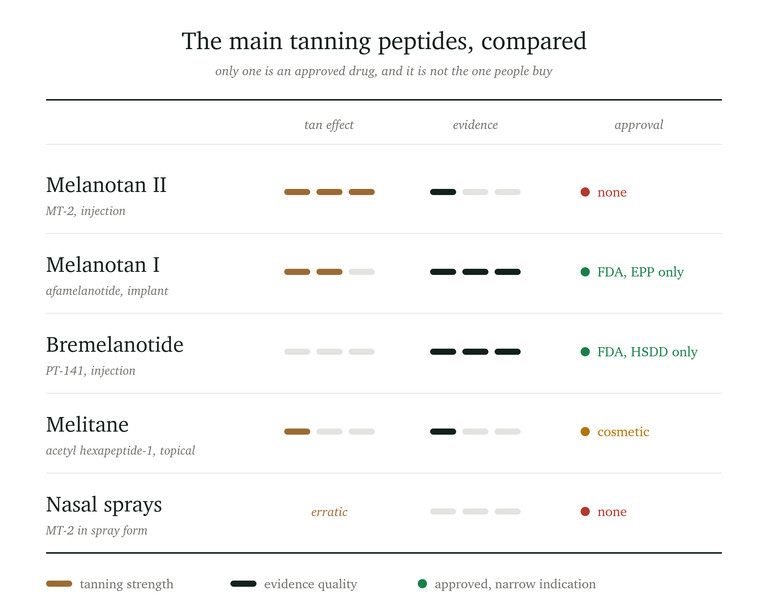
Compound | Also called | Route | Approval status | Tanning effect | Main risks | Evidence level |
|---|---|---|---|---|---|---|
Melanotan II | MT-2, "Barbie peptide" | Injection, also nasal sprays | None, anywhere | Strongest, fastest | Nausea, mole darkening, rhabdomyolysis, priapism, renal infarction | Case reports and small studies |
Melanotan I | Afamelanotide, SCENESSE | Subcutaneous implant (Rx) | FDA-approved Oct 2019, EPP only | Slower, milder | Far fewer systemic effects | Randomised controlled trials |
Bremelanotide | PT-141, Vyleesi | Injection (Rx) | FDA-approved Jun 2019, HSDD only | Not a tanning agent | Nausea, flushing | RCTs, different indication |
Melitane | Acetyl hexapeptide-1 | Topical cosmetic | Cosmetic ingredient | Subtle, gradual | Low | Manufacturer data, thin independent evidence |
Tanning nasal sprays | "Tan jabs" | Nasal | None | Erratic | Unverifiable dose and contents | None |
Melanotan II (MT-2): the one people mean
Melanotan II is what circulates as "tanning peptides." It is a cyclic α-MSH analogue, non-selective across the melanocortin receptors, and it is not approved by any regulator on earth for any purpose. Everything sold under the name is unlicensed, which means no dose verification, no purity testing, and no manufacturing oversight unless a specific vendor voluntarily provides third-party analysis.
It produces the fastest and most dramatic pigmentation of anything in this category. It also produces the most systemic effects, for the receptor reasons above. For dosing context, storage, and the full side-effect profile, see our Melanotan II compound profile.
Melanotan I (afamelanotide / SCENESSE): the approved one
This is the fact that reframes the whole category, and almost nobody writing about it leads with it.
Afamelanotide is a real, approved drug. The FDA approved SCENESSE on 8 October 2019 to increase pain-free light exposure in adults with erythropoietic protoporphyria (EPP), a rare inherited disorder in which sunlight causes severe pain. Approval rested on three clinical trials in 244 adults, and the pivotal evidence was published in the New England Journal of Medicine (Langendonk et al., 2015).
It is delivered as a subcutaneous implant by a trained physician, not a self-administered injection. It is not approved, prescribed, or available for cosmetic tanning. See our Melanotan I profile for more details.
Bremelanotide (PT-141): a melanocortin, but not a tanning peptide
Bremelanotide is structurally a variant of melanotan II, and it is the clearest case of mistaken identity in this category. It targets MC3R and MC4R, and the FDA approved it as Vyleesi on 21 June 2019 for acquired, generalised hypoactive sexual desire disorder in premenopausal women.
It is a melanocortin agonist. It is not a tanning agent, it is not prescribed for pigmentation, and buying it expecting a tan is a category error. Details on our PT-141 profile.
Topical "tanning peptides" and the DHA confusion
Sunless tanners, self-tanning lotions and serums almost all rely on dihydroxyacetone (DHA), and DHA is not a peptide. It is a simple sugar that browns dead cells in the outermost skin layer through the Maillard reaction, the same chemistry that browns toast. It never touches melanocytes.
Some formulas do add α-MSH-biomimetic peptides such as melitane (acetyl hexapeptide-1), sold as tan accelerators. The effect is subtle and the independent evidence thin: a 2026 systematic review covering DHA, melanotan, forskolin and carotenoids across 68 studies did not treat cosmetic tanning peptides as an evidenced category.
Tanning nasal sprays
Nasal melanotan products are typically melanotan II in a different delivery vehicle. Nasal absorption is variable and dose per spray is effectively unverifiable, which makes an already unregulated product less predictable. A 2025 case report in the International Journal of Oral and Maxillofacial Surgery raised melanotan II nasal spray as a possible risk factor for oral mucosal melanoma. It was framed as a question rather than a conclusion, but it is worth knowing before inhaling a melanocortin agonist.
Melanotan 1 vs Melanotan 2: Which Is Used for Tanning?
Short answer: melanotan II is what people use cosmetically. It is more potent, works faster, and is what is sold online. Melanotan I is milder, its clinical effect is centred on pigmentation rather than systemic melanocortin activity, and in its regulated form (afamelanotide) it is a prescription implant for a rare disease rather than something you can buy.
Shop research peptides
Live pricing from our top-rated vendor. Prices update as vendor listings change.
We have a full head-to-head covering receptor selectivity, dosing, tanning speed and side effects: Melanotan 1 vs Melanotan 2.

Melanotan 2 (MT-2): What It Is and How People Use It
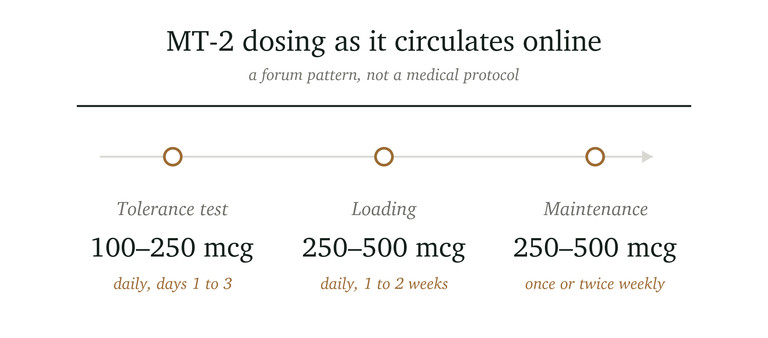
Melanotan 2 is a cyclic seven-amino-acid analogue of α-MSH, injected subcutaneously, that triggers pigment production directly rather than through sun exposure. Circulated protocols run a daily "loading" phase of roughly 250 to 500 mcg until the desired colour appears, then drop to one or two maintenance doses a week. None of this is approved, and none of it comes from a dose-finding trial designed for cosmetic use.
What Melanotan 2 actually is
Chemically it is Ac-Nle-Asp-His-D-Phe-Arg-Trp-Lys-NH2, a lactam-bridged ring structure. That ring is the point: cyclising the molecule makes it far more stable than natural α-MSH, which the body clears within minutes. The result is a compound described in the original literature as "superpotent," active at very small doses and long-lasting enough to be dosed once a day rather than continuously.
It ships as a lyophilised powder, usually 10 mg per vial, and has to be reconstituted with bacteriostatic water before use.
How people take it
Subcutaneous injection, using an insulin syringe, into abdominal fat. Two practical habits show up in nearly every circulated protocol, and both exist to manage nausea rather than to improve results: inject at night, so the worst of the flushing and queasiness happens while asleep, and inject on an empty stomach.

Reconstituting a 10 mg vial with 3 mL of bacteriostatic water gives roughly 3,333 mcg per mL, which works out as follows on a standard U-100 insulin syringe:
Dose | Volume | Insulin syringe units |
|---|---|---|
100 mcg | 0.03 mL | 3 units |
250 mcg | 0.075 mL | 7.5 units |
500 mcg | 0.15 mL | 15 units |
1,000 mcg | 0.30 mL | 30 units |
Units change entirely if you reconstitute with a different volume, so the number on the syringe is meaningless without knowing the concentration. Our peptide dosage calculator and reconstitution guide cover the arithmetic.
The dosages circulated online
The pattern that circulates is consistent across forums and vendor pages:
Days one to three: 100 to 250 mcg daily, described as a tolerance test rather than a therapeutic step. Nausea and facial flushing peak here.
Loading phase: 250 to 500 mcg daily for one to two weeks, until the wanted colour appears.
Maintenance: 250 to 500 mcg once or twice a week, continued indefinitely.
These numbers are titrated against nausea, not efficacy data. The only human dose-finding work, a 1996 Phase I study, ran 0.01 to 0.03 mg/kg, roughly 700 to 2,100 mcg for a 70 kg person. The circulated 250 to 500 mcg sits below the starting dose of the only trial that ever set a range.
The online consensus is therefore more conservative than the clinical work, and completely unstudied in duration.
How much faster does it tan you?
Shop research peptides
Live pricing from our top-rated vendor. Prices update as vendor listings change.
Faster than sun exposure, though the multipliers quoted online are invented.
In the 1996 Phase I study, two of three volunteers showed visible pigmentation after just five low doses across two weeks. It appeared on the buttock as well as the face, and the buttock gets no sun, which is direct evidence the peptide works without UV.
The real difference is uniformity: a UV tan builds only where light reaches skin, while melanotan 2 pigments everywhere at once. No trial has compared the two head to head, so treat specific speed claims as marketing.
Tanning Peptides Before and After: What Results Actually Look Like
Realistic before and after timelines follow the same arc: systemic side effects arrive first, freckles and existing moles darken before overall skin tone shifts, visible tanning appears around weeks two to three, and colour fades over roughly one to three months after stopping. Individual variation is large, and skin type matters enormously.
Week | Commonly reported | What is happening | Caveat |
|---|---|---|---|
1 | Flushing, nausea after doses, no visible colour change | Systemic melanocortin activation | Side effects front-load |
2 to 3 | Freckles and existing moles darken first | Existing melanocytes upregulate | This is the mole-change window, covered below |
3 to 5 | Overall skin tone deepens | Eumelanin accumulates | Fair skin types often respond least |
6 to 8 | Colour plateaus, users shift to less frequent dosing | Response steadies | Varies widely |
After stopping | Fades over one to three months | Normal melanin turnover | Highly variable |
Composite of reported user experience and the published case literature. Not a clinical schedule, and not a guarantee.

The week two to three row deserves a hard stop. In the British Journal of Dermatology review, dermatologists were advised that melanotan use "may be suspected in unexpectedly tanned individuals with rapidly pigmenting naevi." Multiple case reports document exactly this: eruptive new moles and darkening of pre-existing ones, in one 2014 European Journal of Dermatology case within 24 hours of a single injection.
If any mole changes in size, shape, or colour, stop immediately and see a dermatologist. Get a full-body skin check before starting, not after something looks wrong.
Why the before and after photos online are unreliable
Tanning peptides before and after photos are the most-searched part of this topic and the least trustworthy. Four structural problems make circulating photo sets close to worthless as evidence:
Concurrent UV exposure. Most subjects are also using sunbeds or sunbathing. UV alone produces a tan, and nothing in a photo pair separates the two.
Uncontrolled photography. Lighting, white balance, exposure, tan lines and pose differ between shots. Warm lighting alone can manufacture most of a "result."
Commercial origin. Nearly every photo set traces back to a vendor or reseller with a product to move.
Survivorship bias. People who saw nothing, or who felt sick and quit in week one, do not post.
A genuinely informative before and after would need fixed lighting and camera settings, controlled or eliminated UV exposure, and ideally standardised colorimetry. Effectively none of the photo sets in circulation meet even the first condition. Treat them as marketing, not data.
Do Tanning Peptides Actually Work? What the Research Shows
The mechanism is real. Several of the claims built on top of it are not. Graded honestly:
Increases skin pigmentation: Supported. The melanocortin pathway is well characterised, and afamelanotide's randomised trial evidence in EPP confirms that an α-MSH analogue meaningfully increases melanin density in humans.
Works without ultraviolet exposure: Supported as a mechanism. MC1R activation drives melanogenesis directly. Whether users avoid UV is a different question, and the case literature says many do not.
Protects against sunburn or reduces skin cancer risk: Unsupported, and the most dangerous assumption on this page. Increased pigment is not sunscreen. A tan is a marker of prior DNA damage rather than a substitute for SPF, and a slower burn response can extend the time someone spends in the sun before discomfort tells them to stop. Afamelanotide's approved photoprotective use is in a specific inherited porphyria under medical supervision. That is not evidence of cosmetic photoprotection, and it should never be read as permission to skip sunscreen.
Aids weight loss or improves libido (melanotan II): Off-target, not benefits. These are MC3R and MC4R effects. If sexual dysfunction is the actual goal, bremelanotide exists as an approved drug with trial evidence and a known dose. Reaching for an unregulated tanning compound instead is a worse version of an available option.
Shop research peptides
Live pricing from our top-rated vendor. Prices update as vendor listings change.
On user reports and Reddit threads: they agree on two things, that pigmentation happens and that nausea is common. They are useless for the questions that matter most. Nobody follows up five years later, and no forum thread can detect a melanoma risk signal.
Are Tanning Peptides Safe? Side Effects and Documented Risks
No, not in the form nearly everyone encounters them. Melanotan II is unapproved, unregulated in production, and linked in the medical literature to serious adverse events. Below is what is actually documented, separated by severity and stated at the level of certainty the evidence supports.
Commonly reported side effects
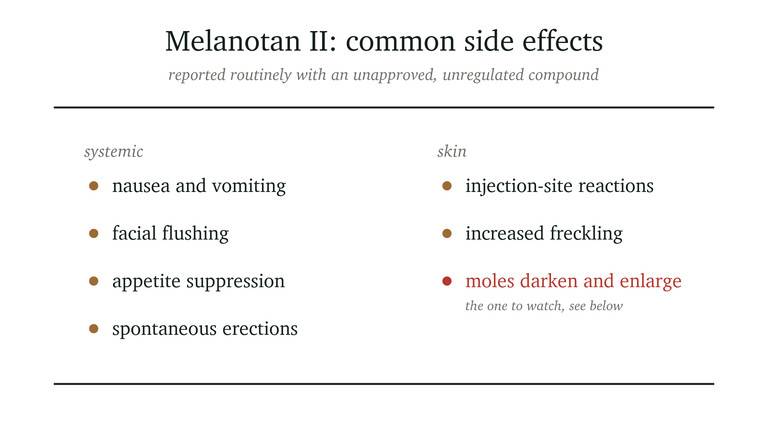
Nausea and vomiting, facial flushing, spontaneous erections, appetite suppression, injection-site reactions, increased freckling, and darkening and enlargement of existing moles.
Map them back to the receptor table: nausea and appetite loss are MC4R, erections are MC4R and MC3R, oilier skin is MC5R. Predictable, not mysterious.
Documented serious events
These are case reports, not trials. They show these events have happened in people using melanotan. They do not establish population-level causation, and several involve confounding exposures.
Rhabdomyolysis. A 39-year-old injected 6 mg, six times his stated dose, and was admitted to intensive care with a creatine kinase of 17,773 IU/L and acute kidney injury (Clin Toxicol, 2012).
Priapism, following reported MT-2 overdose (Clin Toxicol, 2013).
Renal infarction (CEN Case Rep, 2020).
Posterior reversible encephalopathy syndrome (Ann Intern Med, 2013).
Eruptive and atypical moles, in one case within 24 hours of a single dose (Arch Dermatol 2009, Br J Dermatol 2009, Ir Med J 2013, Eur J Dermatol 2014).
Melanoma. Five primary melanomas in situ in one patient, though with combined tanning bed and anabolic hormone exposure (JAAD Case Rep, 2026).
A 2026 systematic review puts it plainly: unregulated melanotan use "has caused serious adverse effects, including rhabdomyolysis, renal infarction, and priapism."
The supply-chain risk
Even setting pharmacology aside, an unlicensed injectable carries risks the molecule itself does not:
Unknown purity and content. There is no requirement that the vial contains what the label says, at the stated amount, or nothing else.
Non-sterile reconstitution and injection technique.
If someone is going to proceed regardless, the minimum is batch-specific third-party analysis. Our guides on certificates of analysis, reconstitution, and storage cover what to check and how, and how to find a legitimate peptide vendor covers vetting the source.
Are Tanning Peptides Legal?
Melanotan II is not approved as a medicine in the United States, United Kingdom, European Union, or Australia. It is not a controlled substance in most jurisdictions, but selling it for human use is unlawful in all of them, which is why it is sold as a "research chemical."
Afamelanotide (SCENESSE) is the exception, and a narrow one: an approved prescription implant for erythropoietic protoporphyria, administered by a physician. There is no legal cosmetic-tanning route to any melanocortin agonist.
If you are researching the wider legal framework around research peptides, see our guide to research use only (RUO) designations.
Cost and Where People Buy Tanning Peptides
Shop research peptides
Live pricing from our top-rated vendor. Prices update as vendor listings change.
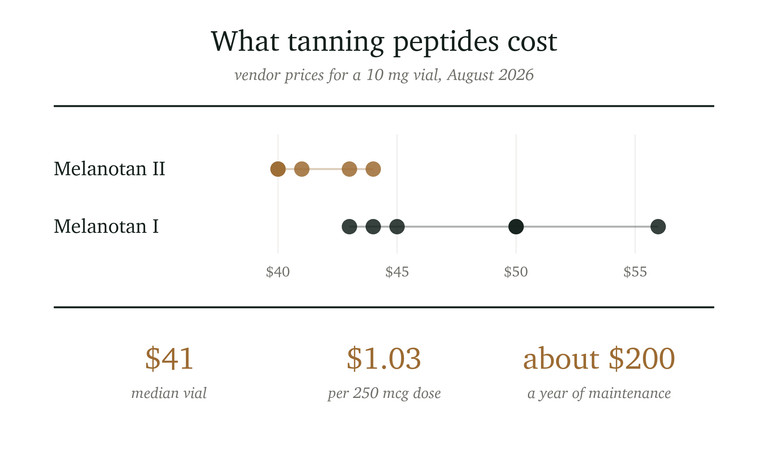
Research suppliers sell both melanotan compounds as 10 mg lyophilised vials. Melanotan 2 sits in a tight band around $40 to $44, and melanotan 1 runs higher at $43 to $56. The figures below were taken directly from vendor listings on 17 August 2026.
Melanotan II (MT-2) prices, 10 mg vial
Supplier | Price |
|---|---|
Protide Health | $40.00 |
Prime Peptides | $40.00 |
Core Peptides | $41.00 |
Ascension Peptides | $43.00 |
Ameano Peptides | $44.00 |
Melanotan I (MT-1) prices, 10 mg vial
Supplier | Price |
|---|---|
Core Peptides | $43.00 |
Ameano Peptides | $44.00 |
Prime Peptides | $45.00 |
Ascension Peptides | $50.00 |
Protide Health | $50.00 |
BioLongevity Labs | $55.97 |
We track melanotan 1 pricing across a wider set of suppliers on our Melanotan I price comparison, which lists current cost alongside reported purity and stock status.
What a vial actually buys you
Prices look abstract until you convert them into doses. A 10 mg vial holds 10,000 mcg, so at the median melanotan 2 price of $41:
Dose per injection | Doses per vial | Cost per dose |
|---|---|---|
250 mcg | 40 | about $1.03 |
500 mcg | 20 | about $2.05 |
Run against the protocols described earlier, a single vial covers a full two-week loading phase at 500 mcg daily and still leaves roughly three weeks of twice-weekly maintenance. Continuing that maintenance year-round works out to about five vials, or somewhere near $200 annually. The compound is cheap. That is a large part of why it spread.
What the numbers say about choosing a supplier
The melanotan 2 spread is only $4 across every supplier listed, which makes price close to useless as a way to choose between them. What genuinely varies is documentation. Several of these suppliers publish batch-specific third-party purity above 99.9%, and others list no purity figure at all. On an unapproved injectable, that gap matters considerably more than four dollars.
What we will say is what to demand of any supplier, for any peptide: batch-specific third-party HPLC and mass spectrometry results and a certificate of analysis that matches the vial in your hand. Our vendor directory and peptide company reviews apply those criteria across the market.
Safer Alternatives to Tanning Peptides
Every dermatology piece on this topic ends at "don't." That is incomplete advice, because the underlying want, looking tan without burning, is reasonable. The options, graded:
DHA self-tanners, the only genuinely low-risk way to get colour. No UV, no systemic exposure, no injection. The 2026 systematic review notes open questions about DHA cytotoxicity and systemic absorption, but the profile is not remotely comparable to an unregulated injectable.
Topical tan-accelerating cosmetic peptides (melitane). Low risk, modest effect, thin independent evidence. Reasonable to try, but do not expect much.
Dietary carotenoids. These accumulate in skin and subcutaneous fat and produce a yellow-orange shift rather than a brown tan. Cosmetically distinct from tanning, and under-researched in humans.
Forskolin. Stimulates melanin independently of melanocortin receptors, with efficacy in animal models and very little human data. Interesting, not yet actionable.
Prescription afamelanotide. Diagnosed EPP only, via a specialist. Not a cosmetic pathway.
If your interest in peptides is skin quality rather than colour, that is a genuinely better-evidenced area. See our guide to the best skincare peptides, the skin and hair peptide cheat sheet, and our full skin peptide category.
Frequently Asked Questions About Tanning Peptides
What are tanning peptides?
Shop research peptides
Live pricing from our top-rated vendor. Prices update as vendor listings change.
Tanning peptides are synthetic analogues of alpha-melanocyte-stimulating hormone (α-MSH) that bind melanocortin receptors on skin melanocytes and stimulate eumelanin production. The main ones are melanotan II, melanotan I (afamelanotide), and topical cosmetic peptides such as melitane. Only afamelanotide is approved, and only for a rare photosensitivity disorder.
How do tanning peptides work?
They activate MC1R on melanocytes, shifting pigment production toward eumelanin, the dark brown pigment, without needing ultraviolet light to initiate it. Melanotan II also activates MC3R, MC4R and MC5R, which is why it causes nausea, spontaneous erections and oilier skin alongside the tan.
Are tanning peptides safe?
Nobody knows yet. Melanotan II has no long-term safety data, and the documented harms, including rhabdomyolysis, renal infarction and atypical moles, come from case reports rather than controlled trials. Risk drops meaningfully with dermatologist skin checks, periodic bloodwork, and a third-party tested vial, though lower risk is not the same as proven safe.
Can you tan while taking tanning peptides without sun exposure?
Mechanistically, yes. MC1R activation drives melanogenesis independently of UV, which is the entire premise. In practice, many users combine melanotan with sunbeds to speed up or deepen results, and that combination appears repeatedly in the adverse-event case literature.
What are the side effects of tanning peptides?
Commonly reported effects include nausea and vomiting, facial flushing, spontaneous erections, appetite suppression, injection-site reactions, increased freckling, and darkening or enlargement of existing moles. Serious documented events include rhabdomyolysis, renal infarction, priapism, and posterior reversible encephalopathy syndrome.
Can tanning peptides cause skin cancer?
Causation is not established. Case reports document eruptive and atypical moles after melanotan use, and a 2026 report describes multiple primary melanomas in a patient with combined melanotan, tanning bed and anabolic hormone exposure, which are confounded exposures. The prudent reading is that melanotan changes moles in ways that complicate melanoma detection. Dermatologist monitoring is essential.
Are tanning peptides legal in the US?
Melanotan II is not FDA-approved and cannot be legally sold for human use. It is sold as a "research chemical". Afamelanotide (SCENESSE) is FDA-approved, but only for erythropoietic protoporphyria and only as a physician-administered implant.
How much are tanning peptides?
Melanotan 2 costs about $40 to $44 for a 10 mg vial from research suppliers, which works out near $2 per 500 mcg dose, or roughly $200 a year on maintenance dosing. Melanotan 1 runs higher at $43 to $56. Prescription afamelanotide is not available cosmetically at any price. Pricing shifts constantly, so verify current figures directly.
How long do tanning peptides take to work?
Reported timelines typically show freckles and existing moles darkening first, around weeks two to three, with overall skin tone deepening through weeks three to five and plateauing by weeks six to eight. Colour generally fades over one to three months after stopping. Fair skin types tend to respond least.
What is the "Barbie peptide"?
"Barbie peptide" and "Barbie drug" are media nicknames for melanotan II, referring to the deep tan it produces. The terms date back over a decade, and a 2010 British Journal of Dermatology review used "Barbie drugs" and "sun-tan jabs" in its title. They describe melanotan II rather than a distinct compound.
Are there tanning peptides that aren't injections?
Shop research peptides
Live pricing from our top-rated vendor. Prices update as vendor listings change.
Topical cosmetic peptides such as melitane exist but produce subtle effects with thin independent evidence, and most "sunless tanning peptide" products are really DHA formulations. DHA is a sugar, not a peptide. Nasal melanotan sprays are usually melanotan II with unverifiable dosing, which makes an unregulated product less predictable rather than safer.
Quick Reference
Compound | Route | Approval | Tanning strength | Biggest risk |
|---|---|---|---|---|
Melanotan II | Injection or nasal | None | Strongest | Systemic toxicity, mole changes |
Melanotan I (afamelanotide) | Rx implant | FDA, EPP only | Moderate | Not cosmetically available |
Bremelanotide (PT-141) | Rx injection | FDA, HSDD only | Negligible | Wrong drug for the goal |
Melitane (topical) | Topical | Cosmetic | Subtle | Minimal, weak evidence |
DHA self-tanner | Topical | Cosmetic | Cosmetic only | Reapplication, no UV protection |
Sources
Langan EA, Nie Z, Rhodes LE. Melanotropic peptides: more than just 'Barbie drugs' and 'sun-tan jabs'? Br J Dermatol. 2010;163(3):451-5. PMID 20545686
Langendonk JG, Balwani M, Anderson KE, Bonkovsky HL, et al. Afamelanotide for Erythropoietic Protoporphyria. N Engl J Med. 2015;373(1):48-59. PMID 26132941
Insights into Tanning Biology and Tanning Products. J Clin Aesthet Dermatol. 2026 Feb. PMID 41890775
Melanotan II injection resulting in systemic toxicity and rhabdomyolysis. Clin Toxicol (Phila). 2012;50(10). PMID 23121206
Melanotan II overdose associated with priapism. Clin Toxicol (Phila). 2013;51(4). PMID 23537392
Melanotan II: a possible cause of renal infarction. CEN Case Rep. 2020;9(2). PMID 31953620
Melanotan and the posterior reversible encephalopathy syndrome. Ann Intern Med. 2013;158(9). PMID 23648958
Eruptive naevi and darkening of pre-existing naevi 24 h after a single mono-dose injection of melanotan II. Eur J Dermatol. 2014;24(1). PMID 24334249
Eruptive melanocytic naevi following melanotan injection. Br J Dermatol. 2009;161(3). PMID 19575725
Five primary melanomas in situ in a patient with recent tanning bed use, melanotan exposure, and anabolic hormone use. JAAD Case Rep. 2026 Jul. PMID 42328529
Melanotan II nasal spray: a possible risk factor for oral mucosal malignant melanoma? Int J Oral Maxillofac Surg. 2025 Sep. PMID 40210573
FDA. Drug Trials Snapshots: SCENESSE (afamelanotide), approved 8 October 2019.
FDA. VYLEESI (bremelanotide) prescribing information, initial US approval 2019.
Therapeutic Goods Administration. Don't risk using tanning products containing melanotan.
Dorr RT, Lines R, Levine N, Brooks C, Xiang L, Hruby VJ, Hadley ME. Evaluation of melanotan-II, a superpotent cyclic melanotropic peptide in a pilot phase-I clinical study. Life Sci. 1996;58(20):1777-84. PMID 8637402
Disclaimer
This article is provided for educational and research purposes only and does not constitute medical advice. Melanotan I and melanotan II are not approved by the FDA or any other regulator for cosmetic tanning, and are not intended for human consumption. Nothing here should be taken as encouragement to obtain or use an unapproved compound. Content is intended for readers 21 and over. Always consult a qualified healthcare professional before starting any compound. See our Terms for full details.
Add a comment
This will be publicly visible.
Your email address will not be published.
Your comment will be reviewed by an admin before it is published.