Microdosing Tirzepatide: Protocol, Dosage Chart & Schedule
Microdosing tirzepatide (GLP-2) explained: what counts as a microdose, a dose chart in mg and units, 3-phase protocol, schedules, side effects, and costs.
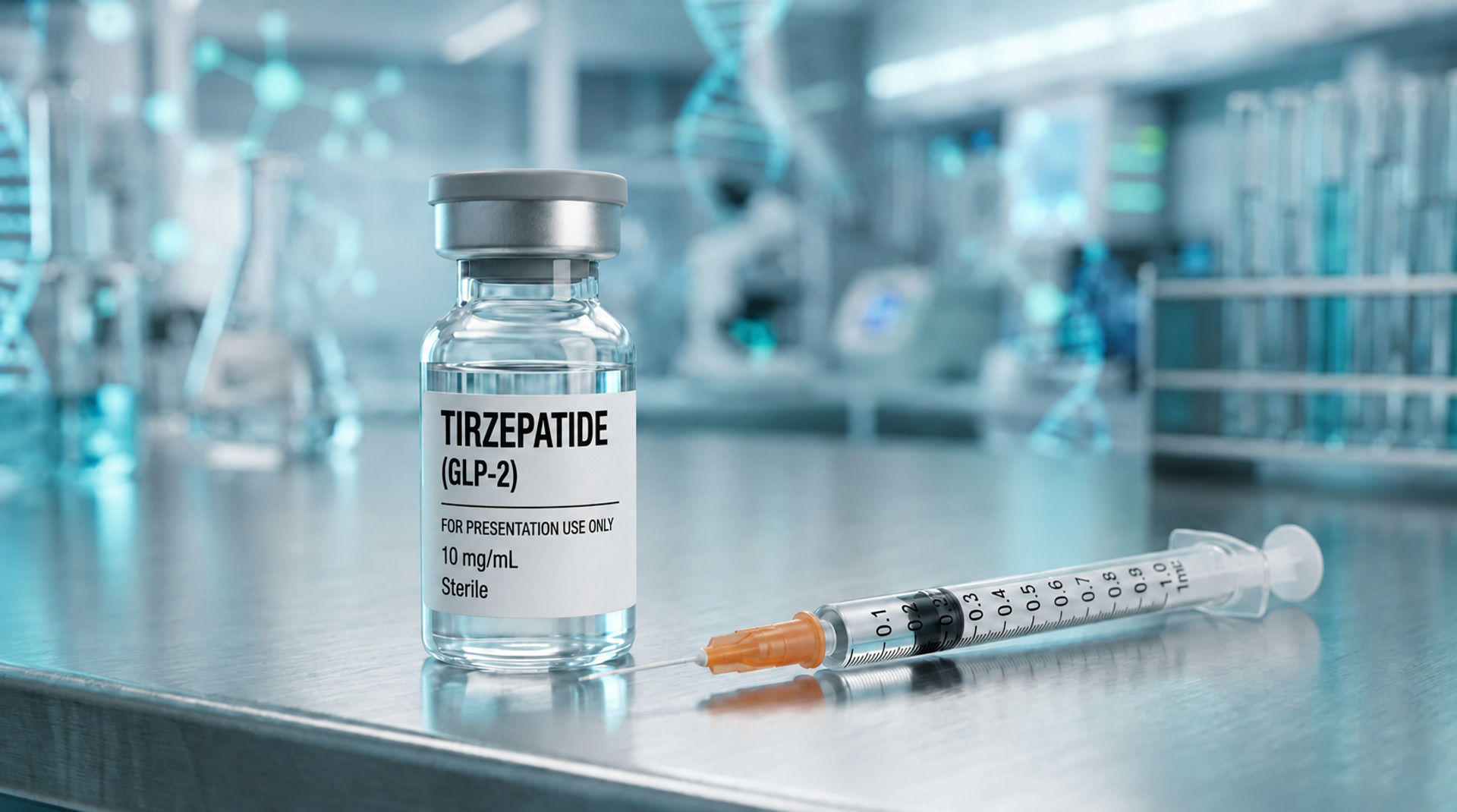

Microdosing tirzepatide (GLP-2) is one of the most-searched dosing questions in the GLP-1 space, and one of the worst-served. Almost nobody publishes the numbers: the milligram values, the syringe units, the half-life math behind stretched schedules, or the one randomized trial arm that tested the microdose range. This guide publishes all of it, and grades every claim supported, plausible, or unsupported.
This article is intended for educational and research purposes only. Always consult a qualified healthcare professional before beginning any peptide regimen.
Quick Reference: Tirzepatide (GLP-2) Microdosing Chart
Phase | Dose | Frequency | When to Advance |
|---|---|---|---|
Phase 1 | 0.5 mg (5 units @ 10 mg/mL) | Once weekly | After a minimum of 4 weeks at steady state |
Phase 2 | 1.0–1.5 mg (10–15 units) | Once weekly | Stay here long term; advance only if results are insufficient |
Phase 3 | 2.0 → 2.5 mg (20–25 units) | Once weekly | 0.5 mg steps, minimum 4 weeks between changes |
What Is Microdosing Tirzepatide?
Microdosing tirzepatide means taking it below the 2.5 mg standard starting dose, most commonly 0.5–2 mg once weekly, or holding a standard dose but stretching the interval between injections. The goal is to keep appetite and metabolic effects while reducing gastrointestinal side effects and cost. No dose below 2.5 mg is FDA-approved.
Tirzepatide is a dual GIP and GLP-1 receptor agonist. It activates two incretin receptors rather than one, which is what separates it from semaglutide. It is sold as Zepbound for weight management and Mounjaro for type 2 diabetes. Full profile: our tirzepatide overview.
Two facts from the FDA label do most of the work here.
First, the approved ladder starts at 2.5 mg. Per the Zepbound prescribing information, the label directs 2.5 mg once weekly for 4 weeks, then increases of 2.5 mg at intervals of at least 4 weeks, to a maintenance dose of 5, 10, or 15 mg. Critically, 2.5 mg is a titration step, not a treatment dose. No trial evaluated it as maintenance. Anything at or below 2.5 mg held long term is off-label by definition.
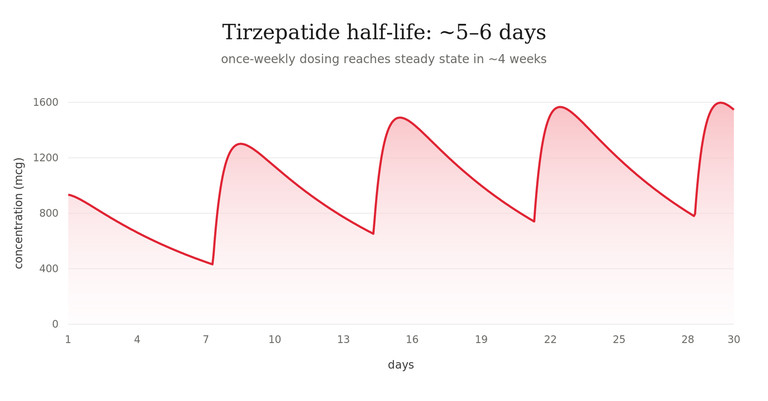
Second, tirzepatide has an elimination half-life of approximately 5–6 days, and steady state arrives after roughly 4 weeks of once-weekly dosing. This is what makes a sub-clinical protocol coherent rather than arbitrary: the drug is still substantially present a week after injection, which is why weekly dosing works at all and why stretching to 10- or 14-day intervals is plausible rather than wishful. It also means you cannot evaluate any dose change for about four weeks. Until then you are measuring an incomplete accumulation curve, not a dose.
For scale: in SURMOUNT-1 (Jastreboff et al., NEJM 2022;387:205–216), 2,539 adults with obesity or overweight received 5, 10, or 15 mg weekly for 72 weeks. Mean weight change was −15.0% at 5 mg, −19.5% at 10 mg, and −20.9% at 15 mg, versus −3.1% for placebo.
Why People Microdose Tirzepatide (Benefits)
Each claimed benefit, graded against the data.
Fewer gastrointestinal side effects: Supported, with a caveat. GI events are the main reason people abandon tirzepatide, and they peak during escalation. In the pooled Zepbound trials, nausea affected 25% at 5 mg, 29% at 10 mg, and 28% at 15 mg, versus 8% on placebo. Across the approved range the dose-response is modest (25% → 28%); the steep drop happens further down. In the phase 2 trial below, the 1 mg arm reported nausea in 3.8% of participants, under the 5.9% placebo rate. The tolerability argument is real, but it lives below 2.5 mg.
Lower monthly spend: Supported, but not as usually framed. Stretching a fixed supply genuinely reduces monthly outlay. It does not reduce cost per milligram. Branded tirzepatide gets cheaper per mg as the dose rises. See the cost section.
Appetite and "food noise" control below standard doses: Plausible at the top of the range, unsupported at the bottom. At 1 mg weekly, "decreased appetite" was reported by 3.8% of participants versus 2.0% on placebo, essentially no signal. The effect emerges somewhere between 1 mg and 5 mg, and nobody has mapped that curve. A 2 mg dose may deliver it; a 0.5 mg dose probably does not.
Reduced inflammation and longevity benefits: Unsupported. Tirzepatide lowers inflammatory markers in trials, but at 5–15 mg alongside 15–21% weight loss, and weight loss itself reduces inflammation. Nothing isolates either effect below 2.5 mg, and no human trial has tested tirzepatide against aging endpoints.

Does Microdosing Tirzepatide Work? What the Evidence Says
Shop research peptides
Live pricing from our top-rated vendor. Prices update as vendor listings change.

No randomized trial has tested sub-2.5 mg tirzepatide as a maintenance dose for weight loss. The closest evidence, a randomized 1 mg arm in type 2 diabetes, produced a strong glycemic effect but almost no weight loss: −0.9 kg over 26 weeks versus −0.4 kg for placebo. A microdose appears to be a different effect, not a smaller one.
The one trial that tested the microdose range
Before the SURMOUNT obesity program, tirzepatide ran a phase 2 dose-finding trial in type 2 diabetes (Frías et al., Lancet 2018;392:2180–2193; NCT03131687), randomizing 318 patients to tirzepatide 1 mg, 5 mg, 10 mg, or 15 mg, dulaglutide 1.5 mg, or placebo for 26 weeks. That 1 mg arm is the only trial-grade data anywhere near the microdose range.
Weekly dose | HbA1c change (26 wk) | Weight change (26 wk) | Nausea | Decreased appetite |
|---|---|---|---|---|
Placebo | −0.06% | −0.4 kg | 5.9% | 2.0% |
1 mg | −1.06% | −0.9 kg | 3.8% | 3.8% |
5 mg | −1.73% | −4.8 kg | 20.0% | 20.0% |
10 mg | −1.89% | −8.7 kg | 21.6% | 25.5% |
15 mg | −1.94% | −11.3 kg | 39.6% | 18.9% |
Frías et al., Lancet 2018; per-arm values as posted to ClinicalTrials.gov (NCT03131687).
At 1 mg weekly, the glycemic effect was already most of the way there, and the weight effect had barely started. An HbA1c reduction of −1.06% is clinically substantial: 55% of the effect seen at 15 mg. But weight loss at 1 mg was 0.5 kg beyond placebo over six months, and appetite suppression was indistinguishable from placebo.
That dissociation is the honest thesis here: tirzepatide's glycemic activity appears at doses far below its appetite and weight-loss activity. The popular framing, a gentler version of the same benefit, is not what the data shows. A true microdose looks like a metabolic intervention with a very small weight effect attached.
Three caveats. This was a type 2 diabetes population, who typically lose less weight on incretin drugs than people without it. It ran 26 weeks, not 72. And it tested 1 mg, not 1.5 mg or 2 mg, where the appetite effect may well switch on. The curve between 1 mg and 5 mg is genuinely unmapped.
What the obesity trials can and cannot tell you
SURMOUNT-1's lowest arm was 5 mg, delivering −15.0% at 72 weeks, or 72% of the 15 mg effect at a third of the dose. That plateau is the strongest argument that lower doses retain most of the benefit. But that arm titrated upward over a 20-week escalation and was then maintained at 5 mg, twice the standard starting dose. It is not a microdose arm.
No SURMOUNT arm tested 2.5 mg or below as a maintenance dose. Any page implying outcome data exists at 2.5 mg is misreading a titration step as a treatment arm.
What user reports add
Reddit threads, clinic testimonials, and review posts skew positive: appetite control at 1–2 mg, fewer side effects, steady loss. They suggest the appetite effect exists somewhere below 2.5 mg, but they are self-selected, unblinded, confounded by simultaneous diet changes, and silent on the people for whom nothing happened. Treat them as a hypothesis generator, not evidence of effect size.
Bottom line: the upper end (1.5–2.5 mg) is a reasonable extrapolation from a flat dose-response curve. At the bottom end (0.5–1 mg), the only trial we have says do not expect meaningful weight loss.
Microdosing Tirzepatide Chart (mg + Insulin Syringe Units)
Every dose in milligrams and insulin-syringe units at two common concentrations, plus an evidence column, because a dose chart without one is a suggestion in a table.
Tier | Weekly dose | Units at 10 mg/mL* | Units at 5 mg/mL* | Typical use | Evidence level |
|---|---|---|---|---|---|
Entry microdose | 0.5 mg | 5 units | 10 units | First 4 weeks; high sensitivity | None. Below any studied dose. Extrapolation only. |
Low microdose | 1.0 mg | 10 units | 20 units | Common starting point | Randomized data (T2D): HbA1c −1.06%, weight −0.9 kg at 26 wk. |
Mid microdose | 1.25 mg | 12.5 units | 25 units | Half of a 2.5 mg vial | None. Interpolated between the 1 mg and 5 mg arms. |
Upper microdose | 1.5 mg | 15 units | 30 units | Typical maintenance target | None. Interpolated. |
Ceiling microdose | 2.0 mg | 20 units | 40 units | Highest true "micro" dose | None. Interpolated; closest to the studied 5 mg arm. |
FDA starting dose | 2.5 mg | 25 units | 50 units | Label weeks 1–4 only | Titration data only. Never tested as maintenance. |
Lowest studied | 5.0 mg | 50 units | 100 units | Label maintenance dose | Full trial data: −15.0% body weight at 72 wk (SURMOUNT-1). |
*Assumes a U-100 insulin syringe (100 units = 1 mL). Your units depend entirely on your reconstitution concentration. At 10 mg/mL, 1 unit = 0.1 mg (100 mcg). At 5 mg/mL, 1 unit = 0.05 mg (50 mcg). Run your own numbers with the peptide dosage calculator.
Worked example: a 10 mg vial reconstituted with 2 mL of bacteriostatic water yields 5 mg/mL. One unit on a U-100 syringe holds 0.01 mL, or 0.05 mg. A 1.25 mg dose is therefore 25 units.
A practical note nobody publishes: at 5 mg/mL, a 0.5 mg dose is a 10-unit draw, where a one-unit misread is a 10% dosing error. Reconstituting the same vial with 3 mL gives 3.33 mg/mL, stretching that same dose to a 15-unit draw and cutting the misread to under 7%. For microdoses, dilute more, not less. Precision is the real constraint at these volumes, and the extra millilitre of BAC water costs nothing.
Shop research peptides
Live pricing from our top-rated vendor. Prices update as vendor listings change.
Maintenance chart
For readers stepping down from a full dose rather than up from zero:
Prior maintenance dose | Step-down target | Units at 10 mg/mL | Notes |
|---|---|---|---|
15 mg weekly | 5 mg weekly | 50 units | Still a label-approved dose, with trial support. |
10 mg weekly | 2.5–5 mg weekly | 25–50 units | 2.5 mg is below any maintenance evidence. |
5 mg weekly | 2.5 mg weekly | 25 units | Off-label as maintenance; no outcome data. |
5 mg weekly | 2.5 mg every other week | 25 units, q14d | Effective ~1.25 mg/week. No data; largest interval swing. |
For contrast: the FDA titration ladder
Weeks | Zepbound dose | Units at 10 mg/mL |
|---|---|---|
1–4 | 2.5 mg | 25 units |
5–8 | 5 mg | 50 units |
9+ | 7.5 → 15 mg | 75 → 150 units |
Increases of 2.5 mg at intervals of at least 4 weeks; maximum 15 mg weekly.
The 3-Phase Tirzepatide Microdosing Protocol
Tirzepatide is dosed once weekly, so this protocol runs on a weekly cadence, not the daily rhythm used for shorter-acting peptides. Every phase transition is governed by one number: with a 5–6 day half-life, steady state takes about 4 weeks. Most people stay in Phase 2.

Phase 1: Start Low
Goal: Establish tolerance and find out whether you respond at the bottom of the range.
Administer 0.5 mg (5 units at 10 mg/mL, or 10 units at 5 mg/mL) once weekly, same day each week.
Hold for a minimum of 4 weeks without adjustment.
Track weekly: appetite between meals, GI symptoms in the 48 hours after injection, and weight on a fixed day.
If GI symptoms are significant at 0.5 mg, hold longer rather than advancing. You are unusually sensitive, and that is useful information.
Do not judge your response before week 4. With a 5–6 day half-life, plasma levels are still climbing until roughly day 25. Anything you conclude in week 2 is a conclusion about an incomplete curve.
Phase 2: Maintenance (Where Most People Stay)
Goal: Hold the lowest dose that produces the effect you are after.
Typical range is 1.0–1.5 mg weekly (10–15 units at 10 mg/mL).
Move here after four stable weeks in Phase 1 by adding 0.5 mg, then hold another 4 weeks.
Most people should remain here long term. If appetite control is adequate and the scale is moving, the dose is correct; its size is irrelevant.
Reassess every 8–12 weeks, not weekly. Week-to-week weight noise is larger than the signal you are reading.
If your current dose is working, do not increase it. The lowest effective dose is the correct dose. Abandoning that at the first plateau converts this into a slow standard titration.
Phase 3: Titrate Up (Only If Needed)
Goal: Step up only when Phase 2 has genuinely failed after a fair trial.
Increase in 0.5 mg steps: 1.5 mg → 2.0 mg → 2.5 mg, waiting a minimum of 4 weeks between changes.
At 2.5 mg you have reached the FDA starting dose. Past that point you are running a standard tirzepatide titration, and the label's schedule and clinical supervision apply.
If side effects appear during a step-up, return to the prior dose and hold rather than pushing through.
Shop research peptides
Live pricing from our top-rated vendor. Prices update as vendor listings change.
Wait a minimum of 4 weeks between any dose increase. Faster escalation titrates against a concentration that has not stabilized. Model your own curve with the peptide accumulation calculator.
How to Administer
Tirzepatide is administered via subcutaneous (SubQ) injection, meaning it goes just under the skin, not into muscle.
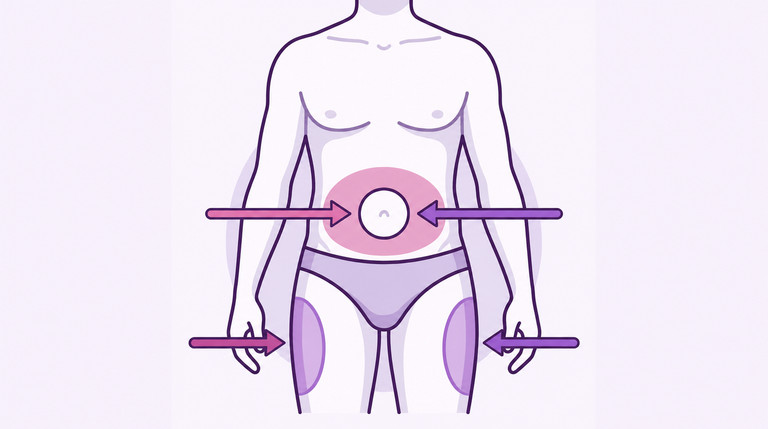
Best injection sites: abdomen or thigh.
Technique tips:
Rotate injection sites with each weekly dose to prevent tissue irritation
Always clean the injection site thoroughly with an alcohol swab before administering
Pinch the skin slightly when injecting into the abdomen for comfort
Inspect the solution first. It should be clear and colorless to slightly yellow, with no particles or discoloration
Timing is where weekly dosing differs from daily peptides. Tirzepatide can be taken at any time of day, with or without meals. You can shift your injection day when you need to, provided at least 3 days (72 hours) separate two doses. If you miss a dose, you have 4 days (96 hours) to take it. Past that, skip it and resume your regular schedule.
Reconstitution & Syringe Math
Microdose accuracy is reconstitution accuracy. Settle this before Phase 1.
Peptide amount: 10 mg tirzepatide (adjust for other vial sizes)
BAC water: 2 mL for microdosing
Resulting concentration: 5 mg/mL
Syringe math: 1 unit on a U-100 insulin syringe = 0.05 mg = 50 mcg
Worked draw: 1.0 mg = 20 units · 1.25 mg = 25 units · 1.5 mg = 30 units
Store reconstituted vials at 2–8 °C, never frozen, and swab the stopper before every draw. For technique and water selection, see how to reconstitute peptides; for any vial size not listed here, use the peptide dosage calculator rather than estimating.
Microdosing Tirzepatide Schedules: Weekly, Twice-Weekly, and Stretched Intervals
The 5–6 day half-life gives real scheduling flexibility. What each option does to your blood levels:
Schedule | Example | Effective weekly dose | Trough vs. peak* | When it makes sense |
|---|---|---|---|---|
Standard weekly (label) | 2.5–15 mg weekly | 2.5–15 mg | ~38–45% | Approved dosing; the reference case. |
Low-dose weekly | 1 mg weekly | 1 mg | ~38–45% | The default microdose schedule. Simplest, steadiest. |
Split twice-weekly | 0.5 mg twice weekly | 1 mg | ~65–70% | Smoother levels; useful if post-injection days are rough. |
Stretched 10-day | 1.5 mg every 10 days | ~1.05 mg | ~25% | Extends a fixed supply; wider swings. |
Stretched 14-day | 2.5 mg every 14 days | ~1.25 mg | ~14–20% | Maximum cost stretch; largest peak-to-trough variation. |
*Approximate fraction of peak remaining at the end of the interval, from a 5–6 day half-life. Illustrative single-dose decay, not steady-state modeling.
Twice a week? Splitting 1 mg into two 0.5 mg injections raises your trough from roughly 40% of peak to roughly 67%. But a 5–6 day half-life already produces fairly stable weekly levels, which is why the drug is approved as a weekly injection. Splitting doubles your injections for modest smoothing: worth it if you feel a distinct post-injection trough, pointless if you do not.
Stretched intervals are the most effective way to extend a fixed supply and the least steady thing you can do to your blood levels. At 14 days, levels fall to roughly 15–20% of peak before redosing, which is the schedule most likely to produce returning appetite late in the cycle. Choose it for economics, not pharmacology.
Microdosing Tirzepatide for Maintenance
After hitting a weight goal, many people step down to a microdose rather than stopping. This is the most defensible use of the approach, because the evidence on stopping entirely is unambiguous, and it is bad. What remains untested is whether a reduced dose preserves the result the way a full dose does.
Shop research peptides
Live pricing from our top-rated vendor. Prices update as vendor listings change.
SURMOUNT-4 (Aronne et al., JAMA 2024;331(1):38–48) is the trial that matters. After a 36-week open-label lead-in on a maximum tolerated dose of 10 or 15 mg, which produced a mean 20.9% weight reduction, 670 participants were randomized to continue tirzepatide or switch to placebo for 52 weeks.
Week 36 → 88 | Continued tirzepatide | Switched to placebo |
|---|---|---|
Mean weight change | −5.5% (further loss) | +14.0% (regain) |
Maintained ≥80% of loss | 89.5% | 16.6% |
Total change, week 0→88 | −25.3% | −9.9% |
Stopping gave back roughly two thirds of the loss within a year. Continuing held the result and improved on it.
Now the gap: SURMOUNT-4 tested full dose versus zero, not a reduced dose. The step-down strategy sits in the untested middle. The reasonable inference, and it is an inference, is that some ongoing receptor activity beats none, since the placebo arm's regain followed complete withdrawal. Whether 1 mg holds a 20% loss as well as 10 mg does is unknown.
If you step down, do it in stages, hold each step at least 4 weeks to reach steady state before judging it, and treat a sustained upward trend over 8–12 weeks as a signal to step back up.
Side Effects and Safety
Taking tirzepatide below the approved range reduces the frequency of gastrointestinal side effects but does not change the drug's contraindications or its warnings. The lowest studied dose produced nausea at placebo-level rates; every safety restriction on the label applies at every dose.

The side effect profile, by dose
From the pooled Zepbound trials (placebo n=958; 5 mg n=630; 10 mg n=948; 15 mg n=941):
Adverse reaction | Placebo | 5 mg | 10 mg | 15 mg |
|---|---|---|---|---|
Nausea | 8% | 25% | 29% | 28% |
Diarrhea | 8% | 19% | 21% | 23% |
Vomiting | 2% | 8% | 11% | 13% |
Constipation | 5% | 17% | 14% | 11% |
Hair loss | 1% | 5% | 4% | 5% |
Discontinuation from adverse reactions ran 4.8%, 6.3%, and 6.7% at 5, 10, and 15 mg versus 3.4% on placebo, mostly in the first few months and mostly gastrointestinal. Note that between 5 and 15 mg, nausea barely moves. The tolerability benefit comes from going below the approved range, where the 1 mg arm reported 3.8% nausea, not from choosing 5 mg over 15 mg.
Does it cause hair loss?
Hair loss appears at 4–5% across all three approved doses versus 1% on placebo. That is flat with dose, which is the tell. The label states that hair loss reactions "were associated with weight reduction," and reports it far more often in women (7.1%) than men (0.5%). That is the pattern of telogen effluvium, temporary shedding following rapid weight loss, rather than a direct drug effect. Because it tracks the speed of loss rather than the dose, a smaller dose may reduce risk indirectly by slowing loss. No participant discontinued because of it.
Contraindications: unchanged at any dose
Per the Zepbound label, tirzepatide is contraindicated in patients with:
A personal or family history of medullary thyroid carcinoma (MTC)
Multiple Endocrine Neoplasia syndrome type 2 (MEN 2)
Known serious hypersensitivity to tirzepatide or any of its excipients
The label also carries a boxed warning for the risk of thyroid C-cell tumors, based on dose- and duration-dependent C-cell tumors in rats at clinically relevant exposures; whether this occurs in humans is unknown.
Separately, the label flags a set of warnings and precautions, not contraindications: severe gastrointestinal adverse reactions, acute kidney injury from volume depletion, acute gallbladder disease, acute pancreatitis, hypersensitivity reactions, hypoglycemia (particularly alongside insulin or a sulfonylurea), diabetic retinopathy complications in type 2 diabetes, and pulmonary aspiration during general anesthesia or deep sedation. On pregnancy the label is explicit: tirzepatide may cause fetal harm, and when pregnancy is recognized, it should be discontinued.
A smaller dose exempts you from none of the above.
Shop research peptides
Live pricing from our top-rated vendor. Prices update as vendor listings change.
The quality variable for research suppliers
Product sold outside prescription channels sits outside pharmacy oversight, making identity, purity, and concentration your variables to verify. At these volumes, an unverified concentration is a larger error source than any dosing decision in this article. If your source cannot produce a batch-specific third-party certificate of analysis, your dosing math is meaningless.
What Microdosing Tirzepatide Costs
Stretching a fixed supply genuinely lowers monthly spend. But branded tirzepatide costs more per milligram as the dose gets smaller: the 2.5 mg strength runs about two and a half times the per-mg price of the 15 mg strength. You save relative to your own prior spend, never per milligram.
Current self-pay pricing direct from Lilly, against a retail list price of roughly $1,086 per month:
Route (Aug 2026) | Price / month | mg per month | Cost per mg | Monthly cost at 1 mg/week* |
|---|---|---|---|---|
Retail list price, 2.5 mg | ~$1,086 | 10 mg | ~$108.60 | ~$470 |
LillyDirect self-pay, 2.5 mg | $299 | 10 mg | $29.90 | ~$129 |
LillyDirect self-pay, 5 mg | $399 | 20 mg | $19.95 | ~$86 |
LillyDirect self-pay, 10 mg | $699† | 40 mg | ~$17.48 | ~$76 |
LillyDirect self-pay, 15 mg | $699† | 60 mg | ~$11.65 | ~$50 |
Telehealth compounded, starter tier | ~$200‡ | 10 mg (2.5 mg/wk) | ~$20.00 | ~$87 |
~$100 per vial | 10 mg | ~$10.00 | ~$43 | |
Research vial (30 mg) | ~$250 per vial | 30 mg | ~$8.33 | ~$36 |
Research vial (60 mg) | ~$400 per vial | 60 mg | ~$6.67 | ~$29 |
*A month is 4.33 weeks, so 1 mg/week is 4.33 mg/month. †Regular self-pay price. Refilling within 45 days of the previous delivery lowers 7.5 mg through 15 mg to $449 per month, or ~$7.48 per mg at the 15 mg strength. ‡Representative telehealth pricing for a starting dose, which runs roughly $150 to $300 per month depending on provider and is not a published list price. See the compounding note above: in March 2026 the FDA issued warning letters to 30 telehealth companies over how compounded GLP-1s were marketed, and has proposed excluding tirzepatide from the 503B bulks list.
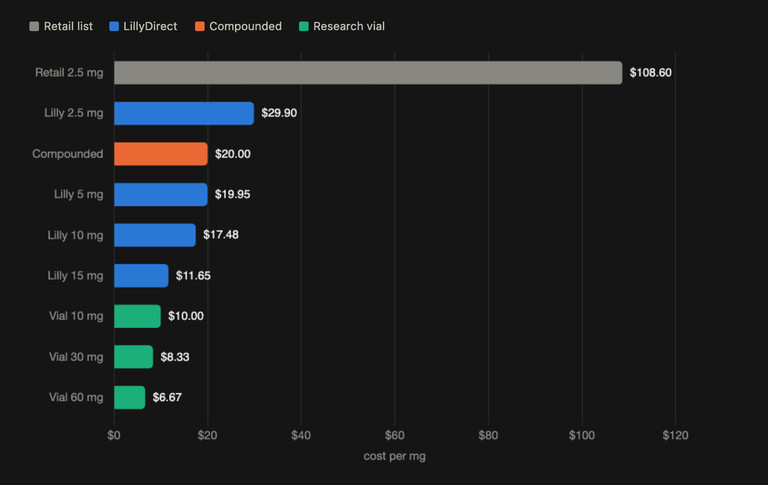
Read the cost-per-mg column, because it inverts the usual pitch. A milligram bought as 2.5 mg costs $29.90; the same milligram bought as 15 mg costs $11.65. Per unit of drug, small doses are the most expensive way to buy tirzepatide.
Research vials are the cheapest milligrams in the table. At roughly $6.67 to $10.00 per mg they undercut every branded and telehealth row, including LillyDirect's best regular rate of $11.65, and the gap widens as vial size increases. What that price does not include is what the branded rows do: a verified concentration, a pharmacy supply chain, and a label. You are trading verification for cost, which is why a third-party certificate of analysis described above is not optional diligence. Larger vials carry a second catch, because the per-mg advantage only holds if the contents are used within the reconstituted shelf life, and at 1 mg per week a 60 mg vial will outlast that window several times over.
The savings come from duration, not unit price. Four 2.5 mg vials at $299 last one month at label dosing. Split into 1.25 mg doses, that same $299 covers eight weeks, about $150/month; at 1.25 mg every other week, sixteen weeks, or about $75/month.
Two constraints on that arithmetic. The Zepbound KwikPen delivers fixed doses and cannot be split. Only the single-dose vial allows a partial draw. And single-dose vials contain no preservative; drawing from one twice is off-label and carries real sterility risk after first puncture.
Who Microdosing Tirzepatide Is (and Isn't) For
Midlife and menopausal women. The largest audience here, with better evidence than most. A retrospective cohort of 120 postmenopausal women presented at ENDO 2025 found greater weight loss with tirzepatide plus menopause hormone therapy (17%) than tirzepatide alone (14%), and a SURMOUNT secondary analysis found it effective across reproductive stages. All at standard doses, so the finding supports tirzepatide for this group, not microdosing specifically.
People with a modest amount to lose. The hospital-side criticism, that people with 10–15 lb to lose are taking a drug developed for a BMI ≥30 population, is fair. Everyone in SURMOUNT-1 had a BMI of 30+, or 27+ with a weight-related complication. Below that threshold you sit outside the population in which benefit and risk were characterized, and no dose reduction changes that.
People maintaining an existing loss. The strongest use case, per the SURMOUNT-4 logic above.
People after metabolic or glycemic benefit rather than weight loss. Arguably the best-supported use and the least discussed: the 1 mg arm delivered a −1.06% HbA1c reduction. Not a self-directed project; it belongs with a clinician monitoring labs.
Fertility and pregnancy: a hard no. Tirzepatide may cause fetal harm and must be discontinued when pregnancy is recognized, and it can reduce the efficacy of oral hormonal contraceptives. If you are trying to conceive, pregnant, or breastfeeding, no dose is appropriate.
Anyone with a contraindication. MTC or MEN 2 history, or serious hypersensitivity to tirzepatide, rules it out at every dose.
Microdosing Tirzepatide vs Other GLP-1s
Shop research peptides
Live pricing from our top-rated vendor. Prices update as vendor listings change.
Compound | Receptors | Half-life | Microdose practicality |
|---|---|---|---|
Semaglutide | GLP-1 | ~7 days | Longest half-life; most forgiving of stretched intervals. |
Tirzepatide | GIP + GLP-1 | ~5–6 days | Weekly or stretched; the only one with a randomized 1 mg arm. |
Retatrutide | GIP + GLP-1 + glucagon | ~6 days | Investigational; no approved dose to work down from. |
Tirzepatide's dual-receptor action is why its dose-response for weight is steeper than semaglutide's, and why a small tirzepatide dose is not interchangeable with a small semaglutide dose.
Deeper comparisons: tirzepatide vs semaglutide, retatrutide vs tirzepatide, and survodutide vs tirzepatide. For the equivalent protocol on a triple agonist, see the retatrutide microdosing protocol; for background on the drug class, our GLP-1 overview.
FAQ
What is considered a microdose of tirzepatide?
Any weekly dose below the 2.5 mg FDA starting dose, in practice 0.5–2 mg once weekly, most commonly 1–1.5 mg. It can also mean a standard dose stretched to a 10- or 14-day interval. No dose under 2.5 mg is FDA-approved or trial-validated for maintenance.
Does microdosing tirzepatide work?
Partly. The only randomized microdose-range data, a 1 mg arm over 26 weeks, produced a strong HbA1c reduction of −1.06% but just −0.9 kg of weight loss versus −0.4 kg for placebo. Doses of 1.5–2 mg may perform better, but that range has never been tested.
Is microdosing tirzepatide safe?
Lower doses meaningfully reduce gastrointestinal side effects: nausea ran 3.8% at 1 mg versus 25–29% at approved doses. But every contraindication still applies: medullary thyroid carcinoma history, MEN 2, hypersensitivity, and pregnancy. Product quality from unverified sources is the larger safety variable.
How many units is a tirzepatide microdose?
It depends entirely on concentration. At 10 mg/mL, 1 unit = 0.1 mg, so 1 mg = 10 units and 1.25 mg = 12.5 units. At 5 mg/mL, 1 unit = 0.05 mg, so 1 mg = 20 units. Confirm your figures with the dosage calculator.
Can you lose weight microdosing tirzepatide?
Probably some, but less than the marketing implies. At 1 mg the measured weight effect was about 0.5 kg beyond placebo over six months. At 5 mg, twice the standard starting dose, mean loss was 15.0% over 72 weeks. Expect results between those points, weighted low.
How much does microdosing tirzepatide cost?
Roughly $29 to $150 a month depending on route. Four 2.5 mg Zepbound vials cost $299 self-pay through LillyDirect; split into 1.25 mg doses that covers eight weeks, about $150 a month. Telehealth compounded runs about $200 for a starting dose. Research vials are cheapest per milligram, roughly $6.67 to $10.00.
How does microdosing tirzepatide work?
Tirzepatide activates GIP and GLP-1 receptors, slowing gastric emptying, improving insulin response, and reducing appetite signaling. At lower doses receptor occupancy is lower, and the evidence suggests glycemic effects appear well before appetite effects do, rather than everything scaling down proportionally.
Can you microdose tirzepatide twice a week?
Yes. Splitting 1 mg into two 0.5 mg doses raises your trough from roughly 40% to roughly 67% of peak, giving steadier levels. Given the 5–6 day half-life, weekly dosing is already fairly stable, so this mainly helps people who feel a distinct post-injection dip.
Shop research peptides
Live pricing from our top-rated vendor. Prices update as vendor listings change.
Does microdosing tirzepatide cause hair loss?
Hair loss occurs at 4–5% across all approved doses versus 1% on placebo, flat with dose, and the label attributes it to weight reduction rather than the drug. It is consistent with telogen effluvium from rapid weight loss. Slower loss on a smaller dose may reduce it indirectly.
Is microdosing tirzepatide right for maintenance?
It is the most defensible use, though untested. SURMOUNT-4 showed full withdrawal caused 14% regain in a year while continued treatment held the result. No trial has tested a reduced maintenance dose, so a microdose is a reasoned midpoint between those arms, not a proven one.
Disclaimer
The information provided on Peptide Mind is for educational purposes only and is not a substitute for professional medical advice. Peptides discussed are unapproved research chemicals intended for laboratory use only. These statements have not been evaluated by the FDA and are not intended to diagnose, treat, cure, or prevent any disease. By using this site, you confirm you are 21+, waive related claims, and agree to our Terms of Service.
References
Jastreboff AM, Aronne LJ, Ahmad NN, et al. Tirzepatide Once Weekly for the Treatment of Obesity. N Engl J Med. 2022;387(3):205–216. doi:10.1056/NEJMoa2206038
Frías JP, Nauck MA, Van J, et al. Efficacy and safety of LY3298176, a novel dual GIP and GLP-1 receptor agonist, in patients with type 2 diabetes: a randomised, placebo-controlled and active comparator-controlled phase 2 trial. Lancet. 2018;392(10160):2180–2193. (Per-arm results: ClinicalTrials.gov NCT03131687)
Aronne LJ, Sattar N, Horn DB, et al. Continued Treatment With Tirzepatide for Maintenance of Weight Reduction in Adults With Obesity: The SURMOUNT-4 Randomized Clinical Trial. JAMA. 2024;331(1):38–48. doi:10.1001/jama.2023.24945
Eli Lilly and Company. ZEPBOUND (tirzepatide) injection: US Prescribing Information.
US Food and Drug Administration. Declaratory Order: Resolution of Shortages of Tirzepatide Injection.
Eli Lilly and Company. Zepbound Coverage & Savings (self-pay pricing).
Castaneda A, et al. Menopause hormone therapy modulates tirzepatide-associated weight loss in postmenopausal women. Presented at ENDO 2025, Endocrine Society.
Add a comment
This will be publicly visible.
Your email address will not be published.
Your comment will be reviewed by an admin before it is published.