Sexual Peptide Cheat Sheet
Explore the ultimate sexual peptide cheat sheet with dosage guidelines, benefits, mechanisms, side effects, and comparisons for PT-141, Kisspeptin, Oxytocin, and more. A quick reference for research and education.
For research purposes only.
This cheat sheet is a research reference only — not for human consumption or therapeutic use.
| Peptide | Purpose | Vial Size | BAC Water | Dosing | Frequency | Cycle |
|---|---|---|---|---|---|---|
test TestagenSexual | Longevity & Anti-Aging | 10 mg | 2 mL | 100–200 mcg | Daily | 20–30 consecutive days |
hcg HCGHormonal | Sexual Health | 5,000 IU | 5 mL | 250–500 IU | 2×/week | Ongoing or 4–6 weeks |
hmg HMGHormonal | Hormonal & Fertility Support | 75 IU | 1 mL | 75–150 IU | 2–3×/week | 4–12 weeks |
MT-2 Melanotan IISkin | Skin & Sexual Health | 10 mg | 3 mL | 250–500 mcg | 1-2x/week | 1–2 weeks loading, then ongoing maintenance |
kis KisspeptinHormonal | Sexual Health | 5 mg | 3 mL | 100 mcg | Daily | 4 weeks on / 4 weeks off |
PT-141 PT-141Sexual | Sexual Health | 10 mg | 3 mL | 500 mcg–1.75 mg | As needed, max 1 dose per 24 hours | As needed, max 8 doses per month |
test
Sexual
- Purpose
- Longevity & Anti-Aging
- Vial Size
- 10 mg
- BAC Water
- 2 mL
- Dosing
- 100–200 mcg
- Frequency
- Daily
- Cycle
- 20–30 consecutive days
hcg
Hormonal
- Purpose
- Sexual Health
- Vial Size
- 5,000 IU
- BAC Water
- 5 mL
- Dosing
- 250–500 IU
- Frequency
- 2×/week
- Cycle
- Ongoing or 4–6 weeks
hmg
Hormonal
- Purpose
- Hormonal & Fertility Support
- Vial Size
- 75 IU
- BAC Water
- 1 mL
- Dosing
- 75–150 IU
- Frequency
- 2–3×/week
- Cycle
- 4–12 weeks
MT-2
Skin
- Purpose
- Skin & Sexual Health
- Vial Size
- 10 mg
- BAC Water
- 3 mL
- Dosing
- 250–500 mcg
- Frequency
- 1-2x/week
- Cycle
- 1–2 weeks loading, then ongoing maintenance
kis
Hormonal
- Purpose
- Sexual Health
- Vial Size
- 5 mg
- BAC Water
- 3 mL
- Dosing
- 100 mcg
- Frequency
- Daily
- Cycle
- 4 weeks on / 4 weeks off
PT-141
Sexual
- Purpose
- Sexual Health
- Vial Size
- 10 mg
- BAC Water
- 3 mL
- Dosing
- 500 mcg–1.75 mg
- Frequency
- As needed, max 1 dose per 24 hours
- Cycle
- As needed, max 8 doses per month
Download the Sexual Peptide Cheat Sheet PDF
Save a free printable PDF of this peptide dosage cheat sheet — vial sizes, BAC water ratios, dosing amounts, and cycle lengths in one quick-reference chart.
Sexual Peptide Cheat Sheet — Research Notes
Key considerations and protocol notes for each peptide in this cheat sheet.
Sexual
test
Hormonal
Testagen is a very short peptide believed to support healthy testicular function and hormone balance in men. It's used in short cycles, often alongside other similar peptides, as part of longevity-focused routines.
Hormonal
hcg
Hormonal
HCG is a hormone that tells the testicles to keep producing testosterone and stay their normal size. It's commonly used after steroid cycles or alongside testosterone therapy to protect fertility and prevent the testicles from shrinking.
Hormonal
hmg
Hormonal
HMG is a fertility hormone that stimulates the testicles to produce sperm and testosterone. It's often used with HCG after a steroid cycle to help restore natural fertility and hormone production.
Skin
MT-2
Sexual
Melanotan II triggers your skin to tan and offers some protection from UV rays by activating a pigment-producing pathway. People typically use it daily until they reach the tan they want, then cut back to once or twice a week to maintain it. Nausea and flushing are common early on, so many start at 100 to 250 mcg for the first few days and inject before bed on an empty stomach.
Hormonal
kis
Hormonal
Kisspeptin helps stimulate a hormone (GnRH) that plays a key role in fertility.
Sexual
PT-141
PT-141 helps boost libido by acting on a pathway in the brain linked to sexual desire. Injected 45 minutes before anticipated activity, with effects starting in 45 to 90 minutes and lasting 4 to 8 hours. The FDA-approved dose is 1.75 mg, though many start at 500 mcg to gauge tolerance since nausea is the most common side effect.
Build your own protocol
Create a custom peptide stack tailored to your goals. Add peptides, set dosages, and share it with the community.
More Cheat Sheets
Explore other peptide reference sheets from PeptideMind.

Frequently asked questions
What is a peptide dosage calculator?
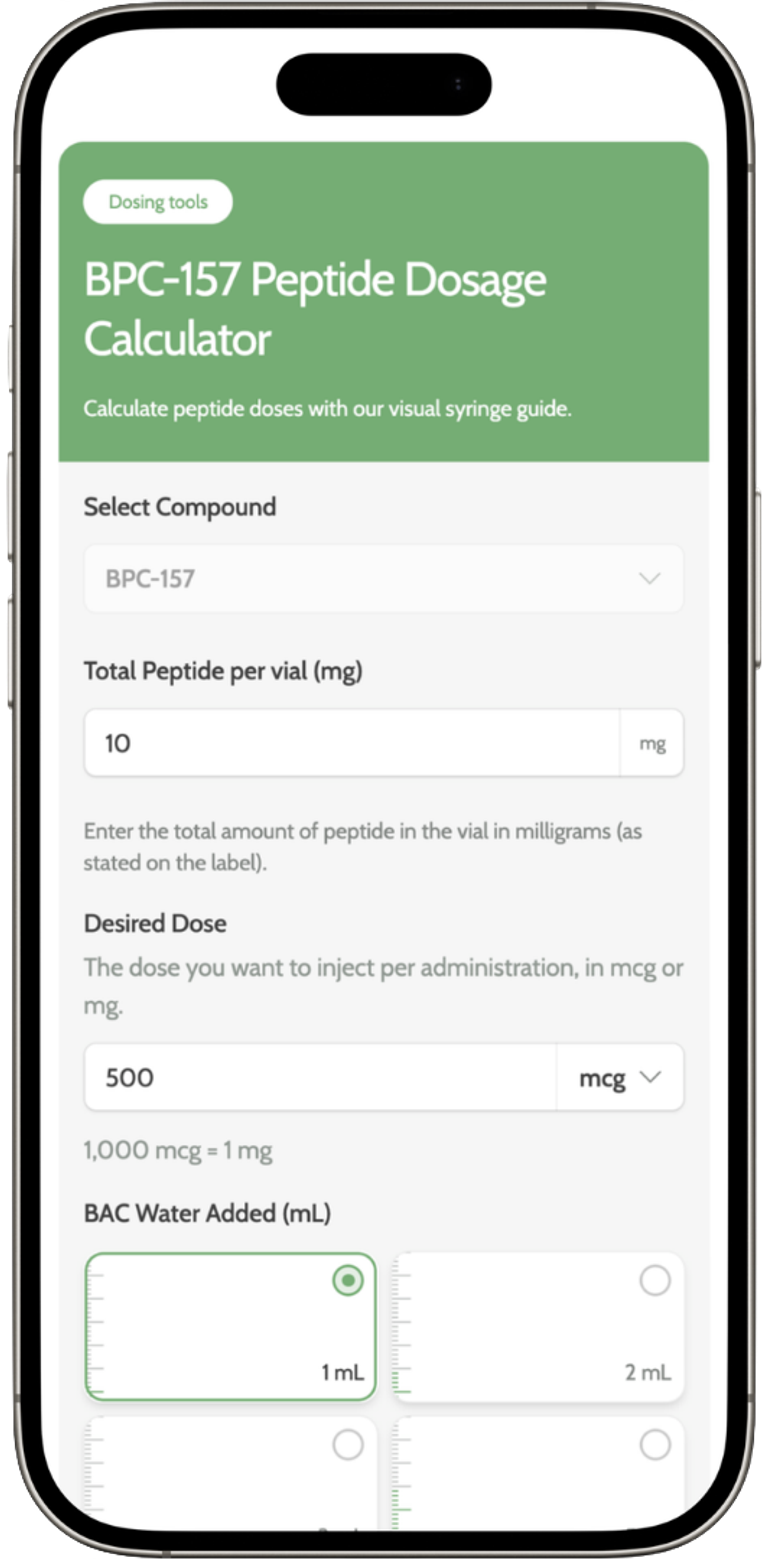
A peptide dosage calculator is a free tool that converts your vial size, bacteriostatic water volume, and target dose into an exact syringe draw volume. Instead of doing the reconstitution math by hand, you enter three inputs and instantly get the concentration of your solution and how many milliliters or syringe units to draw. This calculator works for single peptide compounds and multi-peptide blends.
How do I calculate peptide dosage from a vial?
To calculate your peptide dose, divide the total peptide content of your vial in micrograms by the volume of bacteriostatic water you added in milliliters. This gives you your solution concentration in mcg/mL. Then divide your target dose by that concentration to get your draw volume. For example, a 5mg (5,000 mcg) vial reconstituted with 2mL of BAC water gives a concentration of 2,500 mcg/mL. A 250 mcg dose would require drawing 0.1mL. This calculator automates all of those steps instantly.
How much Bacteriostatic water should I add to a peptide vial?
Most people add 2mL to 3mL of bacteriostatic water per vial, but the right amount depends on the dose you want to draw and the syringe size you are using. Adding 1mL to a 5mg vial gives you a concentration of 5,000 mcg/mL, making each dose very small in volume. Adding 2mL gives you 2,500 mcg/mL, which is easier to measure on a standard insulin syringe. A general guideline is to choose a volume that puts your typical dose somewhere between 10 and 30 units on a U-100 syringe. Use the calculator above to test different water volumes and find what works for your dose.
How are peptides different from proteins?
Both are made of amino acids, but peptides are much smaller than proteins. Because of their tiny size, peptides can act like tiny messengers in the body, sending specific signals to your cells to tell them exactly what to do.
Calculate peptide research quantities
Reference our peptide dosage, blend, and accumulation calculators for research purposes. Enter vial size, reconstitution volume, and target research quantity to calculate draw volumes instantly. For research use only — not administration or dosing guidance of any kind.