Immunity Peptide Cheat Sheet
Your complete reference for immune-supporting peptides. Includes dosage, benefits, and mechanisms for Thymosin Alpha 1, Thymalin, Selank, LL-37, KPV, and more.
For research purposes only.
This cheat sheet is a research reference only — not for human consumption or therapeutic use.
| Peptide | Purpose | Vial Size | BAC Water | Dosing | Frequency | Cycle |
|---|---|---|---|---|---|---|
sel SelankCognitive | Cognitive Enhancement | 5 mg | Nasal spray - no BAC needed | 250–500 mcg | Daily | 4–8 weeks |
thymu ThymulinImmunity | Immune & Anti-Aging | 5 mg | 2 mL | 50–200 mcg | Daily | 4–8 weeks |
cry CrystagenImmunity | Longevity & Anti-Aging | 20 mg | 2 mL | 1–2 mg | Daily | 20 consecutive days |
ill Illumineuro BlendCognitive | Cognitive Enhancement | 50 mg | 3 mL | 250–600 mcg | Daily | 4–8 weeks |
thym ThymogenImmunity | Immune & Gut | 1 mg | 1 mL | 100 mcg | Daily | 20 consecutive days |
thymos Thymosin Beta-4Healing | Recovery & Repair | 5 mg | 2 mL | 1–2.5 mg | 2×/week | 4–6 weeks |
liv LivagenLongevity | Longevity & Anti-Aging | 10 mg | 2 mL | 100–200 mcg | Daily | 20 consecutive days |
vip VIPImmunity | Immune & Gut | 5 mg | 3 mL | 50–100 mcg | Daily | 2–3 months |
epi EpitalonLongevity | Longevity & Anti-Aging | 10 mg | 2 mL | 1–5 mg | Daily | 20 consecutive days, 1–2×/year |
glu GlutathioneLongevity | Longevity & Anti-Aging | 600 mg | 5 mL | 100–200 mg | 2–3×/week | 8–12 weeks |
thy ThymalinImmunity | Immune & Gut | 20 mg | 2 mL | 10 mg | Daily | 5–10 days |
vil VilonImmunity | Immune & Gut | 5 mg | 3 mL | 5 mg | Daily | 10–20 days |
thymo Thymosin Alpha 1Immunity | Immune & Gut | 10 mg | 2 mL | 1.5 mg | Weekly (2×) | 6–12 weeks |
kpv KPVHealing | Immune & Gut | 10 mg | 2 mL | 250–500 mcg | 5 days on / 2 days off | 8 weeks on / 8 weeks off |
ll3 LL-37Immunity | Immune & Gut | 5 mg | 2 mL | 100 mcg | Daily | 4–6 weeks |
sel
Cognitive
- Purpose
- Cognitive Enhancement
- Vial Size
- 5 mg
- BAC Water
- Nasal spray - no BAC needed
- Dosing
- 250–500 mcg
- Frequency
- Daily
- Cycle
- 4–8 weeks
thymu
Immunity
- Purpose
- Immune & Anti-Aging
- Vial Size
- 5 mg
- BAC Water
- 2 mL
- Dosing
- 50–200 mcg
- Frequency
- Daily
- Cycle
- 4–8 weeks
cry
Immunity
- Purpose
- Longevity & Anti-Aging
- Vial Size
- 20 mg
- BAC Water
- 2 mL
- Dosing
- 1–2 mg
- Frequency
- Daily
- Cycle
- 20 consecutive days
ill
Cognitive
- Purpose
- Cognitive Enhancement
- Vial Size
- 50 mg
- BAC Water
- 3 mL
- Dosing
- 250–600 mcg
- Frequency
- Daily
- Cycle
- 4–8 weeks
thym
Immunity
- Purpose
- Immune & Gut
- Vial Size
- 1 mg
- BAC Water
- 1 mL
- Dosing
- 100 mcg
- Frequency
- Daily
- Cycle
- 20 consecutive days
thymos
Healing
- Purpose
- Recovery & Repair
- Vial Size
- 5 mg
- BAC Water
- 2 mL
- Dosing
- 1–2.5 mg
- Frequency
- 2×/week
- Cycle
- 4–6 weeks
liv
Longevity
- Purpose
- Longevity & Anti-Aging
- Vial Size
- 10 mg
- BAC Water
- 2 mL
- Dosing
- 100–200 mcg
- Frequency
- Daily
- Cycle
- 20 consecutive days
vip
Immunity
- Purpose
- Immune & Gut
- Vial Size
- 5 mg
- BAC Water
- 3 mL
- Dosing
- 50–100 mcg
- Frequency
- Daily
- Cycle
- 2–3 months
epi
Longevity
- Purpose
- Longevity & Anti-Aging
- Vial Size
- 10 mg
- BAC Water
- 2 mL
- Dosing
- 1–5 mg
- Frequency
- Daily
- Cycle
- 20 consecutive days, 1–2×/year
glu
Longevity
- Purpose
- Longevity & Anti-Aging
- Vial Size
- 600 mg
- BAC Water
- 5 mL
- Dosing
- 100–200 mg
- Frequency
- 2–3×/week
- Cycle
- 8–12 weeks
thy
Immunity
- Purpose
- Immune & Gut
- Vial Size
- 20 mg
- BAC Water
- 2 mL
- Dosing
- 10 mg
- Frequency
- Daily
- Cycle
- 5–10 days
vil
Immunity
- Purpose
- Immune & Gut
- Vial Size
- 5 mg
- BAC Water
- 3 mL
- Dosing
- 5 mg
- Frequency
- Daily
- Cycle
- 10–20 days
thymo
Immunity
- Purpose
- Immune & Gut
- Vial Size
- 10 mg
- BAC Water
- 2 mL
- Dosing
- 1.5 mg
- Frequency
- Weekly (2×)
- Cycle
- 6–12 weeks
kpv
Healing
- Purpose
- Immune & Gut
- Vial Size
- 10 mg
- BAC Water
- 2 mL
- Dosing
- 250–500 mcg
- Frequency
- 5 days on / 2 days off
- Cycle
- 8 weeks on / 8 weeks off
ll3
Immunity
- Purpose
- Immune & Gut
- Vial Size
- 5 mg
- BAC Water
- 2 mL
- Dosing
- 100 mcg
- Frequency
- Daily
- Cycle
- 4–6 weeks
Download the Immunity Peptide Cheat Sheet PDF
Save a free printable PDF of this peptide dosage cheat sheet — vial sizes, BAC water ratios, dosing amounts, and cycle lengths in one quick-reference chart.
Immunity Peptide Cheat Sheet — Research Notes
Key considerations and protocol notes for each peptide in this cheat sheet.
Cognitive
sel
Longevity
Selank is a lab-made peptide that can help calm anxiety and sharpen focus and memory, usually taken as a nasal spray. It doesn't make you drowsy and isn't habit-forming.
Immunity
thymu
Immunity
Thymulin is a natural hormone that helps train immune cells and may calm inflammation and slow some effects of aging on the immune system. It needs zinc to work properly, and people use it to support immune health, especially as they get older.
Immunity
cry
Immunity
Crystagen is a very short peptide meant to support brain and nervous system health. It's taken in short cycles and may help protect brain cells and support memory as you age.
Cognitive
ill
This is a blend of four brain-focused peptides (Semax, Selank, Pinealon, and PE-22-28) combined to support mood, memory, focus, and new brain cell growth. It comes as a nasal spray or injection, usually taken in the morning on an empty stomach, but there's no research yet on this exact four-peptide combination.
Immunity
thym
Immunity
Thymogen is a very small peptide that helps the immune system mature and work better. It's used to support immune recovery, especially when someone's immune system is weakened, and is also studied for anti-aging benefits.
Healing
thymos
Longevity
Thymosin Beta-4 (also called TB-500) is a peptide that helps the body heal tissue faster, calm inflammation, and repair muscles, tendons, ligaments, and skin. It's popular for recovering from injuries and wounds.
Longevity
liv
Immunity
Livagen is a short peptide studied for helping cells 'turn back on' genes related to immune and heart health, which may support longevity. It's used alongside other similar peptides to support immune function and slow age-related decline.
Longevity
epi
Immunity
Epitalon may help activate an enzyme called telomerase, which is linked to cell aging, and is typically used in short cycles rather than continuously. A full cycle usually totals around 100 mg.
Longevity
glu
Immunity
Glutathione is a powerful antioxidant that supports detoxification, helps calm inflammation, and can improve skin health. Keep the reconstituted vial refrigerated and protected from light, and use it within 2 to 3 weeks, since it breaks down faster than most peptides.
Immunity
thy
Immunity
Thymalin helps restore balance to the immune system and is given as an injection under the skin.
Immunity
vil
Immunity
Vilon is a gentle immune-system support peptide given as an injection under the skin.
Immunity
thymo
Immunity
Thymosin Alpha 1 is often called the 'BPC-157 of the immune system' because it's so widely used to support healthy immune function.
Build your own protocol
Create a custom peptide stack tailored to your goals. Add peptides, set dosages, and share it with the community.
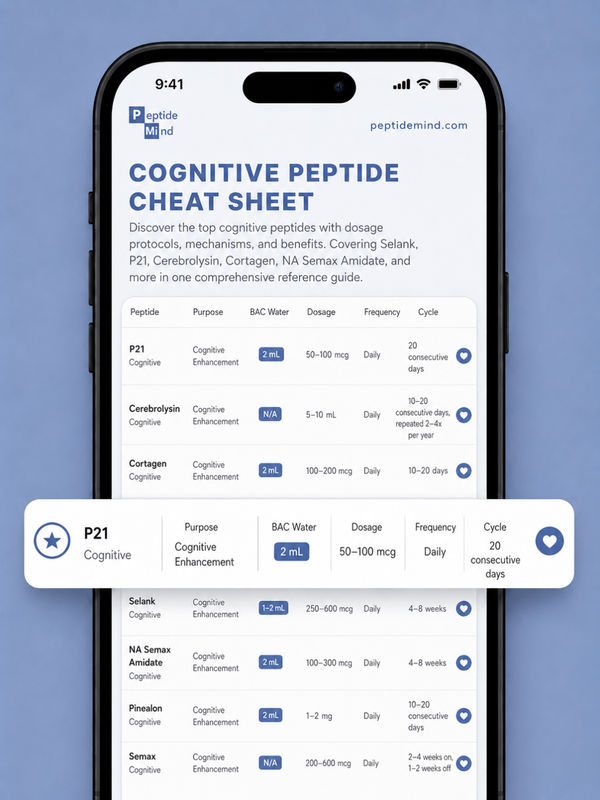
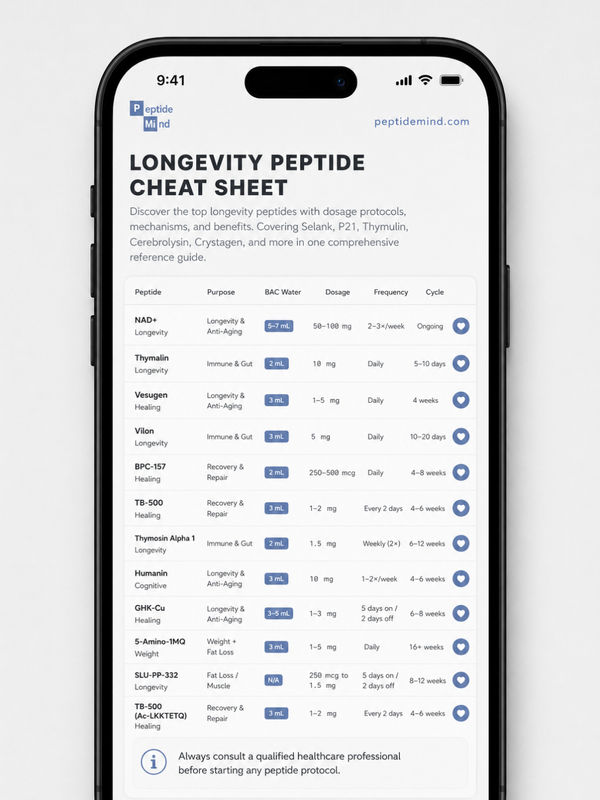
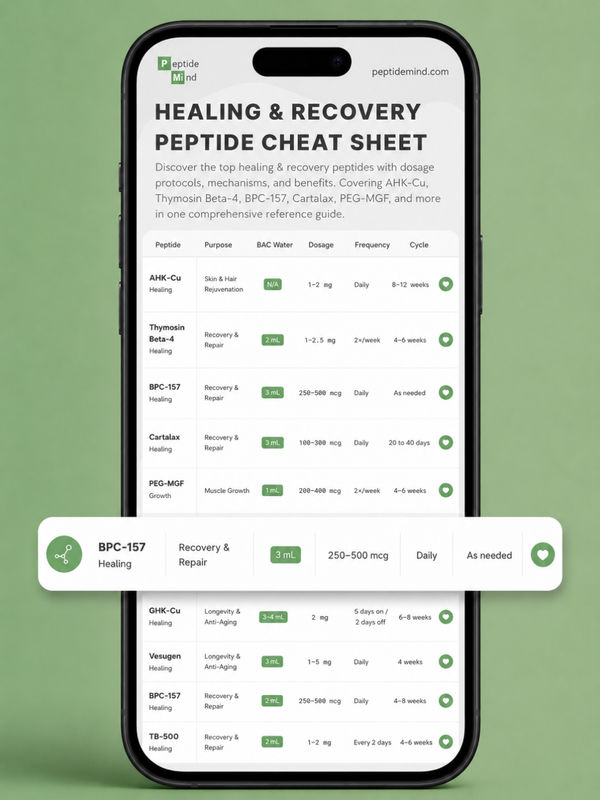
More Cheat Sheets
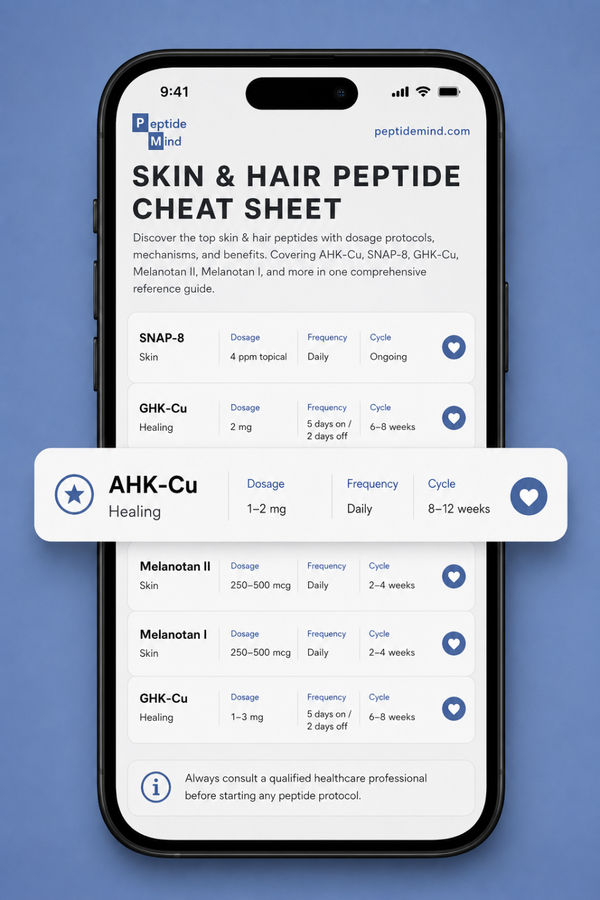
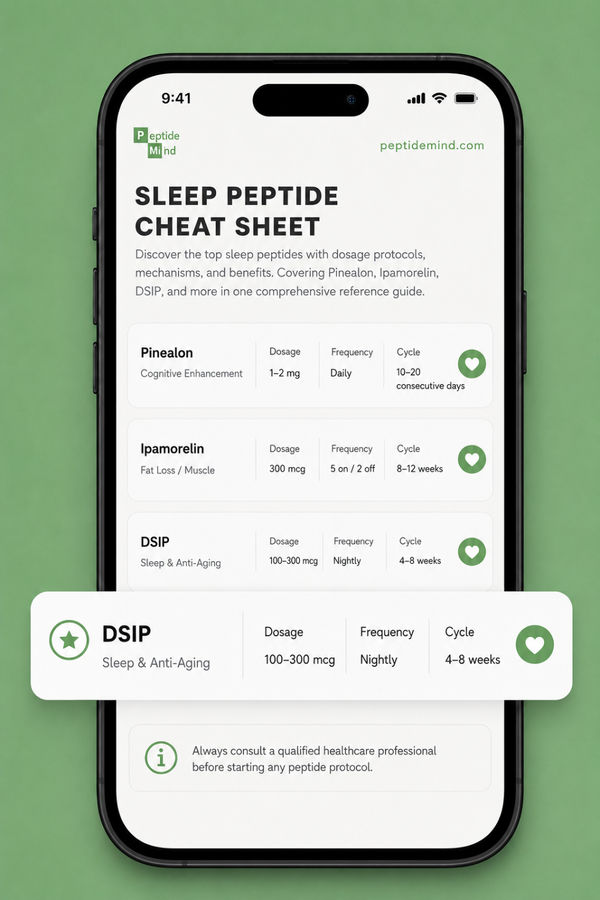
Explore other peptide reference sheets from PeptideMind.

Frequently asked questions
What is a peptide dosage calculator?
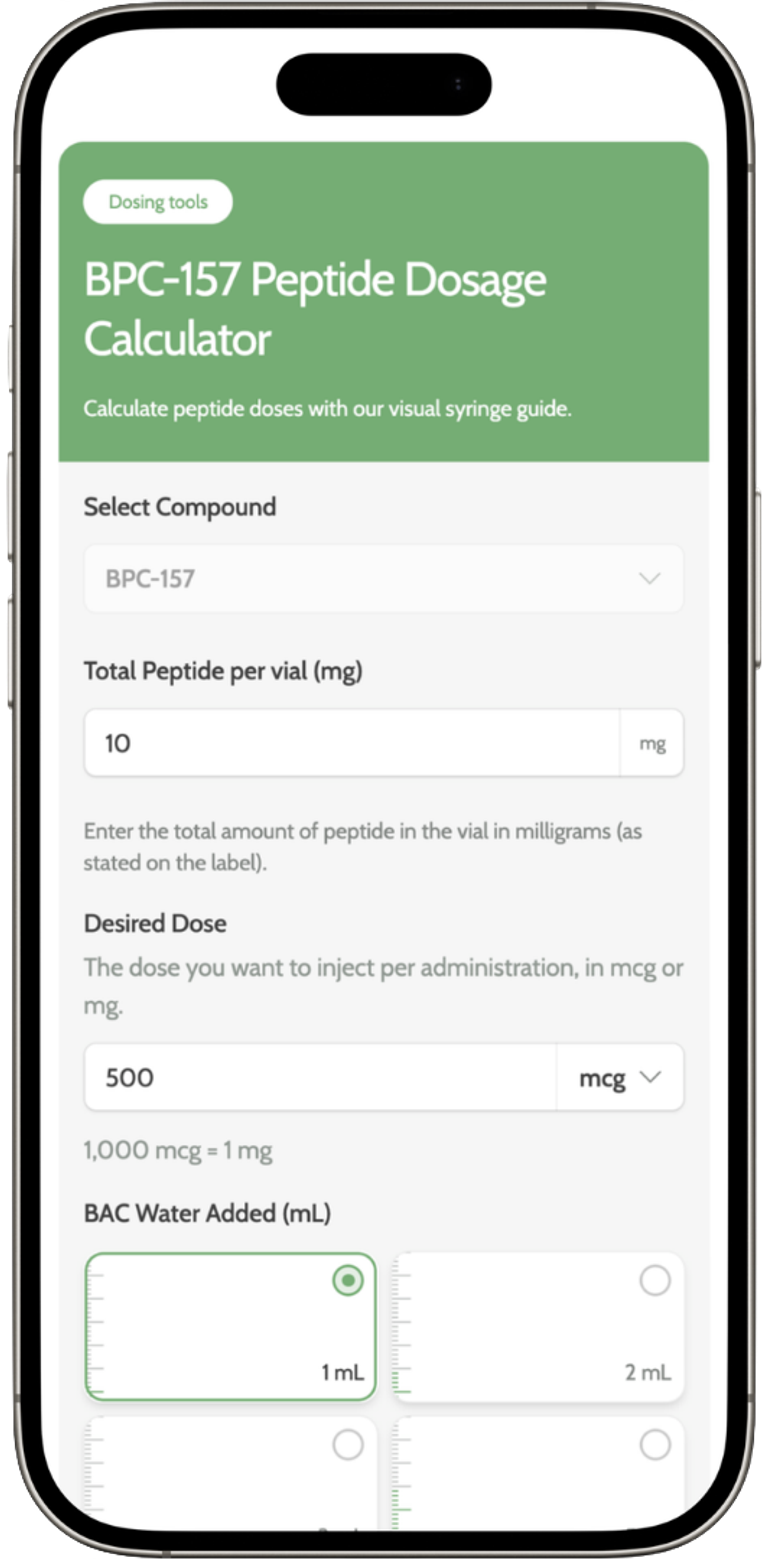
A peptide dosage calculator is a free tool that converts your vial size, bacteriostatic water volume, and target dose into an exact syringe draw volume. Instead of doing the reconstitution math by hand, you enter three inputs and instantly get the concentration of your solution and how many milliliters or syringe units to draw. This calculator works for single peptide compounds and multi-peptide blends.
How do I calculate peptide dosage from a vial?
To calculate your peptide dose, divide the total peptide content of your vial in micrograms by the volume of bacteriostatic water you added in milliliters. This gives you your solution concentration in mcg/mL. Then divide your target dose by that concentration to get your draw volume. For example, a 5mg (5,000 mcg) vial reconstituted with 2mL of BAC water gives a concentration of 2,500 mcg/mL. A 250 mcg dose would require drawing 0.1mL. This calculator automates all of those steps instantly.
How much Bacteriostatic water should I add to a peptide vial?
Most people add 2mL to 3mL of bacteriostatic water per vial, but the right amount depends on the dose you want to draw and the syringe size you are using. Adding 1mL to a 5mg vial gives you a concentration of 5,000 mcg/mL, making each dose very small in volume. Adding 2mL gives you 2,500 mcg/mL, which is easier to measure on a standard insulin syringe. A general guideline is to choose a volume that puts your typical dose somewhere between 10 and 30 units on a U-100 syringe. Use the calculator above to test different water volumes and find what works for your dose.
How are peptides different from proteins?
Both are made of amino acids, but peptides are much smaller than proteins. Because of their tiny size, peptides can act like tiny messengers in the body, sending specific signals to your cells to tell them exactly what to do.
Calculate peptide research quantities
Reference our peptide dosage, blend, and accumulation calculators for research purposes. Enter vial size, reconstitution volume, and target research quantity to calculate draw volumes instantly. For research use only — not administration or dosing guidance of any kind.