GHK-Cu Dosage and Injection Sites: How Much, How Often, and Where to Inject
GHK-Cu dosage explained: how much to inject, how often, where to inject, and what the research and community reports actually show about copper peptide protocols.
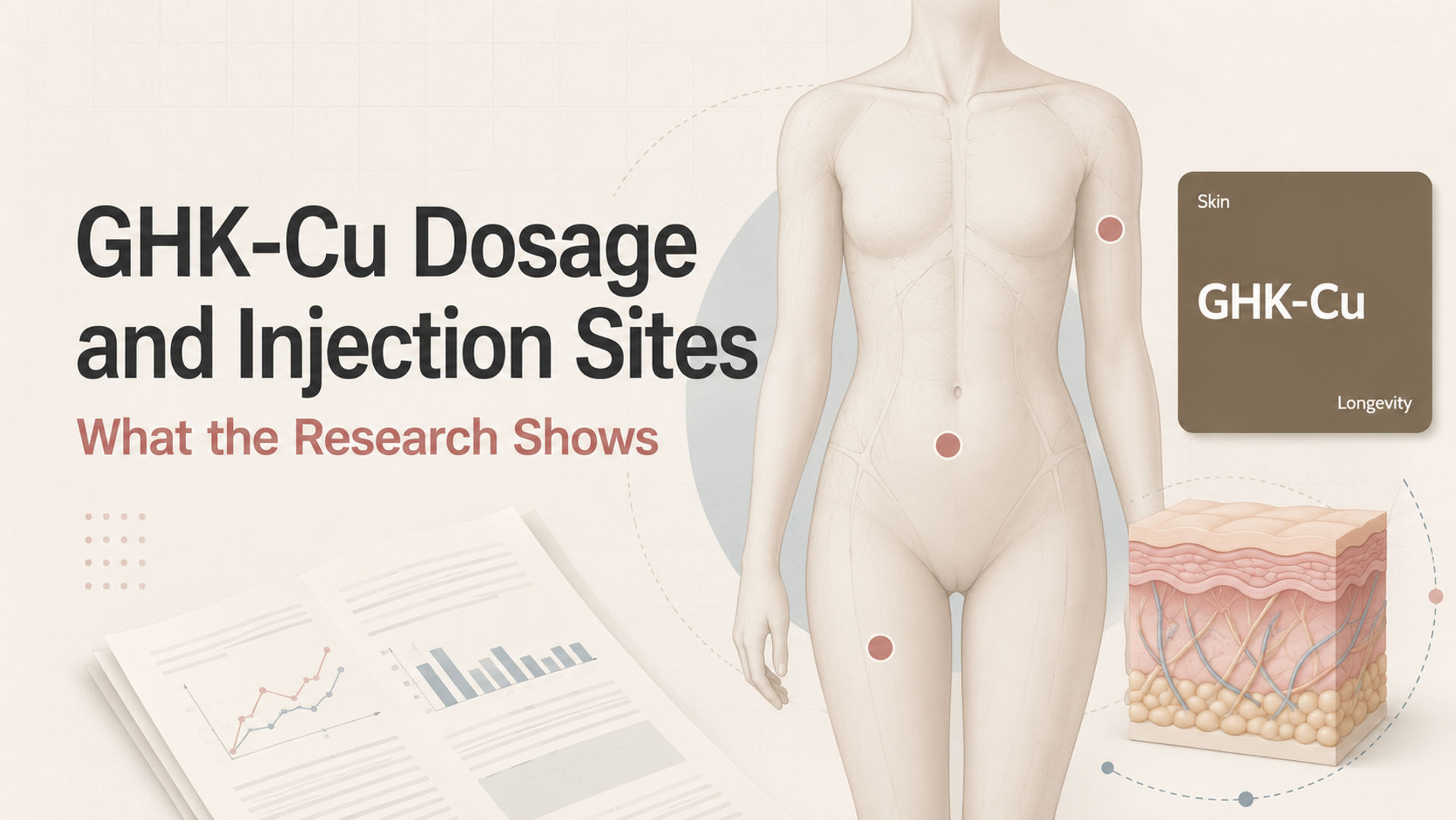

GHK-Cu dosage in injectable research protocols typically falls between 1 mg and 2 mg per day administered subcutaneously, with the abdomen, love handles, and upper glute used as rotation sites. This guide covers where those numbers came from, how often protocols dose, where the injection goes, how much elemental copper each dose delivers, and what people running it report.
Disclaimer: This article is for educational purposes only and is not medical advice. GHK-Cu is an unapproved research chemical, and the dosages below describe reported protocols, not recommendations. See the full disclaimer at the end.
GHK-Cu Dosage Protocol at a Glance
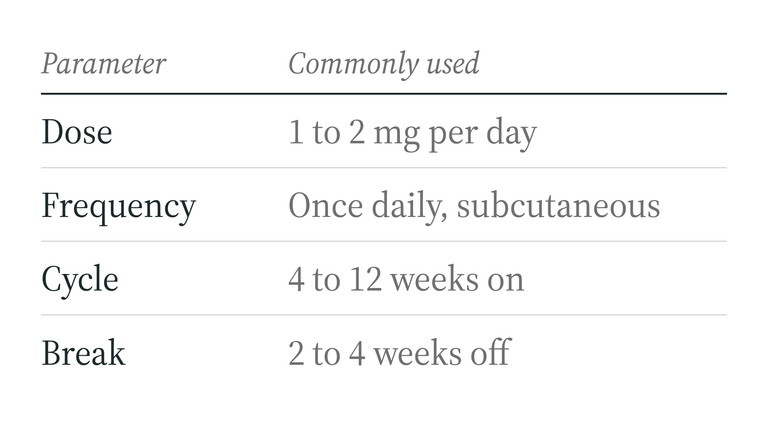
The commonly used injectable GHK-Cu dosage is 1 to 2 mg per day subcutaneously, run for 4 to 12 weeks before a break of 2 to 4 weeks. No regulatory body has set a dose, because no human trial has tested injectable GHK-Cu. The figures below are the ranges that recur across provider protocols and community reports.
Parameter | Commonly used range |
|---|---|
Dose per administration | 1 to 2 mg (some protocols to 3 mg) |
Route | Subcutaneous |
Frequency | Once daily, or every other day at the higher end |
Injection sites | Abdomen, love handles, outer thigh, upper glute |
Cycle length | 4 to 12 weeks on, 2 to 4 weeks off |
Elemental copper per 2 mg dose | Approximately 315 mcg |
GHK-Cu is the tripeptide glycyl-L-histidyl-L-lysine bound to a single copper(II) ion, molecular weight 403.93 g/mol, sold in cosmetics as copper tripeptide-1. Loren Pickart isolated it from human plasma in 1973. Peptide Mind's GHK-Cu peptide guide covers mechanism and benefits; this page is about the numbers.
What the Research Actually Establishes About GHK-Cu Dosing

The published human evidence for GHK-Cu is topical, not injectable. No clinical trial has established a subcutaneous dose, and no human pharmacokinetic study has measured how long an injected dose stays in circulation. That is the honest starting point, and it is what most dosing charts online leave out.
What the literature does establish is that GHK-Cu is active at very small quantities. Plasma GHK sits at about 200 ng/mL at age 20 and declines to 80 ng/mL by age 60, the observation that started the field. At the gene level, Pickart and Margolina reported an unusually broad effect.
GHK stimulated or suppressed 31.2% of human genes by 50% or more in the Broad Institute Connectivity Map dataset, according to Pickart and Margolina's 2018 review in the International Journal of Molecular Sciences.
The closest thing to an injectable dosing study is Maquart and colleagues' 1993 work in the Journal of Clinical Investigation. Rats received sequential injections of GHK-Cu into implanted wound chambers, producing a concentration-dependent rise in collagen and glycosaminoglycan content, with collagen synthesis stimulated at twice the rate of noncollagen proteins. That is local delivery into a wound model, not systemic dosing in a person, so it establishes dose-dependent tissue accumulation without telling you what milligram figure belongs in a syringe. The broader pathway work in skin regeneration is the same story: strong mechanism, no human dose.
One widely repeated number deserves correction. Community guides cite a 30 to 60 minute plasma half-life, and daily dosing is often justified on it. No published human pharmacokinetic study supports that figure. Rapid clearance by plasma peptidases is a reasonable inference from the molecule's size, but the number itself is an estimate repeated until it reads like a measurement.
GHK-Cu Injection Dosage: Common Ranges and How to Calculate Yours
Injectable GHK-Cu dosage protocols cluster at 1 to 2 mg per administration, with 1 mg as a common starting point and 2 mg as the most frequently cited ceiling. Provider protocols often escalate within a cycle: 1 mg daily for days 1 to 15, then 2 mg daily for days 16 to 30.
Higher doses appear in the 2 to 3 mg range, usually spaced further apart rather than daily. Experienced voices in community threads argue against pushing past 2 mg, on the grounds that unbound copper has to be cleared rather than used.
How much copper a GHK-Cu dose actually delivers
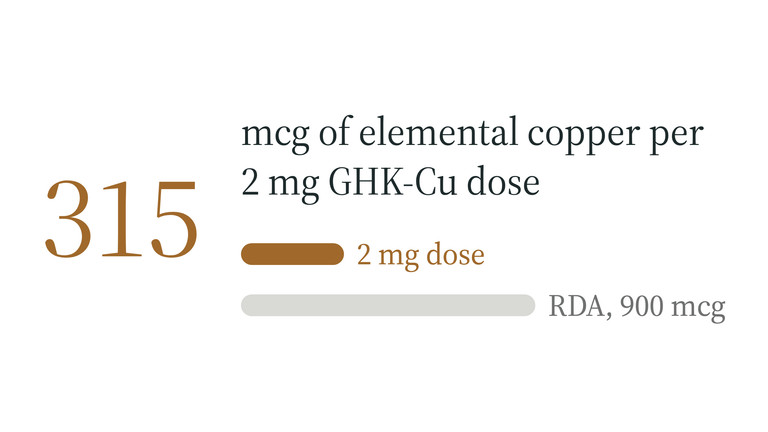
Copper accounts for 63.55 of the complex's 403.93 g/mol, roughly 15.7% of its mass, which makes the arithmetic straightforward.
Shop research peptides
Live pricing from our top-rated vendor. Prices update as vendor listings change.
A 1 mg GHK-Cu dose delivers approximately 157 mcg of elemental copper, and a 2 mg dose approximately 315 mcg. For reference, the adult RDA for copper is 900 mcg per day and the Tolerable Upper Intake Level is 10,000 mcg per day, according to the NIH Office of Dietary Supplements.
Those figures describe oral intake, where the gut throttles absorption back when copper stores are adequate. A subcutaneous injection bypasses that control, so the comparison sets scale rather than a safety limit. It does show that 2 mg is a meaningful copper load, roughly a third of a day's dietary requirement arriving at once with no gut brake on it, which is the mechanistic reason cycling appears in nearly every GHK-Cu protocol.
Working out units from your vial
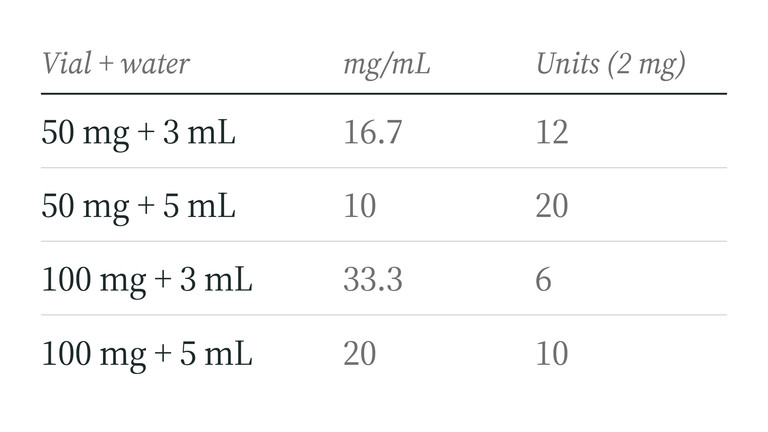
GHK-Cu ships as a lyophilized powder in 50 mg or 100 mg vials, and the units on your syringe depend entirely on how much bacteriostatic water you add. The peptide dosage calculator handles this, and Peptide Mind's reconstitution guide covers the mixing.
Vial and BAC water | Concentration | Units for a 2 mg dose |
|---|---|---|
50 mg + 3 mL | 16.7 mg/mL | 12 units (0.12 mL) |
50 mg + 5 mL | 10 mg/mL | 20 units (0.20 mL) |
100 mg + 3 mL | 33.3 mg/mL | 6 units (0.06 mL) |
100 mg + 5 mL | 20 mg/mL | 10 units (0.10 mL) |
Units refer to a U-100 insulin syringe, where 100 units equals 1 mL. The same 2 mg dose can arrive as 0.06 mL or 0.20 mL depending on how the vial was mixed, and that difference matters more for tolerability than the dose itself.
GHK-Cu Injection Frequency: Daily, Every Other Day, or Weekly
Once daily is the standard GHK-Cu injection frequency in almost every provider protocol and community log. Every-other-day dosing at 2 to 3 mg is the main alternative, used to halve the number of injections and stretch a vial.
Daily dosing is justified on short systemic residence: a 403 g/mol tripeptide clears quickly, so consistent exposure means frequent administration. But the half-life figure behind that reasoning is not from a human study, so the daily-versus-alternate-day question has never been tested in people.
The counterargument is mechanistic. GHK-Cu works by shifting gene expression, which unfolds over days and weeks rather than hours, so spacing doses out may lose nothing. Neither position has trial data. Both schedules produce the outcomes people are after in reports, and every-other-day dosing produces fewer injection site problems for the simple reason that there are fewer injections. Timing within the day appears not to matter, and no study has compared morning to evening.
Where to Inject GHK-Cu: Sites, Rotation, and Technique
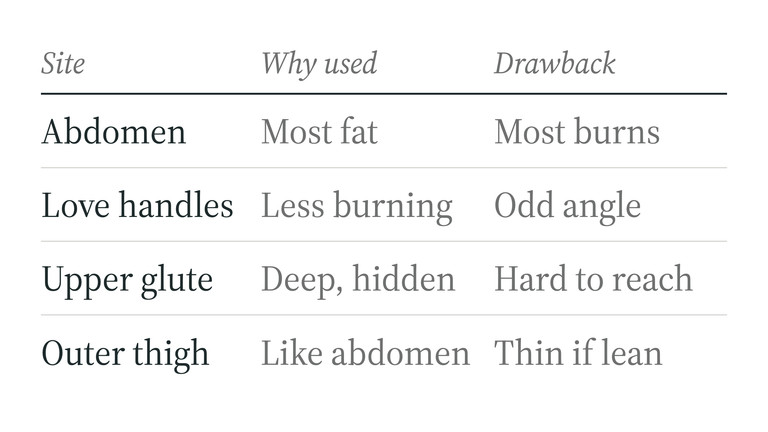
GHK-Cu is injected subcutaneously into pinchable fat: the abdomen at least two inches from the navel, the love handles, the outer thigh, or the upper glute. Site selection matters more here than with most research peptides, because injection site reactions are this compound's defining practical problem.
Site | Why it is used | Reported drawback |
|---|---|---|
Abdomen (2 in. from navel) | Easiest to reach, most subcutaneous fat | Where most burning and welt reports occur |
Love handles / flank | Repeatedly reported as better tolerated | Awkward angle for self-injection |
Upper glute | Deep fat layer, marks stay out of sight | Hard to reach without a mirror |
Outer thigh | Mechanically similar to abdomen | Thinner fat layer in lean subjects |
Site rotation
Rotate with every dose and do not return to the same spot inside a week. That is standard subcutaneous practice, but it carries extra weight with GHK-Cu: one long-term user describes abdomen and outer thigh sites that remained unusable for other compounds two months after stopping GHK-Cu entirely. Rotation is what stops one irritated site from compounding.
Needle length and angle
Subcutaneous means the fat layer, not the dermis above it or the muscle below. Depth is set by needle length and angle together:
4 mm needle: 90 degrees, no pinch
6 mm needle: 90 degrees, pinch the skin
8 mm needle: 45 degrees, pinch the skin
A 29 to 31 gauge insulin syringe is standard. Depositing GHK-Cu too shallowly, into the dermis rather than the fat, is one of the two most commonly cited causes of the burn, and several people report that moving from a 6 mm to an 8 mm needle solved a reaction that dilution alone did not.
Shop research peptides
Live pricing from our top-rated vendor. Prices update as vendor listings change.
Cycling GHK-Cu: How Long On and How Long Off
GHK-Cu cycles typically run 4 to 12 weeks on followed by 2 to 4 weeks off. The two most common patterns are 30 days on with 30 days off, and 8 to 12 weeks on with a shorter break.
Two arguments drive the pause: copper clearance, since every dose carries elemental copper past the gut's absorption controls, and diminishing response, with community discussion pointing to a plateau around 12 weeks. Neither has been quantified in a human study, so cycle lengths are convention rather than evidence. For an objective read, photograph the same area under the same lighting every two weeks.
What Users Report About GHK-Cu Dosing and Injection Sites
Community threads are the largest body of human observational data on injectable GHK-Cu, and the reports are unusually detailed because the local reaction is so distinctive.
Reported dosing and results
The most consistently reported protocol on r/Peptides is 1 to 2 mg daily subcutaneously, and lower doses are reported working. One detailed six-week log describes 500 mcg injected once daily alongside a 3% topical, with visible jawline and neck changes in side-by-side photos. Another user running 2 mg daily without cycling posted eight-month hair density comparisons.
Hair repigmentation comes up repeatedly, and it is worth flagging precisely because no trial has measured it. Independent reports describe grey hairs regaining pigment at the hairline during a cycle, including one user who noticed it after stopping. Copper is a required cofactor for tyrosinase, the enzyme that makes melanin, so a mechanism exists. Corroborated observation, no data.
The copper burn
The defining side effect has a recognizable signature: nothing on injection, then a bee-sting sensation building over roughly 15 minutes, then a red welt. The delay is informative. An acidic solution produces sharp pain immediately that fades fast, so the delayed, escalating pattern points to local copper-driven inflammation instead, as argued in detail in one r/Peptides thread.
Concentration is the variable people most consistently identify. One user who reconstituted with 1 mL of bacteriostatic water reported a site that hurt for two and a half weeks, then had no further pain after re-diluting to 4 mL. Others report 2 mg in 0.1 mL burning while 2 mg in 0.06 mL from a differently mixed vial does not, which is the opposite of what concentration alone predicts and suggests depth and technique matter too.
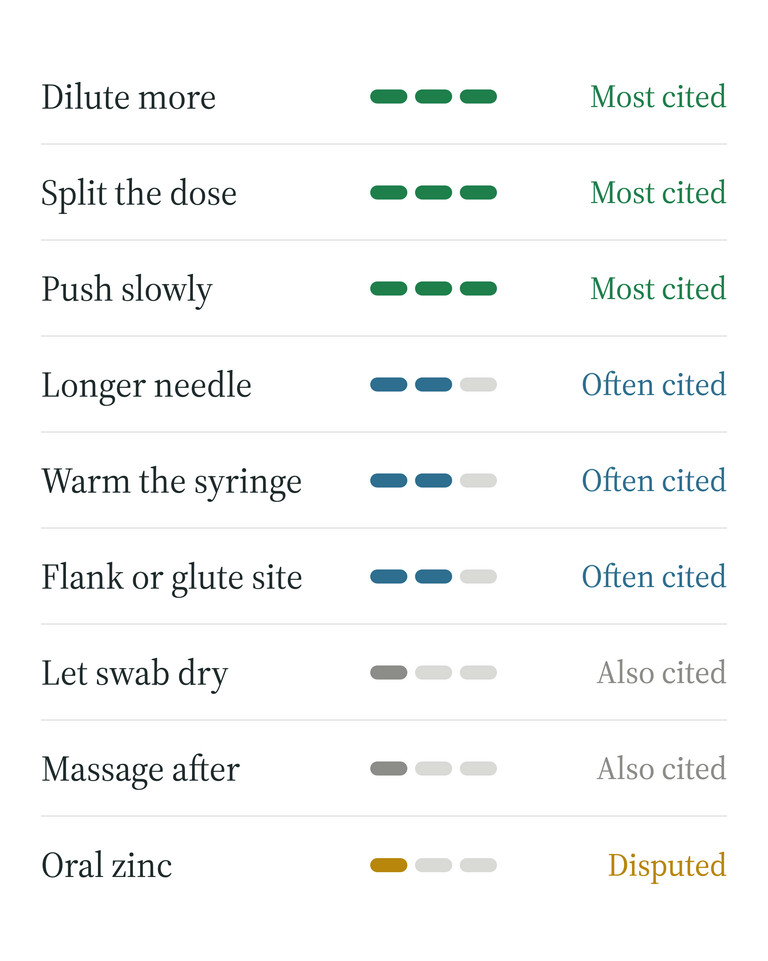
The mitigation checklist that recurs across threads, roughly in order of how often it is credited:
Reconstitute with more bacteriostatic water to lower concentration
Split a dose across two sites at smaller volumes
Push the plunger slowly, over 20 to 30 seconds
Use a longer needle to reach true subcutaneous depth
Let a refrigerated syringe come to room temperature first
Move to love handles or upper glute instead of central abdomen
Let the alcohol swab dry completely before the needle goes in
Massage the site for 30 to 60 seconds afterward
Add oral zinc to balance the copper load
Zinc is the one item with real disagreement behind it. It is widely practiced at 50 to 75 mg daily, and at least one experienced poster argues it is unnecessary at correct doses and risks displacing another mineral. No study has examined zinc alongside injectable GHK-Cu.
Practical Considerations: Concentration, Sourcing, and Regulatory Status
The most consequential decision in a GHK-Cu protocol is not the dose. It is the concentration you reconstitute to, because that determines whether the injections are tolerable. Erring toward more bacteriostatic water costs nothing but vial volume.
A target several experienced users work toward is 5 mg/mL or lower, where 1 mg equals 20 units and 2 mg equals 40 units. Reaching that with a 100 mg vial needs 20 mL, more than any standard vial holds, so it means splitting the solution across sterile vials or diluting further in the syringe before injecting. Peptide Mind's bacteriostatic water guide covers why plain sterile water is not the same thing.
Two sourcing points recur. Reconstituted GHK-Cu should carry a faint blue tint from the copper, which is expected rather than contamination. And clinicians in community threads report that buffered compounding-pharmacy preparations produce noticeably less injection site reaction than research-grade powder.
Shop research peptides
Live pricing from our top-rated vendor. Prices update as vendor listings change.
On regulation: the FDA announced on April 15, 2026 that GHK-Cu is being removed from Category 1 of the 503A bulk drug substances list following withdrawal of its nomination, with Pharmacy Compounding Advisory Committee consultation planned before the end of February 2027. Community threads frequently misreport this as a removal from Category 2. Category 1 covered substances not identified as presenting significant safety risks, so the change reflects a lapsed nomination rather than a new safety finding.
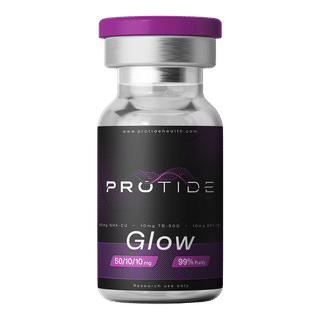
GHK-Cu is also the largest component of the GLOW and KLOW research blends, which is why site reactions attributed to those blends are usually the copper fraction talking. If injectable compounds are new to you, start with the first-time peptide guide.
Frequently Asked Questions
How much GHK-Cu should I inject per day?
Provider protocols and community logs cluster at 1 to 2 mg per day subcutaneously, often starting at 1 mg and escalating to 2 mg after two weeks. Doses of 500 mcg daily are reported producing visible skin changes, and 2 mg is the most commonly cited practical ceiling. No human trial has established an injectable dose, so these are conventions rather than validated figures.
How often should you inject GHK-Cu?
Once daily is the standard frequency in almost every protocol. Every-other-day dosing at 2 to 3 mg is the main alternative and produces fewer injection site problems because there are fewer injections. Time of day appears not to matter; evening dosing is more common out of habit. No study has compared these schedules directly.
Where do you inject GHK-Cu?
Subcutaneously into pinchable fat: the abdomen at least two inches from the navel, the love handles, the outer thigh, or the upper glute. Rotate sites with every dose. Love handles and upper glute are repeatedly reported as better tolerated than the central abdomen, which is where most burning and welt reports come from.
Why does GHK-Cu burn at the injection site?
The burn typically starts about 15 minutes after injection and builds into a red welt. Because it is delayed rather than immediate, it points to local copper-driven inflammation rather than an acidic solution. The two most commonly identified causes are a solution reconstituted too concentrated and a needle too short to reach true subcutaneous depth.
How do you stop GHK-Cu injections from burning?
Dilute more, split the dose across two sites, push the plunger over 20 to 30 seconds, use a longer needle (8 mm at 45 degrees rather than 6 mm), let a refrigerated syringe warm up, and inject into love handles or upper glute rather than central abdomen. These are community-reported fixes; none have been tested in a controlled study.
How long should you cycle GHK-Cu?
Common cycles run 4 to 12 weeks on with 2 to 4 weeks off, with 30 days on and 30 days off as the most frequently published pattern. The break is justified on copper clearance and diminishing response grounds, neither of which has been quantified in a human study of injectable GHK-Cu.
What the GHK-Cu Dosage Protocol Rests On
The working GHK-Cu dosage of 1 to 2 mg daily subcutaneously, rotated across abdomen, love handle, and glute sites, comes from convention and observation rather than clinical trials, which is worth knowing before treating any chart as authoritative. Concentration and injection depth decide whether a protocol is tolerable, and both are under your control in a way the dose is not. Explore Peptide Mind's GHK-Cu research profile for the mechanism behind it.
References
Pickart L, Margolina A. "Regenerative and Protective Actions of the GHK-Cu Peptide in the Light of the New Gene Data." International Journal of Molecular Sciences, 19(7), 2018. PMC6073405.
Pickart L, Vasquez-Soltero JM, Margolina A. "GHK Peptide as a Natural Modulator of Multiple Cellular Pathways in Skin Regeneration." BioMed Research International, 2015. PMC4508379.
Pickart L, Margolina A. "The Human Tri-Peptide GHK and Tissue Remodeling." Aging Pathobiology and Therapeutics, 2021. PMC8789089.
Maquart FX, Bellon G, Chaqour B, et al. "In vivo stimulation of connective tissue accumulation by the tripeptide-copper complex glycyl-L-histidyl-L-lysine-Cu2+ in rat experimental wounds." The Journal of Clinical Investigation, 92(5), 1993. PMID 8227354.
National Institutes of Health, Office of Dietary Supplements. "Copper: Fact Sheet for Health Professionals." 2025.
Orrick, Herrington & Sutcliffe LLP. "FDA Announces Removal of 12 Peptides from Category 2 and Schedules PCAC Meetings." April 2026.
Disclaimer: The information on Peptide Mind is for educational purposes only and is not a substitute for professional medical advice, diagnosis, or treatment. The peptides discussed are unapproved research chemicals for laboratory and research use only, not for human consumption. These statements have not been evaluated by the FDA, and nothing on this site is intended to diagnose, treat, cure, or prevent any disease. By accessing this site, you confirm you are 21 or older and agree to our Terms of Service.
Add a comment
This will be publicly visible.
Your email address will not be published.
Your comment will be reviewed by an admin before it is published.