Best Peptides for Memory: Semax, Selank and 4 Others Compared
The best peptides for memory ranked by what human trials actually measured. Tesamorelin, cerebrolysin, semax, selank and dihexa compared on evidence, dosing and route.
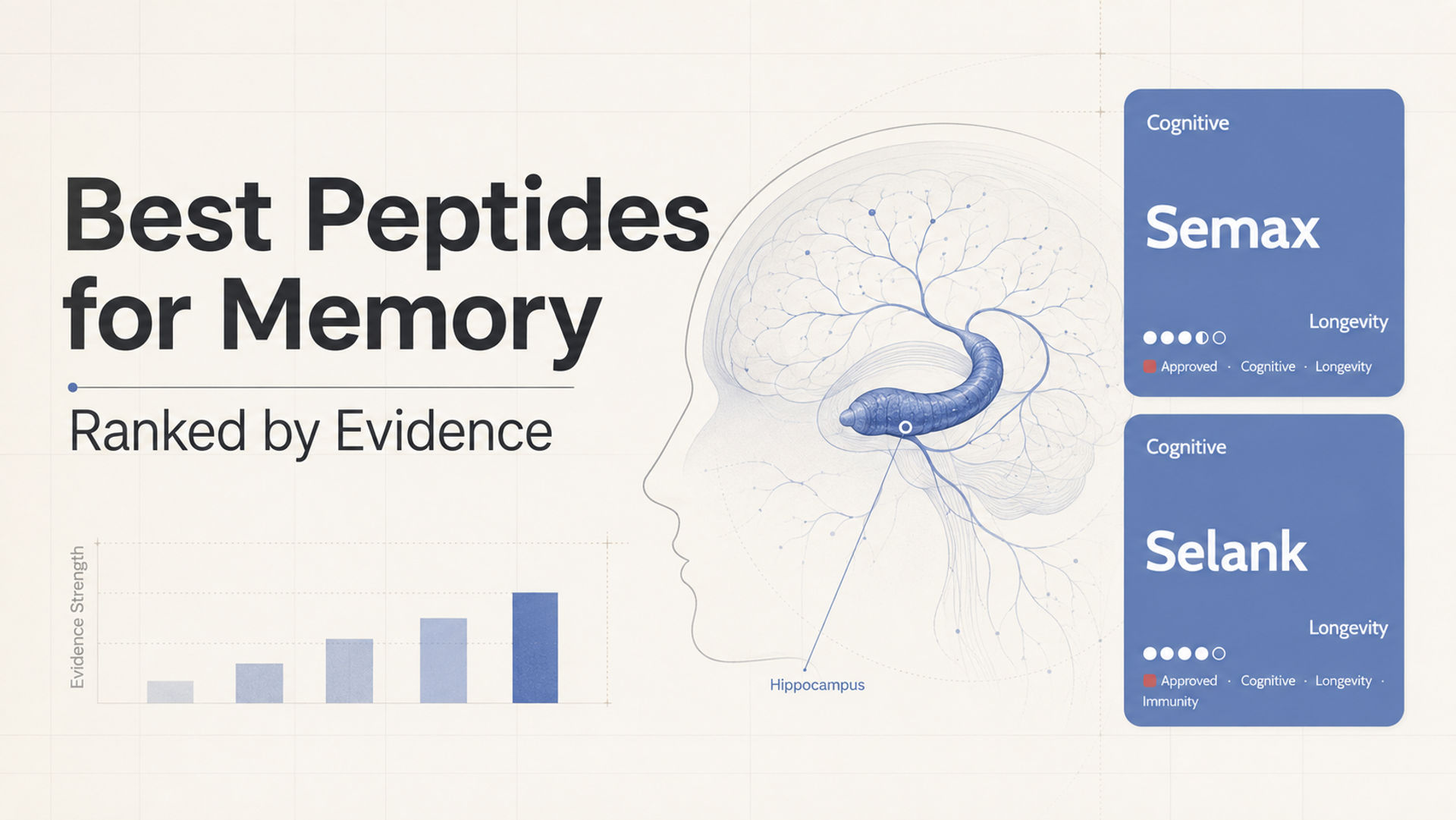

The best peptides for memory are semax and selank, the two Russian nootropic peptides with direct human data on attention and short-term memory, followed by tesamorelin and cerebrolysin, which have stronger trial designs but were tested in older adults and dementia patients rather than for memory itself. Most lists rank this category by how interesting the mechanism sounds, which is why dihexa usually appears near the top despite having no human data and a retracted evidence base. This guide ranks each option by published human outcomes, gives the doses those studies used, and covers what the evidence does not establish.

Why "Memory" Is Three Different Things
Memory is not one system, and the peptides in this category act on different parts of it. Splitting the term into three measurable functions is what makes a ranking checkable, because studies test these separately and a compound can move one while leaving the others flat.
Working memory is holding information active for seconds while you use it: a phone number before you dial it, the start of a sentence while you finish reading it. It is closely tied to attention and is the function most people mean when they say brain fog. It is also the function the Russian peptide literature measures most often.
Episodic and declarative memory is recall of events and facts: where you left your keys, a word list from twenty minutes ago. This is what neuropsychological batteries measure with story recall and paired-associate tasks, and it is the function that declines first in mild cognitive impairment.
Executive function is the control layer above both: task switching, filtering distraction, holding a plan while resisting a competing one. It is not memory in the strict sense, but poor executive function produces complaints that sound exactly like memory failure.
This distinction decides the whole ranking. The compound with the best-designed Western trial moved executive function significantly and verbal memory only at a statistical trend, while the compounds with weaker trial designs were tested directly on attention and short-term memory. A guide that treats those as the same outcome cannot tell you what any of them does.

Best Peptides for Memory, Ranked by Human Evidence
Ranked by how directly each compound has been tested against memory in people, weighted by the volume of human data behind it, the order is semax, selank, tesamorelin, cerebrolysin, intranasal insulin, then beta-lactolin. Trial design runs close to the reverse of this order, so the table below reports both.
Compound | Human memory evidence | Trial design quality |
|---|---|---|
Semax | Attention and short-term memory in healthy volunteers | Mostly uncontrolled, Russian-language |
Selank | Attention and short-term visual memory; three controlled trials | Randomized, active comparators, small |
Tesamorelin | Executive function P = .005, verbal memory P = .08 | Randomized, placebo-controlled, 152 adults |
Cerebrolysin | ADAS-cog+ improved in vascular dementia | Cochrane review of 6 trials, 597 patients |
Intranasal insulin | Early story-recall gains, no benefit at 12 months | Randomized, placebo-controlled, negative |
Beta-lactolin | Associative learning memory in healthy adults 50 to 75 | Randomized, placebo-controlled, 114 adults |
Dihexa | None | Foundational papers retracted for fraud |
1. Semax: The Most Human Data and the Most Direct Memory Evidence
Semax is a synthetic heptapeptide analog of the ACTH(4-10) fragment, developed at the Institute of Molecular Genetics of the Russian Academy of Sciences, and it has more human research behind it than any other compound in this category. PubMed indexes 231 semax papers, 51 of them tagged as human studies. It has been a registered pharmaceutical in Russia since 1994, classified under ATC code N06BX as a nootropic, and it sits on Russia's List of Vital and Essential Medicines.
The finding that matters most for this article was in healthy volunteers, not patients. Kaplan and colleagues gave intranasal semax and tested cognition across a working day.
Intranasal administration of the peptide at 16 mcg/kg significantly increased the attention and short-term memory of the subjects during testing, both at the beginning and at the end of the day. Doses of 250 to 1,000 mcg/kg produced EEG changes similar to those following typical neuroprotective drugs. (Kaplan et al., reported in Kolomin et al., Neuroscience and Medicine, 2013)
That is the only result in this entire category measuring attention and short-term memory in healthy people using a peptide people can actually obtain. A second line of human work supports it: in patients recovering from severe postresuscitation brain injury, neuropsychological testing showed improvement in attention, memory, cognition and audioverbal memory, with EEG confirming improved brain functional state.
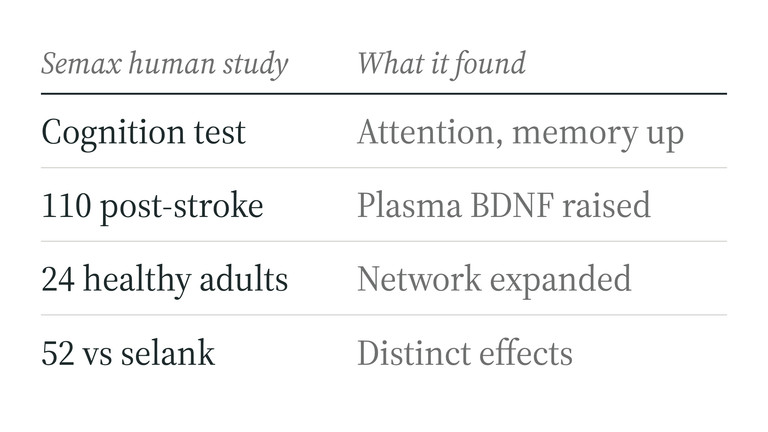
The mechanism has been confirmed in humans rather than inferred from rodents. In 110 post-stroke patients given 6,000 mcg per day intranasally in two 10-day courses, semax raised plasma BDNF levels which stayed high for the study period, alongside faster Barthel index recovery. Brain-derived neurotrophic factor is the growth factor supporting synaptic plasticity and long-term potentiation, the cellular basis of memory formation. Two placebo-controlled neuroimaging studies back this up: 24 healthy volunteers given intranasal 1% semax showed an expanded default mode network rostral subcomponent versus placebo, and a 52-participant study found distinct connectivity effects for semax and selank against placebo.
Here is the honest limit, and it is a real one. Almost none of this is placebo-controlled against a validated cognitive battery, most primary papers are in Russian, and the most detailed review comes from the institute that developed the peptide. An independent assessment by the Alzheimer's Drug Discovery Foundation concluded that published literature of well-conducted studies is lacking and that little evidence establishes whether semax improves cognition in healthy people. Thirty years of registered clinical use is meaningful evidence about safety and tolerability. It is not the same thing as a positive Phase 3 trial. Peptide Mind covers the compound in detail in the Semax research guide.
Shop research peptides
Live pricing from our top-rated vendor. Prices update as vendor listings change.
2. Selank: Registered as a Nootropic, With Three Controlled Trials
Selank is a synthetic heptapeptide analog of the immunomodulatory tetrapeptide tuftsin, developed by the same Russian institute as semax, and it was registered by the Russian Ministry of Health in 2009 as both an anxiolytic and a nootropic. It has the best trial designs in the Russian literature and a documented effect on the attention side of memory.
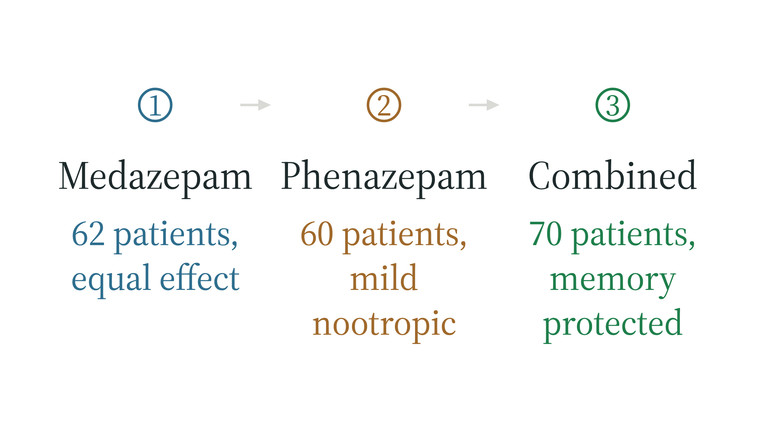
Three controlled human trials exist. Zozulya and colleagues compared selank against medazepam, a benzodiazepine, in 62 patients with generalized anxiety disorder and neurasthenia, finding comparable anxiolytic effects plus antiasthenic and psychostimulant effects the benzodiazepine did not produce. A 60-patient comparison against phenazepam reported pronounced anxiolytic and mild nootropic effects, with the anxiolytic effect persisting a week after the last dose.
The third is the most relevant to memory. In 70 patients, selank added to phenazepam was compared against phenazepam alone using the Stroop test and verbal fluency test, and the combination reduced the attention and memory impairment that the benzodiazepine caused on its own. A compound that protects cognition against a drug known to degrade it is a different and harder claim than a compound that improves it in healthy people.
Selank's own clinical reports describe improved concentration, reduced forgetfulness, faster sensorimotor reaction speed and improved short-term visual memory, with the gains growing over longer courses. The same caveats as semax apply: small samples, Russian-language primary literature, active comparators rather than placebo. A 2021 review in the Western literature described both selank and phenibut as poorly studied Russian drugs, which is a fair characterization of the evidence even though selank's safety record is far better than phenibut's. The differences between the two peptides are covered in the semax vs selank comparison.
3. Tesamorelin: The Best Trial Design, Aimed at the Wrong Function
Tesamorelin is a stabilized synthetic analog of growth hormone-releasing hormone (GHRH) and holds the best-designed cognitive trial of any peptide on this list. Baker and colleagues randomized 152 adults aged 55 to 87, of whom 66 met criteria for amnestic mild cognitive impairment, to daily subcutaneous tesamorelin or placebo for 20 weeks.
Tesamorelin produced a positive effect on executive function (P = .005), with a trend toward benefit in verbal memory (P = .08). Cognitive function improved in healthy older adults, and the expected decline in adults with mild cognitive impairment was attenuated. (Baker et al., Archives of Neurology, 2012)
Read those numbers against the taxonomy above. The effect on executive function was statistically solid. The effect on verbal memory did not reach significance. This is the strongest evidence in the category for the control layer and only suggestive evidence for recall, which is why a compound with a better trial ranks below two with weaker ones on a memory-specific list.
Two facts still favor it. It is an FDA-approved drug, approved for HIV-associated lipodystrophy rather than cognition, so its safety profile is characterized in a way no research peptide's is. And the trial dosed it 30 minutes before bed, matching the overnight growth hormone pulse, a timing detail that carries across the growth hormone axis and into guides on peptides for energy and peptides for sleep.
4. Cerebrolysin: The Largest Pooled Dataset, in Dementia Patients Only
Cerebrolysin is a mixture of low-molecular-weight peptides and amino acids derived from purified porcine brain protein, given intravenously, and it has more pooled controlled data than anything else here. A Cochrane systematic review by Chen and colleagues pooled six randomized controlled trials covering 597 patients with mild to moderate vascular dementia.
Meta-analysis found a beneficial effect on general cognitive function measured by ADAS-cog+ (weighted mean difference -4.01; 95% CI -5.36 to -2.66), and improved global clinical function by response rate (relative risk 2.71; 95% CI 1.83 to 4.00). (Chen et al., Cochrane Database of Systematic Reviews, 2013)
A four-point ADAS-cog+ improvement is clinically meaningful and comparable to what approved cholinesterase inhibitors produce. The reviewers still declined to recommend it as routine treatment, citing the small number of trials, inconsistent durations and short follow-up. That is the honest read of the evidence: a real effect in a specific patient population.
It ranks fourth for practical reasons. Cerebrolysin is given intravenously at 20 to 30 mL daily in multi-week courses, which puts it outside what anyone administers independently, and every trial studied diagnosed dementia patients. Nothing here shows an effect in a healthy adult who feels forgetful.
5. Intranasal Insulin: Strong Early Signal, Negative Large Trial
Intranasal insulin delivers insulin along olfactory and trigeminal pathways directly into the brain, and it is the clearest case here of an early positive result that did not survive a larger trial. Short studies were encouraging: 20 IU improved story recall in memory-impaired adults within 15 minutes of a single dose, and 20 IU twice daily sustained benefit over 21 days.
The definitive test went the other way. Craft and colleagues ran a 12-month randomized trial in adults with mild cognitive impairment and Alzheimer's disease, and no cognitive or functional benefit appeared in the primary intention-to-treat analysis. The trial was complicated by a device change partway through, which the authors flagged as a limitation on interpreting the null result.
It earns a place because the mechanism is well established and the early data was real. It ranks fifth because the largest and longest trial found nothing, and that outranks a set of promising short studies.
Shop research peptides
Live pricing from our top-rated vendor. Prices update as vendor listings change.
6. Beta-Lactolin: A Clean Placebo-Controlled Result in Healthy Adults
Beta-lactolin is a whey-derived lacto-tetrapeptide (glycine-threonine-tryptophan-tyrosine, or GTWY) taken orally, and it has the cleanest placebo-controlled result in healthy people of anything on this list. Kita and colleagues randomized 114 healthy adults aged 50 to 75 to whey peptide rich in beta-lactolin or placebo for 12 weeks, testing cognition at weeks 0, 6 and 12.
The supplemented group improved on associative learning memory and control of attention, which map onto episodic memory and working memory respectively. The proposed mechanism is regulation of the monoamine system rather than a neurotrophic effect.
It ranks last among compounds with positive data because the effect size is modest and it is a food-derived supplement rather than a peptide drug. That said, it is oral, widely available, and the only entry here whose positive result comes from a properly placebo-controlled trial in healthy adults.
The Peptides With a Mechanism and No Human Memory Data
Several compounds appear on nearly every "best nootropic peptides" list on the strength of their mechanism alone. Grouping them honestly is more useful than ranking them, because none has been tested against a memory endpoint in people.
BPC-157 has preclinical neuroprotective data, including effects on the dopaminergic and serotonergic systems in rodents, but no human cognitive trial of any kind.
Epitalon and the Khavinson bioregulators, including pinealon, come from a Russian research program on short peptide regulation of gene expression. The published work is small, largely from a single group, and not independently replicated. These appear in the wider peptides for longevity literature for the same reason.
NAD+ and its precursors are frequently listed as nootropic peptides and are not peptides at all. NAD+ is a coenzyme built from vitamin B3, as covered in is NAD a peptide.
P21 and davunetide (NAP) are neurotrophic peptide fragments with genuine preclinical support. Davunetide reached a Phase 3 trial in progressive supranuclear palsy and missed its endpoints.
Blends marketed for cognition, such as the components in the Illumineuro peptide, inherit the evidence of their individual ingredients rather than generating any of their own.
Dihexa: Why the Evidence Base No Longer Exists
Dihexa is an orally active angiotensin IV analog that ranks near the top of most cognitive peptide lists, and the research it is ranked on was retracted in April 2025. This is the single most important fact about the compound and it appears in none of the pages currently ranking for this topic.
Two papers from Washington State University established the dihexa story. The 2012 Kawas paper described the molecules as HGF-dimerization mimetics binding hepatocyte growth factor at picomolar affinity. The 2014 Benoist paper attributed the procognitive and synaptogenic effects to HGF/c-Met activation, and produced the figure most often quoted about dihexa: that it is seven orders of magnitude more potent than BDNF.
Both were retracted. Following a Washington State University investigation, figures in the 2014 paper were found to contain falsified and/or fabricated data, with two authors held solely responsible, and the 2012 paper was retracted on the same day after a Notice of Concern issued in 2021. In January 2025, the biotech company founded on the underlying work agreed to pay more than $4 million to settle False Claims Act allegations relating to NIH grants that cited it.
The compound has never been tested for memory in humans. What separates it from the other entries in this section is not just the absence of human data but the removal of the preclinical foundation those claims rested on. Any current source quoting the potency figure is quoting a retracted paper.
What Was Tested Against Memory and Failed
MK-677 (ibutamoren) is the clearest negative result in this category, and it is instructive because the biology worked exactly as designed while the cognition did not move. It is an orally active growth hormone secretagogue, not a peptide, though it acts on the same axis as tesamorelin.
Merck ran a double-blind multicenter trial randomizing 563 patients with mild to moderate Alzheimer's disease to MK-677 25 mg daily or placebo for 12 months. Serum IGF-1 rose 60.1% at six weeks and 72.9% at 12 months, confirming the drug hit its target. Despite that clear target engagement, MK-677 was ineffective at slowing disease progression.
This deserves more attention than most positive findings on this list. A compound raised its intended biomarker by nearly three quarters, in a trial four times larger than any other here, and cognition did not follow. Higher IGF-1 is routinely cited as a reason growth hormone peptides should help memory. In the one large trial that tested that inference directly, it did not hold.
Research Dosages in Published Studies
The doses below are the ones published studies used. They are reported for reference on what was studied, not as protocols, and note how far apart the routes and units are.
Compound | Dose in published research | Route and schedule |
|---|---|---|
Semax | 16 mcg/kg (cognition); 9 to 12 mg/day | Intranasal, 10-day courses |
Selank | 250 to 500 mcg, 1 to 3 times daily | Intranasal, 2 to 4 week blocks |
Tesamorelin | 1 mg daily | Subcutaneous, 30 min before bed, 20 wk |
Cerebrolysin | 20 to 30 mL daily | Intravenous, courses of 4 weeks |
Intranasal insulin | 20 IU, once or twice daily | Intranasal, 21 days to 12 months |
Beta-lactolin | Whey peptide rich in GTWY, daily | Oral, 12 weeks |
MK-677 | 25 mg daily (negative trial) | Oral, 12 months |
Shop research peptides
Live pricing from our top-rated vendor. Prices update as vendor listings change.
Semax concentration matters more than the milligram figure suggests, because it is sold as both a 0.1% and a 1% solution and the clinical literature uses them for different purposes. Russian clinical practice uses the lower 0.1% concentration for cognitive indications in healthy individuals and the 1% solution for stroke, where reported daily doses reach 12 mg for moderate strokes and 18 mg for severe ones. Converting any milligram figure into a syringe or dropper volume depends on vial strength and diluent added, which is where most dosing errors happen. The peptide dosage calculator handles that conversion.

Why Route of Administration Decides Everything Here
Route matters more for cognitive peptides than for any other category, because a peptide that never crosses the blood-brain barrier cannot affect memory regardless of what it does in a dish. This is not a side issue; it is why the two compounds at the top of this ranking are the two delivered intranasally.
The blood-brain barrier excludes most peptides by size and charge. Larger peptides injected subcutaneously reach systemic circulation and then stop. Intranasal delivery moves compounds along olfactory and trigeminal nerve pathways directly into the brain, bypassing circulation entirely. Semax, selank and insulin are all dosed this way for exactly that reason, and semax was specifically engineered for it: attaching the Pro-Gly-Pro tripeptide to the C-terminus of the ACTH fragment resisted enzymatic degradation and extended its action to 20 to 24 hours, roughly 50 times longer than the unmodified fragment.
The other three routes work differently. Tesamorelin is subcutaneous and does not need to cross the barrier itself, because it acts on the pituitary to raise growth hormone and the downstream signal reaches the brain. Cerebrolysin is intravenous and its fragments are small enough to cross. Beta-lactolin is oral and small enough to survive digestion and reach circulation intact.
This is also the practical objection to dihexa's remaining selling point. Oral bioavailability and barrier penetration are real advantages when a compound has demonstrated effects. Neither substitutes for the effects.

Safety and Practical Considerations
Semax and selank have the most human safety exposure of anything on this list, and the reported adverse event rates are specific. Across Russian clinical use of the 1% semax solution, the documented side effects were discoloration of the nasal mucous membrane in 10% of patients and a mild increase in blood glucose in 7.4% of patients with diabetes. One report also noted episodes of paroxysmal EEG activity in some patients with posthypoxic encephalopathy, prompting a recommendation to monitor brain electrical activity on first administration in that population.
Purity is the variable that most affects whether any of this research applies to a given vial. Peptides sold for research use are not manufactured to pharmaceutical standards, and identity, purity and actual fill weight vary substantially between suppliers. Ask for a batch-specific certificate of analysis, not a generic one for the product line. It should report HPLC purity for the specific lot number on the vial and mass spectrometry confirming molecular weight. Peptide Mind's guide on how to verify a peptide supplier covers what a real COA contains.
Two storage points matter here. Lyophilized peptides are stable at room temperature in transit but should be refrigerated on arrival and protected from light. Once reconstituted with bacteriostatic water, most peptides hold for roughly 28 days refrigerated, set by the preservative rather than by the peptide.
Legal status is worth stating plainly. None of these compounds is FDA-approved for memory or cognition. Semax and selank are approved in Russia, which carries no regulatory weight in the United States and does not mean the FDA has evaluated them. Tesamorelin is FDA-approved for a different indication entirely. Everything else is sold for research use only.
Frequently Asked Questions
Which peptide is best for memory?
Among the best peptides for memory, semax has the most direct human evidence: healthy volunteers given 16 mcg/kg intranasally showed improved attention and short-term memory. Selank is second, with three controlled trials and documented gains in attention and short-term visual memory. Tesamorelin has the strongest trial design but improved executive function rather than memory itself.
Do nootropic peptides actually work?
Some have measurable human effects. Semax and selank are registered nootropic drugs in Russia with reported improvements in attention and short-term memory, though most primary studies are Russian-language and few are placebo-controlled. Tesamorelin, cerebrolysin and beta-lactolin each moved a cognitive endpoint in a randomized trial. Dihexa, one of the most popular, rests on research retracted in 2025 for falsified data.
Are peptides nootropics?
Semax and selank are formally classified as nootropics in Russia, where semax carries ATC code N06BX and appears on the List of Vital and Essential Medicines. Selank was registered in 2009 as both an anxiolytic and a nootropic. The category label is not evidence on its own, but in these two cases it reflects a completed national regulatory review.
Shop research peptides
Live pricing from our top-rated vendor. Prices update as vendor listings change.
Can peptides help with dementia?
Cerebrolysin improved cognitive and global function in mild to moderate vascular dementia across six randomized trials, though Cochrane reviewers declined to recommend it as routine treatment given the limited number of trials and short follow-up. MK-677 failed to slow Alzheimer's progression in 563 patients over 12 months, and there is no evidence for semax in Alzheimer's disease.
Can peptides cause memory loss?
No peptide on this list has been associated with memory loss in published studies, and selank was shown to reduce the memory impairment caused by a benzodiazepine. The realistic risks are different: unverified purity from unregulated suppliers, nasal mucosa discoloration in about 10% of semax patients, mild blood glucose increases in diabetics, and higher IGF-1 from growth hormone axis compounds.
What peptides are good for brain fog?
Brain fog usually describes working memory and attention rather than recall, which is exactly what the Russian peptide literature measures. Semax improved attention and short-term memory in healthy volunteers, and selank improved concentration, reduced forgetfulness and increased sensorimotor reaction speed while reducing anxiety, which itself consumes working memory capacity.
Are nootropic peptides safe?
Semax and selank have three decades and roughly fifteen years of registered clinical use respectively, with low reported adverse event rates. Tesamorelin has a characterized safety profile because it is FDA-approved for another indication. Compounds with no human trials, including dihexa, have no human safety data at all, and dihexa additionally has no valid preclinical foundation.
What the Evidence Actually Supports
The best peptides for memory are semax and selank, judged on direct human testing of attention and short-term memory plus decades of registered clinical use, with tesamorelin and cerebrolysin behind them on stronger trial designs aimed at different populations and different functions. The honest caveat runs alongside that ranking rather than against it: the Russian evidence is broad and specific but rarely placebo-controlled, and no compound here is FDA-approved for memory. Mechanism is not evidence, retracted research is not evidence, and a biomarker moving is not evidence, as MK-677's 563-patient trial showed. Explore the research through Peptide Mind's Semax research profile and the wider peptide research library.
References
Kolomin T, Shadrina M, Slominsky P, Limborska S, Myasoedov N. "A new generation of drugs: synthetic peptides based on natural regulatory peptides." Neuroscience and Medicine, 4(4), 2013.
Lebedeva IS, Panikratova YR, Sokolov OY, et al. "Effects of Semax on the default mode network of the brain." Bulletin of Experimental Biology and Medicine, 165(5), 2018. PubMed 30225715.
Panikratova YR, Lebedeva IS, Sokolov OY, et al. "Functional connectomic approach to studying Selank and Semax effects." Doklady Biological Sciences, 490(1), 2020. PubMed 32342318.
Gusev EI, Martynov MY, Kostenko EV, et al. "The efficacy of semax in the treatment of patients at different stages of ischemic stroke." Zhurnal Nevrologii i Psikhiatrii, 118(3), 2018. PubMed 29798983.
Alzheimer's Drug Discovery Foundation. "Semax: Cognitive Vitality for Researchers." CognitiveVitality.org, 2020.
Zozulya AA, Neznamov GG, Siuniakov TS, et al. "Efficacy and possible mechanisms of action of a new peptide anxiolytic selank in the therapy of generalized anxiety disorders and neurasthenia." Zhurnal Nevrologii i Psikhiatrii, 108(4), 2008. PubMed 18454096.
Medvedev VE, Tereshchenko ON, Kost NV, et al. "Optimization of the treatment of anxiety disorders with selank." Zhurnal Nevrologii i Psikhiatrii, 115(6), 2015. PubMed 26356395.
Medvedev VE, Tereshchenko ON, Israelian AIu, et al. "A comparison of the anxiolytic effect and tolerability of selank and phenazepam in the treatment of anxiety disorders." Zhurnal Nevrologii i Psikhiatrii, 114(7), 2014. PubMed 25176261.
Baker LD, Barsness SM, Borson S, et al. "Effects of growth hormone-releasing hormone on cognitive function in adults with mild cognitive impairment and healthy older adults: results of a controlled trial." Archives of Neurology, 69(11), 2012. PubMed 22869065.
Chen N, Yang M, Guo J, Zhou M, Zhu C, He L. "Cerebrolysin for vascular dementia." Cochrane Database of Systematic Reviews, (1), 2013. PubMed 23440834.
Craft S, Raman R, Chow TW, et al. "Safety, efficacy, and feasibility of intranasal insulin for the treatment of mild cognitive impairment and Alzheimer disease dementia: a randomized clinical trial." JAMA Neurology, 77(9), 2020. PubMed 32568367.
Kita M, Obara K, Kondo S, Umeda S, Ano Y. "Supplementation with whey peptide rich in beta-lactolin improves cognitive performance in healthy older adults: a randomized, double-blind, placebo-controlled study." Frontiers in Neuroscience, 13, 2019. PMC6491855.
Sevigny JJ, Ryan JM, van Dyck CH, Peng Y, Lines CR, Nessly ML. "Growth hormone secretagogue MK-677: no clinical effect on AD progression in a randomized trial." Neurology, 71(21), 2008. PubMed 19015485.
Doyno CR, White CM. "Sedative-hypnotic agents that impact gamma-aminobutyric acid receptors: focus on flunitrazepam, gamma-hydroxybutyric acid, phenibut, and selank." Journal of Clinical Pharmacology, 61(Suppl 2), 2021. PubMed 34396551.
"Retraction notice to 'The procognitive and synaptogenic effects of angiotensin IV-derived peptides are dependent on activation of the hepatocyte growth factor/c-Met system' [J Pharmacol Exp Ther 351 (2014) 390-402]." Journal of Pharmacology and Experimental Therapeutics, 2025. PubMed 40312093.
"Retraction notice to 'Development of angiotensin IV analogs as hepatocyte growth factor/Met modifiers' [J Pharmacol Exp Ther 340 (2012) 539-548]." Journal of Pharmacology and Experimental Therapeutics, 2025. PubMed 40312092.
Disclaimer: The information on Peptide Mind is for educational purposes only and is not a substitute for professional medical advice, diagnosis, or treatment. The peptides discussed are unapproved research chemicals for laboratory and research use only, not for human consumption. These statements have not been evaluated by the FDA, and nothing on this site is intended to diagnose, treat, cure, or prevent any disease. By accessing this site, you confirm you are 21 or older and agree to our Terms of Service.
Add a comment
This will be publicly visible.
Your email address will not be published.
Your comment will be reviewed by an admin before it is published.