Peptides for the Immune System: The 7 Compounds Most Studied
Peptides for immune system function, ranked by what human trials measured. Thymosin alpha-1, thymalin, VIP, LL-37, KPV and more compared on real evidence.
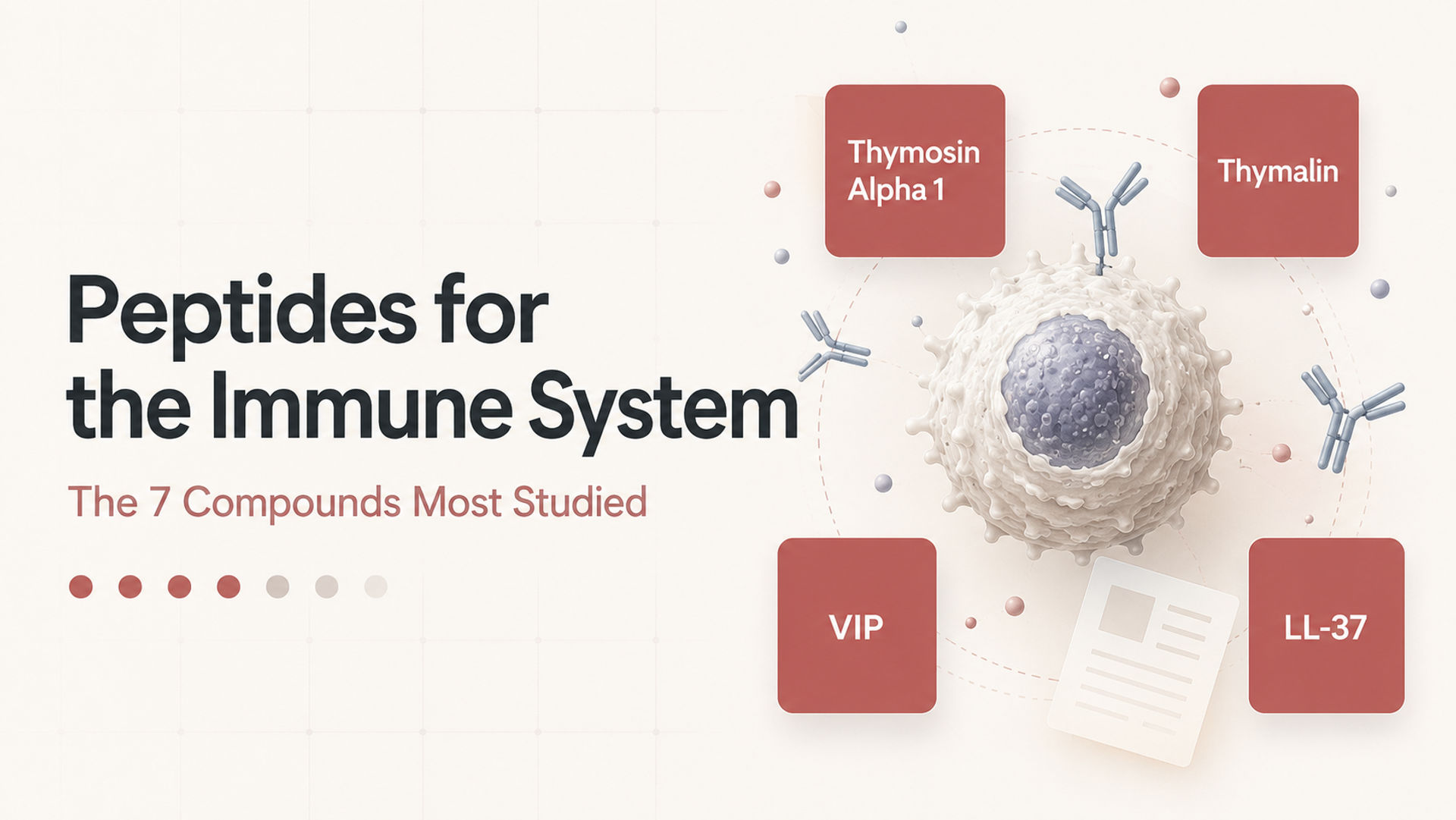

Peptides for immune system support fall into three groups: thymic peptides with human trial data, signaling peptides with human data in narrow conditions, and anti-inflammatory peptides studied almost entirely in animals. This guide ranks seven of them by what human research has actually measured, not by how often they appear in clinic marketing.

The 7 Best Peptides for Immune System Support, Ranked
Thymosin alpha-1 sits at the top because it is the only peptide on this list with multiple phase 3 randomized trials in immune indications. The ranking basis below is the strength and directness of human evidence for immune function specifically, with mechanism and safety data used to break ties.
Peptide | Strongest evidence | Evidence stage |
|---|---|---|
Thymosin alpha-1 | Phase 3 RCTs, hepatitis B approval in 35+ countries | Human, mixed results |
Controlled clinical studies in older adults | Human, single-country | |
Phase 2 sarcoidosis trial | Human, narrow indication | |
Endogenous human peptide, mapped mechanism | Preclinical for supplementation | |
Inflammation resolution in animal infection models | Preclinical | |
Colitis models via PepT1 transport | Preclinical | |
Cytokine reduction in rodents, one 12-patient study | Preclinical |
A note on what "ranked by evidence" excludes. Popularity in community threads does not move a compound up this list, and neither does a strong mechanism. LL-37 sits fourth despite being one of the best-characterized peptides in human immunology, because nobody has run a controlled trial of injecting it for immune support.
What "Immune Peptide" Actually Means
An immune peptide is a short amino acid chain that changes how immune cells signal, not one that simply makes the immune system stronger. The distinction matters because the three functional categories do opposite things, and the one most people have in mind is not always what a given peptide does.
The 2014 review in Immunotherapy by Gokhale and Satyanarayanajois sorts them into three functional categories: suppressive agents that block immune responses in autoimmunity and transplant rejection, stimulatory agents that activate immunity against infection and cancer, and selective removal agents that target specific immune cell subtypes.
Immunostimulant vs immunomodulator vs immunosuppressant
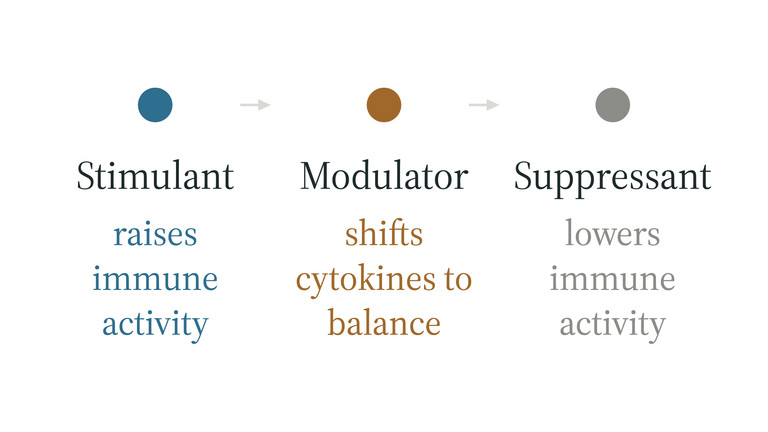
An immunostimulant pushes immune activity up. An immunosuppressant pushes it down. An immunomodulator, which is what most peptides in this category are described as, shifts cytokine signaling toward a set point instead of pushing it one way.
That framing is the reason a peptide can be studied in both chronic infection and autoimmune disease. A 2024 review in Frontiers in Immunology describes bioactive peptides suppressing IL-6 and TNF-alpha while raising anti-inflammatory IL-10, primarily by blocking NF-kB nuclear translocation and MAPK phosphorylation. Those are the two pathways nearly every peptide below touches.
If the underlying biology is new to you, Peptide Mind's guide to what a peptide is covers structure and classification first.
1. Thymosin Alpha-1

Thymosin alpha-1 is a 28-amino acid peptide first isolated from calf thymus and present in humans, and it has the deepest human trial record of any peptide studied for immune function. It is approved for hepatitis B in more than 35 countries and has been trialed in sepsis, cancer, and vaccine response.
Its mechanism is well mapped: it stimulates T lymphocyte production, modulates IL-2, drives interferon-gamma output, and increases NK cell activity. A 2025 review in the International Journal of Molecular Sciences notes that endogenous production of the peptide declines with age alongside thymic involution, in which cortical lymphocytes fall by roughly 95%, and that supplementation restored the humoral response to influenza vaccine in adults aged 65 to 99.
The results in critical illness are less flattering, and most pages covering this peptide leave them out.
The TESTS phase 3 trial randomized 1,106 adults with sepsis across 22 centres. 28-day all-cause mortality was 23.4% with thymosin alpha-1 versus 24.1% with placebo, a difference that did not reach statistical significance. BMJ, 2025.
Shop research peptides
Live pricing from our top-rated vendor. Prices update as vendor listings change.
A 2025 meta-analysis of 11 randomized trials covering 1,927 sepsis patients did find a pooled 28-day mortality benefit (OR 0.73, 95% CI 0.59 to 0.90), but the authors noted the benefit disappeared when analysis was restricted to high-quality multicentre trials. Read together, the picture is a peptide with real immune effects whose benefit depends heavily on who is receiving it.
Published dosing sits at 1.6 mg subcutaneously twice weekly in the hepatitis B trials.
2. Thymalin
Thymalin is a polypeptide complex extracted from calf thymus, developed in Russia in the 1970s, and studied mainly in older adults with reduced immune function. It is a different compound from thymosin alpha-1, which is a single defined peptide, and the two are frequently confused.
Its reported activity is attributed to short peptide fragments (KE, EW, EDP) that bind double-stranded DNA and influence expression of immune system genes. In a controlled study of severe COVID-19 in older patients, 36 patients receiving thymalin alongside standard therapy showed faster recovery from lymphopenia and faster normalization of C-reactive protein and D-dimer than 44 patients on standard therapy alone, with hospital mortality halved.
The limitation is concentrated evidence. Nearly all of the clinical work comes from a single research group over several decades, and it has not been replicated by independent teams outside Russia. Thymalin also appears in Peptide Mind's coverage of peptides studied for longevity, where the same body of work is the primary source.
3. Vasoactive Intestinal Peptide (VIP)
VIP is a 28-amino acid neuropeptide with direct human trial data, though in one narrow condition and not general immune support. It binds VPAC-1 and VPAC-2 receptors, raises intracellular cyclic AMP, and inhibits NF-kB translocation in macrophages and dendritic cells.
In an open phase 2 study, 20 patients with active biopsy-confirmed sarcoidosis inhaled nebulized VIP for four weeks. Treatment was well tolerated and significantly reduced TNF-alpha production by cells recovered from bronchoalveolar lavage fluid.
VIP's practical problem is pharmacokinetic. Its half-life is short and local retention is poor, which is why the human work uses inhaled delivery straight to the target tissue instead of systemic dosing. Anyone extrapolating from a nebulized lung study to subcutaneous immune support is extrapolating a long way.
4. LL-37
LL-37 is the only human cathelicidin, a cationic antimicrobial peptide stored in neutrophil granules and produced by epithelial cells. Its immune role is not in question: it is chemotactic for monocytes, T cells, neutrophils and mast cells, it modulates dendritic cell differentiation, and it has direct antiviral activity against enveloped viruses.
What is missing is any controlled trial of administering it for immune support. The evidence base is mechanistic and preclinical, which is a different thing from a peptide having been tested.
LL-37 also carries a documented risk that clinic pages consistently omit. A 2020 review in Vaccines describes LL-37 complexed to self-DNA acting as an autoantigen in psoriasis and lupus, where it drives interferon production by plasmacytoid dendritic cells. In psoriatic arthritis it is recognized directly by autoantibodies. For anyone with an existing autoimmune or inflammatory skin condition, that is the opposite of the intended effect.
5. Thymosin Beta-4
Thymosin beta-4 is a 43-residue actin-sequestering peptide better known for tissue repair, with a secondary body of work on resolving inflammation instead of suppressing it. TB-500 is a synthetic fragment of it, and Peptide Mind covers how the two differ in detail.
A 2024 study in Frontiers in Immunology using a bacterial keratitis model found thymosin beta-4 inhibited pro-inflammatory 5-LOX while raising 12/15-LOX, drove lipoxin A4 and resolvin D2 higher in tissue, and increased macrophage clearance of apoptotic cells. That combination, damping the initial inflammatory wave while switching on resolution pathways, is a genuinely different mechanism from the thymic peptides above.
The evidence stage is the constraint here. All of the immune work on thymosin beta-4 comes from animal infection and injury models, and no human trial has tested it for immune function, which is why it sits fifth on this list.
6. KPV
KPV is a tripeptide (lysine-proline-valine) derived from the C-terminal end of alpha-MSH, studied mainly for gut inflammation. It enters intestinal epithelial and immune cells through the PepT1 di/tripeptide transporter, which is upregulated in the colon during inflammatory bowel disease.
Shop research peptides
Live pricing from our top-rated vendor. Prices update as vendor listings change.
At 10 nM in intestinal epithelial cells, KPV reduced IL-1beta-induced IL-8 mRNA by roughly 35% and cut colonic myeloperoxidase activity by about 50% in a DSS colitis model. Gastroenterology, 2007.
That PepT1-mediated mechanism is what makes KPV interesting: it works at nanomolar concentrations because the transporter concentrates it where the inflammation is. The evidence remains preclinical, with no published randomized human trial. Peptide Mind's breakdown of KPV benefits by evidence grade covers the gut, skin and antimicrobial data separately.
7. BPC-157
BPC-157 is a 15-amino acid synthetic peptide studied mostly for tissue repair, with anti-inflammatory cytokine effects as a secondary finding. It reduces IL-6, TNF-alpha and IL-1beta in rodent tissue, which is why it appears on immune peptide lists at all.
Its human record is thin. A 2025 systematic review in the HSS Journal screened 36 studies and found only one clinical study, a 12-patient trial of intraarticular injection for chronic knee pain in which 7 of 12 reported improvement beyond six months. The authors state plainly that clinical safety in humans remains unknown.
BPC-157 belongs on this list for gut barrier and inflammation research rather than for immune defense. Peptide Mind's BPC-157 research guide and its ranking of peptides studied for healing cover its primary research areas.
What Users Report
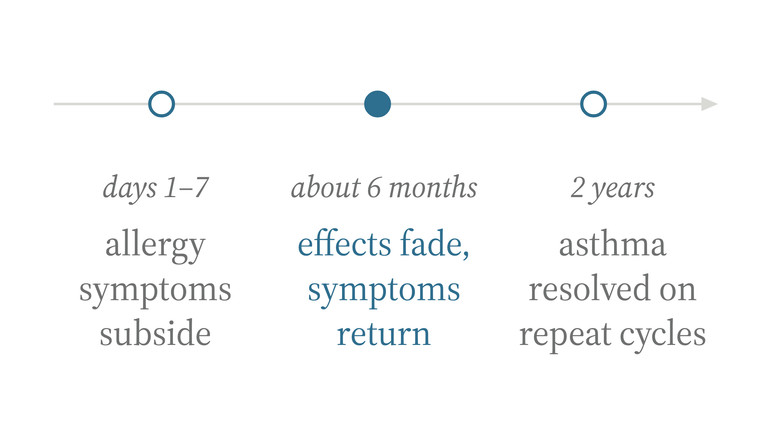
The most consistently reported effect across r/Peptides threads is not fewer colds. It is reduced allergy and atopy symptoms on thymosin alpha-1, an outcome no published trial has measured.
In one detailed thymosin alpha-1 review thread, a user running 800 mcg once weekly for 12 weeks described seasonal allergy symptoms subsiding within the first week, effects lasting roughly six months before symptoms returned, and asthma symptoms resolving across two years of repeated cycles. A separate thread reports grass allergy symptoms clearing within about five days for two family members. Neither reported side effects.
Reported dosing splits into two patterns. Community reports describe either a weekly bolus of 800 mcg to 1.6 mg, or the same weekly total divided into daily 100 mcg doses, with users debating whether the two produce equivalent immunomodulation.
Community reports on LL-37 are sparser and shorter-lived. One combined LL-37 and thymosin alpha-1 log describes food sensitivity symptoms and an associated rash resolving on 150 mcg LL-37 twice weekly, then recurring after the cycle ended, which the poster followed up on months later.
Who Should Be Careful
Anyone with an autoimmune condition should treat immune peptides as a category requiring more caution, not less. The mechanism that makes a compound useful in immunodeficiency can work against someone whose immune system is already overactive.
LL-37 is the clearest case, given its established role as an autoantigen in psoriasis and lupus. Thymosin alpha-1 raises a different question: it stimulates T lymphocyte production and interferon-gamma, both of which run high in several autoimmune conditions.
Three practical points that apply across all seven:
None of these compounds are FDA-approved for immune support in the United States. Thymosin alpha-1's approvals are in other national regulatory systems, for hepatitis B.
Sourcing quality is the most common failure point people report. Purity verification through a batch certificate of analysis matters more here than for most categories, since these are injected and unregulated.
Reconstitution and dosing errors are common with peptides sold in milligram vials but dosed in micrograms. Peptide Mind's dosage calculator handles the conversion, and its guide to peptide stacks by goal covers how combinations are typically structured.
Frequently Asked Questions
Do peptides boost the immune system?
Some do, but "boost" is the wrong frame for most peptides for immune system support. Thymosin alpha-1 has human trial data showing restored vaccine response in older adults and increased NK cell activity. Most other peptides on this list are immunomodulators that shift cytokine signaling toward balance, which can mean raising or lowering immune activity depending on the starting state.
Shop research peptides
Live pricing from our top-rated vendor. Prices update as vendor listings change.
Can peptides weaken the immune system?
Yes. Several peptide classes are deliberately immunosuppressive, developed for autoimmune disease and transplant rejection by inhibiting T cell proliferation and macrophage antigen presentation. Among the peptides in this guide, the anti-inflammatory ones (KPV, thymosin beta-4, BPC-157) reduce inflammatory signaling by design, which is a dampening effect rather than an enhancement.
Which peptide is best for immune system support?
Thymosin alpha-1 has the strongest human evidence by a wide margin, with phase 3 randomized trials and regulatory approval for hepatitis B in more than 35 countries. That said, its phase 3 sepsis trial found no mortality benefit, and the strongest clinical signals come from populations with existing immune impairment, not healthy adults.
Can peptides help with autoimmune disease?
Research is active but early. VIP reduced TNF-alpha production in a phase 2 sarcoidosis trial, and KPV reduced inflammatory markers in colitis models. No peptide in this guide has randomized human trial data establishing efficacy in a named autoimmune condition, and LL-37 has documented involvement in driving psoriasis and lupus pathology.
Are peptides good for inflammation?
Several show consistent anti-inflammatory activity in preclinical work through the same two pathways. KPV, thymosin beta-4 and BPC-157 all reduce IL-6 and TNF-alpha signaling by inhibiting NF-kB and MAPK activation. Thymosin beta-4 is distinct in also activating resolution pathways, raising lipoxin A4 and resolvin D2 rather than only suppressing inflammatory mediators.
Where the Evidence Actually Points
Peptides for immune system support are best understood as a split field: one compound with real human trial data and mixed results, a handful with narrow or single-source human evidence, and several strong preclinical candidates that nobody has tested in people. Thymosin alpha-1 is where the research is, and where the caveats are too. Explore thymosin alpha-1 research for the full profile.
References
Gokhale AS, Satyanarayanajois S. "Peptides and peptidomimetics as immunomodulators." Immunotherapy, 6(6), 2014. PMC4201125.
Liu H, Zhang L, Yu J, Shao S. "Advances in the application and mechanism of bioactive peptides in the treatment of inflammation." Frontiers in Immunology, 15, 2024. PMC11377253.
Simonova MA, Ivanov I, Shoshina NS, et al. "Aging and Thymosin Alpha-1." International Journal of Molecular Sciences, 2025. PMC12692621.
Gu B, Zhou Y, Nie Y, et al. "Efficacy of thymosin α1 for sepsis: a systematic review and meta-analysis of randomized controlled trials." Frontiers in Cellular and Infection Microbiology, 2025. PubMed 40969554.
Liu D, Yu W, Xie J, et al. "The efficacy and safety of thymosin α1 for sepsis (TESTS): multicentre, double blinded, randomised, placebo controlled, phase 3 trial." BMJ, 388, 2025. PubMed 39814420.
Khavinson VK, Kuznik BI, Tarnovskaya SI, et al. "Peptide Drug Thymalin Regulates Immune Status in Severe COVID-19 Older Patients." Advances in Gerontology, 11(4), 2021.
Prasse A, Zissel G, Lützen N, et al. "Inhaled vasoactive intestinal peptide exerts immunoregulatory effects in sarcoidosis." American Journal of Respiratory and Critical Care Medicine, 182(4), 2010. PubMed 20442436.
Pahar B, Madonna S, Das A, Albanesi C, Girolomoni G. "Immunomodulatory Role of the Antimicrobial LL-37 Peptide in Autoimmune Diseases and Viral Infections." Vaccines, 8(3), 2020. PMC7565865.
Wang Y, Banga S, Ebrahim T, et al. "Activation of pro-resolving pathways mediate the therapeutic effects of thymosin beta-4 during Pseudomonas aeruginosa-induced keratitis." Frontiers in Immunology, 15, 2024. PMC11458456.
Dalmasso G, Charrier-Hisamuddin L, Nguyen HTT, et al. "PepT1-Mediated Tripeptide KPV Uptake Reduces Intestinal Inflammation." Gastroenterology, 134(1), 2008. PMC2431115.
Vasireddi N, Nechiporenko M, Vasireddi S, et al. "Emerging Use of BPC-157 in Orthopaedic Sports Medicine: A Systematic Review." HSS Journal, 2025. PMC12313605.
Disclaimer: The information on Peptide Mind is for educational purposes only and is not a substitute for professional medical advice, diagnosis, or treatment. The peptides discussed are unapproved research chemicals for laboratory and research use only, not for human consumption. These statements have not been evaluated by the FDA, and nothing on this site is intended to diagnose, treat, cure, or prevent any disease. By accessing this site, you confirm you are 21 or older and agree to our Terms of Service.
Add a comment
This will be publicly visible.
Your email address will not be published.
Your comment will be reviewed by an admin before it is published.