Best Peptides for Energy: What the Human Trials Show
The best peptides for energy ranked by what human trials measured. GH secretagogues, NAD+, MOTS-c, SS-31 and tesamorelin compared on evidence, dosing and timing.

The best peptides for energy are the growth hormone secretagogues and the mitochondrial peptides, and the gap between them comes down to what has actually been measured in people. Growth hormone secretagogues sit on top because the pathway they act on has placebo-controlled human data showing improved energy scores. The mitochondrial peptides have the more interesting mechanism and far less human evidence. This guide ranks each option by what published trials measured, then covers dosing, timing, and the compounds sold for energy that have no energy data at all.

Why Some Peptides Affect Energy and Others Do Not
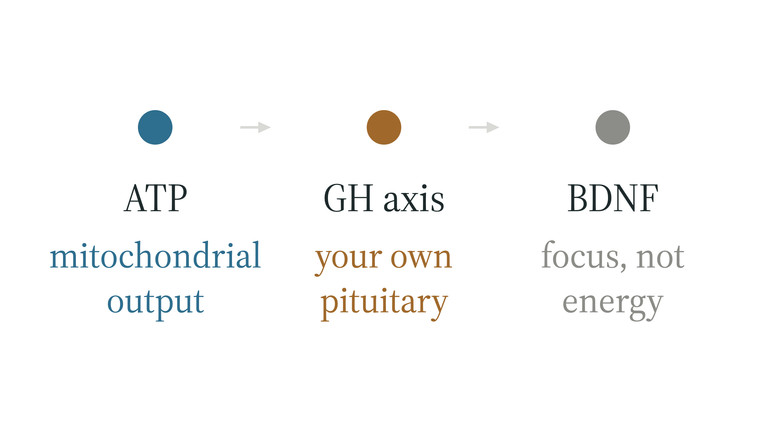
Peptides that influence energy act on one of three systems: mitochondrial ATP production, the growth hormone axis, or the neurochemical circuits behind drive and focus. Which pathway a compound touches determines whether it addresses your specific kind of tiredness or something unrelated to it.
The mitochondrial pathway is the most direct. Mitochondria convert nutrients into ATP, the molecule that powers every cell, and the peptides in this group act on that machinery. MOTS-c and SS-31 both belong here, and neither one is a stimulant. They change how efficiently cells make and use energy over weeks, not how alert you feel in an hour.
The growth hormone axis works on a longer timescale. Growth hormone output declines with age, and adults with clinical deficiency report low energy as a defining symptom. Peptides in this group do not supply growth hormone; they prompt the pituitary to release more of your own.
The third pathway is neurochemical. Compounds like semax and selank act on brain-derived neurotrophic factor and neurotransmitter systems that govern focus and motivation. That is a different target from cellular energy, and it matters only if what you call fatigue is really flat mood or poor concentration.
Anything marketed for energy that does not act on one of these three systems is being sold on association rather than mechanism.
Best Peptides for Energy, Ranked by Evidence
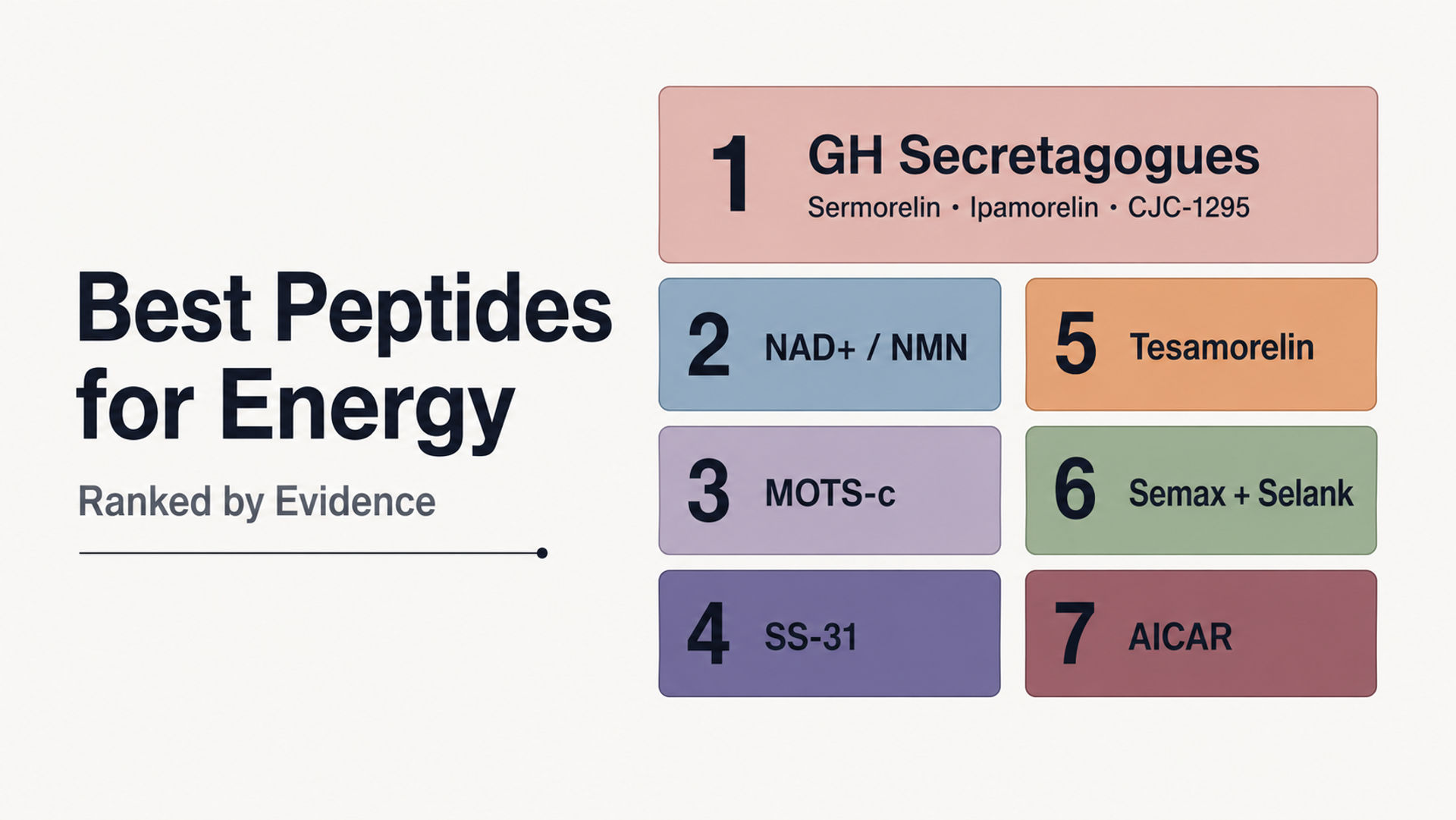
Ranked by the strength of published human data on measured energy, endurance or fatigue outcomes, the order is growth hormone secretagogues, NAD+ precursors, MOTS-c, SS-31, tesamorelin, semax and selank, then AICAR. Popularity and evidence are close to inverted here, which is why this ranking looks different from most lists.
Compound | Pathway | Strongest human evidence |
|---|---|---|
Sermorelin, ipamorelin, CJC-1295 | GH axis | Placebo-controlled energy gains in GH-deficient adults, class data |
NAD+ and NMN | Mitochondrial cofactor | Randomized 6-week trial, aerobic capacity improved |
MOTS-c | Mitochondrial, AMPK | Exercise induction confirmed in humans; efficacy data in mice only |
SS-31 (elamipretide) | Cardiolipin, inner membrane | Phase 2 fatigue improvement, Phase 3 missed primary endpoints |
GHRH analog | FDA-approved; 20-week executive function trial | |
Semax and selank | BDNF, neurotransmitters | Russian clinical use, limited Western replication |
AMPK agonist | No human efficacy trials; WADA prohibited |
1. Growth Hormone Secretagogues: The Strongest Human Chain

Sermorelin, ipamorelin and CJC-1295 rank first because the pathway they act on has real placebo-controlled evidence behind the energy claim. In the Australian Multicenter Trial, 166 adults with growth hormone deficiency received either growth hormone or placebo for six months. Beneficial treatment effects appeared for energy, pain and emotional reaction on the Nottingham Health Profile, alongside gains in fat-free mass.
That study tested growth hormone itself, not a secretagogue. The connection is an inference: secretagogues raise your own growth hormone output, so the downstream effects should follow in the same direction at a smaller magnitude. It is still an inference built on measured human outcomes rather than on nothing.
Ipamorelin is the cleanest option in the group. Raun and colleagues at Novo Nordisk found that ipamorelin did not release ACTH or cortisol above GHRH-stimulated levels even at doses more than 200-fold higher than the ED50 for growth hormone release. GHRP-6 and GHRP-2, the older compounds in the same class, both raise cortisol, which works against daytime energy rather than for it.
The honest caveat is that these effects were measured in deficient adults. If your growth hormone output is normal for your age, the ceiling for improvement is lower.
2. NAD+ and NMN: The Only Randomized Aerobic Capacity Trial

Shop research peptides
Live pricing from our top-rated vendor. Prices update as vendor listings change.
NAD+ and its precursor NMN have the best controlled human data of anything in this category, though neither is technically a peptide. NAD+ is the coenzyme that carries electrons through the reactions producing cellular ATP, and its levels fall with age.
Liu and colleagues randomized 48 amateur runners to 300 mg, 600 mg or 1,200 mg of NMN daily or placebo for six weeks alongside a supervised training program.
Oxygen uptake, percentage of VO2 max, and power at both the first and second ventilatory thresholds increased more in the medium and high dose groups than in the control group. VO2 max itself did not change in any group. (Liu et al., Journal of the International Society of Sports Nutrition, 2021)
That distinction matters. NMN did not raise peak capacity; it improved how efficiently skeletal muscle used the oxygen already available. The authors attributed the result to enhanced O2 utilization of the skeletal muscle rather than to any change in cardiac output.
Injectable NAD+ bypasses the conversion step that oral NMN depends on, which is why it appears in blends like the MitoPrime peptide blend. No trial has compared the injectable and oral routes head to head for energy outcomes.
3. MOTS-c: The Best Mechanism, the Thinnest Human Data

MOTS-c is a 16-amino acid peptide encoded inside mitochondrial DNA rather than the cell nucleus, discovered by Lee and colleagues at the University of Southern California. It activates AMPK, the enzyme that signals cells to shift toward energy production, which is the same switch exercise flips.
Reynolds and colleagues at USC and the University of Auckland showed that MOTS-c is induced by exercise in human skeletal muscle and circulation, then tested it in mice.
Late-life intermittent MOTS-c treatment starting at 23.5 months, given three times per week, increased physical capacity and healthspan in mice, with running capacity in older animals roughly doubling. (Reynolds et al., Nature Communications, 2021)
The human half of that paper confirms MOTS-c behaves as an exercise-responsive signal in people. The efficacy half is entirely rodent. No published human trial has administered MOTS-c and measured energy, which is the single most important thing to understand before buying it. Peptide Mind's MOTS-c beginner's guide covers the protocols circulating in research and clinic settings.
4. SS-31 (Elamipretide): Tested Against Fatigue and Mostly Failed
Elamipretide, also called SS-31, is the only compound on this list that has been tested against a fatigue endpoint in a Phase 3 trial. It targets cardiolipin in the inner mitochondrial membrane, stabilizing the structure where the electron transport chain sits.
The Phase 2 crossover trial was encouraging. Thirty adults with primary mitochondrial myopathy took 40 mg daily for four weeks against placebo. Participants reported significantly less total fatigue on elamipretide, with improvements in tiredness at rest (P = 0.0008) and tiredness during activity (P = 0.0046). The six-minute walk distance improved by 19.8 meters, which fell short of significance at P = 0.0833.
MMPOWER-3, the 24-week Phase 3, did not reproduce it. The difference from baseline to week 24 was negative 3.2 meters on the six-minute walk test and negative 0.07 on the total fatigue score, neither favoring treatment. A post hoc analysis found a walk-test benefit confined to patients with nuclear DNA variants.
That pattern generalizes. A four-week subjective fatigue improvement that disappears over 24 weeks is what an expectation effect looks like, which is why short self-reported results in this category deserve skepticism.
5. Tesamorelin: The Approved One
Tesamorelin is a stabilized GHRH analog and the only compound here with FDA approval, granted for HIV-associated lipodystrophy rather than for energy. Its relevance to the "energy and focus" search is a cognition trial rather than a fatigue trial.
Baker and colleagues at the University of Washington randomized 152 adults aged 55 to 87, including 66 with mild cognitive impairment, to 1 mg of tesamorelin or placebo self-administered 30 minutes before bed for 20 weeks. Treatment was associated with improvement on tests of executive function and, to a lesser degree, short-term verbal memory, in both the healthy and impaired groups.
Executive function is the capacity that mental fatigue degrades first, which makes this the most relevant human endpoint anyone has measured for peptides marketed toward focus. Tesamorelin is also the most expensive option in the growth hormone group by a wide margin.
Shop research peptides
Live pricing from our top-rated vendor. Prices update as vendor listings change.
6. Semax and Selank: Focus, Not Energy
Semax and selank are Russian-developed peptides used clinically in Russia and largely unstudied in Western trials. Semax is a fragment of ACTH modified to remove hormonal activity, and selank is a synthetic analog of the immunomodulatory peptide tuftsin.
Both act on brain chemistry rather than on cellular energy production. Semax has been studied for effects on BDNF and dopaminergic signaling, and selank has controlled anxiety data against the benzodiazepine medazepam. Users describe the result as clearer thinking rather than more physical energy.
If your complaint is brain fog rather than tiredness, this group is a better match than anything in the mitochondrial category, though the evidence base remains thin outside Russian-language literature.
7. AICAR: The Exercise Mimetic That Stayed in the Lab
AICAR activates AMPK directly and became known as "exercise in a pill" after rodent studies showed sedentary mice gaining endurance without training. It has no human efficacy trials for energy or performance, and the World Anti-Doping Agency prohibits it in competition.
It also requires large doses relative to everything else on this list, which makes it costly, and its pharmacokinetics in humans are poorly characterized. It appears here because it appears on vendor lists, not because it earns a place.

SLU-PP-332: The Exercise Mimetic That Is Not a Peptide
SLU-PP-332 comes up constantly in energy discussions and is not a peptide. It is a small synthetic molecule that activates the estrogen-related receptors ERR alpha, beta and gamma, developed by Thomas Burris and colleagues at Saint Louis University and now studied at the University of Florida and Washington University in St. Louis. It is grouped with peptides because the same vendors sell it, not because it shares their chemistry.
The animal data is the most striking of anything in this article. In the 2023 characterization study, SLU-PP-332 was reported to switch on the same ERR-driven gene program that acute aerobic exercise activates, without any change in training or food intake. Treated normal-weight mice ran roughly 70% longer and 45% further than untreated animals.

The follow-up work tested it in diet-induced obese and ob/ob mice at 50 mg/kg twice daily for 28 days.
SLU-PP-332 increased energy expenditure and fatty acid oxidation and reduced fat mass accumulation, improved insulin sensitivity and markedly reduced hepatic steatosis in both obesity models. Treated obese mice gained roughly ten times less fat than untreated controls. (Billon et al., Journal of Pharmacology and Experimental Therapeutics, 2024)
What people report using it is consistent with that mechanism and worth reading with caution. The common description is higher endurance and warmth during training, a noticeable drop in appetite, and no stimulant feeling. The half-life is short, which is why community protocols split the dose across the day, and the compound is not orally bioavailable in the form most vendors sell.
The gap is total. There are no human trials of SLU-PP-332, no human pharmacokinetic data, and no safety data in people at any dose. The mouse dose that produced these results is also high, and ERR receptors sit upstream of a wide set of metabolic genes, which makes off-target effects a real question rather than a theoretical one. It belongs in this article because people ask about it, not because the evidence supports using it.
Peptides Sold for Energy With No Energy Data
Several compounds appear on nearly every "peptides for energy" list without any published research on energy outcomes. Their reputations come from adjacent effects rather than from measured results.
BPC-157. A gastric peptide with a substantial preclinical tissue-repair literature and no human trial data of any kind. Faster recovery from an injury can feel like more energy. That is not the same as an effect on energy production.
TB-500. A synthetic fragment of thymosin beta-4, studied for cell migration and tissue repair in animal models. Nothing in that literature involves fatigue, ATP or endurance.
Shop research peptides
Live pricing from our top-rated vendor. Prices update as vendor listings change.
AOD-9604. A fragment of the growth hormone molecule engineered to isolate the fat-loss effect. Its clinical program produced a modest weight-loss signal in an early trial that later, larger studies did not reproduce, and no trial measured energy.
Glutathione. An antioxidant tripeptide given in IV drips at wellness clinics, where it is bundled with saline and B vitamins. Correcting dehydration produces most of what people attribute to the glutathione.
Thymosin alpha-1. An immune-modulating peptide with genuine clinical use in hepatitis and sepsis research. The energy claim rests on the idea that a less burdened immune system feels better, which no trial has tested.
Peptides That Can Make Fatigue Worse
Several popular compounds reduce energy rather than raise it, and the reasons are predictable from their mechanisms.
GLP-1 receptor agonists. Fatigue is among the most commonly reported side effects of semaglutide, tirzepatide and retatrutide, driven largely by the sharp drop in calorie intake they produce. Anyone stacking a GLP-1 with an energy peptide is working against themselves.
CJC-1295 with DAC. The DAC modification extends the half-life to roughly a week, producing a sustained growth hormone elevation rather than a pulse. Users commonly report a flat, hazy quality on the DAC version compared with the no-DAC form.
MK-677 at higher doses. The oral secretagogue causes water retention and morning grogginess, and both scale with dose. The daytime cost often exceeds the benefit.
The first two weeks of any GH secretagogue. A transient fatigue period is common as growth hormone pulsatility shifts. It usually resolves, and mistaking it for the compound failing leads people to abandon protocols early.
How Energy Peptides Are Dosed and Timed
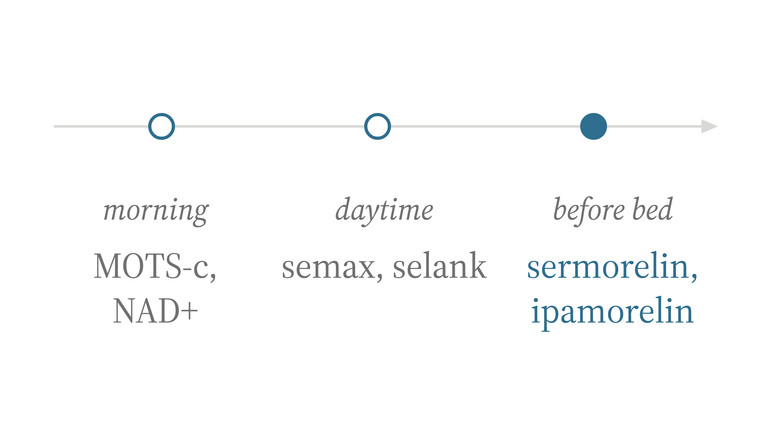
Timing separates the compounds in this category more than dose does, because the growth hormone group and the mitochondrial group work on opposite schedules.
Compound | Typical timing | Route |
|---|---|---|
Sermorelin, ipamorelin, CJC-1295 no DAC | Before bed, empty stomach | Subcutaneous |
NAD+ | Morning, slow administration | Subcutaneous or IV |
MOTS-c | Morning or pre-workout, 2 to 3 times weekly | Subcutaneous |
Tesamorelin | 30 minutes before bed, daily | Subcutaneous |
Semax, selank | Daytime, on demand | Intranasal |
Two rules apply across the group. Food, and carbohydrate in particular, blunts the growth hormone response to a secretagogue, which is why the pre-bed dose is taken on an empty stomach. And mitochondrial peptides go in the morning, because the AMPK activation they drive is the opposite of what you want at bedtime. The evening half of that schedule overlaps heavily with the best peptides for sleep, which is not a coincidence: deeper sleep is a large part of how the growth hormone group produces daytime energy.
Reconstitution accuracy is the most common failure point in practice. A 10 mg vial reconstituted with 2 mL of bacteriostatic water gives a different unit measurement than the same vial with 3 mL, and the error compounds across an entire protocol. Peptide Mind's peptide dosage calculator handles that math, and the beginner's guide to using peptides covers reconstitution and storage step by step.
Practical Considerations Before Choosing Anything
Fatigue is usually not a peptide problem. Iron deficiency, hypothyroidism, untreated sleep apnea, low vitamin D and chronic sleep debt account for the large majority of persistent tiredness, and every one of them is cheaper to test for than a month of peptides. No compound in this article corrects a mechanical airway obstruction or replaces ferritin. A basic blood panel is the correct first step, not the fallback.
Purity is the second variable that explains why protocols produce nothing. None of the compounds discussed here except tesamorelin are FDA-approved for any indication, and all are sold for research use only, so quality control varies substantially between suppliers. A certificate of analysis from an independent lab, with HPLC and mass spectrometry results tied to the batch number on the vial, is the minimum standard.
Storage is the third. Lyophilized peptides tolerate room temperature for shipping but belong in a freezer for long-term storage. Once reconstituted, most are refrigerated and used within 28 days, which is also the shelf life of the bacteriostatic water dissolving them.
Expectations are the fourth. Nothing here works like caffeine: the growth hormone group needs six to twelve weeks before anything shifts enough to notice, and the mitochondrial group is measured in aerobic efficiency rather than in how you feel at 3 PM. Peptide Mind's guides to the most popular peptides and the best peptides for bodybuilding show how these compounds rank against other goals.
Shop research peptides
Live pricing from our top-rated vendor. Prices update as vendor listings change.
Frequently Asked Questions
What peptides are good for energy?
The best peptides for energy by human evidence are the growth hormone secretagogues (sermorelin, ipamorelin, CJC-1295), since placebo-controlled trials showed improved energy scores in growth hormone deficient adults. NAD+ and NMN have the only randomized aerobic capacity trial. MOTS-c has the best mechanism and no human efficacy data. BPC-157, TB-500 and glutathione have none.
Do peptides actually increase energy?
Some do, with measured effects. NMN improved oxygen utilization and ventilatory threshold power in a six-week randomized trial of 48 runners. Growth hormone replacement improved energy scores against placebo in 166 deficient adults. Most peptides marketed for energy, though, have never been tested against an energy endpoint in humans at all.
Which peptide is best for energy and focus?
Tesamorelin has the most relevant human data for the focus half of that question, improving executive function against placebo over 20 weeks in 152 older adults. Semax and selank target focus more directly through BDNF and neurotransmitter pathways but have little Western trial evidence. For physical energy, the growth hormone secretagogues remain the better-supported group.
Can peptides make you tired?
Yes. GLP-1 agonists like semaglutide and retatrutide list fatigue among their most common side effects, largely from reduced calorie intake. CJC-1295 with DAC produces a flat, sustained growth hormone elevation that many users report as hazy. MK-677 causes morning grogginess at higher doses. A transient fatigue phase in the first two weeks of any growth hormone secretagogue is common.
How long do peptides take to work for energy?
Longer than most people expect. The NMN aerobic capacity trial ran six weeks before measuring changes. Growth hormone secretagogue protocols are generally assessed at eight to twelve weeks, since the downstream effects on body composition and sleep quality accumulate slowly. Nothing in this category produces a same-day stimulant effect.
Are peptides better than caffeine for energy?
They work on a different problem. Caffeine blocks adenosine receptors and masks fatigue signaling within an hour, with no effect on the machinery producing energy. Peptides in this category act on mitochondrial efficiency or hormone output over weeks. Caffeine is more reliable for acute alertness; peptides target the underlying capacity.
What are the side effects of peptides for energy?
Injection site reactions, redness and irritation are the most common across the group. Growth hormone secretagogues can cause water retention, joint aching, numbness in the hands and increased appetite, all of which scale with dose. NAD+ given too quickly causes chest tightness and flushing, which is why slow administration matters. Long-term safety data is limited for every compound here.
Matching an Energy Peptide to Your Actual Problem
The best peptides for energy are not interchangeable, and the right choice depends on whether your problem is declining hormone output, mitochondrial efficiency or mental drive. Rule out iron, thyroid and sleep issues first, then match the pathway to the symptom and weigh the human evidence honestly. Explore the research behind each option in Peptide Mind's growth hormone peptide category and the goal-based guides for women and perimenopause.
References
Cuneo RC, Judd S, Wallace JD, et al. "The Australian Multicenter Trial of Growth Hormone (GH) Treatment in GH-Deficient Adults." The Journal of Clinical Endocrinology & Metabolism, 83(1), 1998. PMID: 9435425.
Liu S, Zhu J, Wang H, et al. "Nicotinamide mononucleotide supplementation enhances aerobic capacity in amateur runners: a randomized, double-blind study." Journal of the International Society of Sports Nutrition, 18(1), 2021. PMID: 34238308.
Reynolds JC, Lai RW, Woodhead JST, et al. "MOTS-c is an exercise-induced mitochondrial-encoded regulator of age-dependent physical decline and muscle homeostasis." Nature Communications, 12(470), 2021. PMCID: PMC7817689.
Karaa A, Haas R, Goldstein A, et al. "A randomized crossover trial of elamipretide in adults with primary mitochondrial myopathy." Journal of Cachexia, Sarcopenia and Muscle, 11(4), 2020. PMID: 32096613.
Karaa A, Bertini E, Carelli V, et al. "Efficacy and Safety of Elamipretide in Individuals With Primary Mitochondrial Myopathy: The MMPOWER-3 Randomized Clinical Trial." Neurology, 101(3), 2023. PMCID: PMC10382259.
Baker LD, Barsness SM, Borson S, et al. "Effects of growth hormone-releasing hormone on cognitive function in adults with mild cognitive impairment and healthy older adults: results of a controlled trial." Archives of Neurology, 69(11), 2012. PMID: 22869065.
Raun K, Hansen BS, Johansen NL, et al. "Ipamorelin, the first selective growth hormone secretagogue." European Journal of Endocrinology, 139(5), 1998. PMID: 9849822.
Billon C, Sitaula S, Banerjee S, et al. "Synthetic ERRalpha/beta/gamma Agonist Induces an ERRalpha-Dependent Acute Aerobic Exercise Response and Enhances Exercise Capacity." ACS Chemical Biology, 18(4), 2023. PMID: 36988910.
Billon C, Schoepke E, Avdagic A, et al. "A Synthetic ERR Agonist Alleviates Metabolic Syndrome." Journal of Pharmacology and Experimental Therapeutics, 388(2), 2024. PMID: 37739806.
Disclaimer: The information on Peptide Mind is for educational purposes only and is not a substitute for professional medical advice, diagnosis, or treatment. The peptides discussed are unapproved research chemicals for laboratory and research use only, not for human consumption. These statements have not been evaluated by the FDA, and nothing on this site is intended to diagnose, treat, cure, or prevent any disease. By accessing this site, you confirm you are 21 or older and agree to our Terms of Service.
Add a comment
This will be publicly visible.
Your email address will not be published.
Your comment will be reviewed by an admin before it is published.